MONDAY, JULY 10
Fast passenger launches leave for Bocas from Almirante when they have a full load, say every half hour. The crossing takes twenty minutes; the fare is $3 and subsidised by Government. I take the slow car ferry due to leave at 6 a.m. I arrive early on the Honda, buy my ticket ($10 each way).
A car loads first, then the man directing the loading calls, "Simon, bring your bike." I have been traveling three months. Hearing my name called in a strange land at 5.30 a.m. is oddly warming. So is chatting with a couple of truck drivers. Six Mack trucks are carrying sand and gravel to one of the islands where a Gringo (the drivers´term) is constructing a housing development for billionaires. One of the billionaires is a famous basketball player. The drivers recount that the player´s house will cost two million dollars (they learnt this on TV).
Inland a thin mist clings to the trees along the mountainside. Red lights flash on the Cable & Wireless radio masts. The flood lights along Chiquita's pontoon are exactly spaced. Thick black cloud lies over the sea to our left. The water is almost black. An inbound passenger launch leaves a white trail. The smell of frying chicken drifts from the open window behind us and a tin spoon clatters against a cooking pot.
I eat a breakfast of round fluffy pancakes with sausage. Meanwhile the conversation has turned to bikes. A driver has a broken Yamaha. A second driver claims to be a specialist. "Buy the parts," he says: "We'll put it together on a Sunday. Start at six." He acts assembling the engine. " Ping pam, ping pam, ping pam, finshed by four."
This same specialist was in the army. He talks about the US invasion of Panama. "Twenty-three dead," he says of US soldiers. "It's a big lie, Pappi. We shot them in the sky. Pom," he goes, aiming an imaginery rifle. "Pom, pam. I tell you, Pappi, twenty-three is a big lie. And how many they kill, thousands."
All these dead for one man: the US could have grabbed Noriega any time, claims the driver. The invasion was on the 20th. On the 18th, Noriega was visiting a US base. (I have no idea if this is true) Now Iraq is the same. The driver believes that the invasion was a practice run. He says that the Americans believe they can do anything they want. The other two drivers nod their agreement. Perhaps they agree from fellowship for a fellow driver.
I am becoming obsessive in my demand for detail (or recognise my obsession). I am interested in the cost of a used Mack truck. The one driver's Mack is twenty-years old, value $5000. This driver used to drive mules (the motive part of a trailer truck) till Chiquita pushed down the price. $450 is the frieght on a load of gravel out to the island. The crossing takes two-and-a-half hours. The driver makes two trips most days, six days a week. He leaves home at 4:30 in the morning and gets back at 11 p.m. He is paid by the trip. A normal month, he earns $500.
Thursday, July 13, 2006


BANANA BOAT
SUNDAY, JULY 9
Almirante was a United Fruit town. Now the name is Chiquita Banana. Entry to Chiquita's air conditioned office building is thru a guarded security gate in the port area. Two of Chiquita's fleet lie alongside a concrete wharf. The wharf belongs to Chiquita. I require clearance from the Big Men in the open-plan first-floor office. The Big Men are well fed. They are Panamanians with a West Indian heritage and speak English. A lot of telephoning to and fro takes place before I am issued with a visitor's badge and a green hard hat. The Polish Chief engineer wears the baggy shorts and grey T-shirt he wore last night in the Chinese restaurant. I wonder if he slept in them. The ship is sailing in an hour and he conducts me on a whirlwind tour of the engine department. The control room is screens and switches. A steel door leads to the bank of computers that control both ship and cargo. The Chief demonstrates opening and closing one of the many valves that ballance the fuel load. Next we visit the engine which seems small for such a big task. Later on the tour and down a deck level, I realise how deep are the cylinders. We visit pump rooms and more pump rooms, filter rooms and more filter rooms, heating units for the fuel oil, cooling units for the cargo, climate control for the cargo, generators, spare generators, more generators. The tour is designed to impress. I am impressed.
We return to the control room.
"Harrison Ford, bullshit," announces the Chief. He acts the actor spining imaginary control wheels. "Open this valve, open that valve. Big Captain in white uniform save everyone. All bullshit." The Chief jabs a finger at a flashing red light. "Captain, idiot. You think he know what is? Idiot. All idiots. Bulb break, he call me how to fix."
What else did I learn? That bananas are put to sleep while traveling. They reach their destination, are given a whiff of gas, wake up and turn yellow. I know what gas and the climate control that puts them to sleep. And I know that Chiquita has sold off the trucks and trailers that transport the containers from the plantations to the wharf. The new owners are in debt to the bank. They can't argue prices.
Almirante was a United Fruit town. Now the name is Chiquita Banana. Entry to Chiquita's air conditioned office building is thru a guarded security gate in the port area. Two of Chiquita's fleet lie alongside a concrete wharf. The wharf belongs to Chiquita. I require clearance from the Big Men in the open-plan first-floor office. The Big Men are well fed. They are Panamanians with a West Indian heritage and speak English. A lot of telephoning to and fro takes place before I am issued with a visitor's badge and a green hard hat. The Polish Chief engineer wears the baggy shorts and grey T-shirt he wore last night in the Chinese restaurant. I wonder if he slept in them. The ship is sailing in an hour and he conducts me on a whirlwind tour of the engine department. The control room is screens and switches. A steel door leads to the bank of computers that control both ship and cargo. The Chief demonstrates opening and closing one of the many valves that ballance the fuel load. Next we visit the engine which seems small for such a big task. Later on the tour and down a deck level, I realise how deep are the cylinders. We visit pump rooms and more pump rooms, filter rooms and more filter rooms, heating units for the fuel oil, cooling units for the cargo, climate control for the cargo, generators, spare generators, more generators. The tour is designed to impress. I am impressed.
We return to the control room.
"Harrison Ford, bullshit," announces the Chief. He acts the actor spining imaginary control wheels. "Open this valve, open that valve. Big Captain in white uniform save everyone. All bullshit." The Chief jabs a finger at a flashing red light. "Captain, idiot. You think he know what is? Idiot. All idiots. Bulb break, he call me how to fix."
What else did I learn? That bananas are put to sleep while traveling. They reach their destination, are given a whiff of gas, wake up and turn yellow. I know what gas and the climate control that puts them to sleep. And I know that Chiquita has sold off the trucks and trailers that transport the containers from the plantations to the wharf. The new owners are in debt to the bank. They can't argue prices.
MOST BEAUTIFUL TRUCK STOP IN THE WORLD

perfect truck stop
SUNDAY, JULY 9
I bought new batteries for my camera yesterday. They were flat when I reached that awful bridge. I am out of bed by 5.30 this morning and biking back with fresh batteries loaded. I pass three trucks parked on the roadside below a small thatched cafe. I take my photographs (two are on the blog) and stop at the cafe for breakfast. The cafe is on a ridge 80 meters up a dirt track from the road. It is not much of a place. The floor is cement as is a kitchen counter. Wooden posts support the thatch roof. A couple of hammocks hang from hooks. The upright chairs are old and have carved leather backs. Sit at one of the four tables and you look down over rich jungle to the island-spotted gulf of Bocos del Toro.
A girl, 8, sweeps the floor. Her brother, four years older, is lighting the fire outside in a half-drum. The mother fetches me a cup of freshly made coffee.
I question the daughter on her school and whether she enjoys books. Being a pompous old man, I tell her that education is the only road to freedom.
The mother agrees. "There is so much competition now," she tells me.
A white butterfly in a hurry flies directly across my view. Perhaps it is aware that life is short. Most butterflies appear aimless. Here they are copper-colored and red and yellow. Birds work up a racket while I eat (the standard pancakes and chopped steak in sauce). The sun is out. We are up a thousand feet and the air is cool. The family house is a further fifty meters or so up the ridge and has its back to a wood. This must be the most perfect truck stop in the world. Riding back to Almirante, I realize what an idiot I am in talking freedom to the young girl. What do I know? Maybe she is already close to Paradise.
CHINESE DINNER
SATURDAY, JULY 8
I had a weird night. Dinner at a Chinese restaurant. A drunk Polish Chief engineer off a banana boat sat with me. He shouted a good deal. Much of his shouting concerned deck officers being idiots. A second subject was racism. Foreigners (non-Polish) believed Polish people were all racists and idiots. "Not so," the Chief insisted.
As proof that he was not a racist, he presented his recent promotion of a Fillipino to Chief Engineer´s rank.
I had chosen a corner table, my back to the wall. The Fillipino crew were seated across the restaurant watching a boxing fight on TV between a Fillipino and an American.
"They love me," insisted the Chief Enginneer. "I am their King. Of course they love me."
He bellowed for the newly promoted Engineer to come pay hommage - which he did, a quiet man, well mannered, wearing round spectacles. The Chief paraded him as he woulod have a prize dog, then dismissed him and returned to his criticism of deck officers. "I show you ship. Tomorrow I show you ship. You see. All f...ing idiots."
We made a date for 10 a.m.
I had a weird night. Dinner at a Chinese restaurant. A drunk Polish Chief engineer off a banana boat sat with me. He shouted a good deal. Much of his shouting concerned deck officers being idiots. A second subject was racism. Foreigners (non-Polish) believed Polish people were all racists and idiots. "Not so," the Chief insisted.
As proof that he was not a racist, he presented his recent promotion of a Fillipino to Chief Engineer´s rank.
I had chosen a corner table, my back to the wall. The Fillipino crew were seated across the restaurant watching a boxing fight on TV between a Fillipino and an American.
"They love me," insisted the Chief Enginneer. "I am their King. Of course they love me."
He bellowed for the newly promoted Engineer to come pay hommage - which he did, a quiet man, well mannered, wearing round spectacles. The Chief paraded him as he woulod have a prize dog, then dismissed him and returned to his criticism of deck officers. "I show you ship. Tomorrow I show you ship. You see. All f...ing idiots."
We made a date for 10 a.m.
Tuesday, July 11, 2006
ALMIRANTE

station hotel
SATURDAY, JULY 8
Almirante has seen better days. We drove down Main street in the truck passed the Station Hotel. A guest sneezes and the hotel will crumble.
The driver had a delivery to make to the Fereteria Casa Rosa. Thank God, a new hotel had opened across the street, rooms on the upper floor. I may have been the first guest. The room was big, the bed was comfortable, the bathroom functioned, the a/c was silent perfection. Add a fan to keep any mosquitos at bay. One minus, the TV wasn't cable! It will be next week. A friendly mother and daughter run the Hotel Puerto del Almirante. On the next block a lady of Jamaican/Irish decent runs the best breakfast place I've eaten at: $1.75 for chopped steak in pepper sauce served with round, flat, fluffy pancakes and coffee. Add a room rate of $12.50, no wonder I made Almirante my base for three nights.
THANKS TO THESE TWO MEN
SATURDAY, JULY 8
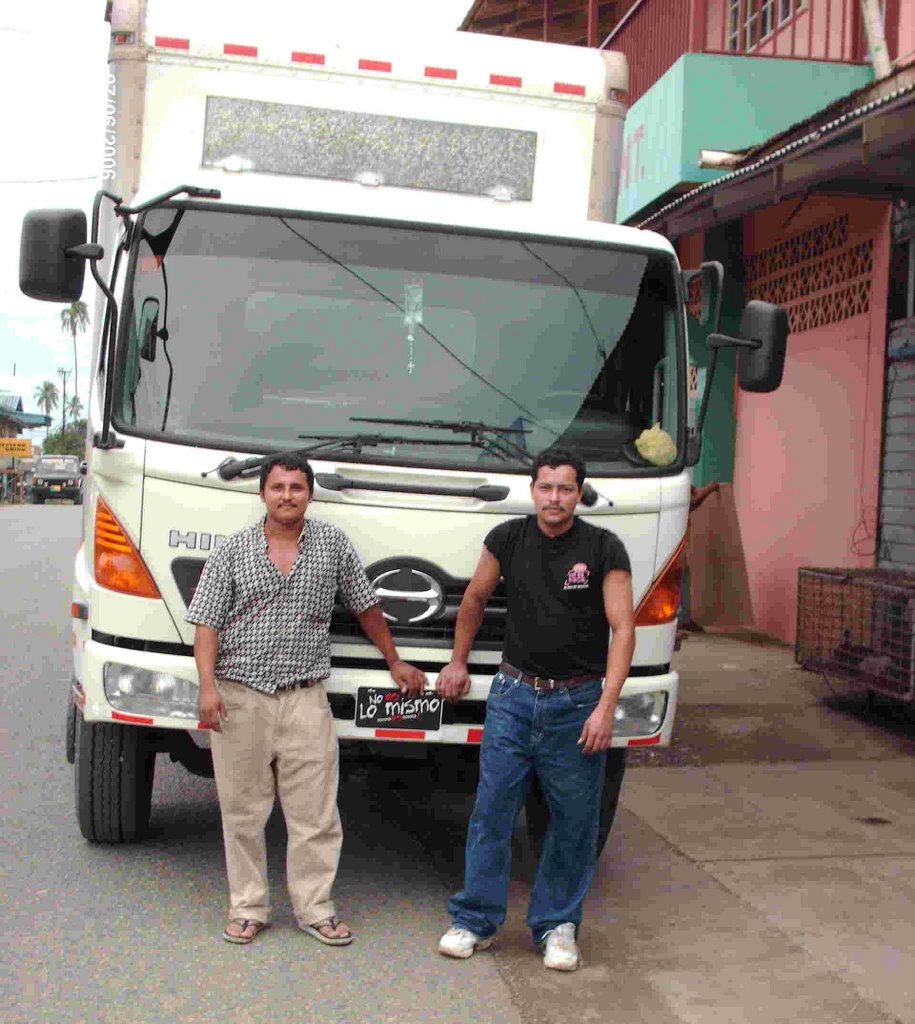
These two men brought me across the bridge in their truck and on to Almirante. Kind and courteous - in fact typical of Panamanians.
Monday, July 10, 2006
A BRIDGE TOO FAR

truly scary
1. other people
had problems
2. a long way
SATURDAY, JULY 8
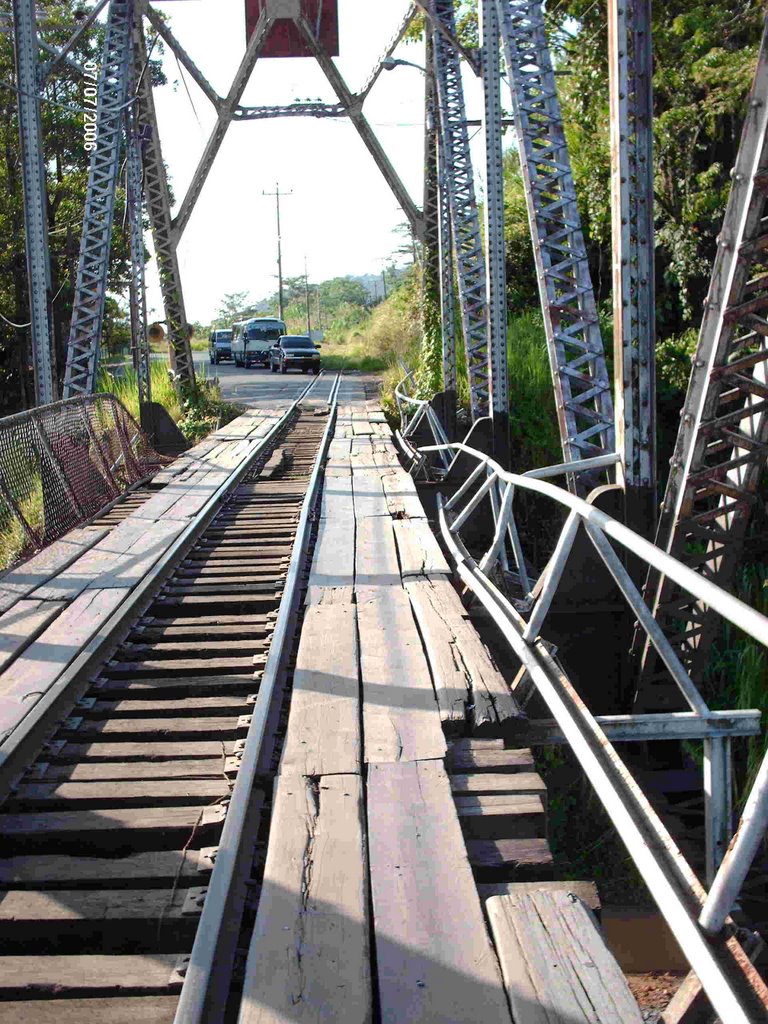
I have been warned. The Bridge of the Americas is all and more than I expected. It is nearly three hundred meters long. The planks are uneven and slippery. Many are missing. A bigger bike than the Honda could fall thru the gap between planks and lower guard rails. Much of the wire safety netting fastened between upper and lower guard rails is missing. I travel the first twenty yards before the bike slips. Desperate to save the Honda, I tip inwards across the rails. I lie pinned under the bike. I look down between the sleepers at the river in spate from the recent rains. Truck drivers run down the track and heave the Honda off my leg. They join in warning me that the bridge is dangerous - as if I require warning. They lift me onto my feet and the bike into the back of a truck. I sit up front. The driver spends the entire fifteen kilometers to Almirante warning me of further perils. He is carrying building supplies to the wharehouse of the biggest store in town. The store owner recommends a hotel across the road run by mother and daughter. The rooms are on the first floor: $25 for a room with bath, TV, and a/c. I protest to the daughter that I am a pensioner. She immediately halves the rate. Bush telegraph is fully functional in Almirante. I sit at a table in the back of a nearby Chinese restaurant and receive the commiserations of half the populace.
COSTA RICA CARIBBEAN
SATURDAY, JULY 8
At first the road to Panama follows the coast. Even the shanty towns of Costa Rica`s capital looked cared for. Here, on the Caribbean coast, wooden house rot unpainted amongst the palm trees: evidence of poverty or of neglect? The road swings inland. Puffs of smoky cloud spill from pockets in the mountains bordering the banana platations. A river divides Costa Rica from Panama. Waiting in line at Costa Rican Immigration takes a few minutes. I am alone at Customs. Panama is the far end of a Chiquita Banana railway bridge. Loose and uneven planks lie end to end across the sleepers each side of the rails. Rain has been spitting and the planks are as slippery as a greased pole. I edge across in first gear, one foot on the rail, one on the planks. Two truck drivers are at the Customs window in Panama. I tell them of my fear. They warn me of a second bridge on the road to Almirante; the second bridge is in worse condition and three times as long. Cars have crashed. For bikes it is very dangerous. Many people have fallen. Recently an American broke his arm. A German broke a leg.
At first the road to Panama follows the coast. Even the shanty towns of Costa Rica`s capital looked cared for. Here, on the Caribbean coast, wooden house rot unpainted amongst the palm trees: evidence of poverty or of neglect? The road swings inland. Puffs of smoky cloud spill from pockets in the mountains bordering the banana platations. A river divides Costa Rica from Panama. Waiting in line at Costa Rican Immigration takes a few minutes. I am alone at Customs. Panama is the far end of a Chiquita Banana railway bridge. Loose and uneven planks lie end to end across the sleepers each side of the rails. Rain has been spitting and the planks are as slippery as a greased pole. I edge across in first gear, one foot on the rail, one on the planks. Two truck drivers are at the Customs window in Panama. I tell them of my fear. They warn me of a second bridge on the road to Almirante; the second bridge is in worse condition and three times as long. Cars have crashed. For bikes it is very dangerous. Many people have fallen. Recently an American broke his arm. A German broke a leg.
LIMON
FRIDAY, JULY 7
Nine hours on the internet. Central America is bananas. Yesterday I visited a 4,000 hectar banana plantation. Today I trespass on the grave of the United Fruit Company. Limon was once a Company town. A photograph (circa 1902) of United Fruit`s headwooden headquarters building shares wall space with two photographs of banana boats alongside United Fruit`s wharf. In Morales, Guartemala, another United Fruit town, locals were made to step off the sidewalk when encountering Company officials. Limon's waterfront is a sad relic of those days of regal glory. I stroll at night alonf the sidewalk below the sea wall. Loving couples share the wall with family groups, a clump of elderly men, five kids kicking a ball. At a table in the town's smartest hotel, five elderly men are recording a local radio program. I sit at the bar, drink a beer, chat with the manageress. A designer enters to show the manageress the mundane logo for this year´s October carnival (young gnome). I dine at a Chinese restaurant on Wonton soup. I have the best room of my travels on the second floor at the Hotel Miami for $17: a/c, hot hot water, cable TV. The internet cafe round the corner had a/c; connecting the Toughbook was easy and uploaded pictures onto the blog.
Nine hours on the internet. Central America is bananas. Yesterday I visited a 4,000 hectar banana plantation. Today I trespass on the grave of the United Fruit Company. Limon was once a Company town. A photograph (circa 1902) of United Fruit`s headwooden headquarters building shares wall space with two photographs of banana boats alongside United Fruit`s wharf. In Morales, Guartemala, another United Fruit town, locals were made to step off the sidewalk when encountering Company officials. Limon's waterfront is a sad relic of those days of regal glory. I stroll at night alonf the sidewalk below the sea wall. Loving couples share the wall with family groups, a clump of elderly men, five kids kicking a ball. At a table in the town's smartest hotel, five elderly men are recording a local radio program. I sit at the bar, drink a beer, chat with the manageress. A designer enters to show the manageress the mundane logo for this year´s October carnival (young gnome). I dine at a Chinese restaurant on Wonton soup. I have the best room of my travels on the second floor at the Hotel Miami for $17: a/c, hot hot water, cable TV. The internet cafe round the corner had a/c; connecting the Toughbook was easy and uploaded pictures onto the blog.
Friday, July 07, 2006
CAP AND SHAWL

volcano wearing a cap and shawl
THURSDAY, JULY 6
I wore two shirts and my windcheater up over the mountains this morning. Chunks of mountain side were swathed in netting. Something called helecho grew under the netting - a new word.
I stopped at a breakfast place with a great view. I drunk my first mug of coffee before the Christians arrived. They described themselves as families and were traveling in three busses (Toyota Coasters). They belonged to a church in Detroit and had been on a mission trip here in Costa Rica and now were enjoying well earned R&R. most were teenagers. I asked an adult woman if she knew what helecho was. She did. They were traveling with an interpreter. Ferns!
I told her of discovering the names of the English martyrs familiar from my childhood written on the chapel wall in the Jesuit temple in Oaxaca. He daughter (real daughter or family daughter?) had joined us and a young man studying literature in Brazil. The daughter asked what I wrote. I replied that I wrote about people acting under pressure. I suggested that church education prepared us to resist pressure (I was doing well). I mentioned a simile I care for: that we are born on the platform of a child's slide; that we put our foot on the slide, how far we slip is a matter of luck (good, so far); that there was no fundamental difference between Eichman and the person who merely makes anti-Semitic remarks. Here I think I made a mistake. I am so unfamiliar with the religious sects of the United States. I forget that they hold curious, and to us Europeans, unpleasant views on those Jewish people.
The lady excused herself soon after. She had matters to attend to. We were at a table on the terrace. She was indoors in the restaurant when I left fifteen minutes later. To my left, a proper volcano wore a cap and shawl.
JUST KIDS
NIGHT OF JULY 5/6
I rode up over mountains to San Jose thru coffee plantations and passed suburban mansions with trim lawns and big gates. The gates of the wealthy are less guarded than in other Central American countries.
I am nervous of riding in capital cities and sought a hotel on the outskirts. I had been warned by expats in Nicaragua that San Jose was unsafe. Ticos told me, Nonsense, and advised that the city center was cheaper and offered more choice.
The city was easy to navigate. I asked only three people for directions to the backpackers' hotel on Avenida 6. A tiny room with a fan and a window to a corridor set me back $22. This is an English speaking haven - even the few French were attempting English. I sat in the restaurant with a young English woman, arrived that evening from the UK. She is a conservationist and will work six weeks on the Caribbean coast as a volunteer before flying to Peru to join a tour of the Inca trail and so on down thru the salt lakes of Bolivia, Chili and the Argentine to where?
Where would any sensible English woman head?
Tierra del Fuego!
We checked our e-mails, headed to our respective beds.
A birthday party was underway at the small swimming pool in the patio. Most were Brits. Latins, we would have heard music, a few good voices. With these Brits, noise production appeared to be a high priority.
I rose at dawn and found girls curled in armchairs and on benches. I write that they were girls because they seemed to me too young to be described as women and lasses is too old fashioned a word even for this Old Fogie.
The noise had gone out of them, the party spirit of the group. Isolated one from another, they appeared very young and pale and vulnerable and waiflike. A boy and a girl were in the pool fishing for pieces of a smashed glass. The boy had found a mug broken in two. A wet packet of cigarettes lay on a table. Two of the cigarettes had fallen on the wet tiles.
I was on my way to the front desk and overheard the girl say, "It was probably my fucking fault."
The word seemed particularly ugly at that hour, almost desperate, and I wished that comforting her was possible.
They left the pool while I surrendered my key and retrieved my deposit. I passed the pool on my way to the rear courtyard where I had parked the Honda. The two kids had left the two cigarettes on the tiles. I stooped and picked them up. They melted in my palm while I sought a bin.
I rode up over mountains to San Jose thru coffee plantations and passed suburban mansions with trim lawns and big gates. The gates of the wealthy are less guarded than in other Central American countries.
I am nervous of riding in capital cities and sought a hotel on the outskirts. I had been warned by expats in Nicaragua that San Jose was unsafe. Ticos told me, Nonsense, and advised that the city center was cheaper and offered more choice.
The city was easy to navigate. I asked only three people for directions to the backpackers' hotel on Avenida 6. A tiny room with a fan and a window to a corridor set me back $22. This is an English speaking haven - even the few French were attempting English. I sat in the restaurant with a young English woman, arrived that evening from the UK. She is a conservationist and will work six weeks on the Caribbean coast as a volunteer before flying to Peru to join a tour of the Inca trail and so on down thru the salt lakes of Bolivia, Chili and the Argentine to where?
Where would any sensible English woman head?
Tierra del Fuego!
We checked our e-mails, headed to our respective beds.
A birthday party was underway at the small swimming pool in the patio. Most were Brits. Latins, we would have heard music, a few good voices. With these Brits, noise production appeared to be a high priority.
I rose at dawn and found girls curled in armchairs and on benches. I write that they were girls because they seemed to me too young to be described as women and lasses is too old fashioned a word even for this Old Fogie.
The noise had gone out of them, the party spirit of the group. Isolated one from another, they appeared very young and pale and vulnerable and waiflike. A boy and a girl were in the pool fishing for pieces of a smashed glass. The boy had found a mug broken in two. A wet packet of cigarettes lay on a table. Two of the cigarettes had fallen on the wet tiles.
I was on my way to the front desk and overheard the girl say, "It was probably my fucking fault."
The word seemed particularly ugly at that hour, almost desperate, and I wished that comforting her was possible.
They left the pool while I surrendered my key and retrieved my deposit. I passed the pool on my way to the rear courtyard where I had parked the Honda. The two kids had left the two cigarettes on the tiles. I stooped and picked them up. They melted in my palm while I sought a bin.
FERRY RIDE
WEDNESDAY, JULY 5
The Nicaraguan with whom I talked on the ferry had worked for twelve years based in the US. Telecommunications is his field and he traveled widely for his employers, Africa, Latin America, Europe. Marriage and two small children persuaded him to give up the traveling. Back home in Nicaragua he has his own business in telecommunications. He is a pro and doing well. He is nervous of the coming elections. Political memory has a ten year life span. The electorate have forgotten the misery they suffered under the Sadanistas. They will forget or forgive the thievery and corruption of Ortega. They will fall for the dream and suffer a new period of chaos and economic ruin.
And he talks bitterly of Europeans falling for the romantic image of the Sadanistas, of deliberately ignoring the truth.
In reporting his beliefs, I will earn the ire of many broadly to the left of the political divide. My reports of those critical of the US have already gained the ire of those on the right. All in all, I am doing well...
The Nicaraguan with whom I talked on the ferry had worked for twelve years based in the US. Telecommunications is his field and he traveled widely for his employers, Africa, Latin America, Europe. Marriage and two small children persuaded him to give up the traveling. Back home in Nicaragua he has his own business in telecommunications. He is a pro and doing well. He is nervous of the coming elections. Political memory has a ten year life span. The electorate have forgotten the misery they suffered under the Sadanistas. They will forget or forgive the thievery and corruption of Ortega. They will fall for the dream and suffer a new period of chaos and economic ruin.
And he talks bitterly of Europeans falling for the romantic image of the Sadanistas, of deliberately ignoring the truth.
In reporting his beliefs, I will earn the ire of many broadly to the left of the political divide. My reports of those critical of the US have already gained the ire of those on the right. All in all, I am doing well...
ME AMONGST MANY
more boys on bikes
writer is the little guy in the middle
WEDNESDAY, JULY 5
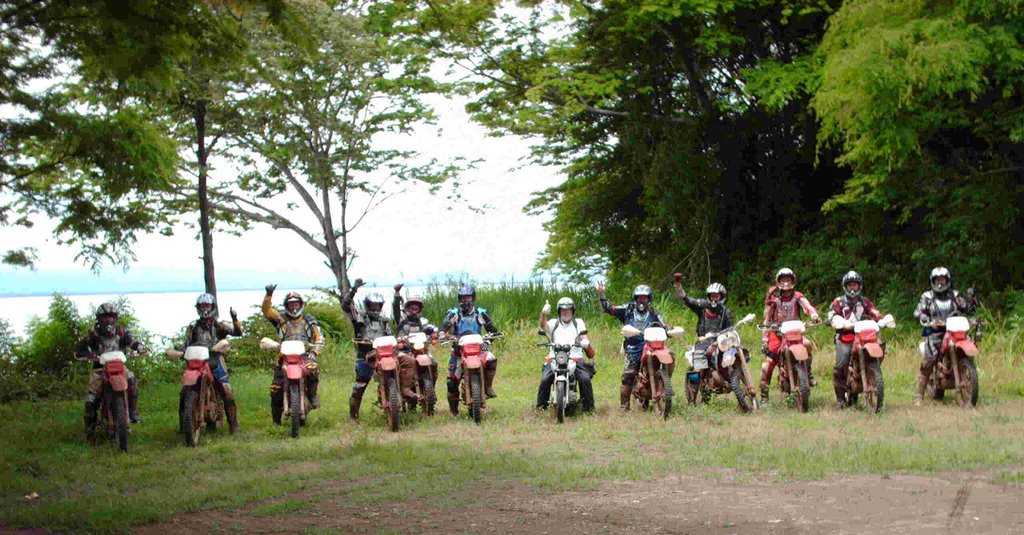
San Francisco Coyote was a pleasure. I leave with regret. We had heavy rain in the night. The dirt road across the Nicoya peninsular is slippery. I wear work gloves bought at the hardware store in Jacaril and I pay great attention to the road. The final few Ks along the coast to the ferry are cratered hard-top. I stop at a cafe on the hill down to the ferry terminal. I rest my but on a comfortable chair and am at peace with breakfast and a third cup of good coffee. All hell breaks loose. Hells Angels! Or a wild bunch of late-thirties reliving their adolescence. They come armed with trail bikes. They work the throttles, BRRRRM BRRRRM ...
They are connected thru college or work or accident. Most are from the States, though one is a Brit, one from Peru and a Nicaraguan with whom I talk on the ninety minute crossing by ferry.
RED HOT CHILI PEPPERS
TUESDAY, JULY 4
The benches outside the store are a fine place for chat. My companion last night was an economics student in his final semester. In music, he is a fan of the Red Hot Chili Peppers. He and his sister are students at the country's premier State university. Away from home, they rent an apartment at $200 a month. Their parents are comfortable financially. Poorer kids share a room or a cupboard. Even this sacrifice is well beyond most budgets.
He finds responsibility for his younger sister difficult on occasion. He and his friends take little interest in politics. National politics are too corrupt. Two ex-Presidents are in jail. He is angered by the sale of Costa Rica's coasts to foreigners. As for foriegn afairs, Costa Rica is little more than a US colony. The US does what it likes in Central America. Look what they did in Panama. And what they are doing in Iraq. Except for scale, Iraq and Panama are the same.
The benches outside the store are a fine place for chat. My companion last night was an economics student in his final semester. In music, he is a fan of the Red Hot Chili Peppers. He and his sister are students at the country's premier State university. Away from home, they rent an apartment at $200 a month. Their parents are comfortable financially. Poorer kids share a room or a cupboard. Even this sacrifice is well beyond most budgets.
He finds responsibility for his younger sister difficult on occasion. He and his friends take little interest in politics. National politics are too corrupt. Two ex-Presidents are in jail. He is angered by the sale of Costa Rica's coasts to foreigners. As for foriegn afairs, Costa Rica is little more than a US colony. The US does what it likes in Central America. Look what they did in Panama. And what they are doing in Iraq. Except for scale, Iraq and Panama are the same.
COYOTE BEACH
TUESDAY, JULY 4
The Dutchman drove me over to see his property. The land stretches up a hillside. They have reserved the top half for wildlife. The lower slope is divided into one hectar lots. They have sold most of these that they wish to sell. The rate around here is $8 a square meter and you can have a good three-bed two-bath house built for $50,000.
The houses are set well back amongst trees on the Dutchman's land; you can't see them from the road. The Dutchman has lived here for the past fifteen years and tends the houses and oversees new construction. We drove down to his neighborhood restaurant a hundred meters up the road from Coyote beach. The beach is four Ks long and is divided by the river. You can wade across the mouth of the river at low tide. There are no buildings on the beach.
We ate at the restaurant and drank a few beers. Six to be exact. And we each ate a fried snapper caught that day. The bill came to $11.
The Dutchman drove me over to see his property. The land stretches up a hillside. They have reserved the top half for wildlife. The lower slope is divided into one hectar lots. They have sold most of these that they wish to sell. The rate around here is $8 a square meter and you can have a good three-bed two-bath house built for $50,000.
The houses are set well back amongst trees on the Dutchman's land; you can't see them from the road. The Dutchman has lived here for the past fifteen years and tends the houses and oversees new construction. We drove down to his neighborhood restaurant a hundred meters up the road from Coyote beach. The beach is four Ks long and is divided by the river. You can wade across the mouth of the river at low tide. There are no buildings on the beach.
We ate at the restaurant and drank a few beers. Six to be exact. And we each ate a fried snapper caught that day. The bill came to $11.
COINCIDENCE OR HUMOR?

fun juxtaposition
TUESDAY, JULY 4
Village life is fun (for me). I watch the comings and goings from a bench outside the store. The under-forties are on wheels, two or four, and mostly motorized. The elders are on horseback. A reasonable horse costs $80. Add saddle and bridle and you are mobile for $150. Fuel grows on the roadside.
Most have heard of my accident. I field a stream of enquiries as to how I am and is it true that I intend riding to Argentina. A trio from a Turtle protection group drop by to chat. One is from Mexico. They collect eggs and take them to a hatchery. They launch the baby turtles into the sea. Shrimp boats work a mile offshore. Shrimping is the preserve of the Taiwanese. The shrimp nets sweep up the baby turtles along with the shrimp and about everything else.
Turtle protectors need volunteers. The beach is beautiful.
www.tortugamarina.org
A public telephone is attached to a post. The female half of a pair of blond young foreign lovers talks at length. The male half hovers. She retreats to the shade of the tree overstanding the post - seeking a privacy of which he is nervous. A plump young woman in tight short shorts and a stretched pink top that almost covers the bits she wants covered is a pinball addict. She rides up every half hour or so on a push bike to play the left hand machine of the two in the bar area of the store. The Dutchman arrives on his quad bike. The store owner's wife invites us to lunch in their kitchen. Delicious vegetables of which I can swear to baby okra and green beans.
GENERALS ARE GOOD FOR YOU
TUESDAY, JULY 4
I talk with the two brothers of the holidaying family over breakfast. The elder brother complains of foreigners owning all the best land in Costa Rica. Neither brother cares much for foreigners. They corrupt Costa Rican society. They breed prostitution and spread their drug culture. The elder brother is a fan of the Somoza years.
"There was no crime," he tells me (not mentioning that the Somozas and their cronies stole the entire country and murdered anyone who argued). "The roads were properly maintained," he states. "Under Somoza, we had thousands of road workers. There was work for everyone." He is also a fan of Castro. "There's no crime in Cuba."
Unless depriving a people of their freedom is a crime...
Clearly his father was of the privileged in the years of the dictatorship.
I am here to report, not to argue. I nod politely.
I talk with the two brothers of the holidaying family over breakfast. The elder brother complains of foreigners owning all the best land in Costa Rica. Neither brother cares much for foreigners. They corrupt Costa Rican society. They breed prostitution and spread their drug culture. The elder brother is a fan of the Somoza years.
"There was no crime," he tells me (not mentioning that the Somozas and their cronies stole the entire country and murdered anyone who argued). "The roads were properly maintained," he states. "Under Somoza, we had thousands of road workers. There was work for everyone." He is also a fan of Castro. "There's no crime in Cuba."
Unless depriving a people of their freedom is a crime...
Clearly his father was of the privileged in the years of the dictatorship.
I am here to report, not to argue. I nod politely.
VILLAGE LIFE
village home
MONDAY, JULY 3
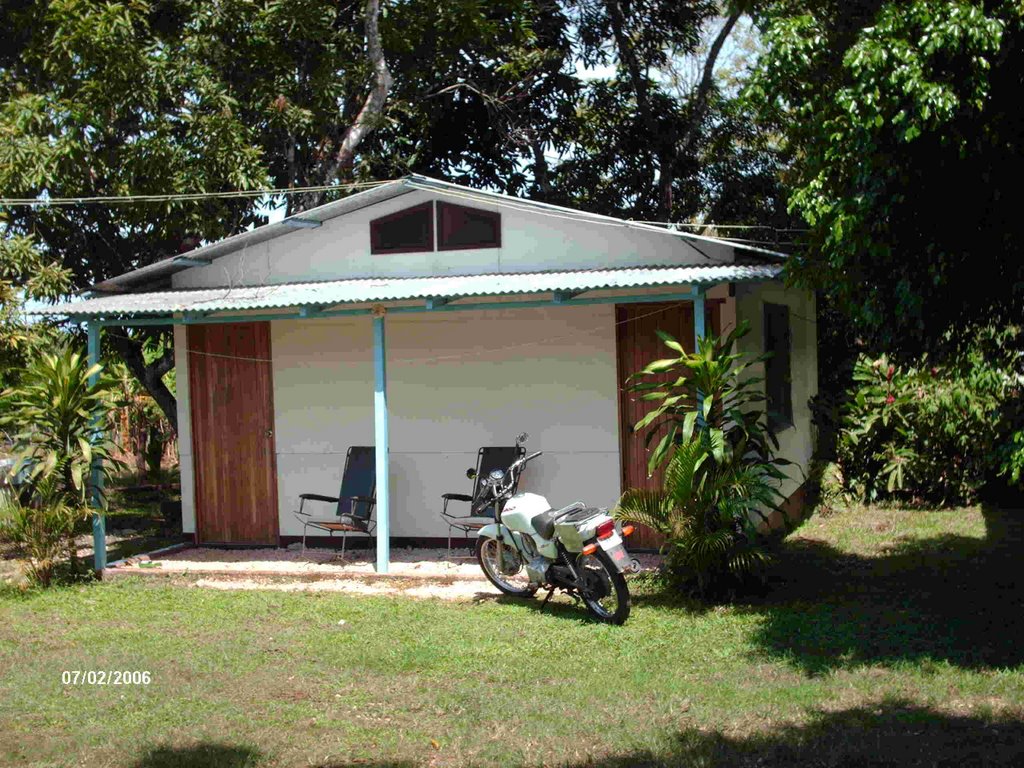
I am settled into a cabin behind one of the two general stores. I have a bathroom and a fan in the village of San Francisco Coyote. The restaurant belongs to the store keeper. I eat dinner after a near three hour ride back from Jacaril town on an old US school bus. I order steak. I am faced with two thick chunks of meat each the size of my shoe soles: salad, fries, fried bananas, two beers. $4 does not seem excessive!
A Dutchman with a development on a hillside beyond the boutique hotel has ridden my bags over on his four-wheel bike. Bush tellegraph alerted him to my accident and he dropped by the general store this morning to check who I was and that I was OK.
A double brother family of Costa Rican businessmen occupy the remaining three cabins for the night: two couples, four kids from seven to sixteen, and one wife's parents. They were double booked into a rental holiday home for the first night of the school vacation.
A terrace out front of the store shades a bar and four teak tables and benches. I sit after dinner with the store owner and a twenty-somthing graduate. The store owner talks philosophy. What is the route to happiness? Do I believe in a God, an afterlife? Would I prefer coffee or another beer?
"Black coffee would be just fine," I say.
I also say that I would prefer a night in his cabins than a week preparing for death in the boutique hotel.
IN SEARCH OF A BANK
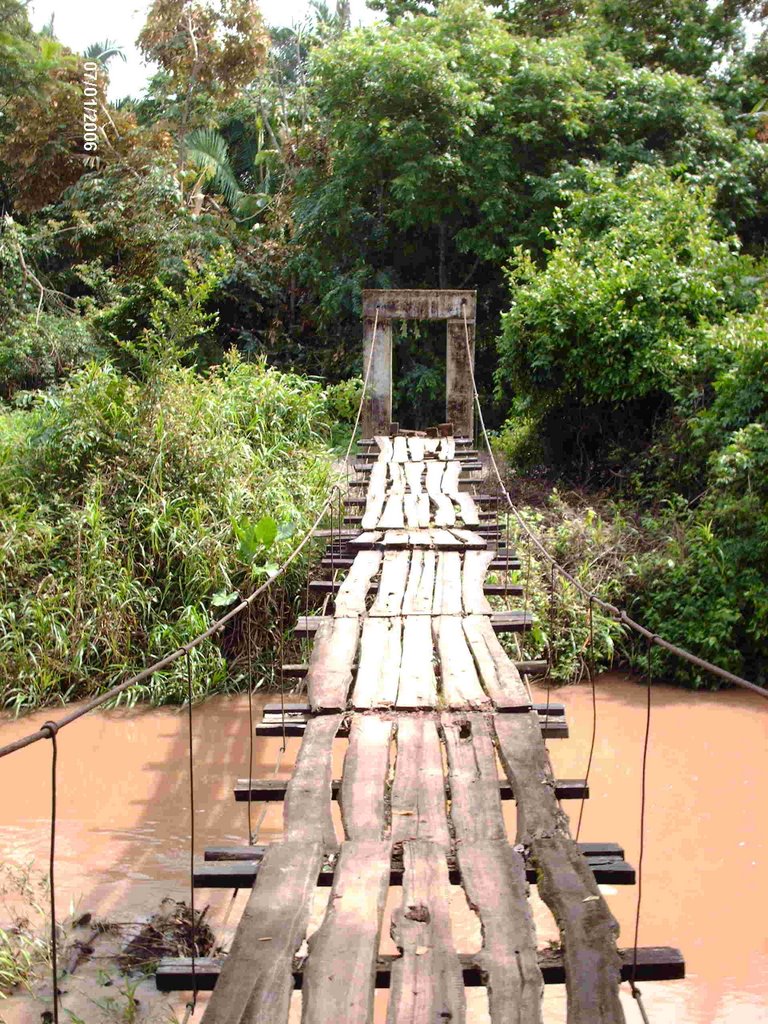
shivery footbridge
MONDAY, JULY 3
The hotel and the doctor have absorbed my cash. I don't carry credit cards. Lose or have them stolen and God knows what will happen before you reach a tellephone. Debit cards are safe. I require a bank and an ATM machine.
The hotel is on a vast ranch owned by an American billionaire. He has owned the ranch for thirty years. He flies in from his home in Hawai on his private jet each month for a few days. The hotel is a recent hobby (its losses tax deductible).
The river is high after the storm. The farm manager drives me by pick-up to the river ford. I cross the foot bridge and walk two Ks to the village of San Francisco. I find a mechanic to overhaul the bike. He directs me to a parts shop where I find replacement mirrors - genuine Honda parts in a community served by two general stores and a kiosk selling cheap jeans and T-shirts.
The nearest bank is thirty-three Ks in the town of Jicaral. The bus journey takes over two hours.
TIPPY-TOE IN CHAPEL
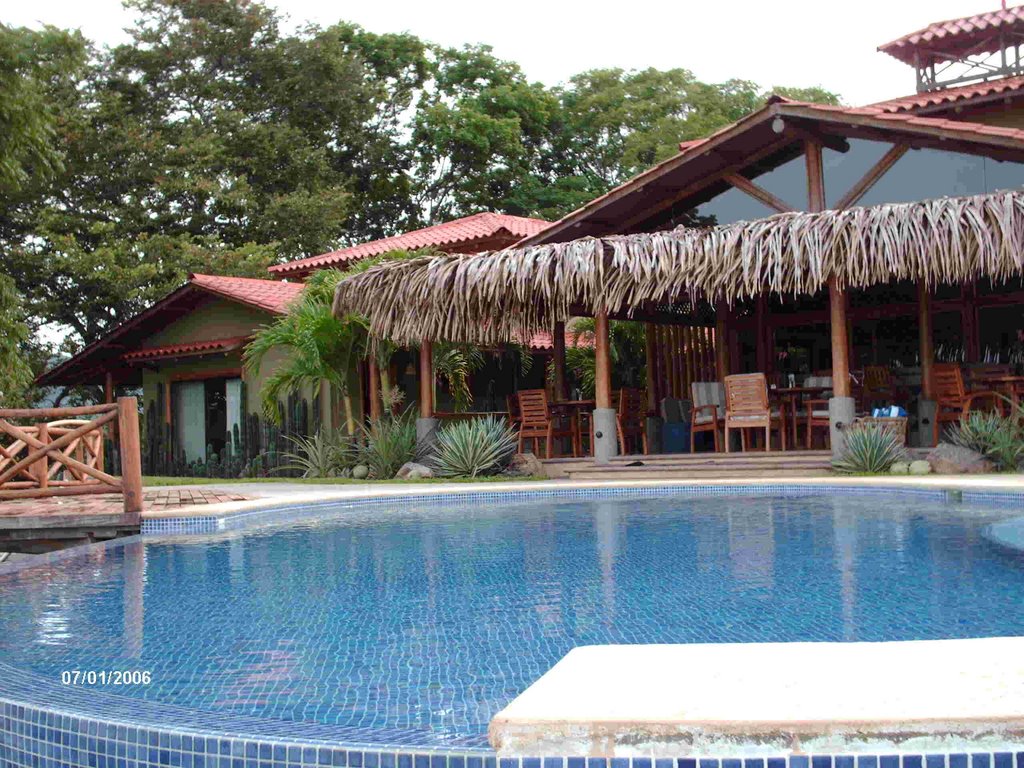
boutique hotel pool
MONDAY, JULY 3
The curtains are open to the terrace. I wake at dawn. My watch broke in the crash. No matter, this is too beautiful a time and place for bed. I am alone as I tippy-toe out to the pool terrace and see the river clear for the first time, waters brown in spate. Two curls of chocolate sand mark the corners of its mouth. Palm trees hide the beach. I sit alone by the pool and watch surf break, three white lines. A howler monkey hollers back in the trees. Bird chatter seems noisy. The tide shifts a flock of pelican off the sand. Clumsy on the ground, they are wonderfully graceful as they glide up-river into the trees. I watch a pale yellow buitterfly. Workers arrive to mend storm-damage, collect broken branches. They work in silence. The Philippina manageress presents me with a steaming mug of black coffee. I have been up an hour. It is 6 a.m.
CONRAD COUNTRY
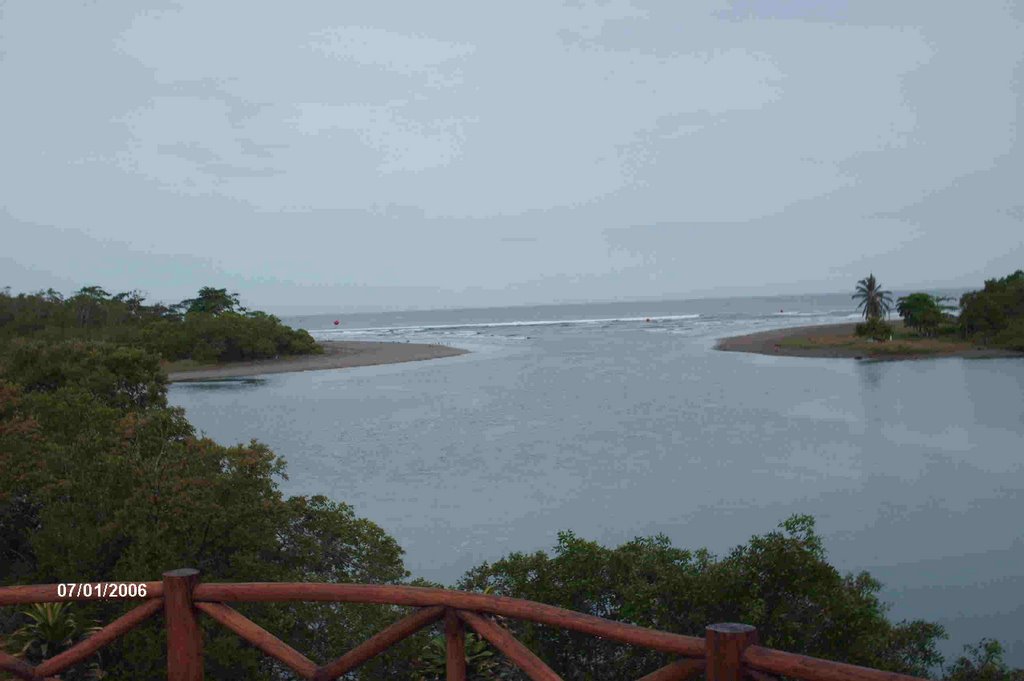
Conrad country by daylight
MONDAY, JULY 3
Thunder smashes me out of sleep. Disorientated, I lie shivering with cold. Lightning shows a picture window, terrace, trees bent under a silver downpour. The cold is air conditioning. I stagger to the windows and out to the room's private terrace. I arrived after nightfall and am unprepared for my surroundings. Lightning displays black waters of a river below the terrace. An animal shrieks. Thunder shakes the terrace. Trees quake beneath a squall. Lightning and I see, thru the rain, surf break. This is Conrad country...
BANKER TALK
SUNDAY, JULY 2
I don't eat dinner. The banker and his wife talk with me once their children are in bed. They have worked in London which they loved (or are polite), and in Miami which they hated for the domination of the new rich Cubans whom they found ostentatious and revoltingly vulgar. The banker visits Cuba regularly on business - barable, he says, for three or four days. He can pretend he is a tourist and ignore the reality that the Cubans suffer: poverty, lack of freedom.
The rash of condominiums on the peninsular is another hate. Prices will double once the coast road is tarred (paid for by the Costa Rican tax payer). Already Costa Ricans, even of their financial bracket, are priced out of the market in their own land. They have been forced to reasess their view of themselves. Costa Ricans had considered themselves different from other Latin Americans, more advanced, more cultured, more organised, more on a par with the United States with whom they were natural allies. Only a few years ago they would have identified with the US team in the World Cup, yet now the banker's friends celebrated when the US was eliminated.
The Iraq war had changed their perceptions (I quote the banker). Access to satelite TV had forced their eyes open. They watched bombs and shells fall. They saw pictures of American soldiers abusing Arabs. This was what the US had done in Panama, killed hundreds in the desire to grab one man. Arabs, Latin Americans weren't important.
This Blog may be offensive and hurtful to my daughter and to my American friends. Should I act as censor or write what I am told?
I don't eat dinner. The banker and his wife talk with me once their children are in bed. They have worked in London which they loved (or are polite), and in Miami which they hated for the domination of the new rich Cubans whom they found ostentatious and revoltingly vulgar. The banker visits Cuba regularly on business - barable, he says, for three or four days. He can pretend he is a tourist and ignore the reality that the Cubans suffer: poverty, lack of freedom.
The rash of condominiums on the peninsular is another hate. Prices will double once the coast road is tarred (paid for by the Costa Rican tax payer). Already Costa Ricans, even of their financial bracket, are priced out of the market in their own land. They have been forced to reasess their view of themselves. Costa Ricans had considered themselves different from other Latin Americans, more advanced, more cultured, more organised, more on a par with the United States with whom they were natural allies. Only a few years ago they would have identified with the US team in the World Cup, yet now the banker's friends celebrated when the US was eliminated.
The Iraq war had changed their perceptions (I quote the banker). Access to satelite TV had forced their eyes open. They watched bombs and shells fall. They saw pictures of American soldiers abusing Arabs. This was what the US had done in Panama, killed hundreds in the desire to grab one man. Arabs, Latin Americans weren't important.
This Blog may be offensive and hurtful to my daughter and to my American friends. Should I act as censor or write what I am told?
BOUTIQUE CHURCH
altar orchids in a boutique hotel
SUNDAY, JULY 2
I have eleven stitches in my hand. I have lost blood. I need a comfortable bed. And I MUST grab the opportunity to talk with a Costa Rican in the upper echelons of the country's professional classes. The bikers have brought my bike to the village. A pick-up driver gives me a lift back to the boutique hotel. The banker family are the only guests. Quiet is an understatement: non-denominational chapel in an up market funeral parlor.
The manageress is Philippina. I recognize the unhuh she uses, so soft (even when she argues the price). I negotiate the room rate down from $120 to $80. Breakfast is included. So is an acre of stone-floor, a king size bed and a bathroom for commited sybarites.
SUNDAY, JULY 2
I have eleven stitches in my hand. I have lost blood. I need a comfortable bed. And I MUST grab the opportunity to talk with a Costa Rican in the upper echelons of the country's professional classes. The bikers have brought my bike to the village. A pick-up driver gives me a lift back to the boutique hotel. The banker family are the only guests. Quiet is an understatement: non-denominational chapel in an up market funeral parlor.
The manageress is Philippina. I recognize the unhuh she uses, so soft (even when she argues the price). I negotiate the room rate down from $120 to $80. Breakfast is included. So is an acre of stone-floor, a king size bed and a bathroom for commited sybarites.
Tuesday, July 04, 2006
ROUGH ROAD TO DISASTER
SUNDAY, JULY 2
The dirt road twists between steep hills. Each village is in mid-football match. A great quantity of beer is drunk. I stop for water and am bought a coke by the barman. A mike-assisted chant comes from round the corner. The Spanish is too fast and too acented for my understanding. A few numbers are recogniseable. Psalms? Verses from the Bible? And threats that this is the audience's last chance, Absolutely the last chance! And more numbers. I presume an evangelist preacher in competition with the evident sinfulness of a football match - with a bar serving alcohol.
Wrong.
I ride round the corner into a cattle auction.
The sun is setting. I have reached that point of fatigue where taking decisions becomes near impossible. I spot a boutique hotel (so advertised) on what could be a side road.
I take the other road. It leads down hill. A left turn is signed to a beach. I hear a bike behind me. I break and turn to ask the driver´s advice. One moment of inatention. The Honda slips. I lie beneath the Honda. The leather gaiter saves my leg from frying. One mirror is smashed.
The two men on the following bike lift the Honda free. Only then do I realise that a shard of mirror has sliced my right hand.
A second bike rider insists I return for First Aid to the boutique hotel.
The wound is washed. Blood spurts. A Costa Rican family are the only guests. The husband, an investment banker, drives me to the village of San Francisco. I wait in a restaurant. Doctor and wife arrive. The wife wears a mini miniskirt. Owners, staff and clientelle of the restaurant watch while I am injected, scrubbed and sewn. The blood is amplier and more realistic than the blood in the Al Pacino movie on TV. The audience is mine.
I dislike watching the doctor at work.
Wherer else to look?
The doctor may dislike me looking at his wife's thighs.
Such are the dilemas of the walking wounded.
The dirt road twists between steep hills. Each village is in mid-football match. A great quantity of beer is drunk. I stop for water and am bought a coke by the barman. A mike-assisted chant comes from round the corner. The Spanish is too fast and too acented for my understanding. A few numbers are recogniseable. Psalms? Verses from the Bible? And threats that this is the audience's last chance, Absolutely the last chance! And more numbers. I presume an evangelist preacher in competition with the evident sinfulness of a football match - with a bar serving alcohol.
Wrong.
I ride round the corner into a cattle auction.
The sun is setting. I have reached that point of fatigue where taking decisions becomes near impossible. I spot a boutique hotel (so advertised) on what could be a side road.
I take the other road. It leads down hill. A left turn is signed to a beach. I hear a bike behind me. I break and turn to ask the driver´s advice. One moment of inatention. The Honda slips. I lie beneath the Honda. The leather gaiter saves my leg from frying. One mirror is smashed.
The two men on the following bike lift the Honda free. Only then do I realise that a shard of mirror has sliced my right hand.
A second bike rider insists I return for First Aid to the boutique hotel.
The wound is washed. Blood spurts. A Costa Rican family are the only guests. The husband, an investment banker, drives me to the village of San Francisco. I wait in a restaurant. Doctor and wife arrive. The wife wears a mini miniskirt. Owners, staff and clientelle of the restaurant watch while I am injected, scrubbed and sewn. The blood is amplier and more realistic than the blood in the Al Pacino movie on TV. The audience is mine.
I dislike watching the doctor at work.
Wherer else to look?
The doctor may dislike me looking at his wife's thighs.
Such are the dilemas of the walking wounded.
COSTA CONDO
SUNDAY, JULY 2
I see no hovels as I speed down the Panamerican Highway in Coata Rica. I note less refuse on the verge than in other Central American countries. The land is more cared for, big trees left standing to protect the soil. And, yes, there is a feel more of organisation than of chaos. I turn south at Liberia. The road passes the airport. Miles of US type hoardings in English advertise car hire and real estate. What is unreal estate?
A hardtop road takes me to Samana - a resort village on a safe beach according to my four-year-old guidebook. The resort has developed. Sunday, it is crowded with coaches. More signs for real estate, for condominiums. The signs are in English. I take the coastal road. It is dirt but good dirt. This is hill country, green and beautiful. White Brahmin cows graze paddocks. White walls and white entrance gates wall off the coast. Apparently condos in Costa Rica are vast gated communities as opposed to apartment blocks.
I see no hovels as I speed down the Panamerican Highway in Coata Rica. I note less refuse on the verge than in other Central American countries. The land is more cared for, big trees left standing to protect the soil. And, yes, there is a feel more of organisation than of chaos. I turn south at Liberia. The road passes the airport. Miles of US type hoardings in English advertise car hire and real estate. What is unreal estate?
A hardtop road takes me to Samana - a resort village on a safe beach according to my four-year-old guidebook. The resort has developed. Sunday, it is crowded with coaches. More signs for real estate, for condominiums. The signs are in English. I take the coastal road. It is dirt but good dirt. This is hill country, green and beautiful. White Brahmin cows graze paddocks. White walls and white entrance gates wall off the coast. Apparently condos in Costa Rica are vast gated communities as opposed to apartment blocks.
FRONTIER
SUNDAY, JULY 2
At the frontier I met a young Argetinian driving a white Dodge semi-sports car home. Leaving Nicaragua was a slow rather than difficult. Costa Rica was good natured, though definitely slow. I carry photocopies of everything from the size of my belly button to the circumference of my ears. The Argentinan was more innocent. He didn´t know the registration number of the Dodge engine - nor where to find it. I entered customs behind him. He caught me up on the highway some three quarters of an hour later. Perhaps we will meet again, possibly in Panama both trying to work out how to get our vehicles to Colombia at a sensible price.
At the frontier I met a young Argetinian driving a white Dodge semi-sports car home. Leaving Nicaragua was a slow rather than difficult. Costa Rica was good natured, though definitely slow. I carry photocopies of everything from the size of my belly button to the circumference of my ears. The Argentinan was more innocent. He didn´t know the registration number of the Dodge engine - nor where to find it. I entered customs behind him. He caught me up on the highway some three quarters of an hour later. Perhaps we will meet again, possibly in Panama both trying to work out how to get our vehicles to Colombia at a sensible price.
NICE AMERICAN
SATURDAY, JULY 1
I sat in San Juan at an open-air waterfront bar last night with a retired dealer in truck parts. The bar was the least pretentious on the bay. The owner, a woman in her sixties, had owned half the hill that forms the right hook of the bay. She and her family sold the hill rediculously cheap some years back. They didn´t know. Now big houses dot the hill. Meanwhile the American, bored at doing nothing and angry that developers had taken advantage of a nice woman and her family, invested in a couple of fishing launches that her sons run. Fishing hasn´t been good the past weeks. The American is considering opening a furniture store in partnership with the woman. They are not a relationship. The woman is merely someone the American likes and admires - and, as I wrote, he is bored doing nothing and enjoys being part of a community. He drank vodka breezers, I drank a beer and we ate prawns in a chili sauce. The breeze blew off the sea. The moon did its thing, as did the stars. Nothing special happened, a pleasent evening...
I sat in San Juan at an open-air waterfront bar last night with a retired dealer in truck parts. The bar was the least pretentious on the bay. The owner, a woman in her sixties, had owned half the hill that forms the right hook of the bay. She and her family sold the hill rediculously cheap some years back. They didn´t know. Now big houses dot the hill. Meanwhile the American, bored at doing nothing and angry that developers had taken advantage of a nice woman and her family, invested in a couple of fishing launches that her sons run. Fishing hasn´t been good the past weeks. The American is considering opening a furniture store in partnership with the woman. They are not a relationship. The woman is merely someone the American likes and admires - and, as I wrote, he is bored doing nothing and enjoys being part of a community. He drank vodka breezers, I drank a beer and we ate prawns in a chili sauce. The breeze blew off the sea. The moon did its thing, as did the stars. Nothing special happened, a pleasent evening...
RAT OLYMPICS
SATURDAY, JULY 1
San Juan I found an air conditioned room mid-block back from the beach for $7. The building was wood with a tin roof and old. My room faced onto the first floor terrace. The bathroom worked. The sheets were clean. I have been away from such places a while and had forgotten the coconut rats. The San Juan rats are in training for the relay races at the rat olympics. Training commences shortly before 5 a.m. First the athlete rats sprint up and down the ceiling. Soon the rat coaches get in on the act with their shrieks and chittering.
San Juan I found an air conditioned room mid-block back from the beach for $7. The building was wood with a tin roof and old. My room faced onto the first floor terrace. The bathroom worked. The sheets were clean. I have been away from such places a while and had forgotten the coconut rats. The San Juan rats are in training for the relay races at the rat olympics. Training commences shortly before 5 a.m. First the athlete rats sprint up and down the ceiling. Soon the rat coaches get in on the act with their shrieks and chittering.
GOOD RIDDANCE TO GRANADA
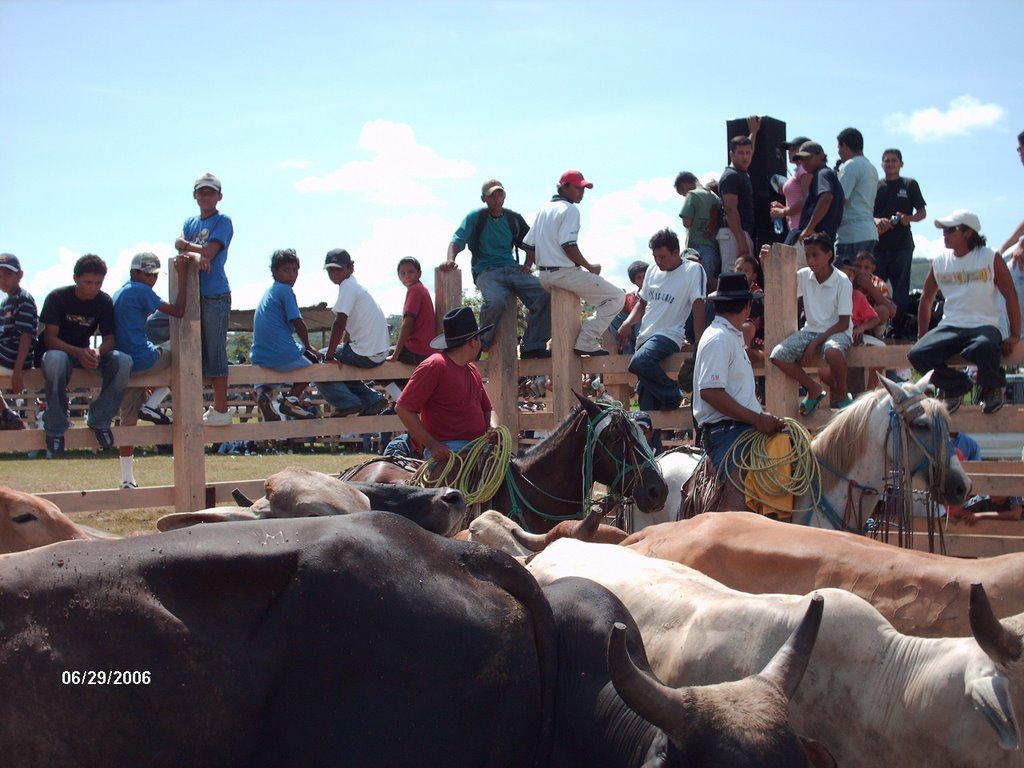
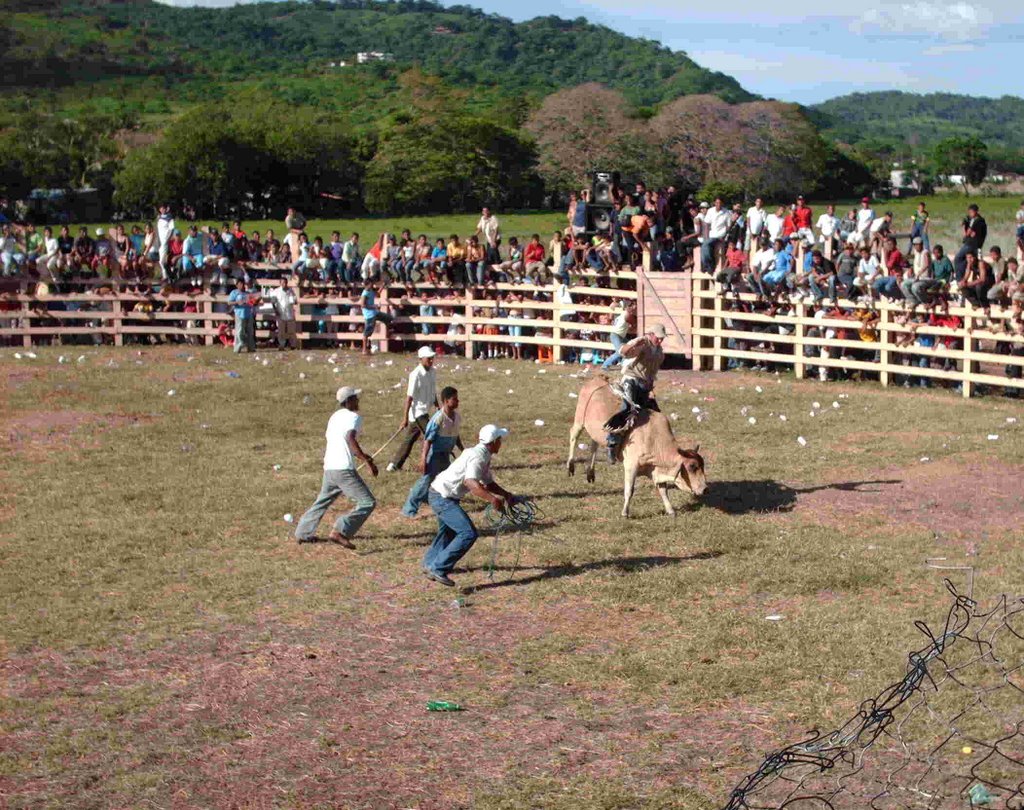
San Juan rodeo<
SATURDAY, JULY 1
A ride along the lake thru rich green ranch land studded with big trees is a fine way to clear your head. I turned off 30 Ks short of the Costa Rica frontier to San Juan. The approach to the beach town is thru country spread with giant green mole hills tufted with small trees. Hills ringed a small wood stadium. People were streaming in off the road. A cop told me they were holding a rodeo. I paid for a shade seat on the upper terrace. A brass and drum band was blasting a Latin American version of circus YahYah music. Hawkers were shouting their wares: icecream, sodas, cashew, banana chips, chittlings, barbecue meat. A brass band clarion heralded the launch from a chute of a bull calf with rider. The calf bucked a few times, became bored. I was back where I wanted to be, back in Central America.
LAST LOOK AT GRANADA
SATURDAY, JULY 1
I watched the England/Portugal football match at a corner bar with a big screen TV. The bar is a familar of all such countries. It is the hangout of US citizens resident in Nicaragua to drink cheap and get laid. I sit at the bar. A girl with silver nails and vaguely bleached hair sits at a table beside a North American in his fifties. She looks fifteen. The man comes to the bar. The girl is his trophy and he shows the girl's ID to the man sitting beside me. The ID says she is nineteen. The ID maybe the girl's and it maybe authentic. He sits back down beside her. She leans a little away from him as he strokes her arm. Later he returns to the bar for a fresh beer. Midday and his eyes are already marginally out of focus. The girl looks round. Anyone can read her thoughts: "I'll be in bed with that drunk soon, YUK!"
This is one couple. There were others much the same together with the standard solitary drunks who had missed out at AA. The North Americans were yelling for England. The few Latinos identified with Portugal. Most of them were unsureas to where Portugal is.
I watched the England/Portugal football match at a corner bar with a big screen TV. The bar is a familar of all such countries. It is the hangout of US citizens resident in Nicaragua to drink cheap and get laid. I sit at the bar. A girl with silver nails and vaguely bleached hair sits at a table beside a North American in his fifties. She looks fifteen. The man comes to the bar. The girl is his trophy and he shows the girl's ID to the man sitting beside me. The ID says she is nineteen. The ID maybe the girl's and it maybe authentic. He sits back down beside her. She leans a little away from him as he strokes her arm. Later he returns to the bar for a fresh beer. Midday and his eyes are already marginally out of focus. The girl looks round. Anyone can read her thoughts: "I'll be in bed with that drunk soon, YUK!"
This is one couple. There were others much the same together with the standard solitary drunks who had missed out at AA. The North Americans were yelling for England. The few Latinos identified with Portugal. Most of them were unsureas to where Portugal is.
FURTHER NUTS
FRIDAY, JUNE 30
Did I mention the Austrailian tax lawyer, mid forties? Free biking is his passion, riding down mountains and over share drops. Jed would understand. Maybe it's a cure for boredom. If so, it is a little extreme.
Did I mention the Austrailian tax lawyer, mid forties? Free biking is his passion, riding down mountains and over share drops. Jed would understand. Maybe it's a cure for boredom. If so, it is a little extreme.
NUTS IN GRANADA
FRIDAY, JUNE 30
You have met the toothless American with two cigarettes and a reincarnated mother. Meet another of Granada's happy hunters. This one I took to dinner. Serial killers are hot with the media. This was a serial non-killer. She had tired to kill herself on three occasions and had tried twice to kill her lover.
One failure in self-killing, OK. Next try, you go up a few extra floors before jumping out the window. As to killing her lover: they were sharing a bed. How diffcult can that be? Didn´t she store a baseball bat in the umbrella stand? I would have understood were she a vegetarion and shocked by blood. However, she ate half a barbecue chicken while relating that she had been saved by meditation, alternative medcine and studying the works of Carlos Castenedes. Carlos Catenedes is the Brown Rice Sixties, marajuhana, LSD and the hush hush secrets of Motorcycle Maintenence. I was the one with the motorcycle...
As to meditation, she was messing up on the dose. She was fine thru the chicken. We had to walk a few blocks in search of carrot cake and the dosage ran low. She transformed from Church mouse to F this and F that to the accompiment of a shrill giggle. Ouch...
You have met the toothless American with two cigarettes and a reincarnated mother. Meet another of Granada's happy hunters. This one I took to dinner. Serial killers are hot with the media. This was a serial non-killer. She had tired to kill herself on three occasions and had tried twice to kill her lover.
One failure in self-killing, OK. Next try, you go up a few extra floors before jumping out the window. As to killing her lover: they were sharing a bed. How diffcult can that be? Didn´t she store a baseball bat in the umbrella stand? I would have understood were she a vegetarion and shocked by blood. However, she ate half a barbecue chicken while relating that she had been saved by meditation, alternative medcine and studying the works of Carlos Castenedes. Carlos Catenedes is the Brown Rice Sixties, marajuhana, LSD and the hush hush secrets of Motorcycle Maintenence. I was the one with the motorcycle...
As to meditation, she was messing up on the dose. She was fine thru the chicken. We had to walk a few blocks in search of carrot cake and the dosage ran low. She transformed from Church mouse to F this and F that to the accompiment of a shrill giggle. Ouch...
THE H SCALE
FRIDAY, JUNE 30
I have been mulling over a scale against which to grade people. H10/Positive is supreme in politically correct prejudice, ignorance and idiocy. An H10/Negative is awarded for maximum awareness of reality. You have to be aware to care. M
y Texan host rated high on the H/negative scale. His property taxes back in Texas had been quadrupled, taxes for schooling Latino illegal immigrants' kids. My host's objection was to the woeful education rather than the taxes. Educate the kids successfully and they would be a credit to their communities and the USA. Educating them badly was both imoral and a sure route to future social problems.
My host had owned a business in Texas and had bought his siblings' share of the family ranch. Aged fifty he discovered hot air ballooning. He learnt to pilot balloons, gained a licence, sold up his business and spent 10 years living and flying in the heart of Kenya's Massai reserve. Recently he paddled a canoe down the San Juan river from Lake Nicaragua to the Caribbean. As for politics, he has a deep contempt for the entire Bush family. He has known them all, all his life. He is my age.
I have been mulling over a scale against which to grade people. H10/Positive is supreme in politically correct prejudice, ignorance and idiocy. An H10/Negative is awarded for maximum awareness of reality. You have to be aware to care. M
y Texan host rated high on the H/negative scale. His property taxes back in Texas had been quadrupled, taxes for schooling Latino illegal immigrants' kids. My host's objection was to the woeful education rather than the taxes. Educate the kids successfully and they would be a credit to their communities and the USA. Educating them badly was both imoral and a sure route to future social problems.
My host had owned a business in Texas and had bought his siblings' share of the family ranch. Aged fifty he discovered hot air ballooning. He learnt to pilot balloons, gained a licence, sold up his business and spent 10 years living and flying in the heart of Kenya's Massai reserve. Recently he paddled a canoe down the San Juan river from Lake Nicaragua to the Caribbean. As for politics, he has a deep contempt for the entire Bush family. He has known them all, all his life. He is my age.
BIG HOUSE
FRIDAY, JUNE 30
Stir fry in a dream house, Spanish colonial two patios deep. The owners, a male Texan married to a Brit, built a second floor above the centre section that seperates the two patios. The raised floor is invisible from the street, not does it overlook their neigbours. It is supported on earthquake proof pillars to protect the original ground-floor rooms of adobe. The one side is open. The view is perfect across ancient pantiled roofs to the massive cloud-wrapped volcano that domiates Granada. A vast unglazed window faces the opposit way and collects the breeze in proof that a well-designed space has need neither for a/c nor fans. A pool fills the rear patio, the front patio is jungle garden. The floors are baked clay. Furniture is sparse and simple. Conversation was warm while the beer was cold.
Stir fry in a dream house, Spanish colonial two patios deep. The owners, a male Texan married to a Brit, built a second floor above the centre section that seperates the two patios. The raised floor is invisible from the street, not does it overlook their neigbours. It is supported on earthquake proof pillars to protect the original ground-floor rooms of adobe. The one side is open. The view is perfect across ancient pantiled roofs to the massive cloud-wrapped volcano that domiates Granada. A vast unglazed window faces the opposit way and collects the breeze in proof that a well-designed space has need neither for a/c nor fans. A pool fills the rear patio, the front patio is jungle garden. The floors are baked clay. Furniture is sparse and simple. Conversation was warm while the beer was cold.
Friday, June 30, 2006
GROWING YOUNGER IN GRANADA
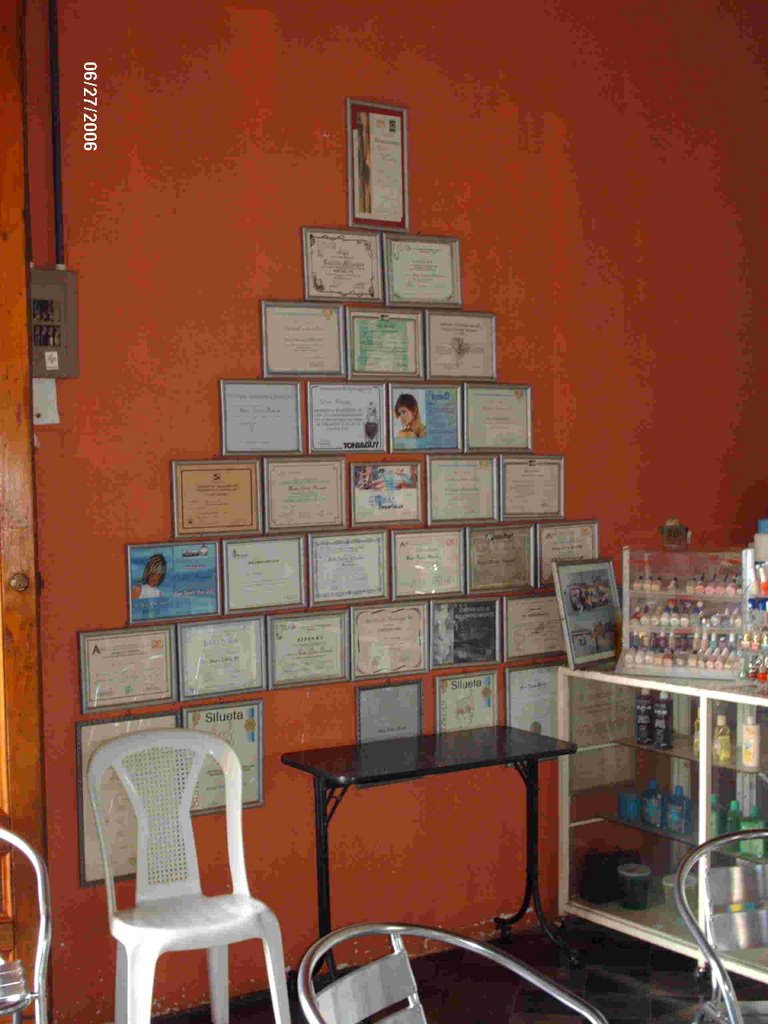
diplomas in the beauty salon
SATURDAY, JUNE 30
I am invited to a large house near the cathedral square. The owner is a North American of my age. He has lived in Granada for three years. He is married (or has a partner) who is British. The invitation is for tea or perhaps a drink. I have been on the road two months. I need sprucing. A corner beauty parlour displays an impressive pyramid of diplomas. With luck, one of the diplomas is for returning youth to old faces.
COLONIAL CITY

parade outside the cathedral
FRIDAY, JUNE 29
Granada boasts many examples of Spanish colonial domestic architecture; there is a great need for maintenance. The cathedral is simple and spacious. School students attended a sung High mass today. The girls paraded after mass, marching back to school to the beat of drums. Stick whirlers led the parade. Next marched girls waving red plactic pompoms. The whirlers wore gold mini skirts, the pompom girls wore red. A Conservative pope reigns in the Vatican. I wonder what his views are regarding minikirts.
Thursday, June 29, 2006
CERTAINLY PECULIAR
THURSDAY, JUNE 28
I sat at a sidewalk cafe and sipped papaya juice. A threesome occupied the next table: two European women and a Nicaraguan man. One women had bought an island. She had overrun her budget in building a house on the island. She was off to London and Sydney to buy two further properties. The property market in London was already high and she had little expectation of making a profit. She had high hopes of the Australian investment.
An old lady with badly bowed legs hobbled bye and asked for alms. The Nicaraguan, a handsom man in his mid thirties, told the old woman that they didn't have any money. The old woman shuffled on.
I appologised for interupting. Curiosity impelled me to enquire what sort of island: eight acres with palms and perfect beaches off Nicaragua's Caribbean coast.
I sat at a sidewalk cafe and sipped papaya juice. A threesome occupied the next table: two European women and a Nicaraguan man. One women had bought an island. She had overrun her budget in building a house on the island. She was off to London and Sydney to buy two further properties. The property market in London was already high and she had little expectation of making a profit. She had high hopes of the Australian investment.
An old lady with badly bowed legs hobbled bye and asked for alms. The Nicaraguan, a handsom man in his mid thirties, told the old woman that they didn't have any money. The old woman shuffled on.
I appologised for interupting. Curiosity impelled me to enquire what sort of island: eight acres with palms and perfect beaches off Nicaragua's Caribbean coast.
MAD HOUSE
THURSDAY, JUNE 28
Granada is a mad house. An elderly North American beckoned me onto the terrace of his small house for coffee. He had forgotten to fit his false teeth and was difficult to understand. He was one of twins, so he recounted. His mother and twin brother died in child birth thru the incompetence of his grandfather, a doctor with cataracts.
The American had rediscovered his mother on a coffee finca in Costa Rica six years back. She had been reborn as a coffee picker. He showed me photographs and related a series of dates that proved that one of his reincarnated mother's children was his reincarnated twin brother. I was confused by the dates and the math. The American seemed confused as to which of two lit cigarettes he should smoke. He held one in each hand and waved them in emphasis of the crucial proofs in his family history. One cigarette was tobaco the other was herbal.
Granada is a mad house. An elderly North American beckoned me onto the terrace of his small house for coffee. He had forgotten to fit his false teeth and was difficult to understand. He was one of twins, so he recounted. His mother and twin brother died in child birth thru the incompetence of his grandfather, a doctor with cataracts.
The American had rediscovered his mother on a coffee finca in Costa Rica six years back. She had been reborn as a coffee picker. He showed me photographs and related a series of dates that proved that one of his reincarnated mother's children was his reincarnated twin brother. I was confused by the dates and the math. The American seemed confused as to which of two lit cigarettes he should smoke. He held one in each hand and waved them in emphasis of the crucial proofs in his family history. One cigarette was tobaco the other was herbal.
Wednesday, June 28, 2006
THE ROAD TO GRANADA

Improper volcanos
TUESDAY, JUNE 27
A chain of volcanos runs the length of Nicaraua. Volcanos explode. Earthquakes are frequent. You would expect Nicaraguans to be jumpy. They seem very much at ease. Two good roads leads from Leon to the capital, Managua. The northen road runs beside the smaller of the country's two vast lakes and is less busy. I avoid capitals. They are noisy, polluted and often dangerous. Helpful drivers pointed me on the road thru to Granada. I booked into a hotel recomended by Frenchman, Patrick. I have a double room with a fan and good sized bathroom: $13 a night. The electricity was off in that segment of town. It was on in the center. Parking in the Cathedral square, I found an airconditioned internet cafe. A tornado hit the square while I wrote up the blog. Tiles off a hotel roof lay scattered in the gutter and on the roofs of parked cars. The Honda was on its side.
Electricity was back on at the hotel. I showered and chatted with the German owner before riding down to the lake where the hotels were in darkness along the waterfront. Later I found a comedor near the hotel. A beer, steak, Christians and Moors, fried bananas, cabbage salad and banana chips cost me $2.50. The food was good. Lights went out while I was eating (memories of Cuba). Back at the hotel I chatted more with the owner until the lights went on. This is a daily occurence - great boost for tourism - though many of the North Americans residents are too old to know whether the lights are on or off. A front page scare story in the local English language newspaper warned: SEX TOURISM IN GRANADA. A sexual thought would put these Oldies in an ambulance.
I lay in bed and watched a rerun of the France/Spain match. One goal each was the score midway thru the second half when I switched off the TV. I learn this morning that the match ended with two great goals by the French. That's the way life goes.

HAH!
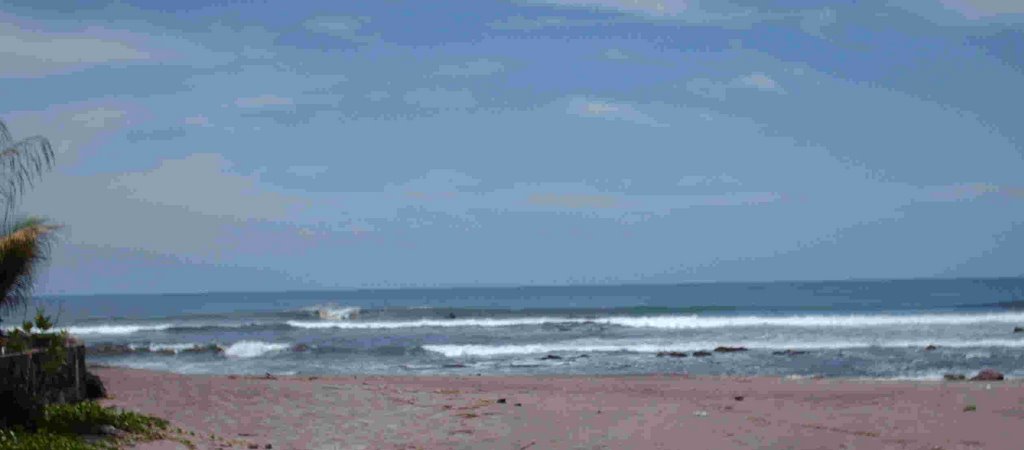
Hah! Dream away, kids!
TUESDAY, JUNE 27
I was out of the hellhole at 6.15 and at the beach by seven. The sky was overcast. Beach resorts need people. They require smiling faces and an amplitude of tanned naked flesh. This was midweek, out of season, and rain had been falling much of the night. The rain had dyed the dirt road and the beach a dung brown and weighted the broad leaves of the sea grape trees so that the branches appeared to droop with depression. I turned right and rode one street in from the beach. A couple of fiberglass fishing boats were dragged up at the creek the far end of the beach where palm thatch palapas dripped last night´s downpour. The uncertainties that tipify a Nicaraguan existence were evident in the quantity of buildings abandoned in mid construction.
I had dreams of breakfast. I found a young Brit couple loading packs onto a bus outside a backpacker´s haven. The kitchen was shut. Everything was shut. I rode in the oposite direction. I can scent a lone Frenchman in the middle of the Sahara desert. Patrick, owner of the Oasis was easy. He was half asleep in a hammock. He made coffee that was coffee. The sun came out while we exchanged life experiences. His cook produced scrambled eggs and fresh orange juice. The beach dried. Sand was transformed from dung brown to rich gold. Trees perked up. Abandoned plastic bottles gleamed.
Patrick´s rooms are large. You can ride a wheelchair into his bathrooms. He has two bungalows. Everything is clean and orderly and practical. Surf breaks a hundred metres out from the beach. I took photographs to arouse the jealousy of the boys back home in the rain: Jed, Josh and Josh´s friend, Ben.
patrick426@caramail.com
www.oasislaspenitas.com
Riding back, I slalomed the potholes, vegetation brilliant in the sunlight. A bridge divided a lagoon. Two men were fishing with a net, two others swum and splashed in the muddy water, maybe driving prey. The men were laughing. They waved as I passed. I stopped to ask whether they were fishing for fish or prawn.
"Prawns. Big ones," one of the men shouted, spreading his hands.
The men were having a ball.
So was I.
Where am I now?
Granada...
GET ME OUT OF HERE
TUESDAY, JUNE 27
I packed last night. I was eager to leave. I washed myself one last time in a shower ingrained with grime, lept across the pools leaking from beneath the lavatory bowl, slipped into sandals to keep my feet dry of the seepage that flowed across the room´s tiled floor. Did I discribe the ceiling of moulting hardboard? The bugs? The odour of sewage damp? The terrifying electrical fittings? Better not...
The information I gained from the students was priceless. $6.50 a night for the room was outrageous overcharging. I deserve a medal for staying the course.
Breakfast at the beach will serve as my reward...
I packed last night. I was eager to leave. I washed myself one last time in a shower ingrained with grime, lept across the pools leaking from beneath the lavatory bowl, slipped into sandals to keep my feet dry of the seepage that flowed across the room´s tiled floor. Did I discribe the ceiling of moulting hardboard? The bugs? The odour of sewage damp? The terrifying electrical fittings? Better not...
The information I gained from the students was priceless. $6.50 a night for the room was outrageous overcharging. I deserve a medal for staying the course.
Breakfast at the beach will serve as my reward...
PECULIAR HOTEL
TUESDAY, JUNE 27
I stayed in an peculiar hotel in Leon. I wouldn´t recomend the dump to a dead dog. To be in character, the woman owner should have been drinking gin out of Tenesee Williams tea cup with a broken handle. I stayed for the opportunity to talk with two young university students. One studies computer sciences. He qualifies and Nicaragua won´t see the flash of his departure. The other is the youngest of six. His older siblings have marketable qualifications and have already gone. He is commited to study law. Nicaraguan law is moderately useless inside of Nicaragua. Outside, it is totally useless. He will have to stay. Clever Mum...
I stayed in an peculiar hotel in Leon. I wouldn´t recomend the dump to a dead dog. To be in character, the woman owner should have been drinking gin out of Tenesee Williams tea cup with a broken handle. I stayed for the opportunity to talk with two young university students. One studies computer sciences. He qualifies and Nicaragua won´t see the flash of his departure. The other is the youngest of six. His older siblings have marketable qualifications and have already gone. He is commited to study law. Nicaraguan law is moderately useless inside of Nicaragua. Outside, it is totally useless. He will have to stay. Clever Mum...
PESADO
MONDAY, JUNE 26
Rain fell hard this evening. I was caught in the storm while sipping juice and talking with a Spanish volunteer. Volunteering began in Nicaragua during the romantic period immediately following the fall of the Somoza dictatorship. It continues: mostly young people from Europe helping in schools.
I had been invited to dinner. I went and got soaked on the way. The other guests had cancelled. I was stuck with the clockmaker. Heavy and pesado have similar dictionary meanings. In common usage they are very different. Heavy suggests seriousness while pesado is best translated as Turgid. Turgid is what I suffered for nearly two hours: politics at its worst, a stream of platitudes. I have been thru this before and refrained from interjecting so much as a cough less I prolonged the lecture. The clockmaker took my silence as evidence that I was left wing - I have no idea why. No food arrived, not even a nut. I had brought a bottle of rum which stood on a tray unopened. I had brought fresh limes, Hierba buena. The tray was within my peripheral vision. Such cruelty...
Rain fell hard this evening. I was caught in the storm while sipping juice and talking with a Spanish volunteer. Volunteering began in Nicaragua during the romantic period immediately following the fall of the Somoza dictatorship. It continues: mostly young people from Europe helping in schools.
I had been invited to dinner. I went and got soaked on the way. The other guests had cancelled. I was stuck with the clockmaker. Heavy and pesado have similar dictionary meanings. In common usage they are very different. Heavy suggests seriousness while pesado is best translated as Turgid. Turgid is what I suffered for nearly two hours: politics at its worst, a stream of platitudes. I have been thru this before and refrained from interjecting so much as a cough less I prolonged the lecture. The clockmaker took my silence as evidence that I was left wing - I have no idea why. No food arrived, not even a nut. I had brought a bottle of rum which stood on a tray unopened. I had brought fresh limes, Hierba buena. The tray was within my peripheral vision. Such cruelty...
Monday, June 26, 2006
SPLENDIDLY ILLOGICAL NICARAGUA
MONDAY, JUNE 26
I took coffee this morning with an elderly Nicaraguan maker of grandfather clocks. He is also a fan of BIG Band music. Heavy rain fell all last night. Trapped in my hotel, I went to bed at 7 p.m. In Guatemala or Honduras the electrcity would have failed at the first clap of thunder. I waited for my fan to stop whirring. I foresaw sweltering thru the night and being devoured by mosquitos. To the contrary...I required a vest and pyjama trousers against the chill.
Nicaragua is not logical.
Today we enjoyed a fine sunny morning. The clockmaker and I were back in his patio sipping coffee and listening to Glen Miller. The electricity failed.
I took coffee this morning with an elderly Nicaraguan maker of grandfather clocks. He is also a fan of BIG Band music. Heavy rain fell all last night. Trapped in my hotel, I went to bed at 7 p.m. In Guatemala or Honduras the electrcity would have failed at the first clap of thunder. I waited for my fan to stop whirring. I foresaw sweltering thru the night and being devoured by mosquitos. To the contrary...I required a vest and pyjama trousers against the chill.
Nicaragua is not logical.
Today we enjoyed a fine sunny morning. The clockmaker and I were back in his patio sipping coffee and listening to Glen Miller. The electricity failed.
IN THE COMPANY OF LIONS IN LEON
Cathedral lion without British lion
MONDAY, JUNE 26
I was interviewed today for Nicaragua TV astride my bike outside the cathedral. Directly behind and above me stood a large stone lion. The photographer gestured that I should pull in my belly.
Tonight I am invited to dinner. I shall present my hosts with a bottle of rum and a bag of fresh limes. Later, I will inspect myself in the bathroom mirror back at my rather odd hotel. Perhaps the rum will have made me slimmer.
MONDAY, JUNE 26
I was interviewed today for Nicaragua TV astride my bike outside the cathedral. Directly behind and above me stood a large stone lion. The photographer gestured that I should pull in my belly.
Tonight I am invited to dinner. I shall present my hosts with a bottle of rum and a bag of fresh limes. Later, I will inspect myself in the bathroom mirror back at my rather odd hotel. Perhaps the rum will have made me slimmer.
UN CRIME
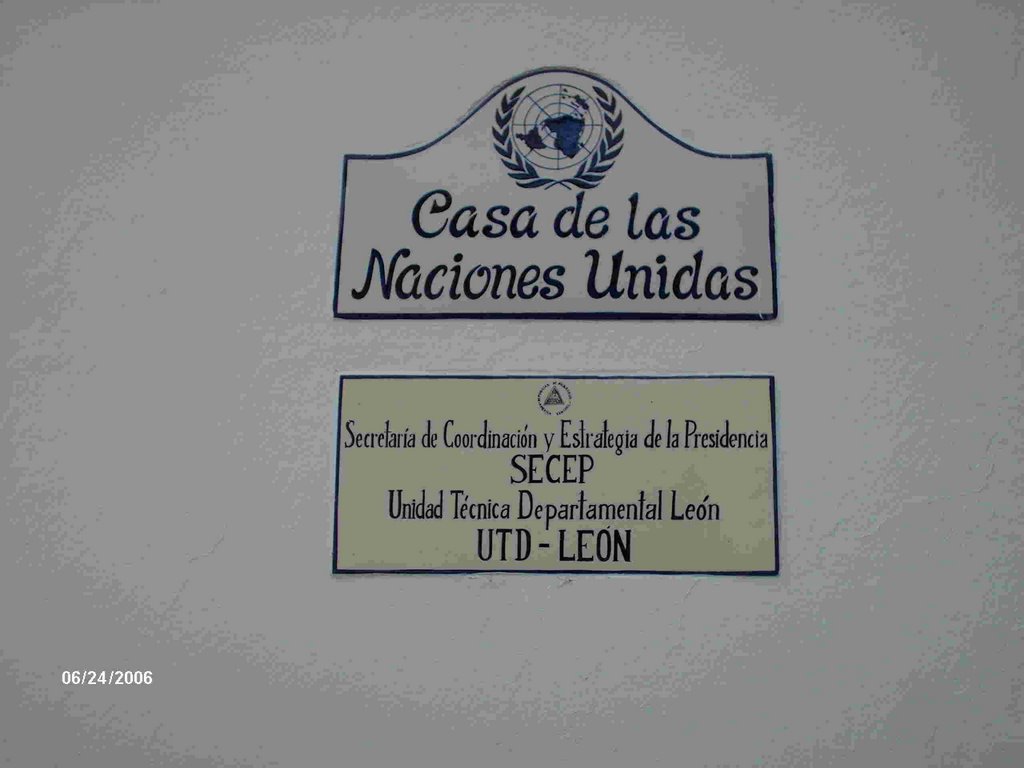
boasting
MONDAY, JUNE 26
I have uncovered a crime commited by the UN. UNESCO, a UN agency, funds restoration of World Heritage sites. Leon competes with Antigua, Guatemala, and San Miguel de Allende, Mexico, in Spanish Colonial domestic architecture, though not in funding. I was delighted to find a building housing UN offices and restored by the UN.
I should have stayed outside.
The pillars supporting the patio terrace have been resculpted with cement to resemble the trunks of palm trees. The pillars are painted shit brown and varnished. The patio is desecrated by a kidney shaped plunge pool painted pale shiny chemical blue. The walls of the pool rise two feet above the floor of the patio thus destroying the space. The conference area to the left is seperated from the patio by concrete block with holes in them. The blocks are painted gloss white.
I could continue...
THE POLITICALLY COMMITED

note the Toyota - names change, Empires go on for ever
MONDAY, JUNE 26
The politically commited are seldom commited to accuracy. My female informant (ex secretary to Sadinista leader) told me that workers in the Tax Free zones earned a dollar a day. I checked. The average wage is $120 a month, surely sufficiently low not to require exageration. All employers pay health insurance and pension contributions. Some supply free housing.
Sunday, June 25, 2006
BUSH GENOCIDA
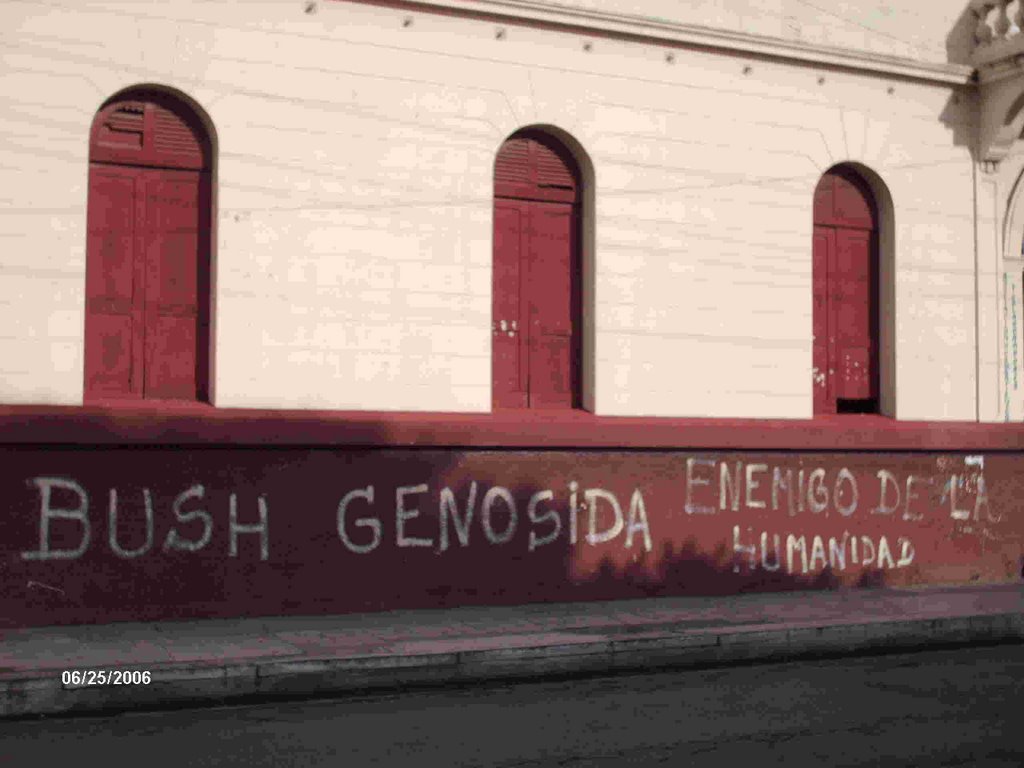
a few words on a wall
SUNDAY, JUNE 25
BUSH GENOSIDA is written in huge letters on a wall facing across the central square to the cathedral in Leon. Bush is not guilty of genocide. Mostly what he does is make mistakes. We all make mistakes. Being President of the most powerful nation in the world, Bush´s mistakes are naturally on a large scale. Both President Bush and Prime Minister Blair distorted intelligence. They lied to their own nations. Secretary of State Powell deceived the United Nations. This is proven fact.
Deception is not genocide.
Though innacurate, at least the scrawled message is specific in whom it accuses. It doesn´t accuse Americans or even America. Bush is the target.
My personal dislike is Haliburton and those in the present US Adminstration who continually award Haliburton contracts that are licenses to print money. However, those employed by Haliburton must be average Americans and I have more close American friends than I have Brits.
I have an American adoptive daughter whom I adore and an ex to whom I am close and who is always generous and supportive. My daughter´s brother is another Jed (though not a Jedediah) and I believe we connect. Certainly I had a great time in his company when I was last in Providence. These are a type of American I have heard referred to in the Southern States as those Jewish people - as is my agent, a kind, gentle, cultured man of absolute integrity.
My friend in Dallas, Don, is perhaps more what foreigners picture as an American. A big, tall man, he is a product of Texas A&M, a Good Ol´Boy, third generation Dallas, third generation to live in the same home. A day spent driving round his construction sites is both instructive and a delight. He has wisdom and a slow dry sense of humor. He knows his clients and he knows his work. He is wealthy because his workers like and respect and trust him and don´t let him down. His workers are Mexican.
I write this lest readers believe my own views mirror those I report. This a journey of discovery. I am not in the judgement game. I have repeated to Central Americans again and again much of what I have written in this blog: the importance of avoiding generalisations, of not labelling people.
LEON IS NOISY
SUNDAY, JUNE 25
Workers in the Tax free zones earn $1 a day. See the knock-on effect in the central square. There is one cafe across from the splendid cathedral. The prices are resonable by the standard of such cafes: $1.25 for a beer $1.80 for a large glass of fresh juice. Saturday evening and few tables were occupied. Sunday morning I drank juice there after attending mass in the cathedral. Two couples and a single man were the only other customers. The square is superb. Mexico you would have queued for a seat.
I have walked five blocks West, five blocks East, five North, five South. The architecture is Spanish Colonial: single story houses built round a central patio, high ceilings, pantiled roofs. Some are grand. Some have been restored. A convent has been transformed into a hotel of which the the central garden is beautiful and groomed. I saw no guests. Perhaps they were all young lovers and spending the day in bed. I ate last night at a fish restaurant to which I was recomended by a plump lady. I ate a red snapper, fresh and perfectly fried. I was one of three customers. Leon was the first caspital of Nicaragua. It has never been wealthy. Meanwhile I see from the newspaper that Granada is suffering from sex tourism. My informant of last night claims to prefer penury to beeing overwhelmed with foreigners.
Workers in the Tax free zones earn $1 a day. See the knock-on effect in the central square. There is one cafe across from the splendid cathedral. The prices are resonable by the standard of such cafes: $1.25 for a beer $1.80 for a large glass of fresh juice. Saturday evening and few tables were occupied. Sunday morning I drank juice there after attending mass in the cathedral. Two couples and a single man were the only other customers. The square is superb. Mexico you would have queued for a seat.
I have walked five blocks West, five blocks East, five North, five South. The architecture is Spanish Colonial: single story houses built round a central patio, high ceilings, pantiled roofs. Some are grand. Some have been restored. A convent has been transformed into a hotel of which the the central garden is beautiful and groomed. I saw no guests. Perhaps they were all young lovers and spending the day in bed. I ate last night at a fish restaurant to which I was recomended by a plump lady. I ate a red snapper, fresh and perfectly fried. I was one of three customers. Leon was the first caspital of Nicaragua. It has never been wealthy. Meanwhile I see from the newspaper that Granada is suffering from sex tourism. My informant of last night claims to prefer penury to beeing overwhelmed with foreigners.
LEON
SATURDAY, JUNE 24
The highway from Honduras to Managua, capital of Nicaragua, is good, as is the highway from Managua to Leon. I turned right at San Isidro to cut the corner. The road must have been good once. Now the tar is crumbling. Short stretches are dust and gravel. Other places you weave between elephant traps. At a guess this is a countryside of big ranches and poor villagers, a land where the landowner´s horses are better fed than his workers. That is how it appears. To the left rise a chain of volcanos. One is a perfect cone. Made of rubber and minaturised, it would serve as a golf tee.
Leon is a bigger version of Antigua, Guatemala, except that it is short on maintenance and there are few tourists.
No tourists = no shops.
Nicaraguans don´t earn shopping money. They have been sold cheap by the Government to Japanese and US multinationals and work in factories within Tax free zones. Seven such zones are the pride of the Government. The multinationals send all profit home. Nicaragua earns nothing. I am told this by a woman who was adminstrative secetary to one of the leaders of the Sadinistas. She assures me that she will always be a Sadinista in her heart. She no longer votes Sadinista - she hadn´t expected the speed with which power corrupts. I will check her figures.
The highway from Honduras to Managua, capital of Nicaragua, is good, as is the highway from Managua to Leon. I turned right at San Isidro to cut the corner. The road must have been good once. Now the tar is crumbling. Short stretches are dust and gravel. Other places you weave between elephant traps. At a guess this is a countryside of big ranches and poor villagers, a land where the landowner´s horses are better fed than his workers. That is how it appears. To the left rise a chain of volcanos. One is a perfect cone. Made of rubber and minaturised, it would serve as a golf tee.
Leon is a bigger version of Antigua, Guatemala, except that it is short on maintenance and there are few tourists.
No tourists = no shops.
Nicaraguans don´t earn shopping money. They have been sold cheap by the Government to Japanese and US multinationals and work in factories within Tax free zones. Seven such zones are the pride of the Government. The multinationals send all profit home. Nicaragua earns nothing. I am told this by a woman who was adminstrative secetary to one of the leaders of the Sadinistas. She assures me that she will always be a Sadinista in her heart. She no longer votes Sadinista - she hadn´t expected the speed with which power corrupts. I will check her figures.
NEGOTIATIONS
SATURDAY, JUNE 24
Poverty was obvious close to the border. I rode thru a dry area of rain shadow. The nearer I came to Leon, the more affluent were the farms and houses in a countryside of spiky hills scattered with trees and rich fields. The truck of a very fat Nicaraguan driver was parked opposite a comedor on the left side of the road. The driver´s girth was recomendation enough; I pulled in for breakfast. A pretty waitress in her mid teens brought me the standard fare of eggs, beans, avocado and fried bananas, big tin mug of fresh orange juice. Unusual was a massive cup of strong unsweetened coffee. The fat driver was telling stories at a nearby table. Here is a snap judgement: Nicaraguans are noisy.
The highway was in excellent condition. The sun came out. I felt great. I sped and was stopped by the cops, five of them in a pick-up. Three-hundred Cordobas is the statutory fine for crossing a solid yellow line while overtaking a crawling truck on a hill. A cop showed me the paragraph in a pamphlet on road safety. The fine had to be paid at a bank. I pleaded my age. I pleaded poverty. The cops settled for one-hundred paid in cash - approximately $6.50.
Poverty was obvious close to the border. I rode thru a dry area of rain shadow. The nearer I came to Leon, the more affluent were the farms and houses in a countryside of spiky hills scattered with trees and rich fields. The truck of a very fat Nicaraguan driver was parked opposite a comedor on the left side of the road. The driver´s girth was recomendation enough; I pulled in for breakfast. A pretty waitress in her mid teens brought me the standard fare of eggs, beans, avocado and fried bananas, big tin mug of fresh orange juice. Unusual was a massive cup of strong unsweetened coffee. The fat driver was telling stories at a nearby table. Here is a snap judgement: Nicaraguans are noisy.
The highway was in excellent condition. The sun came out. I felt great. I sped and was stopped by the cops, five of them in a pick-up. Three-hundred Cordobas is the statutory fine for crossing a solid yellow line while overtaking a crawling truck on a hill. A cop showed me the paragraph in a pamphlet on road safety. The fine had to be paid at a bank. I pleaded my age. I pleaded poverty. The cops settled for one-hundred paid in cash - approximately $6.50.
ANOTHER FRONTIER
SATURDAY, JUNE 24
Honduras and Hondurans have been kind to me. Danli has a great feel. Yes, it´s a dump, but the people are warm and open. The chain on the Honda reaquired adjustment and the bike needed a check-up. Carlo the Kikuyu was recomended. I found his shop. We chatted while he did the necessary - may be half an hour´s work for which he refused payment. Contributing to my adventure was sufficient reward!
Crossing from Honduras into Nicaragua took 30 minutes. I was folloowed by a pleaenr kid who I let push my papers thru the window I was already standing at - much to the amusement of the officials. The Honduran customs officers (two women) chased me out of their office amidst hoots of laughter - all I wanted was a kiss. In Nicaragua, insurance (obligatory)is $12 plus various small fees = $25.
Honduras and Hondurans have been kind to me. Danli has a great feel. Yes, it´s a dump, but the people are warm and open. The chain on the Honda reaquired adjustment and the bike needed a check-up. Carlo the Kikuyu was recomended. I found his shop. We chatted while he did the necessary - may be half an hour´s work for which he refused payment. Contributing to my adventure was sufficient reward!
Crossing from Honduras into Nicaragua took 30 minutes. I was folloowed by a pleaenr kid who I let push my papers thru the window I was already standing at - much to the amusement of the officials. The Honduran customs officers (two women) chased me out of their office amidst hoots of laughter - all I wanted was a kiss. In Nicaragua, insurance (obligatory)is $12 plus various small fees = $25.
Friday, June 23, 2006
NATURAL MEDICINE
FRIDAY,JUNE 23
Is listening to other people´s opinions a natural medicine? The US is blamed for such different ills and evils - like blaming your parents - and is deeply unpopular in those countries I have so far visited. I write of every Latin American with whom I have spoken over the past weeks. The Latin American at Zamoran remarked that people in the US never listened to any opinion other than their own. Perhaps the not listening and the unpopularity are connected.
Today I spent more than an hour listening to a woman´s account of her life and of life in Danli. She was married at 17, bore her first child at 18. She had wanted an education. Her father owned a tiny store up in the mountains and was too poor. A nice man, he entered his daughter´s store while I was there. She was married for 15 years before getting a divorce. Her husband had gone to work in the US. "Men return changed," she told me. "They are rude and all they do is drink and go with women."
She believed that people in the US, white people, had contempt for Latins. "How can they not?" she asked. "They only meet those of us who have no education. Those are the only Latins who go north."
She spoke of Spain: Spaniards were even more racist than white people in the US. She knew this from her friends who went to work in Spain. Many women went to Spain. The men to the US. In Danli they were unable to support their families. Her son-in-law was a barber. Some days he was without a customer. Weekends he worked. He could take $20 over the weekend. Labourers earned $5 a day. Not enough to feed a family. So the parents left. Many of the fathers began a new life in the US. At first they would send money. The money ceased. And now there were the gangs - the sons of those who had gone to the US. They were sent back by the Americans. They were evil. They thought nothing of shooting people for a few dollars.
She was lucky, so she told me. She had been ill. She belonged to a church that sent medicines from the US for its members - otherwise she might have died. I didn´t ask whether the church members were white North Americans or if her natural medicines were inefective. Many customers entered the store while I was there. Her daughter served them. She was training her daughter to take over the store. Then she would go to Spain and work until she had enough money to buy a new pick-up and build a second house that she could rent out for her old age.
I report what I hear. I neither edit nor provoke.
Tomorrow I leave for Nicaragua.
Is listening to other people´s opinions a natural medicine? The US is blamed for such different ills and evils - like blaming your parents - and is deeply unpopular in those countries I have so far visited. I write of every Latin American with whom I have spoken over the past weeks. The Latin American at Zamoran remarked that people in the US never listened to any opinion other than their own. Perhaps the not listening and the unpopularity are connected.
Today I spent more than an hour listening to a woman´s account of her life and of life in Danli. She was married at 17, bore her first child at 18. She had wanted an education. Her father owned a tiny store up in the mountains and was too poor. A nice man, he entered his daughter´s store while I was there. She was married for 15 years before getting a divorce. Her husband had gone to work in the US. "Men return changed," she told me. "They are rude and all they do is drink and go with women."
She believed that people in the US, white people, had contempt for Latins. "How can they not?" she asked. "They only meet those of us who have no education. Those are the only Latins who go north."
She spoke of Spain: Spaniards were even more racist than white people in the US. She knew this from her friends who went to work in Spain. Many women went to Spain. The men to the US. In Danli they were unable to support their families. Her son-in-law was a barber. Some days he was without a customer. Weekends he worked. He could take $20 over the weekend. Labourers earned $5 a day. Not enough to feed a family. So the parents left. Many of the fathers began a new life in the US. At first they would send money. The money ceased. And now there were the gangs - the sons of those who had gone to the US. They were sent back by the Americans. They were evil. They thought nothing of shooting people for a few dollars.
She was lucky, so she told me. She had been ill. She belonged to a church that sent medicines from the US for its members - otherwise she might have died. I didn´t ask whether the church members were white North Americans or if her natural medicines were inefective. Many customers entered the store while I was there. Her daughter served them. She was training her daughter to take over the store. Then she would go to Spain and work until she had enough money to buy a new pick-up and build a second house that she could rent out for her old age.
I report what I hear. I neither edit nor provoke.
Tomorrow I leave for Nicaragua.
DANLI

Morris in the forest
FRIDAY, JUNE 23
I paid for my visit to Zamorano with a drenching. I am staying at the Grand Hotel at th entrance to town. The hotel´s swimming pool is no longer in use and the hotel food is disasterous. However the room and bathroom are fine and the water is hot: $15 with fan and cable TV. Danli has a pleasant atmosphere. This is a personal opinion. It may be the centre for all sorts of viciousness. I took my shoes to be mended in the covered market and found a laundry - all my clothes were either wet or dirty. I discovered a really bad internet connection on the Church square which I abandoned and a great internet connection, TECHNOCHAT on a down street (down hill towards the hotel). And I talked for more than an hour with a woman, the owner of store selling stationary and natural medicines. An odd combination?
I have been writing much of the day.
ZAMORANO

What should a writer publish? Everything - or should he edit himself? I talked for an hour with the teacher of English at Zamorano. He had been teaching for over two years. He was homesick. He missed those small town family celebrations of Thanksgiving etc. Though married to a Honduran, he seemed to me to be a little lost.
Was he made nervous by my probing? Was he being defensive in his replies? Perhaps.
I enquired as to the feeling of the students towards the United States. He replied that he found some criticism from South Americans, that Central Americans in general held a positive view of the US. I mentioned his opinions to a Latin American member of staff who raised his eyebrows in despair. Of the visa situation, he said, "When will they learn?" The university was a fruitful project of great importance to Latin American agriculture. Yet one moment of stupid bullying, as with the visas, destroyed all the goodwill the university had earned for the US. He had lived in the US. Any attempt at discusiion of US policy was seen as criticism and received always the same retort: "You don´t like it, why don´t you leave?"
Later I was priviledged to meet one of Honduras´ most eminent cricketers. He is a New Zealander. For the past two years he has been on the winning team or the second team in the Hinduras Cricket Co0nference. True, there are only two teams. They play on the Brigade parade ground in the capital and they use a weighted tennis ball so donmt require pads. The medals are genuine and impressive.
ONWARDS TO DANLI
THURSDAY, JUNE 22
A minivan driver kindly led me from the centre of Tegucicalpa to the Danli road. The road seemed the same as the road in from the west. Ten Ks out of town, I stopped to check. Pine forest is pine forest, mountains are mountains, a tar road which sets ambushes is much the same as any other tar road that sets ambushes. The ambushes in Honduras are potholes that would swallow a Mack truck. They show in sunshine as dark pools of shadow. They are more difficult to spot on a gray day. It was gray today.
I came out of the mountains onto a flat valley, the road ran straight to the next set of mountains. A miracle appeared on the left: disciplined acres in the middle of the standard Central American chaos. I was travelling at 80 Ks. I glimpsed cropped lawns, neat single story buildings arranged with obvious logic, avenues of palm trees. I had to stop. Ahead lay storm clouds. This is the rainy season and there is always a storm in the late afternoon. I needed to get to Danli before the rains broke. But I am a writer. Two Ks further and I made a U turn. I had discovered ZAMORANO, the US funded agricultural University of the Americas.
To be brief, Zomara was founded in 1942. The project was funded by the United Fruit Company. It was the brainchild of a retired director of United Fruit. Now it is funded by the US taxpayer and has an idependent board of trustees. Students come from all parts of Latin America and the Caribbean. The rest you can find on the University web site: www.zamorano.edu
Endless conversations between confused gate guards and equally confused administrators won me entrance to the English language department and an interview with a well meaning young teacher from small town, USA.
A minivan driver kindly led me from the centre of Tegucicalpa to the Danli road. The road seemed the same as the road in from the west. Ten Ks out of town, I stopped to check. Pine forest is pine forest, mountains are mountains, a tar road which sets ambushes is much the same as any other tar road that sets ambushes. The ambushes in Honduras are potholes that would swallow a Mack truck. They show in sunshine as dark pools of shadow. They are more difficult to spot on a gray day. It was gray today.
I came out of the mountains onto a flat valley, the road ran straight to the next set of mountains. A miracle appeared on the left: disciplined acres in the middle of the standard Central American chaos. I was travelling at 80 Ks. I glimpsed cropped lawns, neat single story buildings arranged with obvious logic, avenues of palm trees. I had to stop. Ahead lay storm clouds. This is the rainy season and there is always a storm in the late afternoon. I needed to get to Danli before the rains broke. But I am a writer. Two Ks further and I made a U turn. I had discovered ZAMORANO, the US funded agricultural University of the Americas.
To be brief, Zomara was founded in 1942. The project was funded by the United Fruit Company. It was the brainchild of a retired director of United Fruit. Now it is funded by the US taxpayer and has an idependent board of trustees. Students come from all parts of Latin America and the Caribbean. The rest you can find on the University web site: www.zamorano.edu
Endless conversations between confused gate guards and equally confused administrators won me entrance to the English language department and an interview with a well meaning young teacher from small town, USA.
PEOPLE WATCHING IN TEGUCIGALPA
WEDNESDAY, JUNE 21
In Honduras, Chinese restaurants are good people-watching territory. In Macala, the electricity was off. The Chinese restaurant on the same block as Hotel Medina had candles. I faced a table of four - three men and a woman who kept her mouth shut. One of the men dominated the table. He was big, shorn scalp, gold necklace, gold bracelet. He posessed a big voice and he had taken charge of the controller for the TV - as I discovered when the lights went on. Was he a local gangster or a short order cook back on holiday from Nueve Yorke and determined to impress?
In Tegucigalpa I fell in with three Government medium level administrators in from the provinces for a conference. The conversation soon turned to the news of the week. The Honduran President had met with President Chavez of Venezuela - to discuss Honduras´ need for oil. The Honduran President is presumed to have been trying to make an advantagous deal - odd behaviour for a President. The US have reacted by cancelling all Honduran applications for visas. This is a serious threat to the country´s economy - Hondurans abroad remit in excess of one billion dollars a year.
The three administrators were enraged. "As if we are children to be punished," one complained. Another pointed out that the US imports oil from Venezuela.
Let me paraphrase the rest of the conversation:
For years the US used Honduras as a base for the wars it sponsered in the region: to unseat the Sadinista Government in Nicaragua, fight the left wing guerillas in El Salvador and in Guatemala. Successive US Administrations have been used to compliance. They have treated Honduras as a colony, influenced the choice of Government. Now they have no use for Honduras. Honduras can sink in the muck largely created by the US.
The US is responsible for the epidemic violence Honduras is suffering, one of the administrators insisted. The US gave so many arms to the Contras. The Contras sold them once the war was over. The price was $30 for an AK47 or M16. And the Immigration Department in the US expelled so many young men, Hondurans by parentage, but kids who had never been in Honduras, kids infected with the American gang culture - the Kripps, etc.
These three Hondurans were conservative rather than rabble rousers of an anti-American left. I merely relay their arguments, their anger, their bitterness.
In Honduras, Chinese restaurants are good people-watching territory. In Macala, the electricity was off. The Chinese restaurant on the same block as Hotel Medina had candles. I faced a table of four - three men and a woman who kept her mouth shut. One of the men dominated the table. He was big, shorn scalp, gold necklace, gold bracelet. He posessed a big voice and he had taken charge of the controller for the TV - as I discovered when the lights went on. Was he a local gangster or a short order cook back on holiday from Nueve Yorke and determined to impress?
In Tegucigalpa I fell in with three Government medium level administrators in from the provinces for a conference. The conversation soon turned to the news of the week. The Honduran President had met with President Chavez of Venezuela - to discuss Honduras´ need for oil. The Honduran President is presumed to have been trying to make an advantagous deal - odd behaviour for a President. The US have reacted by cancelling all Honduran applications for visas. This is a serious threat to the country´s economy - Hondurans abroad remit in excess of one billion dollars a year.
The three administrators were enraged. "As if we are children to be punished," one complained. Another pointed out that the US imports oil from Venezuela.
Let me paraphrase the rest of the conversation:
For years the US used Honduras as a base for the wars it sponsered in the region: to unseat the Sadinista Government in Nicaragua, fight the left wing guerillas in El Salvador and in Guatemala. Successive US Administrations have been used to compliance. They have treated Honduras as a colony, influenced the choice of Government. Now they have no use for Honduras. Honduras can sink in the muck largely created by the US.
The US is responsible for the epidemic violence Honduras is suffering, one of the administrators insisted. The US gave so many arms to the Contras. The Contras sold them once the war was over. The price was $30 for an AK47 or M16. And the Immigration Department in the US expelled so many young men, Hondurans by parentage, but kids who had never been in Honduras, kids infected with the American gang culture - the Kripps, etc.
These three Hondurans were conservative rather than rabble rousers of an anti-American left. I merely relay their arguments, their anger, their bitterness.
TEGUCIGALPA
WEDNESDAY, JUNE 21
I enjoy typing TEGUCIGALPA. It has a ring to it. I am dislectic (or is it dyslectic?). Getting the name right is satisfying. As to the mistakes I make in spelling these blogs, none of the programs here have spell check. If they did, it would be for Spanish.
I enjoy typing TEGUCIGALPA. It has a ring to it. I am dislectic (or is it dyslectic?). Getting the name right is satisfying. As to the mistakes I make in spelling these blogs, none of the programs here have spell check. If they did, it would be for Spanish.
CAPITAL CITY
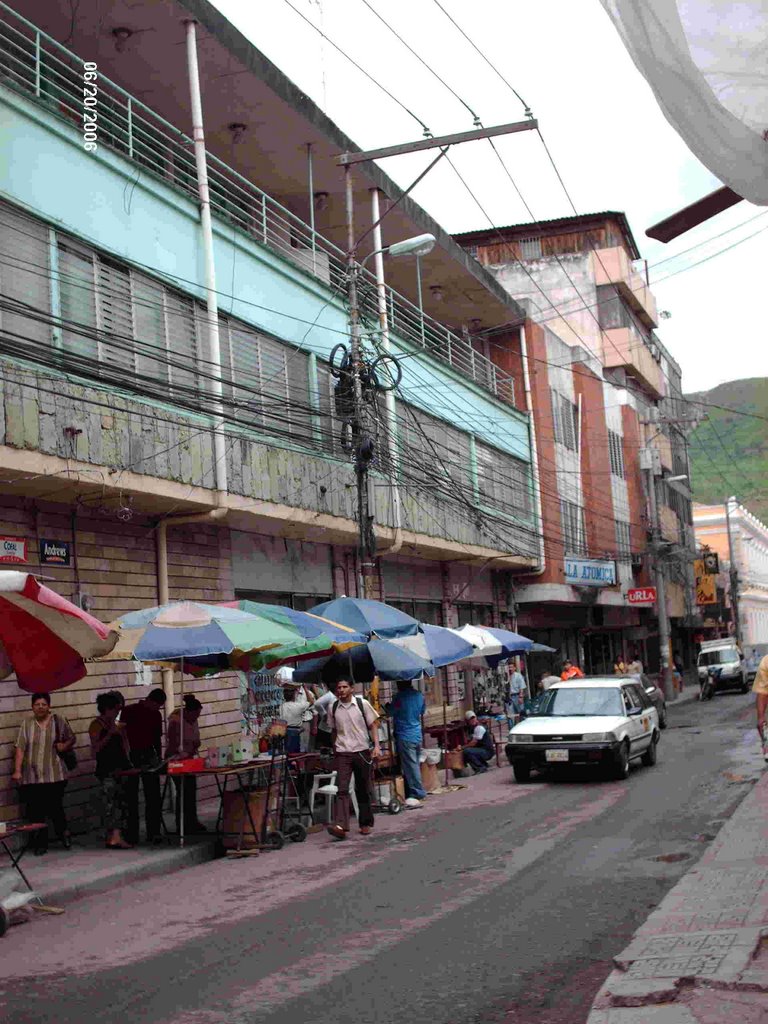
WEDNESDAY, JUNE 21
The capital city of Honduras, Tegucigalpa, faces a decion: will it fall down today or wait a little. Tegucigalpa does NOT sit on a geologicaL fault, nor has it been bombed. The uninformed traveler might believe that it has suffered both disasters continuously over the past hundred years.
I did find the best hotel room of my journey so far for $15 at Hotel Boston. The room is fifteen feet by fifteen, high ceiling with old fashioned ceiling fan, tiled floor, large bathroom with hot water, window and doors onto a balcony. So the street is noisy in the early morning. I got up and enjoyed watching the city wake.
These are understandable directions for the mature traveller (a traveller confused by guidebook code).
Finding the cathedral square is easy. You ask.
Face the cathedral. Turn left and go one block beyond the square. Turn left. You are on Avenida Maximo Jerez. Don´t be fooled by the Avenida. It is a narrow one-way street. Keep going and you come to a tunnel. Go thru the tunnel. The Hotel Boston is on the left on the next block. The owners are shy (I presume) as they have HB on a sign rather than HOTEL BOSTON. The sign is a shield sticking out over the sidewalk.
You will find a good internet connection next door. Turn right off Maximo Jerez at the end of the same block; there is an excellent Chinese restaurant on your left. Upstairs is good for people watching. I ordered a chop suey for $5. The waiter didn´t tell me that dishes on the main menu were for four people. A mountain arrived!
MASSACRE TOURISM
WEDNESDAY, JUNE 21
Three travelers over the past weeks have impressed on me the pleasures of Perquin in northen El Salvador. "Hey, it´s really great. It´s a must. You´ll love it."
Except...
Do I want to visit the sights of massacres?
Do I want to admire the photography?
Am I gripped by smashed US helicopters as sculptural art?
Is slaughter my THING?
Not really.
I´ve seen it up close. I´ve ridden thru country where every village had been bombed, where 70% of the population had fled over the borders to vile camps. I´ve lain behind a rock beneath a pile of Afghans while a Russian gunship popped at us.
I´ve driven thru country suffering total droubt where the nomadic villages were abandoning their old folk and their infants to insure that the breeding stock of the tribe survived.
Worse, I have described the most horrendous massacre that I could imagine (AFTERMATH)only to read in the Peace Commision´s report of a similar massacre taking place in the same place.
So, no, I think I´ll give Perquin a miss.
Paz sounds a better destination - then on to the Honduran capital, Tegucigalpa.
Three travelers over the past weeks have impressed on me the pleasures of Perquin in northen El Salvador. "Hey, it´s really great. It´s a must. You´ll love it."
Except...
Do I want to visit the sights of massacres?
Do I want to admire the photography?
Am I gripped by smashed US helicopters as sculptural art?
Is slaughter my THING?
Not really.
I´ve seen it up close. I´ve ridden thru country where every village had been bombed, where 70% of the population had fled over the borders to vile camps. I´ve lain behind a rock beneath a pile of Afghans while a Russian gunship popped at us.
I´ve driven thru country suffering total droubt where the nomadic villages were abandoning their old folk and their infants to insure that the breeding stock of the tribe survived.
Worse, I have described the most horrendous massacre that I could imagine (AFTERMATH)only to read in the Peace Commision´s report of a similar massacre taking place in the same place.
So, no, I think I´ll give Perquin a miss.
Paz sounds a better destination - then on to the Honduran capital, Tegucigalpa.
Wednesday, June 21, 2006
HEY, I´M SORRY: I HAD A GREAT DAY
TUESDAY, JUNE 20
I read travel/trouble books. Breakdowns, fevers, bandits, ghastly food, horrid people. Good days are boring.
This is a blog for people of my age. Mature citizens, we have had our share of difficulties. Now is the time to have our feet up (metaphorically) and enjoy ourselves. So, yes, I had a great day.
Yesterday I was with people. Let me have my grump: US students. They appear to be unaware of the existence of other people. I was writing up my blog last night; a party charged into the internet cafe conversing at the top of their voices, taking over the place; oblivious of outsiders. They were probably pleasent kids. The Hondurans in the cafe were more judgemental.
A second incident at the ruins: one of the same group was unaware that he had dropped his camera on the grass. A Guatemalan of the missionery party called to him. He turned back, picked up the camera, walked on. The Guatemalan´s spirituality took a knock. She turned to me: "Nice of him to say thank you."
I dined last night with an English teacher working in El Salvador and her father. Toady I was on my own. I rode out of Copan Ruinas early and stopped at Santa Rosa for an excellent breakfast: slices of skirt with eggs, beans and cheese, a huge glass of papaya juice and GOOD coffee:$2.50. For fellow travelers, follow the church square round to the chain where you are forced to drive straight on. The Rincon Tipico is on the left on the next block.
I have been riding thru green ranch land. The poverty is less obvious than in Guatemala, fewer mud hovels. On the main highway I passed notices warning of banditry and that silence was the bandits´ friend. The gas station had guards, one armed with an automatic rifle, a second carrying a .45 revolver, bullets massive in his belt. "Yes," he told me, "there were many robbers."
I reached Gracias at noon and turned off the main highway to Esperanza. The road cut thru mountain country. The tar ended. I hoped this was only for a few Ks. Wrong. It was rough dirt all the way to Esperanza, big pot holes, ravines cut by the rains. Sore bum!
I stopped in Esperanza for the England v Sweden match at an air conditioned Chinese restaurant on the high street. Why do the English relax and become over confident the moment they score? I had to order something. I drank a beer and ate Chinese barbecued beef (delicious - $2.75). Enraged at draw, I rode on into a massive thunder storm. The rain cooled my mood! I sheltered an hour in the inadequate shelter of the pines. Riding on, I dried slowly as the sun broke thru. Glorious mountains cloaked in pine forest.
The dirt road was tricky, not only because of the wet; in places it was solid rock , in others not much better than a river bed. I kept much of the way in second and, even, first gear. Views made up for the discomfort. Few signs of poverty. I learnt later that the river valleys in this area supply much of the country´s vegetables. Houses are square with peaked pantiled roofs. The centre section is open front and back to channel the breeze, sometimes with chairs, more often housing that most important member of a Central American family: THE TWIN CAB PICK-UP.
You see horsemen everywhere and horses grazing small patches of greenery amongst the trees. My brother and my adotive daughter are horse mad and my thoughts were with them most of the day. I have ridden across chunks of Afghamistan both before the Russian occupation and during it - see my web site. In those days I dreamt of riding with my brother north thru the tribal areas of Pakistan. Such a ride was possible. We would have met kindness and hospitality. No longer. That world is closed to us.
At Macal, I booked into the Medina Hotel, good room with shower etc. for $10 - a reduction of $2 when I copmplained that I was a pensionmer! I looked forward to hot water. An electric storm hit and the electricity was off! I was holed up in a pool saloon for an hour. Drunken Honduran pool players were slightly unerving. However I talked with a sheltering school teacher whose niece worked in Spain. She had been to Frankfurt for a week´s holiday. Was that near Barcelona?
"Not very," I said.
Meanwhile thunder smashed down at us and lightning flashed down streets transformed into rivers in spate.
Drunken Hondurans shouted at each other across the pool tables.
Will this do as a proper adventure?
Or is OK to have had a great day?
I read travel/trouble books. Breakdowns, fevers, bandits, ghastly food, horrid people. Good days are boring.
This is a blog for people of my age. Mature citizens, we have had our share of difficulties. Now is the time to have our feet up (metaphorically) and enjoy ourselves. So, yes, I had a great day.
Yesterday I was with people. Let me have my grump: US students. They appear to be unaware of the existence of other people. I was writing up my blog last night; a party charged into the internet cafe conversing at the top of their voices, taking over the place; oblivious of outsiders. They were probably pleasent kids. The Hondurans in the cafe were more judgemental.
A second incident at the ruins: one of the same group was unaware that he had dropped his camera on the grass. A Guatemalan of the missionery party called to him. He turned back, picked up the camera, walked on. The Guatemalan´s spirituality took a knock. She turned to me: "Nice of him to say thank you."
I dined last night with an English teacher working in El Salvador and her father. Toady I was on my own. I rode out of Copan Ruinas early and stopped at Santa Rosa for an excellent breakfast: slices of skirt with eggs, beans and cheese, a huge glass of papaya juice and GOOD coffee:$2.50. For fellow travelers, follow the church square round to the chain where you are forced to drive straight on. The Rincon Tipico is on the left on the next block.
I have been riding thru green ranch land. The poverty is less obvious than in Guatemala, fewer mud hovels. On the main highway I passed notices warning of banditry and that silence was the bandits´ friend. The gas station had guards, one armed with an automatic rifle, a second carrying a .45 revolver, bullets massive in his belt. "Yes," he told me, "there were many robbers."
I reached Gracias at noon and turned off the main highway to Esperanza. The road cut thru mountain country. The tar ended. I hoped this was only for a few Ks. Wrong. It was rough dirt all the way to Esperanza, big pot holes, ravines cut by the rains. Sore bum!
I stopped in Esperanza for the England v Sweden match at an air conditioned Chinese restaurant on the high street. Why do the English relax and become over confident the moment they score? I had to order something. I drank a beer and ate Chinese barbecued beef (delicious - $2.75). Enraged at draw, I rode on into a massive thunder storm. The rain cooled my mood! I sheltered an hour in the inadequate shelter of the pines. Riding on, I dried slowly as the sun broke thru. Glorious mountains cloaked in pine forest.
The dirt road was tricky, not only because of the wet; in places it was solid rock , in others not much better than a river bed. I kept much of the way in second and, even, first gear. Views made up for the discomfort. Few signs of poverty. I learnt later that the river valleys in this area supply much of the country´s vegetables. Houses are square with peaked pantiled roofs. The centre section is open front and back to channel the breeze, sometimes with chairs, more often housing that most important member of a Central American family: THE TWIN CAB PICK-UP.
You see horsemen everywhere and horses grazing small patches of greenery amongst the trees. My brother and my adotive daughter are horse mad and my thoughts were with them most of the day. I have ridden across chunks of Afghamistan both before the Russian occupation and during it - see my web site. In those days I dreamt of riding with my brother north thru the tribal areas of Pakistan. Such a ride was possible. We would have met kindness and hospitality. No longer. That world is closed to us.
At Macal, I booked into the Medina Hotel, good room with shower etc. for $10 - a reduction of $2 when I copmplained that I was a pensionmer! I looked forward to hot water. An electric storm hit and the electricity was off! I was holed up in a pool saloon for an hour. Drunken Honduran pool players were slightly unerving. However I talked with a sheltering school teacher whose niece worked in Spain. She had been to Frankfurt for a week´s holiday. Was that near Barcelona?
"Not very," I said.
Meanwhile thunder smashed down at us and lightning flashed down streets transformed into rivers in spate.
Drunken Hondurans shouted at each other across the pool tables.
Will this do as a proper adventure?
Or is OK to have had a great day?
Monday, June 19, 2006
MY BROTHER, ANTONY

Macala High Street
TUESDAY, JUNE 20
I have one brother, Antony. He is very dear to me. Tomorrow is his seventy-fifth birthday. He doesn't do email. However Bernadette tells me that he has been following my blog on his wife's lap-top. So I use this blog for something truly useful: to affirm my love and to congratulate my brother on such a milestone.
Tomorrow I will be off early. Maybe I will find a TV somewhere along the road on which to watch the England-Sweden match. I could, of course, return to the Honduran customs post...
MAYA RUINS

MONDAY, JUNE 18
I ride my bike the mile to the Maya ruins. Guatemala, cops remain expressionless as they stare at you. Here a cop armed with a rifle waves at me from the roadside. The entrance fee to the ruins and the museum is aproximately US$15. I prefer sightseeing at my own pace and buy a guide book rather than join a guided troop. Big parrots greet me. I take their photograph. They seem pleased, nodding and squarking.
The ruins are great as ruins go. The setting is magnificent this time of year, the surrounding mountains green as are the huge trees and cropped grass between the pyramids and ball courts and acropolys.
I sit in the shade on the lower steps of a pyramid. I face the sloping side wall of a pyramid some thirty meters high. A pale young blond woman slips on the decent behind me and twists her ankle. She is a missionary, wouldn't you know? From Minesota. She and an older male of the species are in company with a Guatemalan doctor, female, and two others who translate for the missionaries the word of God. The doctor requests a bandage to wrap the ankle. God is off-duty. I remove the bandage I wear when biking (it stops the leather gaiter rubbing the burn).
The incident has destroyed my ability to concentrate on or be impressed by the Maya Gods. I think instead of the work in cutting those stones that form the pyramids, the thosands of cut or crushed fingers. I read in my book that Maya kings destroyed much of what their predecesers had built and rebuilt on the same sight - taller, of course, more impressive.
They, the kings, built: it says so in the book. The book lies. The people built. I know the system well from our years in Cuba: The following will volunteer...The army is the same.
I walk a little, sit a little, admire the gray of the stone so well presented against the brilliant green of the rainy season. I talk with an English woman and her father: she is teaching at an English private school in El Salvador. Later I notice what I think are leaf insects beside a path. I look closer and discover a column of ants carrying freshly cut leafs on their backs. Leafs are lighter than stones and easier to carve.
I fall in with a Puertoricano and his girlfriend. She is small and the steps up the pyramids are not only steep but also high. We decide the height of the steps was designed to so exhaust the sacrifical victims that they would find relief in having their hearts gouged out with an obsidian knife.
I listen to a guide joke of the sacrifices as he explains the ball game to a noisy troop of American students.
Odd, my guide book doesn't mention human sacrifice.
A group of Guatemalans gather at the entrance to a tunnel. One asks where I am from. While the others enter the tunnel, he and I talk of Tikal, which he hasn't visited. He and his companions are members of a small manufacuring co-operative in Zacapa. They are being put out of business by Chinese imports. They need to retool but nobody is willing to invest. It is fear of what will happen, of the violence...
We have been joined by the tunnel explorers. Yes, the violence, they agree. The violence in the capital is very bad.
One says that the violence is deliberately fostered by the government to destabalise democracy. The rich want another general.
They move on and I sit a while, flipping back thru my guide book. Why were each of these Maya sights abandoned? I think of the ants - and of bees swarming and moving on. And I think of the work entailed and that perhaps the Kings' demands were too great and they self-glorified their kingdoms out of existence.
Later I visited the sculpture museum. There I joyfully recognised an expression, a smile, a grimace, twisted fingers. As the sons of my Mexican and Central American friends share with my sons a love for the same music, so these few, the great Maya sculpters, shared with all those other great sculpters, modern or ancient, of what ever continent, a human understanding and sympathy with humanity that escaped the rule of priest and king.
COPAN TOWN
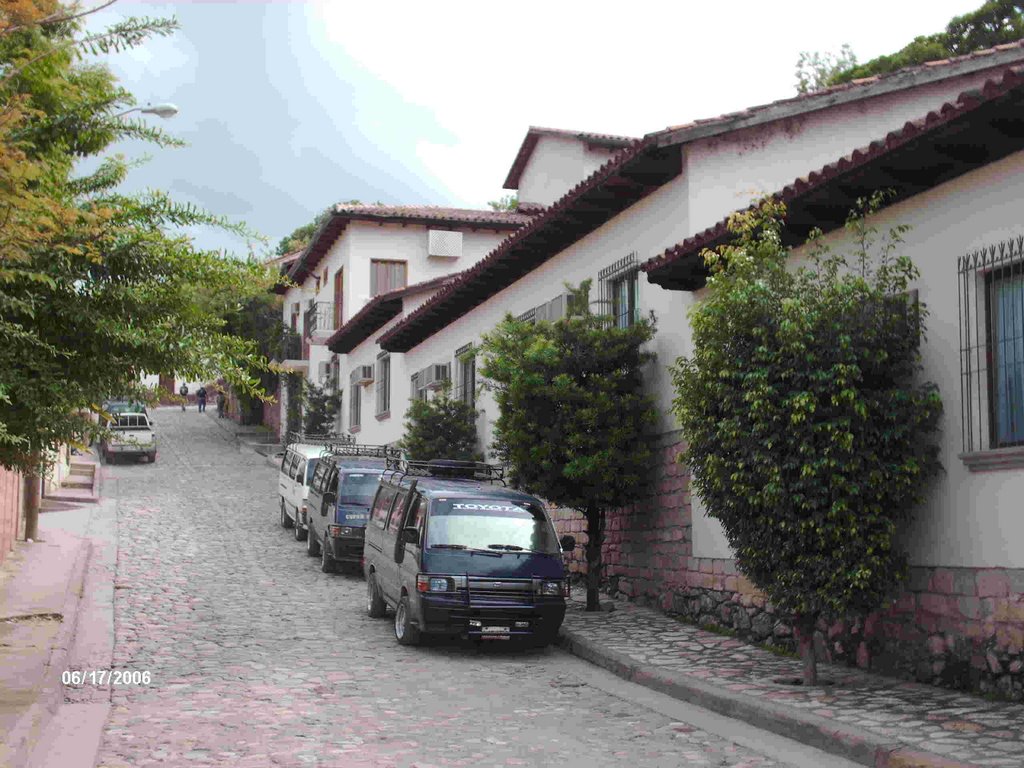
MONDAY, JUNE 19
The Maya ruins have made Copan Ruinas affluent. It is a small, pretty town of perhaps fifty blocks divided by cobbled streets and with low, typically Spanish colonial domestic architecture in good repair and freshly painted. I intend catching up on my blog and am up early, walking down two streets to the restaurant where I ate last night. 7.15 and I order orange juice and coffee with eggs. This is central America: the eggs come with refried beans, fried bananas, avocado. The coffee is good. Have I finally reached coffee heaven? Or is this glory particular to Copan Ruinas? I eat under a hard awning on a terrace that gives onto a jungly garden. Bernadette wouldn't aprove the yellow blossoms. The bill is US$2.60.
Repleat, I wait, sitting on the curb, for the internet cafe to open (8 a.m.). This is a town of hope, wonderful after Guatemala. Householders and shopkeepers are out sweeping the sidewalk and watering the cobbles to lay the dust. Passers-by greet me. A white Hyundai pick-up delivering the big five gallon water bottles is new as is the white Isuzo refuse truck. Even the three-wheeler scooter suicide cabs are polished.
The women of Copan celebrate their wealth. Plump/voluptious is the fashion. They wear their clothes tight - T-shirts stretched at bosom and belly. I greet a woman, mid-twenties, wearing a gold belt wide enough to serve as a cummerbund. A roll of silky brown tum breaks free of a short tight black top and spills over the edge of the belt. She strolls with swagger, proud of her girth. No place here for Cate Moss. The generous townsfolk would think her starving and chase her down the street with tortillas stuffed with cheese and cream and refried beans.
HOLD UP AT HONDURAN CUSTOMS
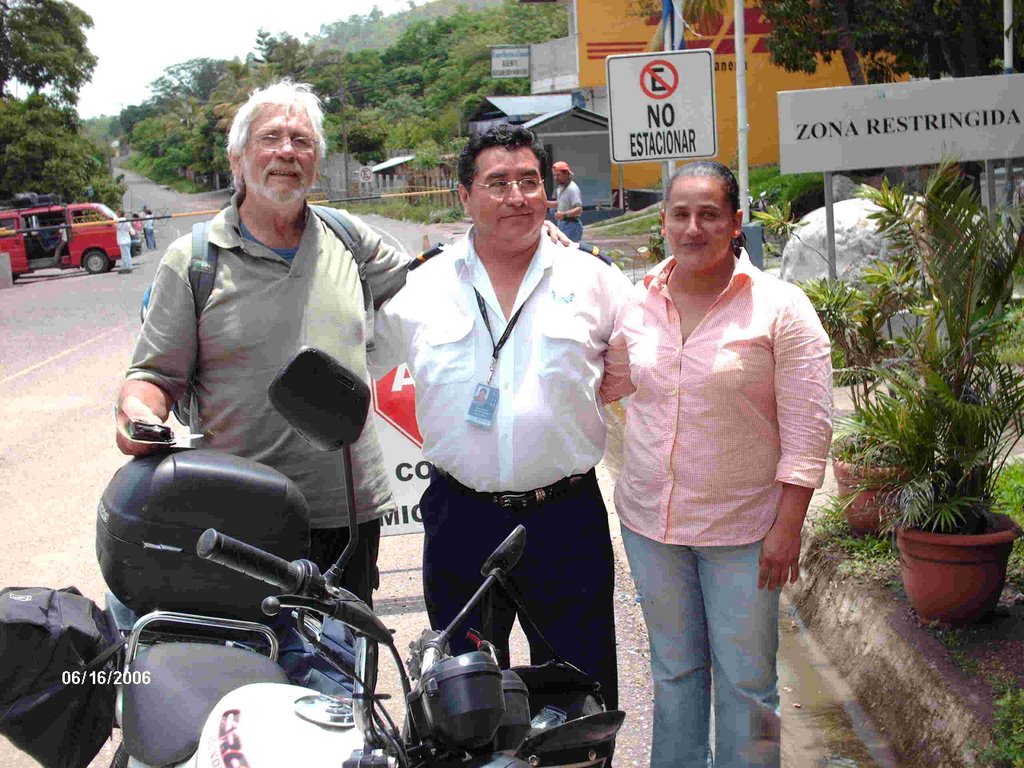
SUNDAY, JUNE 18
I have chosen (lucked into)the right months for travel. The road thru Zacapa to the Honduran frontier runs thru country that Paul Theroux writes of as dusty desert. Now the emerald hillside quivers as the breeze flutters the fresh growth on the trees. The river flows full between irrigated patches of field. The rain storms have torn boulders from the slopes and I ride with extra care on a road that twists thru narrow valleys.
I reach the border. Guatemalan and Honduran Immigration officials share a low, single-story building. They also share a sense of humour of which I, the Honda and my destination are briefly the butt. I negotiate the exchange rate up a few points with a money man in a white Stetson. He then photographs me with the woman Honduran and male Guatemalan Immigration officials.
Honduran Custom officials are more difficult. True, the paper work takes less than ten minutes. However the Customs chief has the world cup on TV in his office: France v Korea. A cold beer, coffee and the match hold me up the best part of an hour.
I ride into Copan Los Ruinas at 4 p.m. A truck pulls up alongside the bike. The driver hands me a card. He owns a hotel: room and bath with hot water for US$10 which is a little less than 200 Limperas (Honduran money). The room is fine. I find a good internet cafe in the care of an Isabelle who plies me with coffee while I work. Dinner is beer and a steak with the normal trimmings: tomatos, fried bananas, black beans, avocado, chili salad - less than four dollars.
TO HONDURAS

SUNDAY, JUNE 18
Breakfast was a real Sunday breakfast: fresh orange juice and fresh fruit for health: bacon, chorizo and French toast with real maple syrup from Canada for cholestrol: great coffee. I load the bike and Ash photographs Marcio and me beside the bike. Marcio has told me of a short cut to the tar road. I ride on good dirt for twenty Ks. I ride slowly and people register what I am. Smiles and Good mornings are almost universal - so different from the Alto Plano of my first two days in Guatemala. The first 50 Ks or so are mostly coffee farms or dairy. Occasionally there is a splash of colour where bourganvilla spills over a fence.
The tar road drops in smooth 70K curves to El Rancho, a distance of 150Ks. I find the road's rythm and am reminded, as I lean into the bends, of skiing Spring snow. This is glorious biking. I sweep thru pine forest and inhale the scent of pine tar. I am dropping from mountain cool into the coastal heat. At El Rancho I gass up beside two massive BMWs and their riders. The BMWs are fitted with all the kit, so are the riders (shades of Dallas, those these two are Guatemaltecos). The fitted luggage costs more than my Honda. We laugh together and shake hands and ride off in different directions - they back to their offices in the capital, me to turn south at Rio Honda...
Sunday, June 18, 2006
LAST NIGHT IN COBAN
SUNDAY, JUNE 18
I doubt that I will revisit Guatemala. Last night a sadness overwhelmed me as I lay in bed. I thought of those I will lose. Eugenio is a brother to me: a younger brother when we first met; now, as I enter my second childhood, an elder brother. Perhaps he will bring Monica and Andresito to visit. And of course there is Santiago, fierce hunter of pigs, and my present hosts, Marcio and Ash - and there is Eric up in Antigua and Lucia.
Waking thru the night, I read Paul Theroux' PATAGONIAN EXPRESS. I have reached page 150, Theroux is in Costa Rica and hasn't yet met anyone he likes. Not has he met anyone to whom he can't condescend. This is a mallady of travel writers. I read a dozen travel books on Latin America before departing on this journey. However charming and amusing and well written the books, in none of them did the writer encounter anyone of greater education or social or financial standing. Apparently it is possible to travel thru Patagonia without being aware of a city of a million inhabitants, of factories and schools and a uiniversity, of office building and apartment blocks equipped with elevators. No wonder those students I talked with back in England pictured Mexicans as sweaty fat men wearing sombreros and speaking with funny accents.
I doubt that I will revisit Guatemala. Last night a sadness overwhelmed me as I lay in bed. I thought of those I will lose. Eugenio is a brother to me: a younger brother when we first met; now, as I enter my second childhood, an elder brother. Perhaps he will bring Monica and Andresito to visit. And of course there is Santiago, fierce hunter of pigs, and my present hosts, Marcio and Ash - and there is Eric up in Antigua and Lucia.
Waking thru the night, I read Paul Theroux' PATAGONIAN EXPRESS. I have reached page 150, Theroux is in Costa Rica and hasn't yet met anyone he likes. Not has he met anyone to whom he can't condescend. This is a mallady of travel writers. I read a dozen travel books on Latin America before departing on this journey. However charming and amusing and well written the books, in none of them did the writer encounter anyone of greater education or social or financial standing. Apparently it is possible to travel thru Patagonia without being aware of a city of a million inhabitants, of factories and schools and a uiniversity, of office building and apartment blocks equipped with elevators. No wonder those students I talked with back in England pictured Mexicans as sweaty fat men wearing sombreros and speaking with funny accents.
FATHERS' DAY
SATURDAY, JUNE 17
Over these past few days I have been cherished by my hosts, Ashley and Marcio: hot baths, breakfast, being driven into town where I spend the day at an internet cafe run by a couple of beautiful sisters. The sisters permitted me to set up my computer at a vacant desk where it has stayed throughout my visit to Coban. They remained patient when I missed the down step into their lavatory, slammed the handbasin off the wall and ended with my head in the lavatory bowl.
More important than the cherishing, has been the conversation. Way back, Marcio's family were Spanish. They have been Guatemalan far far longer than the vast majority of US families have been established in the US. By training, Marcio is plant pathologist and he has a fine collection of orchids out at the farm. However, as with many men brought up in what people call The Third World, he is a man of many accomplishment.
Forced to leave Guatemala during the clandestine war, he earned a good living as a carpenter while attending night classes in business administration. Now he grows macademia trees, several thousand, and he and Ash run a hotel in Coban, Casa d'Acuna.
The hotel is a resurected colonial town house. The resurection has been done with as much attention to detail as has their own home. I made notes on my first visit: china door knobs, spotless bathrooms with real hot water, fresh flowers on the tables, orchids in the patio and syrup feeders for the hummingbirds. The hotel is set up as a partnership with staff and the staff's pride in what they do is obvious.
The rooms are cheap at Q55 a person and travellers find it a good base. I talked with a young German couple journeying thru Central America. Strange that it possible in so short a time to discover a foundation for friendship. What comes next is the hard part: keeping in contact, writing more than a How Are You? I'm fine.
The Germans told Marcio they intended keeping in touch.
Tonight Ash was privileged in inviting to dinner two of the finest beards in Guatemala. Marcio and I sat either side of her, two dads who have done their best - though best never feels near enough.
The food was excellent, however the dinner was a little solemn, a little sad. Travelling is a series of goodbyes and I leave tomorrow...
Over these past few days I have been cherished by my hosts, Ashley and Marcio: hot baths, breakfast, being driven into town where I spend the day at an internet cafe run by a couple of beautiful sisters. The sisters permitted me to set up my computer at a vacant desk where it has stayed throughout my visit to Coban. They remained patient when I missed the down step into their lavatory, slammed the handbasin off the wall and ended with my head in the lavatory bowl.
More important than the cherishing, has been the conversation. Way back, Marcio's family were Spanish. They have been Guatemalan far far longer than the vast majority of US families have been established in the US. By training, Marcio is plant pathologist and he has a fine collection of orchids out at the farm. However, as with many men brought up in what people call The Third World, he is a man of many accomplishment.
Forced to leave Guatemala during the clandestine war, he earned a good living as a carpenter while attending night classes in business administration. Now he grows macademia trees, several thousand, and he and Ash run a hotel in Coban, Casa d'Acuna.
The hotel is a resurected colonial town house. The resurection has been done with as much attention to detail as has their own home. I made notes on my first visit: china door knobs, spotless bathrooms with real hot water, fresh flowers on the tables, orchids in the patio and syrup feeders for the hummingbirds. The hotel is set up as a partnership with staff and the staff's pride in what they do is obvious.
The rooms are cheap at Q55 a person and travellers find it a good base. I talked with a young German couple journeying thru Central America. Strange that it possible in so short a time to discover a foundation for friendship. What comes next is the hard part: keeping in contact, writing more than a How Are You? I'm fine.
The Germans told Marcio they intended keeping in touch.
Tonight Ash was privileged in inviting to dinner two of the finest beards in Guatemala. Marcio and I sat either side of her, two dads who have done their best - though best never feels near enough.
The food was excellent, however the dinner was a little solemn, a little sad. Travelling is a series of goodbyes and I leave tomorrow...
PESKY PRIESTS
FRIDAY, JUNE 16
Guatemala is innundated with missionaries, mostly from the US. My favorite is THE CHURCH OF GOD. Other churches are the church of whom? The Devil? Or, perhaps, the Federal Reserve? We have Baptists and Annabaptists, Evangelicals, Seventh Day Adventists...and then, of course, those pale faced Mormon lads in their tasteless ties.
Today the feast of San Juan was celebrated in the village above which my hosts have their farm. Neither Marcio nor Ashley was sure of which San Juan. Not that it mattered. There was a big parade, men and women dressed in their best - men mostly in white shirts and dark pants, women on their long woven skirts and white blouses. There was a ferris wheel and all sorts of food. We ate at a garden stall in aid of damaged local kids. The food was the traditional feast food of the area, rich turkey broth with a turkey leg or thigh sticking up and a chunk of smoked beef.
The Mormons snuck by.
Mormons are always white and they are always pale. Are they scared of the sun? Or scared of being mistaken for the people they have come to save? And why always two of them? One is more than enough. Are they scared? Or do they need to watch each other so neither sneaks off with the collection box?
I watched as they aproached the elderly lady collecting the dinner money. They sidle. Maybe that comes with unlimited rejections. The lady sent them packing. They snuck back, sneak thiefs on the prowl for a victim. Table to table. None of these people, indiginous or near indiginous, were wealthy. They were bringing their spare cash for their own sick. They didn't need these pink rats nibbling...
However, Guatemalans are polite.
Back home Native Americans, those whose great-grandparents survived slaughter by these Mormons' great-grandaddies, might shoot an arrow up their butts.
And the inner city slums of the US are too dangerous for sweet white kids in ties...
Guatemala is innundated with missionaries, mostly from the US. My favorite is THE CHURCH OF GOD. Other churches are the church of whom? The Devil? Or, perhaps, the Federal Reserve? We have Baptists and Annabaptists, Evangelicals, Seventh Day Adventists...and then, of course, those pale faced Mormon lads in their tasteless ties.
Today the feast of San Juan was celebrated in the village above which my hosts have their farm. Neither Marcio nor Ashley was sure of which San Juan. Not that it mattered. There was a big parade, men and women dressed in their best - men mostly in white shirts and dark pants, women on their long woven skirts and white blouses. There was a ferris wheel and all sorts of food. We ate at a garden stall in aid of damaged local kids. The food was the traditional feast food of the area, rich turkey broth with a turkey leg or thigh sticking up and a chunk of smoked beef.
The Mormons snuck by.
Mormons are always white and they are always pale. Are they scared of the sun? Or scared of being mistaken for the people they have come to save? And why always two of them? One is more than enough. Are they scared? Or do they need to watch each other so neither sneaks off with the collection box?
I watched as they aproached the elderly lady collecting the dinner money. They sidle. Maybe that comes with unlimited rejections. The lady sent them packing. They snuck back, sneak thiefs on the prowl for a victim. Table to table. None of these people, indiginous or near indiginous, were wealthy. They were bringing their spare cash for their own sick. They didn't need these pink rats nibbling...
However, Guatemalans are polite.
Back home Native Americans, those whose great-grandparents survived slaughter by these Mormons' great-grandaddies, might shoot an arrow up their butts.
And the inner city slums of the US are too dangerous for sweet white kids in ties...
Subscribe to:
Posts (Atom)