MONDAY, July 31
The second of the three Americans I talked with over the past few days is a teacher of History at the American School in Honduras. He is from New England (I can't spell Connecticutt). In his early thirties, he is a tall, quiet, thoughtful man. We discussed history and Central America and the war in Iraq. His father, a middle-road Republican, was against the war and believes that the US should withdraw immediately; the teacher votes Democrat and is also against. However, he believes that he would have enjoyed the army, the comradeship and being part of a team. He sent me an e-mail yesterday. I thank him.
I met the third of the American threesome in Portobelo. He has a yacht and was sitting with a Polish electronics engineer and the engineer´s English girlfriend, also with a yacht, at the restaurant where I eat my dinner. The American is a small man, pugnacious and opinionated - not much of a listner. He has read Tad Sculk's biography of Fidel Castro and spent a week in the Havanah marina with his son and his son's friend. The son speaks Spanish. The Yachtie doesn't. Yet he is an expert on Cuba. He suffered a painful (to him) divorce which he blames on the confrontational system of justice the US inherited from we Brits. He blames the same confrontational system for most of the world's woes. He is obsessive on the subject. He harbours a hatred for authority of any kind. He warns me of Colombia, that the Immigration and Customs officers will let me thru only for the cops to shake me down. I was around yachts in my early thirties, skippering in the Mediteranean. This American reminds me of the worst aspect of that life, the presumption amongst other yachtsman that we shared opinions and had common interests. This American reminded me of too many evenings trapped and bored and wanting to scream and I have sympathy for the engineer, an intelligent man, and for his bright, funny, English girlfriend. The freedom of the seas isn't that free once you enter port.
Monday, July 31, 2006


Saturday, July 29, 2006
COONA CATASTROPHY
SATURDAY, JULY 29
I rode to the 5th Street wharf at noon. The boat for Cartagena is in. I spoke with the skipper. He will take me. The bike is a problem. Why? I don't know. The skipper will tell me midday on Monday whether he can take us both. He will give me the fare midday on Monday. I shall spend the weekend chewing my nails. As insurance, I rode out to the Shelter Bay marina. The road crosses the canal. The bridge is a steel grid on top of the lock gates. Water boils out of the sluices on one side while the bows of a massive ship tower above you on the other. Beyond the canal, the road leads to the marina thru the rich forest of a national park. I spoke with the directer, a grey-haired, grey-bearded big-belly American eating lunch in the club house with his decorative female Panamanian assistant (probably thirty years his junior). The assistant showed interest in my journey. The director sent me outside to talk with the janitor, a Coona Indian. The Coona was fishing off a dock with a weighted line and crab for bait. He pulled in a couple of fish while lecturing me on what is good food and what is bad food. Bad food is what everyone eats at Chinese restaurants, so he tells me. The Chinese cook rats and cats and dogs - again, I quote. The bits of meat in fried rice is rat.
The Coona is 59 years-old. He was out of work a year. He visited all the factories in the Free Zone. He was told either that he was too old or that they would be in touch. They never were in touch. He has four children and three grandchildren to feed. He went hungry often. His mother-in-law does sewing and embroidery work to sell to tourists. The mother-in-law was hard on him, nagging and demanding why he didn´t work and why he was reading all the time. The Coona was reading the Bible. He reads the Bible every day. God answered his prayers with the janitor's job. Solving difficulties is all a matter of praying and waiting. God will answers prayers in his own good time.
The Coona was close to tears while relating his trials. Though a sweet man, he was of little help to a aged Englishman with a bike in need of a boat. The marina director and his assistant were in the store. The assistant asked how I had progressed with the Coona. I told her of his mother-in-law and she got the giggles. The director seemed irritated so I left.
I rode to the 5th Street wharf at noon. The boat for Cartagena is in. I spoke with the skipper. He will take me. The bike is a problem. Why? I don't know. The skipper will tell me midday on Monday whether he can take us both. He will give me the fare midday on Monday. I shall spend the weekend chewing my nails. As insurance, I rode out to the Shelter Bay marina. The road crosses the canal. The bridge is a steel grid on top of the lock gates. Water boils out of the sluices on one side while the bows of a massive ship tower above you on the other. Beyond the canal, the road leads to the marina thru the rich forest of a national park. I spoke with the directer, a grey-haired, grey-bearded big-belly American eating lunch in the club house with his decorative female Panamanian assistant (probably thirty years his junior). The assistant showed interest in my journey. The director sent me outside to talk with the janitor, a Coona Indian. The Coona was fishing off a dock with a weighted line and crab for bait. He pulled in a couple of fish while lecturing me on what is good food and what is bad food. Bad food is what everyone eats at Chinese restaurants, so he tells me. The Chinese cook rats and cats and dogs - again, I quote. The bits of meat in fried rice is rat.
The Coona is 59 years-old. He was out of work a year. He visited all the factories in the Free Zone. He was told either that he was too old or that they would be in touch. They never were in touch. He has four children and three grandchildren to feed. He went hungry often. His mother-in-law does sewing and embroidery work to sell to tourists. The mother-in-law was hard on him, nagging and demanding why he didn´t work and why he was reading all the time. The Coona was reading the Bible. He reads the Bible every day. God answered his prayers with the janitor's job. Solving difficulties is all a matter of praying and waiting. God will answers prayers in his own good time.
The Coona was close to tears while relating his trials. Though a sweet man, he was of little help to a aged Englishman with a bike in need of a boat. The marina director and his assistant were in the store. The assistant asked how I had progressed with the Coona. I told her of his mother-in-law and she got the giggles. The director seemed irritated so I left.
MOTORBIKE MANIAC
SATURDAY, JULY 29
I bought a pocket knife today at a big hardware store. The cop guarding the hardware store was an off duty cop. A sergeant, no less, and a fanatic biker. What sex (the cop not the bikes)? Female, mother of four, and a widow. Her left leg turns thru 200 degrees - that was the Harley wreck. The weird elbow was a BMW. A Yamaha 750 did for her right knee. She was impressed by my leather leg gauntlet. Her own right leg has burn scars up to mid-thigh. She was in uniform biker´s britches so couldn't show me. She earns $600 a month, has two kids at school, two in further education and supports her mum. Do the sums and you understand the need for extra income. I fetched the bike and we talked for half an hour out on the sidewalk. A lovely woman...
I bought a pocket knife today at a big hardware store. The cop guarding the hardware store was an off duty cop. A sergeant, no less, and a fanatic biker. What sex (the cop not the bikes)? Female, mother of four, and a widow. Her left leg turns thru 200 degrees - that was the Harley wreck. The weird elbow was a BMW. A Yamaha 750 did for her right knee. She was impressed by my leather leg gauntlet. Her own right leg has burn scars up to mid-thigh. She was in uniform biker´s britches so couldn't show me. She earns $600 a month, has two kids at school, two in further education and supports her mum. Do the sums and you understand the need for extra income. I fetched the bike and we talked for half an hour out on the sidewalk. A lovely woman...
Friday, July 28, 2006
PINK ROSES FOR BREAKFAST
THURSDAY, JULY 27
The relationship between men and women in Portobelo confuses me. The sexes seem separate species and communication between the sexes is clearly difficult. Mostly it comnsists of women shouting at men. What ever the message, it seldom gets thru. I remark on this to the cook. She replies that the men here are cold. She asks where we live and in what type of house. I describe the house and the garden and tell the cook that Bernadette told me today on the telephone that she had saved a failing rose bush. For medicine she had used horse manure from the dungheap behind my brother's stables.
The cook says that no man has ever given her a rose.
Riding back from Colon, I stop at the big supermarket. I buy fruit salad and a packet of cured pork loin for my dinner and a bunch of pink roses for the cook. The cook says that I am a good man and gives me a hug and a kiss. My temporary granddaughter giggles. I drink coffee and watch the traffic pass thru town. Public transport is used school busses imported from the US. The busses have names: Doña Lola, Conquistador, Niña Jenny. The sides are striped and often bare cartoon characters. The back is the real canvas. Some subjects are religious: The Resurection, the Angel Gabriel. Others bare pictures of the jungle, rivers, a puma. I spotted a Swiss mountain scene on one while, in others, scenes are drawn from fantasy movies. Cherished busses have their exhausts extended with chrome pipes risng vertically up the back and all of them have messages painted across their windscreen. In God We Trust is a favorit. Bikers are vulnerable. I would prefer the driver to trust less in God and have better visibility thru undecorated glass.
The relationship between men and women in Portobelo confuses me. The sexes seem separate species and communication between the sexes is clearly difficult. Mostly it comnsists of women shouting at men. What ever the message, it seldom gets thru. I remark on this to the cook. She replies that the men here are cold. She asks where we live and in what type of house. I describe the house and the garden and tell the cook that Bernadette told me today on the telephone that she had saved a failing rose bush. For medicine she had used horse manure from the dungheap behind my brother's stables.
The cook says that no man has ever given her a rose.
Riding back from Colon, I stop at the big supermarket. I buy fruit salad and a packet of cured pork loin for my dinner and a bunch of pink roses for the cook. The cook says that I am a good man and gives me a hug and a kiss. My temporary granddaughter giggles. I drink coffee and watch the traffic pass thru town. Public transport is used school busses imported from the US. The busses have names: Doña Lola, Conquistador, Niña Jenny. The sides are striped and often bare cartoon characters. The back is the real canvas. Some subjects are religious: The Resurection, the Angel Gabriel. Others bare pictures of the jungle, rivers, a puma. I spotted a Swiss mountain scene on one while, in others, scenes are drawn from fantasy movies. Cherished busses have their exhausts extended with chrome pipes risng vertically up the back and all of them have messages painted across their windscreen. In God We Trust is a favorit. Bikers are vulnerable. I would prefer the driver to trust less in God and have better visibility thru undecorated glass.
COLON FOR ADRENALYN FREAKS
THURSDAY, JULY 27
Workmen have closed 5th Street midway between Central Avenue and the wharf. I backtrack down Central Avenue. How can I tell which street is safe? I take a right, ride to the end, take a second right and am at the gates to the wharf. The boat for Cartagena has not arrived. It should be in tomorrow. My informant is the skipper of a boat heading thru the San Blas Islands to Cartagena. I am tempted. However the voyage will take three weeks. Waiting in Panama has already put me behind schedule. I don't have three weeks. The guard at the gate warns me to take a left outside the gates and a second left to return to Central Avenue. Turning right would take me into dangerous territory. Right is the way I came. Ouch...
Workmen have closed 5th Street midway between Central Avenue and the wharf. I backtrack down Central Avenue. How can I tell which street is safe? I take a right, ride to the end, take a second right and am at the gates to the wharf. The boat for Cartagena has not arrived. It should be in tomorrow. My informant is the skipper of a boat heading thru the San Blas Islands to Cartagena. I am tempted. However the voyage will take three weeks. Waiting in Panama has already put me behind schedule. I don't have three weeks. The guard at the gate warns me to take a left outside the gates and a second left to return to Central Avenue. Turning right would take me into dangerous territory. Right is the way I came. Ouch...
PORTOBELO MORNING
THURSDAY, JULY 27
Portobelo awakes to a second day of incessant rain. The Spanish treasure fleet gathered anually in Portobelo Bay. Now the few yachts anchored off shore look misreable and unromantic. I sprint across the road to breakfast. The Spanish bridge is diagonally across the street. The bridge once carried the treasure of the Americas to the Customs house in Potobelo - the town was sacked repeatedly by the Brits. Drake was first - he died here and is buried offshore. The list contains all the great names of pillage: Parker, Morgan, Vernon, Kinghills - all put Potobelo to the torch. Presumably they attacked in the dry season. Today you would require a ton of gas.
Portobelo has been declared a World Heritage Site. The Spanish bridge is being recobbled. This cobbling is the only work in town. Six men are unoccupied with the cobbling. They have rigged awnings against sun and rain and sit on the balustrade and chat amongst themselves.
A black woman wearing a pinstripe business suit sips black coffee at the next table. I watch her watching a couple of black men the far end. The men's speech is loud and comes in brief rapid bursts. They are wired. The one man is unable to keep still. His movements are as jerky as his speech. The cook has brought his breakfast. He forks a mouthful of sausage, only to be distracted. Up he jumps and crosses the street to the Chinese supermarket for a quick talk with a man in a pale grey hoody. He returns and actually eats the first forkful of sausage. Then he is back to the Chinese, then down the street. He returns with a carboard container of orange juice. He picks at his food a moment then is off to speak with the six men sitting under awnings at the Spanish bridge. I continue watching the pinstripe woman. Read her face, and you know that she is thinking: "Lord, am I really part of this?"
She finishes her coffee, checks that all four door of her dark grey Nissan car are securely locked and boards a white Health Department 4X4. Four vultures sit on the roof of the Chinese supermarket. I eat my eggs.
Portobelo awakes to a second day of incessant rain. The Spanish treasure fleet gathered anually in Portobelo Bay. Now the few yachts anchored off shore look misreable and unromantic. I sprint across the road to breakfast. The Spanish bridge is diagonally across the street. The bridge once carried the treasure of the Americas to the Customs house in Potobelo - the town was sacked repeatedly by the Brits. Drake was first - he died here and is buried offshore. The list contains all the great names of pillage: Parker, Morgan, Vernon, Kinghills - all put Potobelo to the torch. Presumably they attacked in the dry season. Today you would require a ton of gas.
Portobelo has been declared a World Heritage Site. The Spanish bridge is being recobbled. This cobbling is the only work in town. Six men are unoccupied with the cobbling. They have rigged awnings against sun and rain and sit on the balustrade and chat amongst themselves.
A black woman wearing a pinstripe business suit sips black coffee at the next table. I watch her watching a couple of black men the far end. The men's speech is loud and comes in brief rapid bursts. They are wired. The one man is unable to keep still. His movements are as jerky as his speech. The cook has brought his breakfast. He forks a mouthful of sausage, only to be distracted. Up he jumps and crosses the street to the Chinese supermarket for a quick talk with a man in a pale grey hoody. He returns and actually eats the first forkful of sausage. Then he is back to the Chinese, then down the street. He returns with a carboard container of orange juice. He picks at his food a moment then is off to speak with the six men sitting under awnings at the Spanish bridge. I continue watching the pinstripe woman. Read her face, and you know that she is thinking: "Lord, am I really part of this?"
She finishes her coffee, checks that all four door of her dark grey Nissan car are securely locked and boards a white Health Department 4X4. Four vultures sit on the roof of the Chinese supermarket. I eat my eggs.
Wednesday, July 26, 2006
GRAN'PAPPY
TUESDAY, JULY 25
I am stuck in Portobelo. I have a room with a bathroom ($10). The bed has two foam mattresses and tissue-thin nylon fitted sheets that slip off the mattress corners if I sneeze. The bathroom is cold water which is fine after the first strike. I could do with a shelf above the sink. Instead, I balance the tubes and cups and soaps of old age along the back of the sink from where they fall whenever I move. I breakfast on scrambled eggs and great coffee at a thatch-roof restaurant across the road ($2.50). A bright, pretty girl of, I would guess, seven, has adopted me as an auxiliary grandfather. She is very dark with naturally straight hair and an unnaturally wicked smile. I believe that she is the cook's daughter. I could be wrong - Caribbean relationships are complicated. She has shown me how to use the washing machines at the launderette and walked me to the health clinic to have a stitch removed from my finger - a stitch the nurse in Boca had overlooked. A black man I believe to be her true grandfather has a habit of talking politics and social issues with me while I drink my second cup of coffee of a morning. He tells me there is no work to be had in Portobelo. He tells me that none of the black people own farms. The Latinos own all the land. They bought the land from the black people for next to nothing. He tells me that modern youth is utterly corrupted. Thirty years ago you could walk thru Colon counting hundred dollar bills and be as safe as in a bank safe. Now kids kill you for a five dollar watch.
I am stuck in Portobelo. I have a room with a bathroom ($10). The bed has two foam mattresses and tissue-thin nylon fitted sheets that slip off the mattress corners if I sneeze. The bathroom is cold water which is fine after the first strike. I could do with a shelf above the sink. Instead, I balance the tubes and cups and soaps of old age along the back of the sink from where they fall whenever I move. I breakfast on scrambled eggs and great coffee at a thatch-roof restaurant across the road ($2.50). A bright, pretty girl of, I would guess, seven, has adopted me as an auxiliary grandfather. She is very dark with naturally straight hair and an unnaturally wicked smile. I believe that she is the cook's daughter. I could be wrong - Caribbean relationships are complicated. She has shown me how to use the washing machines at the launderette and walked me to the health clinic to have a stitch removed from my finger - a stitch the nurse in Boca had overlooked. A black man I believe to be her true grandfather has a habit of talking politics and social issues with me while I drink my second cup of coffee of a morning. He tells me there is no work to be had in Portobelo. He tells me that none of the black people own farms. The Latinos own all the land. They bought the land from the black people for next to nothing. He tells me that modern youth is utterly corrupted. Thirty years ago you could walk thru Colon counting hundred dollar bills and be as safe as in a bank safe. Now kids kill you for a five dollar watch.
5TH STREET
MONDAY, JULY 24
A dual carriage avenue divides Colon. Trees shade the avenue. If it were safe, it would be a pleasant place for a stroll and a little window shopping. I stop on the avenue to ask a woman directing traffic for directions to 5th Street. She advises me to enquire of a proper cop. I follow her directions to a cop shop and find myself at the entrance to a slum street of crumbling tenements. This is a street that I wouldn't enter in an army tank. I do a quick U back to the avenue. A fellow biker, a clerk type with a briefcase, pulls alongside. I ask for directions. He tells me to follow. We cross the avenue and he halts at a couple of cops (checking out the war zone?). The cops signal us on and we make it to the 5th Street dock. Guards direct me to the captain of a small trading vessel. The captain tells me of a vessel due on Thursday and expected to sail Saturday for Cartagena. Enough for one day. I need out of Colon and I need a cold beer...
A dual carriage avenue divides Colon. Trees shade the avenue. If it were safe, it would be a pleasant place for a stroll and a little window shopping. I stop on the avenue to ask a woman directing traffic for directions to 5th Street. She advises me to enquire of a proper cop. I follow her directions to a cop shop and find myself at the entrance to a slum street of crumbling tenements. This is a street that I wouldn't enter in an army tank. I do a quick U back to the avenue. A fellow biker, a clerk type with a briefcase, pulls alongside. I ask for directions. He tells me to follow. We cross the avenue and he halts at a couple of cops (checking out the war zone?). The cops signal us on and we make it to the 5th Street dock. Guards direct me to the captain of a small trading vessel. The captain tells me of a vessel due on Thursday and expected to sail Saturday for Cartagena. Enough for one day. I need out of Colon and I need a cold beer...
COCO SOLO
MONDAY, JULY 24
The cops tell me to check out the Coco Solo wharf in Colon for a trading vessel sailing for Cartagena. Coco Solo lies to the east of the highway. I don't have to ride into the city. A Latino meztizo at a bus stop gives me directions. I ask if it is safe.
"Be careful," is his answer.
Great.
I ride a K and enquire again of a guard at the entrance to the container wharf.
"Keep going," he tells me, "And be careful."
I pass the flooded entrance to a row of tenements ready to be cast in a horror movie. Beyond the tenements lies an opencast litter mine. Rain falls. The road narrows between walls of cane invading the verge. I ask directions of a black woman walking with a cute daughter beneath a pink umbrella. The woman tells me I should have taken the flooded entrance. I turn back. I want to keep going right on back to the highway.
I have already chickened out of sailing to Jaque.
I take the turn at the tenement buildings and ride gingerly thru the flood. The docks and ships lie ahead behind a twelve foot security fence. The road is flooded to the fence. Half a dozen men in semi-rags are picking thru the litter dumped to the right of the flooded road. I imagine myself thru their eyes: a fat juicy pigeon. Hitting a pothole hidden beneath the flood water will put me in serious trouble. A medium dark middle-aged man in cap and dungarees picks his way along the edge of the road from the dock. He tells me that there are no boats in for Cartagena. I should try the wharf on 5th Street, Colon.
I ask whether 5th Street is dangerous.
"Dangerous, Yes. But not as dangerous as where you are now..."
I turn the bike very very ccarefully and ride back thru the flood and out of Coco Solo. I have no deep desire to return. Odd...
The cops tell me to check out the Coco Solo wharf in Colon for a trading vessel sailing for Cartagena. Coco Solo lies to the east of the highway. I don't have to ride into the city. A Latino meztizo at a bus stop gives me directions. I ask if it is safe.
"Be careful," is his answer.
Great.
I ride a K and enquire again of a guard at the entrance to the container wharf.
"Keep going," he tells me, "And be careful."
I pass the flooded entrance to a row of tenements ready to be cast in a horror movie. Beyond the tenements lies an opencast litter mine. Rain falls. The road narrows between walls of cane invading the verge. I ask directions of a black woman walking with a cute daughter beneath a pink umbrella. The woman tells me I should have taken the flooded entrance. I turn back. I want to keep going right on back to the highway.
I have already chickened out of sailing to Jaque.
I take the turn at the tenement buildings and ride gingerly thru the flood. The docks and ships lie ahead behind a twelve foot security fence. The road is flooded to the fence. Half a dozen men in semi-rags are picking thru the litter dumped to the right of the flooded road. I imagine myself thru their eyes: a fat juicy pigeon. Hitting a pothole hidden beneath the flood water will put me in serious trouble. A medium dark middle-aged man in cap and dungarees picks his way along the edge of the road from the dock. He tells me that there are no boats in for Cartagena. I should try the wharf on 5th Street, Colon.
I ask whether 5th Street is dangerous.
"Dangerous, Yes. But not as dangerous as where you are now..."
I turn the bike very very ccarefully and ride back thru the flood and out of Coco Solo. I have no deep desire to return. Odd...
TRASH AND ATTITUDE
MONDAY, JULY 24
Dawn and Portobelo lies under a tablecloth of charcoal cloud. The cloth has a paler fringe at the horizon. The one window in my room at the Hospedaje d'Aduana overlooks the bay. The rain falls steadily. The yachts lying to anchor are almost hidden. Closer to shore a line of pelicans rise to a barely noticeable swell.
This coast maybe a holiday paradise for the wealthy young of Panama City. Perhaps they don't notice the trash, the trash and the attitude. The attitude is unavoidable. This is the first area in 6500 Ks of journey in which people have tried to scare me as I ride by, shouting suddenly or pretending to throw a stone. Not often, but it happens. Kids, mostly, teenagers...
Dawn and Portobelo lies under a tablecloth of charcoal cloud. The cloth has a paler fringe at the horizon. The one window in my room at the Hospedaje d'Aduana overlooks the bay. The rain falls steadily. The yachts lying to anchor are almost hidden. Closer to shore a line of pelicans rise to a barely noticeable swell.
This coast maybe a holiday paradise for the wealthy young of Panama City. Perhaps they don't notice the trash, the trash and the attitude. The attitude is unavoidable. This is the first area in 6500 Ks of journey in which people have tried to scare me as I ride by, shouting suddenly or pretending to throw a stone. Not often, but it happens. Kids, mostly, teenagers...
OUT OF JAIL
SUNDAY, JULY 23
I ride 35 Ks from Portobelo to Sabanitas, junction of the coast road and Panama City-Colon highway. I work at an internet outlet for a couple of hours. Then, for the hell of it, cross the highway to the town's only bank. I stick the plastic in the slot, ask for $200. The ATM machine spits out the cash. Too late to catch the Germans headed for Cartagena...
I ride 35 Ks from Portobelo to Sabanitas, junction of the coast road and Panama City-Colon highway. I work at an internet outlet for a couple of hours. Then, for the hell of it, cross the highway to the town's only bank. I stick the plastic in the slot, ask for $200. The ATM machine spits out the cash. Too late to catch the Germans headed for Cartagena...
PORTOBELO
SUNDAY, JULY 23
I need a base. I have found a room in Portobelo, base for the anual Spanish treaure fleets for 150 years. In truth, the town is no more than a village. It guards a lovely bay. It has three small ruined Spanish forts, a Spanish customs house which now houses a museum, a small walled Spanish cemetery. Three churhes, one of which displays a famous statue of the Black Jesus. Columbus came in 1502. The road to the Pacific, the Camino Real, started here. What more could a tourist town desire?
Portobelo should be beautiful. It should have charm. It has litter. It is strewn with the detritus of the fast food era. It is a polystyrene Paradise, a visual symphony to cellophane, a sepulcher for discarded Styrofoam cups.
The restaurants serve genuine Caribbean food, fried, fried, fried...
Drakes is the gringo yachtie haven. The owners are a Canadian and his Fijian-born wife. I pray and check for yachts headed for Cartagena.
I need a base. I have found a room in Portobelo, base for the anual Spanish treaure fleets for 150 years. In truth, the town is no more than a village. It guards a lovely bay. It has three small ruined Spanish forts, a Spanish customs house which now houses a museum, a small walled Spanish cemetery. Three churhes, one of which displays a famous statue of the Black Jesus. Columbus came in 1502. The road to the Pacific, the Camino Real, started here. What more could a tourist town desire?
Portobelo should be beautiful. It should have charm. It has litter. It is strewn with the detritus of the fast food era. It is a polystyrene Paradise, a visual symphony to cellophane, a sepulcher for discarded Styrofoam cups.
The restaurants serve genuine Caribbean food, fried, fried, fried...
Drakes is the gringo yachtie haven. The owners are a Canadian and his Fijian-born wife. I pray and check for yachts headed for Cartagena.
MIRIMAR
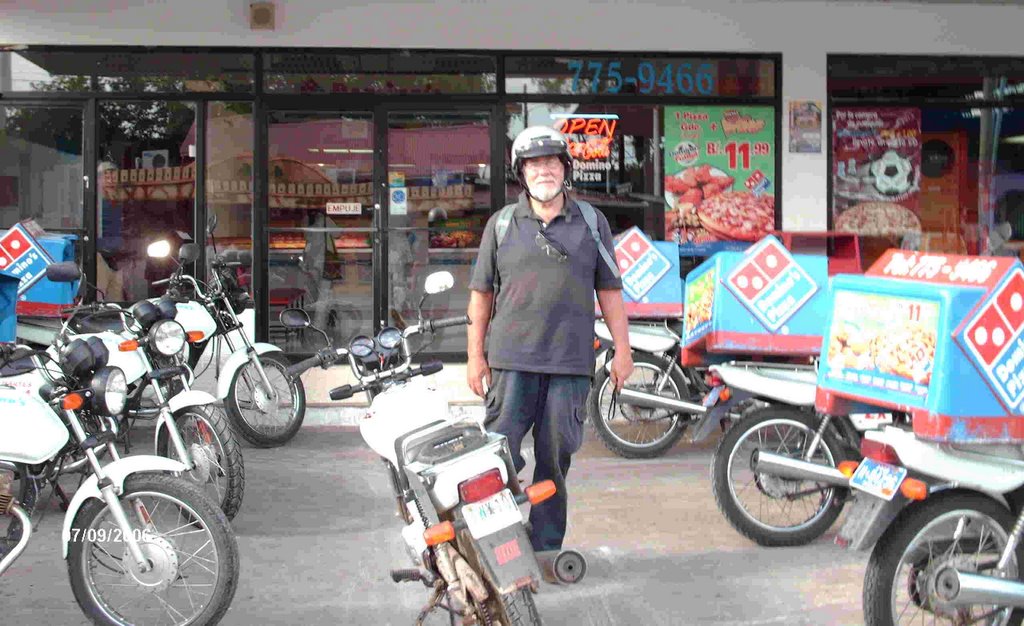
Honda introduces me to brothers and sisters at a Domino pizza parlor
SATURDAY, JULY 22
No Germans are in Mirimar. How do I know? Mirimar is too small to hide a chicken. The dirt street is wet, the trees drip. Small thatched and tin-roof houses sit miserably amongst the puddles. A Yamaha low rider loaded with packs is parked outside a shack. The Japanese biker and his girlfriend are eating fried fish on the small terrace. He has hair down to his shoulders, string and leather bracelets, a few amulets round his neck. She has studs in her tongue. They both speak some English. She has been living in Mexico and speaks better Spanish. I relate my plastic jailer. We share biker experiences. They are impressed by my tales of 400 Ks. They find 300 Ks a full day's ride. Further and their hips hurt. I guess the pain is caused by the angle at which they sit on the low rider. It looks cooler than my Honda pizza-delivery bike. However I sit upright on the Honda. All I suffer is a numb butt.
We walk to the dock. A big dugout canoe lies alongside. I would guess it is thirty feet in length. It is narrow of beam and powered by an outboard. The bulwarks have been heightened with planks and it carries a cargo that is mostly Coca Cola. The captain, a Coona, has his crew shift the Coca Cola aft to make room for the Yamaha. The canoe is five feet below the dock. They tie a strip of canvas to the bike and lower away. I would be scared for the bike. So are the Japanese. Up there in the bows, the bike is going to get wet in anything other than a glass-flat sea. Islands of mangrove protect the shore and we can't see the height of the waves. We say our goodbyes and our good-lucks. I watch the canoe slide out from the dock and head out between the mangrove. Maybe the Plastic jailer did me a favor. I return to the terrace where we met and eat fried snapper.
PLASTIC JAILER
SATURDAY, JULY 22
We depend on plastic. Even more so, when traveling. I am stuck. I am in jail. Plastic is my jailer. Will plastic release me on Monday? Meanwhile what to do? Maybe the Germans from Stahlratte will be at Mirimar. I can explain my predicament.
Mirimar is 85 Ks east along the coast from the Panama-Colon highway. A weekend and this a weekender coast. Schools are out on summer vacation and the wealthy are down from Panama City. Flash family 4X4s come loaded with surfboards and ice chests.
The road is good for the first 35 Ks to Portobelo. Beyond Portobelo I weave between potholes. The road is hard dirt for the final stretch. I walk the bike across one of those plank on plank bridges. To me this is a different country. It is not Latin America. It is Caribbean. The sea is ever present, palm trees, almonds, sea grape trees. Most faces are black. Men favor sleaveless undershirts. Small girls wear their hair braided. Big girls and women have the curls ironed out. Each village carries the scent of fried fish and the music volume is on high.
We depend on plastic. Even more so, when traveling. I am stuck. I am in jail. Plastic is my jailer. Will plastic release me on Monday? Meanwhile what to do? Maybe the Germans from Stahlratte will be at Mirimar. I can explain my predicament.
Mirimar is 85 Ks east along the coast from the Panama-Colon highway. A weekend and this a weekender coast. Schools are out on summer vacation and the wealthy are down from Panama City. Flash family 4X4s come loaded with surfboards and ice chests.
The road is good for the first 35 Ks to Portobelo. Beyond Portobelo I weave between potholes. The road is hard dirt for the final stretch. I walk the bike across one of those plank on plank bridges. To me this is a different country. It is not Latin America. It is Caribbean. The sea is ever present, palm trees, almonds, sea grape trees. Most faces are black. Men favor sleaveless undershirts. Small girls wear their hair braided. Big girls and women have the curls ironed out. Each village carries the scent of fried fish and the music volume is on high.
COLON IS DANGEROUS
SATURDAY, JULY 22
Guide books claim that Panama City is dangerous. I have ridden thru the city over the past week. A barrio has a look of danger, I find a different route. I have been careful and have never felt threatened and have been assisted with courtesy asking for directions. I have had a great time.
Colon is different.
Colon is dangerous.
Development has passed it by.
No skyscrapers, no flash banks.
Not even a decent downtown hotel. No sensible visitor would want to stay downtown.
I stop by a couple of cops patrolling the sidewalk on the central avenue. They direct me to a bank and call a motorbike team to escort me. The two cops on the trail bike wear dark-glass space helmets and flak jackets over combat camouflage. They are armed with machine pistols and automatics and clubs. I follow them to the bank. The bank has three guards. It is a small bank by Panama standards.
I carry a Debit card in preference to a Credit card. Debit cards are of little use to a thief. Debit cards are of little use to the Colon bank. A kind teller presumes I have misused the ATM machine. She tries the card and gets the same message: call my bank. Saturday afternoon in England and my bank is closed for the weekend.
Guide books claim that Panama City is dangerous. I have ridden thru the city over the past week. A barrio has a look of danger, I find a different route. I have been careful and have never felt threatened and have been assisted with courtesy asking for directions. I have had a great time.
Colon is different.
Colon is dangerous.
Development has passed it by.
No skyscrapers, no flash banks.
Not even a decent downtown hotel. No sensible visitor would want to stay downtown.
I stop by a couple of cops patrolling the sidewalk on the central avenue. They direct me to a bank and call a motorbike team to escort me. The two cops on the trail bike wear dark-glass space helmets and flak jackets over combat camouflage. They are armed with machine pistols and automatics and clubs. I follow them to the bank. The bank has three guards. It is a small bank by Panama standards.
I carry a Debit card in preference to a Credit card. Debit cards are of little use to a thief. Debit cards are of little use to the Colon bank. A kind teller presumes I have misused the ATM machine. She tries the card and gets the same message: call my bank. Saturday afternoon in England and my bank is closed for the weekend.
PLASTIC
FRIDAY, JULY 21
Stick plastic in an ATM machine and you get money. Or you get a message. I get a message to call my bank. I try two more banks and the ATM in a casino before calling the UK. A woman, young judging by her voice, answers. I tell her my card is blocked.
She consults whatever requires consulting and says, "No, it isn't."
"It is," I say. "I've tried it on three machines in three separate banks and at a casino."
"Well, it's not blocked," she says.
"Why can't I get any money?" I ask.
"Possibly the system is being updated," she suggests.
I try to sound neither desperate nor infuriated. "How long does that take?"
"Not too long," she says. "You can try the ATM again in the morning."
"I have to pay for a boat ride in the morning," I say.
She says, "Well, that's all I can suggest." She is home in England. This is Saturday morning early. She will finish work and sit with a boyfriend in the sun outside a country pub.
I will worry all thru the night.
My best choice is to ride down to Colon early. I will be closer to Mirimar. If the ATM machione refuses my card, I can talk with the local bank.
Stick plastic in an ATM machine and you get money. Or you get a message. I get a message to call my bank. I try two more banks and the ATM in a casino before calling the UK. A woman, young judging by her voice, answers. I tell her my card is blocked.
She consults whatever requires consulting and says, "No, it isn't."
"It is," I say. "I've tried it on three machines in three separate banks and at a casino."
"Well, it's not blocked," she says.
"Why can't I get any money?" I ask.
"Possibly the system is being updated," she suggests.
I try to sound neither desperate nor infuriated. "How long does that take?"
"Not too long," she says. "You can try the ATM again in the morning."
"I have to pay for a boat ride in the morning," I say.
She says, "Well, that's all I can suggest." She is home in England. This is Saturday morning early. She will finish work and sit with a boyfriend in the sun outside a country pub.
I will worry all thru the night.
My best choice is to ride down to Colon early. I will be closer to Mirimar. If the ATM machione refuses my card, I can talk with the local bank.
STAHLRATTE.ORG
FRIDAY, JULY 22
Stahlratte is a German sailing assocciation. They own a 100 foot steel schooner and they do the run thru the San Bas islands to Cartagena and back.
Find them at www.stahlratte.org or check their blog: www.stahlratte.blogspot.com
They are sailing for Cartagena on Monday, 24. Perfect. I call their mobile. Sure, they take bikes. They have a Japanese biker booked on this coming trip. $500 is the fare. The ship is at Porto Vinir in the San Bas islands. A Coona launch leaves Mirimar at midday, Saturday, for Porto Vinir, $50 for a bike and rider. Mirimar is 85 Ks east of the Colon highway. No problem. I head to the nearest bank and stick my plastic in the ATM machine.
Stahlratte is a German sailing assocciation. They own a 100 foot steel schooner and they do the run thru the San Bas islands to Cartagena and back.
Find them at www.stahlratte.org or check their blog: www.stahlratte.blogspot.com
They are sailing for Cartagena on Monday, 24. Perfect. I call their mobile. Sure, they take bikes. They have a Japanese biker booked on this coming trip. $500 is the fare. The ship is at Porto Vinir in the San Bas islands. A Coona launch leaves Mirimar at midday, Saturday, for Porto Vinir, $50 for a bike and rider. Mirimar is 85 Ks east of the Colon highway. No problem. I head to the nearest bank and stick my plastic in the ATM machine.
Tuesday, July 25, 2006
TAKE CONTROL
THURSDAY, JULY 21
Waiting for a boat, I have been drifting. I need to take control. First I must find an orthodontist. I am up at 7 a.m. and consult the receptionist. The receptionist gets the giggles over my teeth. She consults the hotel owner while I gum a plate of scrambled eggs. 8.30 a.m. and I sprawl in a luxurious dental chair. I am at the Clinica Rojas Pardini. My mouth is full of gel.
The heart specialist I consulted in Guatemala was Johns Hopkins plus the standard extras.
The orthodontist overseeing the mechanic taking an impression of my mouth is Boston plus the standard extras.
9.30 and I am equipped with a fully reseated set of top teeth. Maybe the dentist is kind to pensioners - or enjoys the idea of my trip. What ever, he charges me $50.
I feel back in control.
I leave the bike for a total overhaul at the Honda agents, Promotos.
I cab across town to Electronico Chino where a genius repairs the charger for my lap top.
I hit the internet and discover a yacht leaving Monday for Cartagena.
Waiting for a boat, I have been drifting. I need to take control. First I must find an orthodontist. I am up at 7 a.m. and consult the receptionist. The receptionist gets the giggles over my teeth. She consults the hotel owner while I gum a plate of scrambled eggs. 8.30 a.m. and I sprawl in a luxurious dental chair. I am at the Clinica Rojas Pardini. My mouth is full of gel.
The heart specialist I consulted in Guatemala was Johns Hopkins plus the standard extras.
The orthodontist overseeing the mechanic taking an impression of my mouth is Boston plus the standard extras.
9.30 and I am equipped with a fully reseated set of top teeth. Maybe the dentist is kind to pensioners - or enjoys the idea of my trip. What ever, he charges me $50.
I feel back in control.
I leave the bike for a total overhaul at the Honda agents, Promotos.
I cab across town to Electronico Chino where a genius repairs the charger for my lap top.
I hit the internet and discover a yacht leaving Monday for Cartagena.
BROKEN AND BEWAILING
WEDNESDAY, JULY 20
Late evening and I sit outdoors at a cafe in the company of a young American botanist who works out of Jaque. He says that Jaque is safe but not that safe. He keeps a low profile and keeps each visit down to a max of a couple of months. Longer and he could become too tempting a target for kidnappers. Only a lunatic would attempt traveling in Colombia's Choco Province of which only Bahia Solano and Buenaventura are safe for a short visit. Bahia Solano is OK, Buenaventura is a dump.
I feel good at having made a sensible decision. I head back to the hotel. While preparing for bed, I drop my top plate in the sink. The plate had been repaired in Mexico. It snaps in three pieces. One piece disappears down the drain. I sit on the bed with the two remaining pieces cupped in my hands. I am a writer and I turn for consolation to my laptop. The battery is flat. I plug in the charger. Nothing happens. I feel old and stupid and very alone. I want to go home. Help...
Late evening and I sit outdoors at a cafe in the company of a young American botanist who works out of Jaque. He says that Jaque is safe but not that safe. He keeps a low profile and keeps each visit down to a max of a couple of months. Longer and he could become too tempting a target for kidnappers. Only a lunatic would attempt traveling in Colombia's Choco Province of which only Bahia Solano and Buenaventura are safe for a short visit. Bahia Solano is OK, Buenaventura is a dump.
I feel good at having made a sensible decision. I head back to the hotel. While preparing for bed, I drop my top plate in the sink. The plate had been repaired in Mexico. It snaps in three pieces. One piece disappears down the drain. I sit on the bed with the two remaining pieces cupped in my hands. I am a writer and I turn for consolation to my laptop. The battery is flat. I plug in the charger. Nothing happens. I feel old and stupid and very alone. I want to go home. Help...
CHARLIE B
WEDNESDAY, JULY 20
I need to think. I write a letter to my grandson, Charlie B. Charlie B is four- months-old, a good age for a sage. I explain that the trip is in three stages and that the first two destinations have no road communication with the outside world. I describe the disaster of a boat and the unfriendly captain charged with my wellbeing on the initial stage to Jaque. Then I search for a rationalle understandable to a four-month-old sage.
What is my aim?
To travel thru Colombia.
Buenaventura is way to the south. I will have to ride all the way back north to see anything of the country.
I enjoy sailing.
I want to sail, why did I buy a bike?
And the cost...
And the worry as to what the cost will be.
So why?
Because I am afraid of seeming afraid if I chicken out.
Hardly a rationalle.
Nor am I a competive traveler. I don't give a damn whether I am the first outsider to visit a place or the five-billionth. I travel because I enjoy traveling. I visit places which I expect to enjoy. I make the getting there enjoyable. This trip down the Pacific coast fits none of these parameters. Call it off. Switch to the Atlantic coast. Ship self and the bike to Cartagena.
I need to think. I write a letter to my grandson, Charlie B. Charlie B is four- months-old, a good age for a sage. I explain that the trip is in three stages and that the first two destinations have no road communication with the outside world. I describe the disaster of a boat and the unfriendly captain charged with my wellbeing on the initial stage to Jaque. Then I search for a rationalle understandable to a four-month-old sage.
What is my aim?
To travel thru Colombia.
Buenaventura is way to the south. I will have to ride all the way back north to see anything of the country.
I enjoy sailing.
I want to sail, why did I buy a bike?
And the cost...
And the worry as to what the cost will be.
So why?
Because I am afraid of seeming afraid if I chicken out.
Hardly a rationalle.
Nor am I a competive traveler. I don't give a damn whether I am the first outsider to visit a place or the five-billionth. I travel because I enjoy traveling. I visit places which I expect to enjoy. I make the getting there enjoyable. This trip down the Pacific coast fits none of these parameters. Call it off. Switch to the Atlantic coast. Ship self and the bike to Cartagena.
BLACK SHEEP, MEDELLIN
THURSDAY, JULY 20
I park in Plaza Herera. The pear lady has fresh pear juice in the ice box. I sit at a computer and email a query to Kelvin at the Blacksheep hostel in Medellin (kelvin@blacksheepmedellin.com): can I fly the Honda up from Bahia Solano?
I pour myself a second glass of pear juice. The pear juice woman reminds me of a Cuban, the owner of the longest surviving private restaurant in Santa Fe. Both women are short and square; they dress identically: baggy grey T-shirts, baggy jeans cut off at mid-knee; they wear their hair short-short and they walk with their elbows out (not, as with Blair and Bush, to appear manly - but to bypass ample bosoms and ample hips). I tell her the problems of Bahia Solano.
She warns me that Colombia is dangerous.
Not Bahia Solano, I reply.
All Colombia, she insists.
I drink my pear juice and check the BBC website for new destruction meted to the Lebanese by Israel. I recall Lebanon as a more beautiful and less crowded South of France. I recall warm company of kids my own age, of laughter and great food and dancing thru the night at cafes up in the cool mountain air, the lights of Beirut spread below and the arc of the sea front. My recollections of the Lebanon are ancient, almost half a century.
Kelvin brings my knowledge of Colombia up to date. I can not fly the bike from Bahia Solano to Medellin.
I park in Plaza Herera. The pear lady has fresh pear juice in the ice box. I sit at a computer and email a query to Kelvin at the Blacksheep hostel in Medellin (kelvin@blacksheepmedellin.com): can I fly the Honda up from Bahia Solano?
I pour myself a second glass of pear juice. The pear juice woman reminds me of a Cuban, the owner of the longest surviving private restaurant in Santa Fe. Both women are short and square; they dress identically: baggy grey T-shirts, baggy jeans cut off at mid-knee; they wear their hair short-short and they walk with their elbows out (not, as with Blair and Bush, to appear manly - but to bypass ample bosoms and ample hips). I tell her the problems of Bahia Solano.
She warns me that Colombia is dangerous.
Not Bahia Solano, I reply.
All Colombia, she insists.
I drink my pear juice and check the BBC website for new destruction meted to the Lebanese by Israel. I recall Lebanon as a more beautiful and less crowded South of France. I recall warm company of kids my own age, of laughter and great food and dancing thru the night at cafes up in the cool mountain air, the lights of Beirut spread below and the arc of the sea front. My recollections of the Lebanon are ancient, almost half a century.
Kelvin brings my knowledge of Colombia up to date. I can not fly the bike from Bahia Solano to Medellin.
DOUBTS
THURSDAY, JULY 20
I visit the boat and Captain at the Fiscal wharf. The Captain has the charm of a tent-peg mallet. I wait ten minutes before he acknowledges my existence. Meanwhile I talk with a Coona woman shipping yams. Coona are the indigenous people of the Darien. She has returned recently from both Jaque and Bahia Solano. She assures me that both places are pleasant and safe (most places I visit, safety is a given). She provides the name of a boatman for the trip to Bahia Solano. He sails on Tuesdays or Wednesdays so I will be stuck in Jaque 5 days. The Coona woman paid $70 from Jaque to Bahia Solano. I suspect she is a tough negotiator while I have proved a walk-over and I own a bike. Bike fare always exceeds people fare. She tells me that there is no road out of Bahia Solano: if there was a road, only a suicide would travel it.
I said, "You said Bahia Solano is safe."
"The town is," she said.
So I require a boat south from Bahia Solano to Buenaventura, three days, if and when there is a boat. I do some basic math and dislike the result. I also dislike placing myself and my negotiating ability at the mercy of boatmen in Jaque or Bahia Solano.
I visit the boat and Captain at the Fiscal wharf. The Captain has the charm of a tent-peg mallet. I wait ten minutes before he acknowledges my existence. Meanwhile I talk with a Coona woman shipping yams. Coona are the indigenous people of the Darien. She has returned recently from both Jaque and Bahia Solano. She assures me that both places are pleasant and safe (most places I visit, safety is a given). She provides the name of a boatman for the trip to Bahia Solano. He sails on Tuesdays or Wednesdays so I will be stuck in Jaque 5 days. The Coona woman paid $70 from Jaque to Bahia Solano. I suspect she is a tough negotiator while I have proved a walk-over and I own a bike. Bike fare always exceeds people fare. She tells me that there is no road out of Bahia Solano: if there was a road, only a suicide would travel it.
I said, "You said Bahia Solano is safe."
"The town is," she said.
So I require a boat south from Bahia Solano to Buenaventura, three days, if and when there is a boat. I do some basic math and dislike the result. I also dislike placing myself and my negotiating ability at the mercy of boatmen in Jaque or Bahia Solano.
Thursday, July 20, 2006
GOODBYE NORIEGA
WEDNESDAY, JULY 19
This is my last blog on JUST CAUSE. I spent a while in conversation with a respected Panamanian journalist at the offices of the leading Panamanian newspaper. Have no doubts: Noriega is a vile man. A group of Defense Force officers arrested him on 3 October, 1989. The officers telephoned the US Embassy. The Embassy refused support. The officers were at a loss as to how to act. A majority of the group fled to the Canal Zone. Noriega persuaded the remainder to release him. Noriega had nine of this group shot the following day. The US invaded Panama on December 20, 1989. The JUST CAUSE was to arrest Noriega. A minimum of 1000 Panamanian civilians were killed in the invasion. The city was ransacked.
The journalist said of the US soldiers that they were country boys, young, ill educated and inexperienced, that they often fired from panic. The blame for the killing of civilians and for the ransacking of the airport by US soldiers lay with incompetent officers.
For Panamanians, the invasion remains an essential ingredient in Panamanian/US relations. I suspect it is considered of very little importance in the US and that few North Americans recall or ever knew the details.
Let me give the last word to the Panamanian journalist: The gringos have never thought of us as equals or important.
This is my last blog on JUST CAUSE. I spent a while in conversation with a respected Panamanian journalist at the offices of the leading Panamanian newspaper. Have no doubts: Noriega is a vile man. A group of Defense Force officers arrested him on 3 October, 1989. The officers telephoned the US Embassy. The Embassy refused support. The officers were at a loss as to how to act. A majority of the group fled to the Canal Zone. Noriega persuaded the remainder to release him. Noriega had nine of this group shot the following day. The US invaded Panama on December 20, 1989. The JUST CAUSE was to arrest Noriega. A minimum of 1000 Panamanian civilians were killed in the invasion. The city was ransacked.
The journalist said of the US soldiers that they were country boys, young, ill educated and inexperienced, that they often fired from panic. The blame for the killing of civilians and for the ransacking of the airport by US soldiers lay with incompetent officers.
For Panamanians, the invasion remains an essential ingredient in Panamanian/US relations. I suspect it is considered of very little importance in the US and that few North Americans recall or ever knew the details.
Let me give the last word to the Panamanian journalist: The gringos have never thought of us as equals or important.
Tuesday, July 18, 2006
ON THAT BOAT?
TUESDAY, JULY 18
I ride to the Fiscal wharf this morning. The wharf is roofed to protect cargo. It is a slum and it stinks. Oswaldo is a big black immigration official with a big kind heart. He has elected himself my transport counsel. We walk down the wharf. The boat that can take me to Jaque lies along side. It is forty feet long. The hull is of rough planks. The deck planks are rougher. Dockers are manhandling sections of mahogany tree trunk from a small hold forward. A wheelhouse/cabin sits on the after deck. A paint can passed by the boat a few years back and forgot to stop. Even a casual inspection gives pause for consideration: as in, What keeps it afloat?.
I enquire of Oswaldo if there is another boat.
"Next month, maybe," Oswaldo says.
I say, "Oh..."
I repeat the Oh.
Then, "This maybe-boat, how is it?"
"The same," says Oswaldo in whom I sense compassion.
"Oh," I say.
The captain of the hulk inspects the Honda and quotes the fare. Oswaldo expects me to negotiate. Negotiating is tough when the alternative is a maybe. I agree the fare. I have betrayed Oswaldo.
Oswaldo, a football fan, watched the penalty shootout between Portugal and England. He believes English fotballers are short on courage. Not negotiating places me in the same catagory.
I am not doing well.
I ride to the Fiscal wharf this morning. The wharf is roofed to protect cargo. It is a slum and it stinks. Oswaldo is a big black immigration official with a big kind heart. He has elected himself my transport counsel. We walk down the wharf. The boat that can take me to Jaque lies along side. It is forty feet long. The hull is of rough planks. The deck planks are rougher. Dockers are manhandling sections of mahogany tree trunk from a small hold forward. A wheelhouse/cabin sits on the after deck. A paint can passed by the boat a few years back and forgot to stop. Even a casual inspection gives pause for consideration: as in, What keeps it afloat?.
I enquire of Oswaldo if there is another boat.
"Next month, maybe," Oswaldo says.
I say, "Oh..."
I repeat the Oh.
Then, "This maybe-boat, how is it?"
"The same," says Oswaldo in whom I sense compassion.
"Oh," I say.
The captain of the hulk inspects the Honda and quotes the fare. Oswaldo expects me to negotiate. Negotiating is tough when the alternative is a maybe. I agree the fare. I have betrayed Oswaldo.
Oswaldo, a football fan, watched the penalty shootout between Portugal and England. He believes English fotballers are short on courage. Not negotiating places me in the same catagory.
I am not doing well.
PANAMA CITY - BAGDAD
MONDAY, JULY 17
I met with a retired police captain this afternoon. He was born in Casco Viejo and lives there now in a house that belonged to his father. He was a lieutenant of police at the time of the invasion. The US Army arrested him and held him in jail without charge for five months. The US Army arrested all the officers of the police force and of the Defense Force. The city was undefended and was ransacked. Is this a familiar scenario?
I met with a retired police captain this afternoon. He was born in Casco Viejo and lives there now in a house that belonged to his father. He was a lieutenant of police at the time of the invasion. The US Army arrested him and held him in jail without charge for five months. The US Army arrested all the officers of the police force and of the Defense Force. The city was undefended and was ransacked. Is this a familiar scenario?
SEA IN SIGHT
MONDAY, JULY 17
Panama City is splendid at providing contrasts. The old quarter of Casco Viejo marks the west end of tthe shore, the ruins of Pananma Viejo mark the east. I entered the city thru a hinterland of slum tenements as grim as any outside Havana. My hotel is in a mid market visitor district for both foreign tourists and Panamanians in from the Provinces. Internet cafes abound, restaurants are reasonable, street walkers appear at night. Turn left up a block and you find a trafic-congested streets of sidewalk stalls and super saver stores. I bought three light-weight short sleeve shirts at $3.95 a piece and a pair of chinos for $9.95. Turn right and you head into a land of pristine highrise cathedrals. Money is God in this BMW banker territory of dark suits, polished shoes and respectable ties. Cops are the street walkers. They linger at every entrance and on most intersections. Sidewalks are swept, shrubs are barbered, grass dividers shaved and watered. Even the poor are neatly dressed - money, however dirty, demands clean servants. Panama is a laundry for dirty money.
Panama City is splendid at providing contrasts. The old quarter of Casco Viejo marks the west end of tthe shore, the ruins of Pananma Viejo mark the east. I entered the city thru a hinterland of slum tenements as grim as any outside Havana. My hotel is in a mid market visitor district for both foreign tourists and Panamanians in from the Provinces. Internet cafes abound, restaurants are reasonable, street walkers appear at night. Turn left up a block and you find a trafic-congested streets of sidewalk stalls and super saver stores. I bought three light-weight short sleeve shirts at $3.95 a piece and a pair of chinos for $9.95. Turn right and you head into a land of pristine highrise cathedrals. Money is God in this BMW banker territory of dark suits, polished shoes and respectable ties. Cops are the street walkers. They linger at every entrance and on most intersections. Sidewalks are swept, shrubs are barbered, grass dividers shaved and watered. Even the poor are neatly dressed - money, however dirty, demands clean servants. Panama is a laundry for dirty money.
Sunday, July 16, 2006
JUST BECAUSE
Just Because was the Pentagon joke name for Operation Just Cause. George H W Bush was the US President. US Army estimated Panamanian deaths at 516 while an Army internal memo put the figure at over a thousand. An independent Commission of Inquiry put the figure at between 1000 and 4000. Some 15,000 civillians were displaced - most were working class. Wide spread looting bankrupted many businesses - insurance companies refused to pay, naming the invasion an act of war. A great museum was ransacked. This was to arrest one man. Shades of Iraq.
Hugh Thomas (though a Protestant, a good historian) writes of Cortes's conquest of Mexico: To a good general, history is as important as geography.
US Generals and the Bush family either disagree or are too lazy to do their homework.
Hugh Thomas (though a Protestant, a good historian) writes of Cortes's conquest of Mexico: To a good general, history is as important as geography.
US Generals and the Bush family either disagree or are too lazy to do their homework.
Saturday, July 15, 2006
PANAMA CANAL
SATURDAY, JULY 15
The Panama Canal is what the US did best. It demanded the absolute support of a Government ruthless in pursuit of a benefit to the US. It demanded great vision and determination, brilliant planning and design, a massive workforce and vast finance. Miaflores dock is a short run from Panama city. Entrance is $8 for an adult, half price for pensioners. The museum is fascinating, clear explanations, geat models, insects, aquarium tanks. Indoors is air conditioned. My spectacles fogged each time I went outdoors and I slept thru most of the promotional film in the theatre.
And something bugged me.
A couple of hours passed before I came up with what. The canal is the only garbage-free zone in Central America. The grass is mown between the roadways and rails. The windows shine. None of the workers shout.
The restaurant is good. Prices range from reasonabale to luxury: $8 or #9 for hamburger or chicken with rice, $14 for Thai sea bass steamed in banana leaves, $35 for San Blas crab.
I stuck to bottled water and a pack of peanuts at the ground floor cafeteria.
Eat and watch the ships go by.
Most people watch from the fourth floor deck. Don't. Perspective takes size from the ships. Stay on the ground floor. The highest price transit ever passed thru today. The ship, MSC FABRIENNE, was built to the maximum size permitted thru the canal. She carries 4500 containers for a transit fee of $246,666. Looking up from gound level, the hard hats at the forward bulwarks looked to be a scattering of M&Ms. A lone pelican sat on the lock gates. Frigate birds floated overhead. Low cloud closed in from the Atlantic coast and rain hid the conical hills.
http//www.pancanal.com and watch the 24 hour live cam of ships passing thru the locks.
The Panama Canal is what the US did best. It demanded the absolute support of a Government ruthless in pursuit of a benefit to the US. It demanded great vision and determination, brilliant planning and design, a massive workforce and vast finance. Miaflores dock is a short run from Panama city. Entrance is $8 for an adult, half price for pensioners. The museum is fascinating, clear explanations, geat models, insects, aquarium tanks. Indoors is air conditioned. My spectacles fogged each time I went outdoors and I slept thru most of the promotional film in the theatre.
And something bugged me.
A couple of hours passed before I came up with what. The canal is the only garbage-free zone in Central America. The grass is mown between the roadways and rails. The windows shine. None of the workers shout.
The restaurant is good. Prices range from reasonabale to luxury: $8 or #9 for hamburger or chicken with rice, $14 for Thai sea bass steamed in banana leaves, $35 for San Blas crab.
I stuck to bottled water and a pack of peanuts at the ground floor cafeteria.
Eat and watch the ships go by.
Most people watch from the fourth floor deck. Don't. Perspective takes size from the ships. Stay on the ground floor. The highest price transit ever passed thru today. The ship, MSC FABRIENNE, was built to the maximum size permitted thru the canal. She carries 4500 containers for a transit fee of $246,666. Looking up from gound level, the hard hats at the forward bulwarks looked to be a scattering of M&Ms. A lone pelican sat on the lock gates. Frigate birds floated overhead. Low cloud closed in from the Atlantic coast and rain hid the conical hills.
http//www.pancanal.com and watch the 24 hour live cam of ships passing thru the locks.
JUST CAUSE
FRIDAY, JULY 14
We sat facing the Cathedral. The two white towers gleamed in the sun. The plump, motherly school teacher was reluctant to talk of people. She talked of the apartment buildings in the district that were destroyed in the invasion, that the buildings weren't luxurious but that they were an improvement and that there was a community feeling to the district.
She repeated the Bocas driver's accusation: that Noriega was easy to arrest. There were so many opportunities. He travelled out in the country, walked in the streets.
"So many people died."
She spoke of an entire family who were her neighbors. All were killed. The grandmother was seventy-three(my age). The youngest child was only six, a girl. The teacher said that none of the houses of the rich were damaged, none of the rich were killed, none of the captains.
Her friend nodded agreement. "They knew," she said. Her husband was second-in-command in Colon (cop?). At eight in the evening he sent one of his men with food and instructions that she wasn't to leave the house.
"It was against the poor," the motherly teacher insisted. Poor people weren't important. Artisans died and poor people who sold fried fish on the street corner and on the beach at weekend. "Very flavoursom," she assured me, "Fried with chili and with garlic."
Memory of the fish was a trigger. She wept, yet her tone of voice remained calm, almost wonderous, as she talked of her sister who had lived on the top floor of a building. "They shouted that everyone must come out into the street or they would be killed. There was so much blood in the elevator and bits of bodies, hands, legs, a head.
Her sister died two days after the invasion. "It was the shock..."
Her friend, the thin teacher, passed her a handkercief and she wiped her eyes.
"They lied," she said. "They killed more than five thousand people. They buried them with tractors. They are hidden there deep down in the area that is called Arenal. It was Henry Ford and Arias Calderon. They wanted to do it."
In the evening I talked with a successful businessman in his fifties, a computer expert. "Yes," he said, "There were thousands killed."
And, Yes, it would have been easy to capture Noriega. The invasion was uneccessary. He gave the booming Panamanian economy as the reason for the invasion. The canal would be handed over to Panama in ten years. The US was loosing control. The invasion was designed as a reminder for Panamanians as to their true status.
The US army named the invasion, Operation Just Cause.
I have not met a Panamanian who agrees.
We sat facing the Cathedral. The two white towers gleamed in the sun. The plump, motherly school teacher was reluctant to talk of people. She talked of the apartment buildings in the district that were destroyed in the invasion, that the buildings weren't luxurious but that they were an improvement and that there was a community feeling to the district.
She repeated the Bocas driver's accusation: that Noriega was easy to arrest. There were so many opportunities. He travelled out in the country, walked in the streets.
"So many people died."
She spoke of an entire family who were her neighbors. All were killed. The grandmother was seventy-three(my age). The youngest child was only six, a girl. The teacher said that none of the houses of the rich were damaged, none of the rich were killed, none of the captains.
Her friend nodded agreement. "They knew," she said. Her husband was second-in-command in Colon (cop?). At eight in the evening he sent one of his men with food and instructions that she wasn't to leave the house.
"It was against the poor," the motherly teacher insisted. Poor people weren't important. Artisans died and poor people who sold fried fish on the street corner and on the beach at weekend. "Very flavoursom," she assured me, "Fried with chili and with garlic."
Memory of the fish was a trigger. She wept, yet her tone of voice remained calm, almost wonderous, as she talked of her sister who had lived on the top floor of a building. "They shouted that everyone must come out into the street or they would be killed. There was so much blood in the elevator and bits of bodies, hands, legs, a head.
Her sister died two days after the invasion. "It was the shock..."
Her friend, the thin teacher, passed her a handkercief and she wiped her eyes.
"They lied," she said. "They killed more than five thousand people. They buried them with tractors. They are hidden there deep down in the area that is called Arenal. It was Henry Ford and Arias Calderon. They wanted to do it."
In the evening I talked with a successful businessman in his fifties, a computer expert. "Yes," he said, "There were thousands killed."
And, Yes, it would have been easy to capture Noriega. The invasion was uneccessary. He gave the booming Panamanian economy as the reason for the invasion. The canal would be handed over to Panama in ten years. The US was loosing control. The invasion was designed as a reminder for Panamanians as to their true status.
The US army named the invasion, Operation Just Cause.
I have not met a Panamanian who agrees.
TWO TEACHERS
FRIDAY, JULY 14
I returned to Casco Viejo district late this morning. Yesterday I discovered a comida that sells fresh, unsweetened pear juice. Today I drank two glasses ($0.50). Later I sat with two women on a bench in the Cathedral Square. The women were school teachers. They asked if I enjoyed their country and what I enjoyed. I spoke truthfully of the openess I encountered in the people and of the beauty of the country. Pleased, they asked if I had visited the church with the Golden Altar (the altar is a survivor of Henry Morgan's fire. I had and I had walked widely and said that the Casco Viejo would be very beautiful again once it was all restored.
"It will be for tourists," the younger of my companions said. "That is what the Government plans. It will be too costly for ordinary people, for the poor."
This teacher was in her fifties, a thin somewhat severe woman, black, her hair dragged back in a tight tuft.
Mention of the poor started the elder teacher talking of the US invasion of Panama in 1989. She is a plump motherly woman, 64 years old, her hair dyed a golden brown and set in quite youthful curls. She held a transparent plastic file case on her lap. Her fingers were chubby and she wore a gold wedding band together with an engagement ring set with a fragment of green stone.
I returned to Casco Viejo district late this morning. Yesterday I discovered a comida that sells fresh, unsweetened pear juice. Today I drank two glasses ($0.50). Later I sat with two women on a bench in the Cathedral Square. The women were school teachers. They asked if I enjoyed their country and what I enjoyed. I spoke truthfully of the openess I encountered in the people and of the beauty of the country. Pleased, they asked if I had visited the church with the Golden Altar (the altar is a survivor of Henry Morgan's fire. I had and I had walked widely and said that the Casco Viejo would be very beautiful again once it was all restored.
"It will be for tourists," the younger of my companions said. "That is what the Government plans. It will be too costly for ordinary people, for the poor."
This teacher was in her fifties, a thin somewhat severe woman, black, her hair dragged back in a tight tuft.
Mention of the poor started the elder teacher talking of the US invasion of Panama in 1989. She is a plump motherly woman, 64 years old, her hair dyed a golden brown and set in quite youthful curls. She held a transparent plastic file case on her lap. Her fingers were chubby and she wore a gold wedding band together with an engagement ring set with a fragment of green stone.
CASCO VIEJO
THURSDAY, JULY 13
Casco Viejo is a slum undergoing gentrification under Government guidance. Streets have been paved. Official buildings gleam. Buildings awaiting resurection have been given a coat of pastel paint. Other buildings have rows of bells beside new doors. The doors are lined with steel. Police patrol - some on pushbikes and wearing shorts and biker helmets. The first upmarket restaurants have opened behind closed doors (to protect the electrically cooled air). The poor sit on doorsteps. I enter a store in search of ballpoint. The goods on sale are in one half of the room: a few Panama hats, black waistcoats embroidered with golden animals. A grey-haired lady has collapsed on a sofa beside a cutting table in the remaining part of the store. Her husband sits at a work table trimming silk lining for a pair of evening slippers. The lady is overweight and has difficulty in rising. I appologise for disturbing her.
"It is the heat," she says, and wipes her forehead on her forarm...The heat and she has a headache.
I have been walking an hour. My feet ache and I agree as to the heat.
She pours me a glass of water from a plastic jug.
I would be rude in not drinking - possibly unwise in drinking. Travel is full of such quanderies. I sit in a wicker chair beside the work table and write up these notes.
Casco Viejo is a slum undergoing gentrification under Government guidance. Streets have been paved. Official buildings gleam. Buildings awaiting resurection have been given a coat of pastel paint. Other buildings have rows of bells beside new doors. The doors are lined with steel. Police patrol - some on pushbikes and wearing shorts and biker helmets. The first upmarket restaurants have opened behind closed doors (to protect the electrically cooled air). The poor sit on doorsteps. I enter a store in search of ballpoint. The goods on sale are in one half of the room: a few Panama hats, black waistcoats embroidered with golden animals. A grey-haired lady has collapsed on a sofa beside a cutting table in the remaining part of the store. Her husband sits at a work table trimming silk lining for a pair of evening slippers. The lady is overweight and has difficulty in rising. I appologise for disturbing her.
"It is the heat," she says, and wipes her forehead on her forarm...The heat and she has a headache.
I have been walking an hour. My feet ache and I agree as to the heat.
She pours me a glass of water from a plastic jug.
I would be rude in not drinking - possibly unwise in drinking. Travel is full of such quanderies. I sit in a wicker chair beside the work table and write up these notes.
POINTS OF VIEW
THURSDAY, JULY 13
The old part of Panama City dates back to the 1670s. Tourists would expect it to be called Old Panama. It is called the Old Compound, Casco Viejo. Panama Viejo is a collection of overgrown ruins. The buildings were beautiful before they were put to the torch by that great English privateer, Henry Morgan. They were beautiful before they were put to the torch by that vicious murderous English pirate, Henry Morgan.
By family, I am both British and Hispanic. My great grandfather, Ramon Cabrera, was a Spanish terrorist. He built his terrorist band into an army, won battles and became the Marques del Ter, Conde de Morella. I must make a speach in Morella on the 6th of December in celebration of his 200th anniversary. Doing so, I will glorify a terrorist and become a criminal according to the inane laws proposed by the present British Government and passed by Parliament. The Government is sadly short of historians. Most are lawyers. Historians would have known better than commit British troops to Iraq and Afghanistan.
The old part of Panama City dates back to the 1670s. Tourists would expect it to be called Old Panama. It is called the Old Compound, Casco Viejo. Panama Viejo is a collection of overgrown ruins. The buildings were beautiful before they were put to the torch by that great English privateer, Henry Morgan. They were beautiful before they were put to the torch by that vicious murderous English pirate, Henry Morgan.
By family, I am both British and Hispanic. My great grandfather, Ramon Cabrera, was a Spanish terrorist. He built his terrorist band into an army, won battles and became the Marques del Ter, Conde de Morella. I must make a speach in Morella on the 6th of December in celebration of his 200th anniversary. Doing so, I will glorify a terrorist and become a criminal according to the inane laws proposed by the present British Government and passed by Parliament. The Government is sadly short of historians. Most are lawyers. Historians would have known better than commit British troops to Iraq and Afghanistan.
Friday, July 14, 2006
TO PANAMA CITY
WEDNESDAY, JULY 12
I slept last night in David at the Hotel Iris on the Cathedral square, a good clean room with a/c and hot water in the evening, not in the morning ($14). Today I rode to Panama City on the PanAmerican Highway, 450 Ks. I encountered heavy rain part of the way. Guide books report Panama City as dangerous - even by daylight. My destination is the Hotel Caribe on Central Avenue, a big American style highrise easy to find and with a garage for the Honda. I bargain the room rate down $2 to 25. The bed is great. The TV controller doesn't work. Nor does the light in the bathroom. I am too tired to complain and I am mad in the morning at finding the Honda moved and punctured.
Hey, the old fool is going to have to pay to have it fixed - licking of lips.
No.
I push the bike up the ramp and round two blocks to a puncture repair shop. We remove wheel and tyre in time for an electricity cut. Result, I waste the morning - if wasting is being directed to a street stall that serves a great breakfast with two cups of coffee for $.80 and finding a perfect hotel with a hot water power shower, a/c, cable and a good restaurant for $16.
First impressions of Panama City? Cabs stop so you can cross the road. And I haven't been mugged.
I slept last night in David at the Hotel Iris on the Cathedral square, a good clean room with a/c and hot water in the evening, not in the morning ($14). Today I rode to Panama City on the PanAmerican Highway, 450 Ks. I encountered heavy rain part of the way. Guide books report Panama City as dangerous - even by daylight. My destination is the Hotel Caribe on Central Avenue, a big American style highrise easy to find and with a garage for the Honda. I bargain the room rate down $2 to 25. The bed is great. The TV controller doesn't work. Nor does the light in the bathroom. I am too tired to complain and I am mad in the morning at finding the Honda moved and punctured.
Hey, the old fool is going to have to pay to have it fixed - licking of lips.
No.
I push the bike up the ramp and round two blocks to a puncture repair shop. We remove wheel and tyre in time for an electricity cut. Result, I waste the morning - if wasting is being directed to a street stall that serves a great breakfast with two cups of coffee for $.80 and finding a perfect hotel with a hot water power shower, a/c, cable and a good restaurant for $16.
First impressions of Panama City? Cabs stop so you can cross the road. And I haven't been mugged.
STRAWBERRIES AND CREAM

TUESDAY, JULY 11
The Atlantic coast is hot and damp and jungly. Cross the divide and you are in a drier country, a country worked by people. Dairy farms with Swiss names cling to the mountains high on the divide. Lower you are in a rolling grassland of wealthy ranchers. Race horses graze neatly fenced paddocks. Turn up hill and you reach the vegetable and fruit farms of Bloquet and Volcan. Bloquet is sick with an infestation of weekend housing developments. Why must the houses be so utterly charmless? However my goal is reached on the left at the entrance to the town: FRESAS MARIE. Here, close to the equator, I sit in the sun and eat fresh picked strawberries with whipped cream - surely a luxury equal to eating a fresh peach in the Antartic.
Late afternoon and I ride to David, a modern city, and find a comfortable hotel on the central square. Exploring the city, I discover a Domino Pizza Parlor. The delivery bikes are Honda 125 Cargos. I order a pizza and have a delivery rider photograph my own Cargo amongst its pizza twins.
WOW, WHAT A DAY
TUESDAY, JULY 11
The road from Almirante to David first follows the mountainous coast. At each corner there is a fresh and seemingly more beautiful view down across jungle to a sea strewn with wooded islands.
I take photographs and question whether one is a better view than another.
I recall why I have traveled without a camera for years.
The camera is a barrier. I am thinking camera, looking for views and judging views rather than simply absorbing and enjoying an incredible ride.
Yesterday, from the ferry, I counted four lines of mountains rise one above the other. The fourth is the divide. I reach the summit. Nothing separates me from Africa other than the curvature of the earth. Look ahead and only the curvature of the earth separates me from New Zealand, Australia, the Far East. I have been warned of the wind that rips across the ridge. No one mentioned the fear, the sense of being less than a pinhead.
The road from Almirante to David first follows the mountainous coast. At each corner there is a fresh and seemingly more beautiful view down across jungle to a sea strewn with wooded islands.
I take photographs and question whether one is a better view than another.
I recall why I have traveled without a camera for years.
The camera is a barrier. I am thinking camera, looking for views and judging views rather than simply absorbing and enjoying an incredible ride.
Yesterday, from the ferry, I counted four lines of mountains rise one above the other. The fourth is the divide. I reach the summit. Nothing separates me from Africa other than the curvature of the earth. Look ahead and only the curvature of the earth separates me from New Zealand, Australia, the Far East. I have been warned of the wind that rips across the ridge. No one mentioned the fear, the sense of being less than a pinhead.
BREAKFAST IN ALMIRANTE
TUESDAY, JULY 11
Joni runs the best breakfast place in town. She is part Irish going back three generations and the rest West Indian. Her grandad came to Almirante from Jamaica to work for United Fruit. Joni recalls Almirante under United Fruit. The town was clean and ordered. Everything worked. The trains ran on time. The same is said by the Old Folk of Mussolini's Italy and Nazi Germany and the Indian subcontinent under British rule.
An old man enters with packets of dough.
"Just the one today, Pappi," says Joni.
"As you wish, my love," comes the answer.
Then we are back to comparing United Fruit with Chiquita Banana. "Chiquita is all measurements," says Joni. "All they care is measurements. They measure everything."
Later I talk for half an hour with a successful local businessman. He is Jewish. What is happening in the Middle East appauls him. Here, in Panama, Jewish, Syrian and Lebanese do business together; most are IN business together.
"United Fruit was good and bad," he says. Staff were housed according to rank. Houses were maintained by the Company. United Fruit moved employees from Company town to Company town, saw to their health, their pensions, educated their children, decided what stock was available in the Company store. In return, employees were loyal to the Company rather than to themselves and their roots were in the company rather than in Almirante. Now they feel lost and abandoned.
"The Company was king, paternalistic. Chiquita is accountants."
The businessman has a fear of a powerful investor moving in, a financial entity witth no care for the environment. He asks me to tell my readers to support Green Peace.
READERS, SUPPORT GREEN PEACE...
Joni runs the best breakfast place in town. She is part Irish going back three generations and the rest West Indian. Her grandad came to Almirante from Jamaica to work for United Fruit. Joni recalls Almirante under United Fruit. The town was clean and ordered. Everything worked. The trains ran on time. The same is said by the Old Folk of Mussolini's Italy and Nazi Germany and the Indian subcontinent under British rule.
An old man enters with packets of dough.
"Just the one today, Pappi," says Joni.
"As you wish, my love," comes the answer.
Then we are back to comparing United Fruit with Chiquita Banana. "Chiquita is all measurements," says Joni. "All they care is measurements. They measure everything."
Later I talk for half an hour with a successful local businessman. He is Jewish. What is happening in the Middle East appauls him. Here, in Panama, Jewish, Syrian and Lebanese do business together; most are IN business together.
"United Fruit was good and bad," he says. Staff were housed according to rank. Houses were maintained by the Company. United Fruit moved employees from Company town to Company town, saw to their health, their pensions, educated their children, decided what stock was available in the Company store. In return, employees were loyal to the Company rather than to themselves and their roots were in the company rather than in Almirante. Now they feel lost and abandoned.
"The Company was king, paternalistic. Chiquita is accountants."
The businessman has a fear of a powerful investor moving in, a financial entity witth no care for the environment. He asks me to tell my readers to support Green Peace.
READERS, SUPPORT GREEN PEACE...
HUNGER
MONDAY, JULY 11
The ferry is slow. We load trucks and cars in Bocas and head back to Almirante. A young mulatta woman asks if I have a novia. I answer that my wife is my novia. She tells me that many Gringos on Bocas have novias. I believe her. She has failed in seeking a Gringo - partly, perhaps, because she gnaws her nails. She is also awkward in her movements, consumptively thin and devorced of charm. She has no money and hasn't eaten. Fish and fluffy pancakes cost $1.50. She doesn't thank me. One of the drivers and I chat with the cook who earns $250 a month. She is a competent cook of simple food. Most billionaires have more sophisticated tastes.
The ferry is slow. We load trucks and cars in Bocas and head back to Almirante. A young mulatta woman asks if I have a novia. I answer that my wife is my novia. She tells me that many Gringos on Bocas have novias. I believe her. She has failed in seeking a Gringo - partly, perhaps, because she gnaws her nails. She is also awkward in her movements, consumptively thin and devorced of charm. She has no money and hasn't eaten. Fish and fluffy pancakes cost $1.50. She doesn't thank me. One of the drivers and I chat with the cook who earns $250 a month. She is a competent cook of simple food. Most billionaires have more sophisticated tastes.
MILLION DOLLAR HOMES


MONDAY, JULY 10
The ferry from Almirante is on its second run. It unloads a couple of 4X4s and a freezer truck at Bocas. The Mack trucks are on board. I park the Honda and sit with the drivers outside the ferry's cafe. A driver points to the first of the million dollar homes in the Bocas archipelago. The house sits on a point. A second house is a further kilometer down the same island and we spot a third before the ferry turns in to the private dock on Frefor island. Frefor is an island without a village. It is an island without Panamanians. The developer and his staff are American. They speak English. Most of the workers are of West Indian background. They are big men dressed in American work clothes. They are delivered in shifts by launch. They appear well fed and carry themselves with a certain arrogance. It is an arrogance often evident in those employed by the very rich.
The sun breaks thru the clouds and the sea gleams between patches of mangrove. Frefor is a long jungle cloaked ridge. The million dollar homes are on the far side facing the open sea. The ferry turns in to the private dock. I watch the Mack trucks dump their gravel a hundred yards uphill. Hopefully a sufficiency of billionaires will enable the drivers to buy their own trucks.
WATER TAXIS

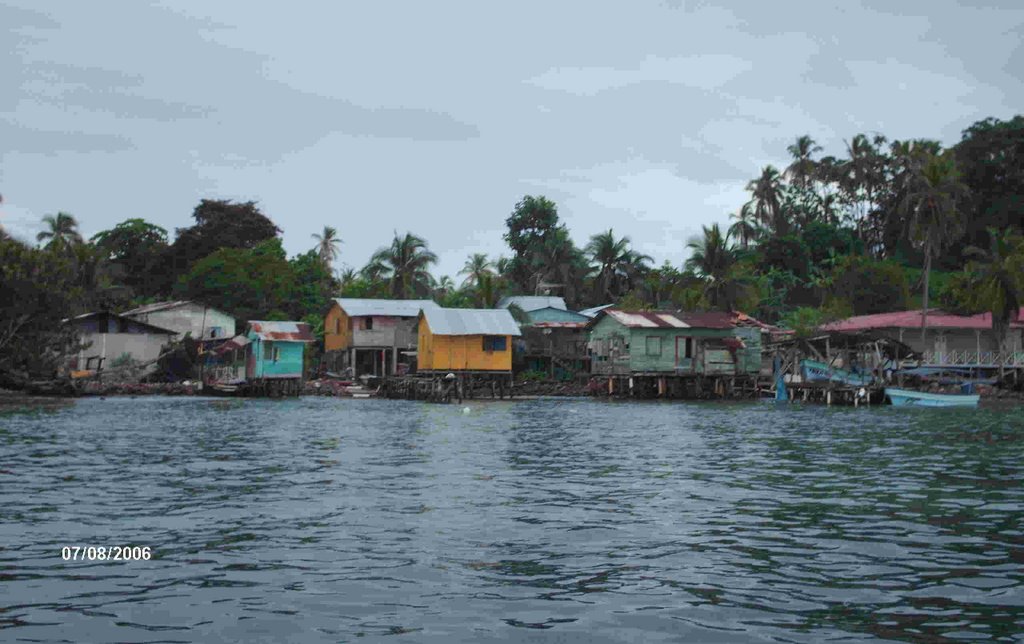
village and plush hotel
MONDAY, JULY 10
Bocas cabs are outboard-powered boats. A tourist party arrives by launch from Almirante. They pile up-market luggage on the dock. They require a boat to take them fifty meters to a plush new hotel on the water front - a confectionery of white paint that has cost (I am told and believe) a million dollars. An indigenous local poles his boat over to the dock. The hotel's white greeter spots half an inch of water in the bilges. He instructs the tourists to wait while he fetches a better boat. He ignores the boatman. The boatman sponges the offending water out of the bilges. He is a patient man, perhaps a little closed. I ride with him over to a village on the next island. A rash of wooden docks stick out from the shore. The boatman patrols a while, collecting passengers one by one. He drops a health worker off at a bar on the return trip to Bocas. A young Israeli woman (resident here for three years)works at the plush hotel. The boatman drops her at the hotel's dock. The boatman and I laugh together. The trip has been fun.
EDUCATION IS A PRIVLEDGE
MONDAY, JULY 10
Light rain falls as I ride the length of Bocas. The road rises thru low hills. The crest is capped with a patch of bamboo forest. Weighted by rain, the bamboos arch over the road. Much of the land is cattle ranch. Lots are advertised for sale. A development of cheap tasteless wooden holiday homes would benefit from a can of gasoline and a match. The bay the far end of the island faces the open sea. Turn left and a sand track leads to the Institue for Tropical Ecology and Conservation. The teachers are North American. So are the students. Some are from Canada, most from the US. I read the literature (ITEC is a not-for-pofit organisation based in Gainesville, Florida).
http//www.itec-edu.org
The school is on a sand beach protected by a reef. A further reef projects from the next island. Students eat at a next door restaurant. The restaurant has a small orchard: breadfruit, guanavara, a calabas tree. I order coffee and watch, between the palm trees, waves break on the reefs. A lone pelican sits on a marker post 50 meters out. Two parots nibble my ankles beneath the table.
The parents of a student I talk with have paid $2,500 for his five week course. He is from New England, a great kid, quarter Indian (as in Asia). He intends entering business once he has his Masters. Business is exciting. He believes that the Iraq war is the right war. He is having a great day. So am I. I resist relating the opinions voiced by the driver of the Mack truck.
I stop off at the Smithsonian Institute on the way back into town. Staff are out on the reef. The adminsitrative secretary gives me a beautifully produced catalogue of the Institute's work in Panama. I will send the catalogue to my son, Mark, a marine biologist.
Light rain falls as I ride the length of Bocas. The road rises thru low hills. The crest is capped with a patch of bamboo forest. Weighted by rain, the bamboos arch over the road. Much of the land is cattle ranch. Lots are advertised for sale. A development of cheap tasteless wooden holiday homes would benefit from a can of gasoline and a match. The bay the far end of the island faces the open sea. Turn left and a sand track leads to the Institue for Tropical Ecology and Conservation. The teachers are North American. So are the students. Some are from Canada, most from the US. I read the literature (ITEC is a not-for-pofit organisation based in Gainesville, Florida).
http//www.itec-edu.org
The school is on a sand beach protected by a reef. A further reef projects from the next island. Students eat at a next door restaurant. The restaurant has a small orchard: breadfruit, guanavara, a calabas tree. I order coffee and watch, between the palm trees, waves break on the reefs. A lone pelican sits on a marker post 50 meters out. Two parots nibble my ankles beneath the table.
The parents of a student I talk with have paid $2,500 for his five week course. He is from New England, a great kid, quarter Indian (as in Asia). He intends entering business once he has his Masters. Business is exciting. He believes that the Iraq war is the right war. He is having a great day. So am I. I resist relating the opinions voiced by the driver of the Mack truck.
I stop off at the Smithsonian Institute on the way back into town. Staff are out on the reef. The adminsitrative secretary gives me a beautifully produced catalogue of the Institute's work in Panama. I will send the catalogue to my son, Mark, a marine biologist.
BOCAS HOSPITAL
MONDAY, JULY 10
Bocas hospital has an emergency unit with aircon. An indigious child with an infected foot is the only other patient. A nurse sits me on a chair and sets to work with tweezers and blade. The removal is painless. The nurse dreams of being a writer. She doesn't read. Read two pages and she has a headache. The headaches began sooon after she left University. She has medical training: sugesting an eye test seems presumptious. She despatches me round the block to pay. I see, thru an open window, a skeletal old man curled up on a bed. He groans as he attempts to roll over. I hunt down the cashier's window and pay $5.
Bocas hospital has an emergency unit with aircon. An indigious child with an infected foot is the only other patient. A nurse sits me on a chair and sets to work with tweezers and blade. The removal is painless. The nurse dreams of being a writer. She doesn't read. Read two pages and she has a headache. The headaches began sooon after she left University. She has medical training: sugesting an eye test seems presumptious. She despatches me round the block to pay. I see, thru an open window, a skeletal old man curled up on a bed. He groans as he attempts to roll over. I hunt down the cashier's window and pay $5.
BOCAS
MONDAY, JULY 10
Bocas is beautiful. A small island, it is on the World map. It has arrived. It is a non-tourist tourist destination. The architecture is wood-shuttering Cape Cod-Carribean. Every building on Main Street sells something: food, booze, tours, real eastate.
Two weeks on the island and tourists enjoy the delusion of belonging. They become prey for male mid-age ex-trendies with tans and pony tails. Hustlers and marks sit in conference in bars and restaurants. On sale is the dream of owning some easy business, life without stress, a yearly holiday of 365 days, sun, sand and sex.
The scene is familiar: Ibiza, Block Island, Hydra, Mykinos...
I need a hospital. Eight days have passed since I sliced my hand. The stitches are due out.
Bocas is beautiful. A small island, it is on the World map. It has arrived. It is a non-tourist tourist destination. The architecture is wood-shuttering Cape Cod-Carribean. Every building on Main Street sells something: food, booze, tours, real eastate.
Two weeks on the island and tourists enjoy the delusion of belonging. They become prey for male mid-age ex-trendies with tans and pony tails. Hustlers and marks sit in conference in bars and restaurants. On sale is the dream of owning some easy business, life without stress, a yearly holiday of 365 days, sun, sand and sex.
The scene is familiar: Ibiza, Block Island, Hydra, Mykinos...
I need a hospital. Eight days have passed since I sliced my hand. The stitches are due out.
Thursday, July 13, 2006
DIFFERENT WORLDS
MONDAY, JULY 10
Fast passenger launches leave for Bocas from Almirante when they have a full load, say every half hour. The crossing takes twenty minutes; the fare is $3 and subsidised by Government. I take the slow car ferry due to leave at 6 a.m. I arrive early on the Honda, buy my ticket ($10 each way).
A car loads first, then the man directing the loading calls, "Simon, bring your bike." I have been traveling three months. Hearing my name called in a strange land at 5.30 a.m. is oddly warming. So is chatting with a couple of truck drivers. Six Mack trucks are carrying sand and gravel to one of the islands where a Gringo (the drivers´term) is constructing a housing development for billionaires. One of the billionaires is a famous basketball player. The drivers recount that the player´s house will cost two million dollars (they learnt this on TV).
Inland a thin mist clings to the trees along the mountainside. Red lights flash on the Cable & Wireless radio masts. The flood lights along Chiquita's pontoon are exactly spaced. Thick black cloud lies over the sea to our left. The water is almost black. An inbound passenger launch leaves a white trail. The smell of frying chicken drifts from the open window behind us and a tin spoon clatters against a cooking pot.
I eat a breakfast of round fluffy pancakes with sausage. Meanwhile the conversation has turned to bikes. A driver has a broken Yamaha. A second driver claims to be a specialist. "Buy the parts," he says: "We'll put it together on a Sunday. Start at six." He acts assembling the engine. " Ping pam, ping pam, ping pam, finshed by four."
This same specialist was in the army. He talks about the US invasion of Panama. "Twenty-three dead," he says of US soldiers. "It's a big lie, Pappi. We shot them in the sky. Pom," he goes, aiming an imaginery rifle. "Pom, pam. I tell you, Pappi, twenty-three is a big lie. And how many they kill, thousands."
All these dead for one man: the US could have grabbed Noriega any time, claims the driver. The invasion was on the 20th. On the 18th, Noriega was visiting a US base. (I have no idea if this is true) Now Iraq is the same. The driver believes that the invasion was a practice run. He says that the Americans believe they can do anything they want. The other two drivers nod their agreement. Perhaps they agree from fellowship for a fellow driver.
I am becoming obsessive in my demand for detail (or recognise my obsession). I am interested in the cost of a used Mack truck. The one driver's Mack is twenty-years old, value $5000. This driver used to drive mules (the motive part of a trailer truck) till Chiquita pushed down the price. $450 is the frieght on a load of gravel out to the island. The crossing takes two-and-a-half hours. The driver makes two trips most days, six days a week. He leaves home at 4:30 in the morning and gets back at 11 p.m. He is paid by the trip. A normal month, he earns $500.
Fast passenger launches leave for Bocas from Almirante when they have a full load, say every half hour. The crossing takes twenty minutes; the fare is $3 and subsidised by Government. I take the slow car ferry due to leave at 6 a.m. I arrive early on the Honda, buy my ticket ($10 each way).
A car loads first, then the man directing the loading calls, "Simon, bring your bike." I have been traveling three months. Hearing my name called in a strange land at 5.30 a.m. is oddly warming. So is chatting with a couple of truck drivers. Six Mack trucks are carrying sand and gravel to one of the islands where a Gringo (the drivers´term) is constructing a housing development for billionaires. One of the billionaires is a famous basketball player. The drivers recount that the player´s house will cost two million dollars (they learnt this on TV).
Inland a thin mist clings to the trees along the mountainside. Red lights flash on the Cable & Wireless radio masts. The flood lights along Chiquita's pontoon are exactly spaced. Thick black cloud lies over the sea to our left. The water is almost black. An inbound passenger launch leaves a white trail. The smell of frying chicken drifts from the open window behind us and a tin spoon clatters against a cooking pot.
I eat a breakfast of round fluffy pancakes with sausage. Meanwhile the conversation has turned to bikes. A driver has a broken Yamaha. A second driver claims to be a specialist. "Buy the parts," he says: "We'll put it together on a Sunday. Start at six." He acts assembling the engine. " Ping pam, ping pam, ping pam, finshed by four."
This same specialist was in the army. He talks about the US invasion of Panama. "Twenty-three dead," he says of US soldiers. "It's a big lie, Pappi. We shot them in the sky. Pom," he goes, aiming an imaginery rifle. "Pom, pam. I tell you, Pappi, twenty-three is a big lie. And how many they kill, thousands."
All these dead for one man: the US could have grabbed Noriega any time, claims the driver. The invasion was on the 20th. On the 18th, Noriega was visiting a US base. (I have no idea if this is true) Now Iraq is the same. The driver believes that the invasion was a practice run. He says that the Americans believe they can do anything they want. The other two drivers nod their agreement. Perhaps they agree from fellowship for a fellow driver.
I am becoming obsessive in my demand for detail (or recognise my obsession). I am interested in the cost of a used Mack truck. The one driver's Mack is twenty-years old, value $5000. This driver used to drive mules (the motive part of a trailer truck) till Chiquita pushed down the price. $450 is the frieght on a load of gravel out to the island. The crossing takes two-and-a-half hours. The driver makes two trips most days, six days a week. He leaves home at 4:30 in the morning and gets back at 11 p.m. He is paid by the trip. A normal month, he earns $500.
BANANA BOAT
SUNDAY, JULY 9
Almirante was a United Fruit town. Now the name is Chiquita Banana. Entry to Chiquita's air conditioned office building is thru a guarded security gate in the port area. Two of Chiquita's fleet lie alongside a concrete wharf. The wharf belongs to Chiquita. I require clearance from the Big Men in the open-plan first-floor office. The Big Men are well fed. They are Panamanians with a West Indian heritage and speak English. A lot of telephoning to and fro takes place before I am issued with a visitor's badge and a green hard hat. The Polish Chief engineer wears the baggy shorts and grey T-shirt he wore last night in the Chinese restaurant. I wonder if he slept in them. The ship is sailing in an hour and he conducts me on a whirlwind tour of the engine department. The control room is screens and switches. A steel door leads to the bank of computers that control both ship and cargo. The Chief demonstrates opening and closing one of the many valves that ballance the fuel load. Next we visit the engine which seems small for such a big task. Later on the tour and down a deck level, I realise how deep are the cylinders. We visit pump rooms and more pump rooms, filter rooms and more filter rooms, heating units for the fuel oil, cooling units for the cargo, climate control for the cargo, generators, spare generators, more generators. The tour is designed to impress. I am impressed.
We return to the control room.
"Harrison Ford, bullshit," announces the Chief. He acts the actor spining imaginary control wheels. "Open this valve, open that valve. Big Captain in white uniform save everyone. All bullshit." The Chief jabs a finger at a flashing red light. "Captain, idiot. You think he know what is? Idiot. All idiots. Bulb break, he call me how to fix."
What else did I learn? That bananas are put to sleep while traveling. They reach their destination, are given a whiff of gas, wake up and turn yellow. I know what gas and the climate control that puts them to sleep. And I know that Chiquita has sold off the trucks and trailers that transport the containers from the plantations to the wharf. The new owners are in debt to the bank. They can't argue prices.
Almirante was a United Fruit town. Now the name is Chiquita Banana. Entry to Chiquita's air conditioned office building is thru a guarded security gate in the port area. Two of Chiquita's fleet lie alongside a concrete wharf. The wharf belongs to Chiquita. I require clearance from the Big Men in the open-plan first-floor office. The Big Men are well fed. They are Panamanians with a West Indian heritage and speak English. A lot of telephoning to and fro takes place before I am issued with a visitor's badge and a green hard hat. The Polish Chief engineer wears the baggy shorts and grey T-shirt he wore last night in the Chinese restaurant. I wonder if he slept in them. The ship is sailing in an hour and he conducts me on a whirlwind tour of the engine department. The control room is screens and switches. A steel door leads to the bank of computers that control both ship and cargo. The Chief demonstrates opening and closing one of the many valves that ballance the fuel load. Next we visit the engine which seems small for such a big task. Later on the tour and down a deck level, I realise how deep are the cylinders. We visit pump rooms and more pump rooms, filter rooms and more filter rooms, heating units for the fuel oil, cooling units for the cargo, climate control for the cargo, generators, spare generators, more generators. The tour is designed to impress. I am impressed.
We return to the control room.
"Harrison Ford, bullshit," announces the Chief. He acts the actor spining imaginary control wheels. "Open this valve, open that valve. Big Captain in white uniform save everyone. All bullshit." The Chief jabs a finger at a flashing red light. "Captain, idiot. You think he know what is? Idiot. All idiots. Bulb break, he call me how to fix."
What else did I learn? That bananas are put to sleep while traveling. They reach their destination, are given a whiff of gas, wake up and turn yellow. I know what gas and the climate control that puts them to sleep. And I know that Chiquita has sold off the trucks and trailers that transport the containers from the plantations to the wharf. The new owners are in debt to the bank. They can't argue prices.
MOST BEAUTIFUL TRUCK STOP IN THE WORLD

perfect truck stop
SUNDAY, JULY 9
I bought new batteries for my camera yesterday. They were flat when I reached that awful bridge. I am out of bed by 5.30 this morning and biking back with fresh batteries loaded. I pass three trucks parked on the roadside below a small thatched cafe. I take my photographs (two are on the blog) and stop at the cafe for breakfast. The cafe is on a ridge 80 meters up a dirt track from the road. It is not much of a place. The floor is cement as is a kitchen counter. Wooden posts support the thatch roof. A couple of hammocks hang from hooks. The upright chairs are old and have carved leather backs. Sit at one of the four tables and you look down over rich jungle to the island-spotted gulf of Bocos del Toro.
A girl, 8, sweeps the floor. Her brother, four years older, is lighting the fire outside in a half-drum. The mother fetches me a cup of freshly made coffee.
I question the daughter on her school and whether she enjoys books. Being a pompous old man, I tell her that education is the only road to freedom.
The mother agrees. "There is so much competition now," she tells me.
A white butterfly in a hurry flies directly across my view. Perhaps it is aware that life is short. Most butterflies appear aimless. Here they are copper-colored and red and yellow. Birds work up a racket while I eat (the standard pancakes and chopped steak in sauce). The sun is out. We are up a thousand feet and the air is cool. The family house is a further fifty meters or so up the ridge and has its back to a wood. This must be the most perfect truck stop in the world. Riding back to Almirante, I realize what an idiot I am in talking freedom to the young girl. What do I know? Maybe she is already close to Paradise.
CHINESE DINNER
SATURDAY, JULY 8
I had a weird night. Dinner at a Chinese restaurant. A drunk Polish Chief engineer off a banana boat sat with me. He shouted a good deal. Much of his shouting concerned deck officers being idiots. A second subject was racism. Foreigners (non-Polish) believed Polish people were all racists and idiots. "Not so," the Chief insisted.
As proof that he was not a racist, he presented his recent promotion of a Fillipino to Chief Engineer´s rank.
I had chosen a corner table, my back to the wall. The Fillipino crew were seated across the restaurant watching a boxing fight on TV between a Fillipino and an American.
"They love me," insisted the Chief Enginneer. "I am their King. Of course they love me."
He bellowed for the newly promoted Engineer to come pay hommage - which he did, a quiet man, well mannered, wearing round spectacles. The Chief paraded him as he woulod have a prize dog, then dismissed him and returned to his criticism of deck officers. "I show you ship. Tomorrow I show you ship. You see. All f...ing idiots."
We made a date for 10 a.m.
I had a weird night. Dinner at a Chinese restaurant. A drunk Polish Chief engineer off a banana boat sat with me. He shouted a good deal. Much of his shouting concerned deck officers being idiots. A second subject was racism. Foreigners (non-Polish) believed Polish people were all racists and idiots. "Not so," the Chief insisted.
As proof that he was not a racist, he presented his recent promotion of a Fillipino to Chief Engineer´s rank.
I had chosen a corner table, my back to the wall. The Fillipino crew were seated across the restaurant watching a boxing fight on TV between a Fillipino and an American.
"They love me," insisted the Chief Enginneer. "I am their King. Of course they love me."
He bellowed for the newly promoted Engineer to come pay hommage - which he did, a quiet man, well mannered, wearing round spectacles. The Chief paraded him as he woulod have a prize dog, then dismissed him and returned to his criticism of deck officers. "I show you ship. Tomorrow I show you ship. You see. All f...ing idiots."
We made a date for 10 a.m.
Tuesday, July 11, 2006
ALMIRANTE

station hotel
SATURDAY, JULY 8
Almirante has seen better days. We drove down Main street in the truck passed the Station Hotel. A guest sneezes and the hotel will crumble.
The driver had a delivery to make to the Fereteria Casa Rosa. Thank God, a new hotel had opened across the street, rooms on the upper floor. I may have been the first guest. The room was big, the bed was comfortable, the bathroom functioned, the a/c was silent perfection. Add a fan to keep any mosquitos at bay. One minus, the TV wasn't cable! It will be next week. A friendly mother and daughter run the Hotel Puerto del Almirante. On the next block a lady of Jamaican/Irish decent runs the best breakfast place I've eaten at: $1.75 for chopped steak in pepper sauce served with round, flat, fluffy pancakes and coffee. Add a room rate of $12.50, no wonder I made Almirante my base for three nights.
THANKS TO THESE TWO MEN
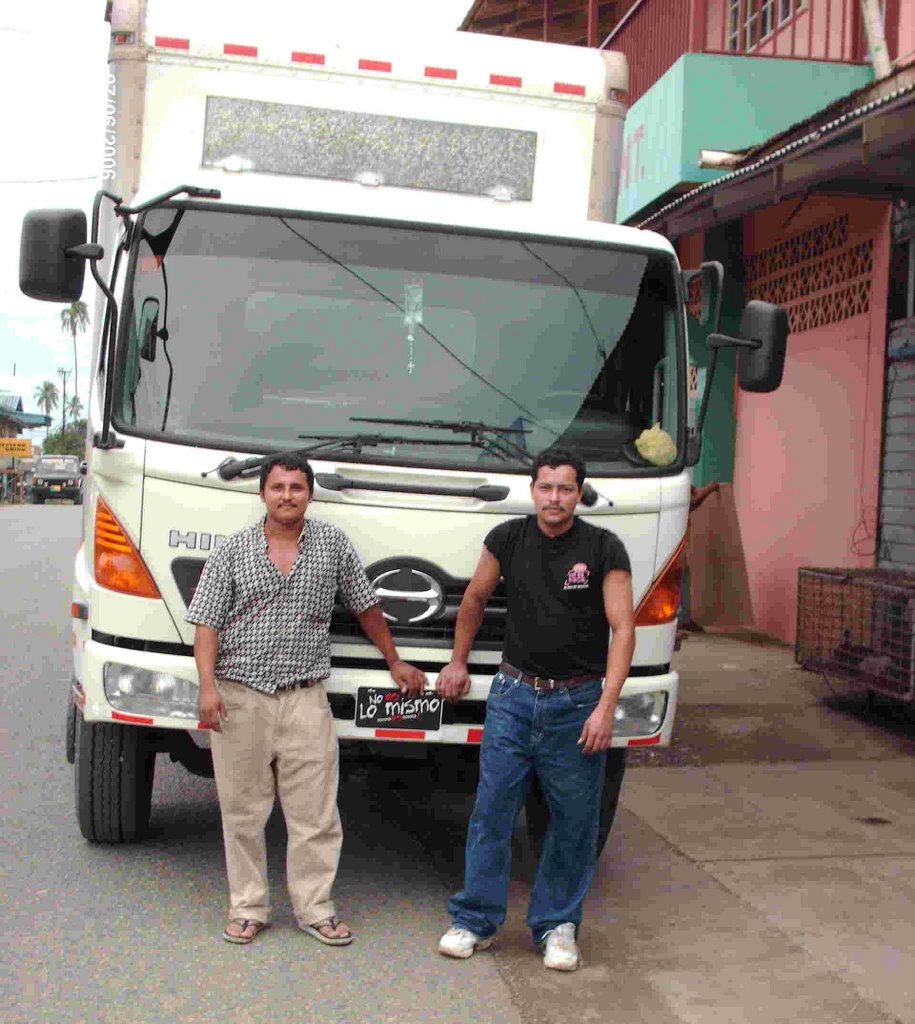
SATURDAY, JULY 8
These two men brought me across the bridge in their truck and on to Almirante. Kind and courteous - in fact typical of Panamanians.
Monday, July 10, 2006
A BRIDGE TOO FAR
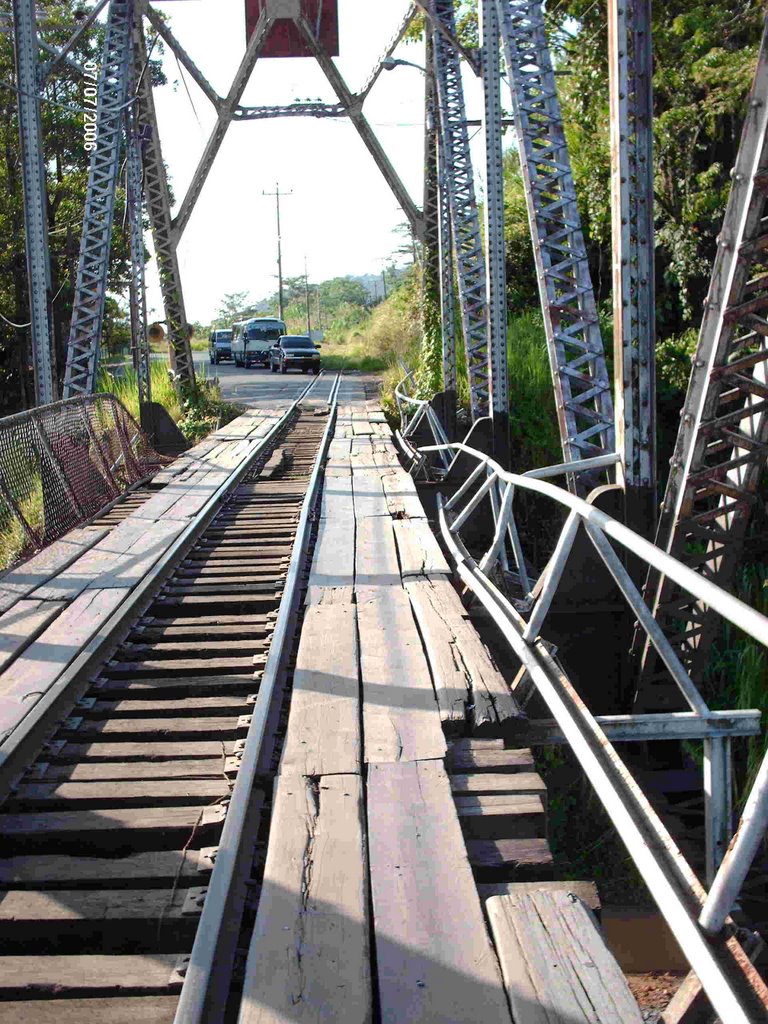

truly scary
1. other people
had problems
2. a long way
SATURDAY, JULY 8
I have been warned. The Bridge of the Americas is all and more than I expected. It is nearly three hundred meters long. The planks are uneven and slippery. Many are missing. A bigger bike than the Honda could fall thru the gap between planks and lower guard rails. Much of the wire safety netting fastened between upper and lower guard rails is missing. I travel the first twenty yards before the bike slips. Desperate to save the Honda, I tip inwards across the rails. I lie pinned under the bike. I look down between the sleepers at the river in spate from the recent rains. Truck drivers run down the track and heave the Honda off my leg. They join in warning me that the bridge is dangerous - as if I require warning. They lift me onto my feet and the bike into the back of a truck. I sit up front. The driver spends the entire fifteen kilometers to Almirante warning me of further perils. He is carrying building supplies to the wharehouse of the biggest store in town. The store owner recommends a hotel across the road run by mother and daughter. The rooms are on the first floor: $25 for a room with bath, TV, and a/c. I protest to the daughter that I am a pensioner. She immediately halves the rate. Bush telegraph is fully functional in Almirante. I sit at a table in the back of a nearby Chinese restaurant and receive the commiserations of half the populace.
COSTA RICA CARIBBEAN
SATURDAY, JULY 8
At first the road to Panama follows the coast. Even the shanty towns of Costa Rica`s capital looked cared for. Here, on the Caribbean coast, wooden house rot unpainted amongst the palm trees: evidence of poverty or of neglect? The road swings inland. Puffs of smoky cloud spill from pockets in the mountains bordering the banana platations. A river divides Costa Rica from Panama. Waiting in line at Costa Rican Immigration takes a few minutes. I am alone at Customs. Panama is the far end of a Chiquita Banana railway bridge. Loose and uneven planks lie end to end across the sleepers each side of the rails. Rain has been spitting and the planks are as slippery as a greased pole. I edge across in first gear, one foot on the rail, one on the planks. Two truck drivers are at the Customs window in Panama. I tell them of my fear. They warn me of a second bridge on the road to Almirante; the second bridge is in worse condition and three times as long. Cars have crashed. For bikes it is very dangerous. Many people have fallen. Recently an American broke his arm. A German broke a leg.
At first the road to Panama follows the coast. Even the shanty towns of Costa Rica`s capital looked cared for. Here, on the Caribbean coast, wooden house rot unpainted amongst the palm trees: evidence of poverty or of neglect? The road swings inland. Puffs of smoky cloud spill from pockets in the mountains bordering the banana platations. A river divides Costa Rica from Panama. Waiting in line at Costa Rican Immigration takes a few minutes. I am alone at Customs. Panama is the far end of a Chiquita Banana railway bridge. Loose and uneven planks lie end to end across the sleepers each side of the rails. Rain has been spitting and the planks are as slippery as a greased pole. I edge across in first gear, one foot on the rail, one on the planks. Two truck drivers are at the Customs window in Panama. I tell them of my fear. They warn me of a second bridge on the road to Almirante; the second bridge is in worse condition and three times as long. Cars have crashed. For bikes it is very dangerous. Many people have fallen. Recently an American broke his arm. A German broke a leg.
LIMON
FRIDAY, JULY 7
Nine hours on the internet. Central America is bananas. Yesterday I visited a 4,000 hectar banana plantation. Today I trespass on the grave of the United Fruit Company. Limon was once a Company town. A photograph (circa 1902) of United Fruit`s headwooden headquarters building shares wall space with two photographs of banana boats alongside United Fruit`s wharf. In Morales, Guartemala, another United Fruit town, locals were made to step off the sidewalk when encountering Company officials. Limon's waterfront is a sad relic of those days of regal glory. I stroll at night alonf the sidewalk below the sea wall. Loving couples share the wall with family groups, a clump of elderly men, five kids kicking a ball. At a table in the town's smartest hotel, five elderly men are recording a local radio program. I sit at the bar, drink a beer, chat with the manageress. A designer enters to show the manageress the mundane logo for this year´s October carnival (young gnome). I dine at a Chinese restaurant on Wonton soup. I have the best room of my travels on the second floor at the Hotel Miami for $17: a/c, hot hot water, cable TV. The internet cafe round the corner had a/c; connecting the Toughbook was easy and uploaded pictures onto the blog.
Nine hours on the internet. Central America is bananas. Yesterday I visited a 4,000 hectar banana plantation. Today I trespass on the grave of the United Fruit Company. Limon was once a Company town. A photograph (circa 1902) of United Fruit`s headwooden headquarters building shares wall space with two photographs of banana boats alongside United Fruit`s wharf. In Morales, Guartemala, another United Fruit town, locals were made to step off the sidewalk when encountering Company officials. Limon's waterfront is a sad relic of those days of regal glory. I stroll at night alonf the sidewalk below the sea wall. Loving couples share the wall with family groups, a clump of elderly men, five kids kicking a ball. At a table in the town's smartest hotel, five elderly men are recording a local radio program. I sit at the bar, drink a beer, chat with the manageress. A designer enters to show the manageress the mundane logo for this year´s October carnival (young gnome). I dine at a Chinese restaurant on Wonton soup. I have the best room of my travels on the second floor at the Hotel Miami for $17: a/c, hot hot water, cable TV. The internet cafe round the corner had a/c; connecting the Toughbook was easy and uploaded pictures onto the blog.
Friday, July 07, 2006
CAP AND SHAWL

volcano wearing a cap and shawl
THURSDAY, JULY 6
I wore two shirts and my windcheater up over the mountains this morning. Chunks of mountain side were swathed in netting. Something called helecho grew under the netting - a new word.
I stopped at a breakfast place with a great view. I drunk my first mug of coffee before the Christians arrived. They described themselves as families and were traveling in three busses (Toyota Coasters). They belonged to a church in Detroit and had been on a mission trip here in Costa Rica and now were enjoying well earned R&R. most were teenagers. I asked an adult woman if she knew what helecho was. She did. They were traveling with an interpreter. Ferns!
I told her of discovering the names of the English martyrs familiar from my childhood written on the chapel wall in the Jesuit temple in Oaxaca. He daughter (real daughter or family daughter?) had joined us and a young man studying literature in Brazil. The daughter asked what I wrote. I replied that I wrote about people acting under pressure. I suggested that church education prepared us to resist pressure (I was doing well). I mentioned a simile I care for: that we are born on the platform of a child's slide; that we put our foot on the slide, how far we slip is a matter of luck (good, so far); that there was no fundamental difference between Eichman and the person who merely makes anti-Semitic remarks. Here I think I made a mistake. I am so unfamiliar with the religious sects of the United States. I forget that they hold curious, and to us Europeans, unpleasant views on those Jewish people.
The lady excused herself soon after. She had matters to attend to. We were at a table on the terrace. She was indoors in the restaurant when I left fifteen minutes later. To my left, a proper volcano wore a cap and shawl.
JUST KIDS
NIGHT OF JULY 5/6
I rode up over mountains to San Jose thru coffee plantations and passed suburban mansions with trim lawns and big gates. The gates of the wealthy are less guarded than in other Central American countries.
I am nervous of riding in capital cities and sought a hotel on the outskirts. I had been warned by expats in Nicaragua that San Jose was unsafe. Ticos told me, Nonsense, and advised that the city center was cheaper and offered more choice.
The city was easy to navigate. I asked only three people for directions to the backpackers' hotel on Avenida 6. A tiny room with a fan and a window to a corridor set me back $22. This is an English speaking haven - even the few French were attempting English. I sat in the restaurant with a young English woman, arrived that evening from the UK. She is a conservationist and will work six weeks on the Caribbean coast as a volunteer before flying to Peru to join a tour of the Inca trail and so on down thru the salt lakes of Bolivia, Chili and the Argentine to where?
Where would any sensible English woman head?
Tierra del Fuego!
We checked our e-mails, headed to our respective beds.
A birthday party was underway at the small swimming pool in the patio. Most were Brits. Latins, we would have heard music, a few good voices. With these Brits, noise production appeared to be a high priority.
I rose at dawn and found girls curled in armchairs and on benches. I write that they were girls because they seemed to me too young to be described as women and lasses is too old fashioned a word even for this Old Fogie.
The noise had gone out of them, the party spirit of the group. Isolated one from another, they appeared very young and pale and vulnerable and waiflike. A boy and a girl were in the pool fishing for pieces of a smashed glass. The boy had found a mug broken in two. A wet packet of cigarettes lay on a table. Two of the cigarettes had fallen on the wet tiles.
I was on my way to the front desk and overheard the girl say, "It was probably my fucking fault."
The word seemed particularly ugly at that hour, almost desperate, and I wished that comforting her was possible.
They left the pool while I surrendered my key and retrieved my deposit. I passed the pool on my way to the rear courtyard where I had parked the Honda. The two kids had left the two cigarettes on the tiles. I stooped and picked them up. They melted in my palm while I sought a bin.
I rode up over mountains to San Jose thru coffee plantations and passed suburban mansions with trim lawns and big gates. The gates of the wealthy are less guarded than in other Central American countries.
I am nervous of riding in capital cities and sought a hotel on the outskirts. I had been warned by expats in Nicaragua that San Jose was unsafe. Ticos told me, Nonsense, and advised that the city center was cheaper and offered more choice.
The city was easy to navigate. I asked only three people for directions to the backpackers' hotel on Avenida 6. A tiny room with a fan and a window to a corridor set me back $22. This is an English speaking haven - even the few French were attempting English. I sat in the restaurant with a young English woman, arrived that evening from the UK. She is a conservationist and will work six weeks on the Caribbean coast as a volunteer before flying to Peru to join a tour of the Inca trail and so on down thru the salt lakes of Bolivia, Chili and the Argentine to where?
Where would any sensible English woman head?
Tierra del Fuego!
We checked our e-mails, headed to our respective beds.
A birthday party was underway at the small swimming pool in the patio. Most were Brits. Latins, we would have heard music, a few good voices. With these Brits, noise production appeared to be a high priority.
I rose at dawn and found girls curled in armchairs and on benches. I write that they were girls because they seemed to me too young to be described as women and lasses is too old fashioned a word even for this Old Fogie.
The noise had gone out of them, the party spirit of the group. Isolated one from another, they appeared very young and pale and vulnerable and waiflike. A boy and a girl were in the pool fishing for pieces of a smashed glass. The boy had found a mug broken in two. A wet packet of cigarettes lay on a table. Two of the cigarettes had fallen on the wet tiles.
I was on my way to the front desk and overheard the girl say, "It was probably my fucking fault."
The word seemed particularly ugly at that hour, almost desperate, and I wished that comforting her was possible.
They left the pool while I surrendered my key and retrieved my deposit. I passed the pool on my way to the rear courtyard where I had parked the Honda. The two kids had left the two cigarettes on the tiles. I stooped and picked them up. They melted in my palm while I sought a bin.
FERRY RIDE
WEDNESDAY, JULY 5
The Nicaraguan with whom I talked on the ferry had worked for twelve years based in the US. Telecommunications is his field and he traveled widely for his employers, Africa, Latin America, Europe. Marriage and two small children persuaded him to give up the traveling. Back home in Nicaragua he has his own business in telecommunications. He is a pro and doing well. He is nervous of the coming elections. Political memory has a ten year life span. The electorate have forgotten the misery they suffered under the Sadanistas. They will forget or forgive the thievery and corruption of Ortega. They will fall for the dream and suffer a new period of chaos and economic ruin.
And he talks bitterly of Europeans falling for the romantic image of the Sadanistas, of deliberately ignoring the truth.
In reporting his beliefs, I will earn the ire of many broadly to the left of the political divide. My reports of those critical of the US have already gained the ire of those on the right. All in all, I am doing well...
The Nicaraguan with whom I talked on the ferry had worked for twelve years based in the US. Telecommunications is his field and he traveled widely for his employers, Africa, Latin America, Europe. Marriage and two small children persuaded him to give up the traveling. Back home in Nicaragua he has his own business in telecommunications. He is a pro and doing well. He is nervous of the coming elections. Political memory has a ten year life span. The electorate have forgotten the misery they suffered under the Sadanistas. They will forget or forgive the thievery and corruption of Ortega. They will fall for the dream and suffer a new period of chaos and economic ruin.
And he talks bitterly of Europeans falling for the romantic image of the Sadanistas, of deliberately ignoring the truth.
In reporting his beliefs, I will earn the ire of many broadly to the left of the political divide. My reports of those critical of the US have already gained the ire of those on the right. All in all, I am doing well...
ME AMONGST MANY
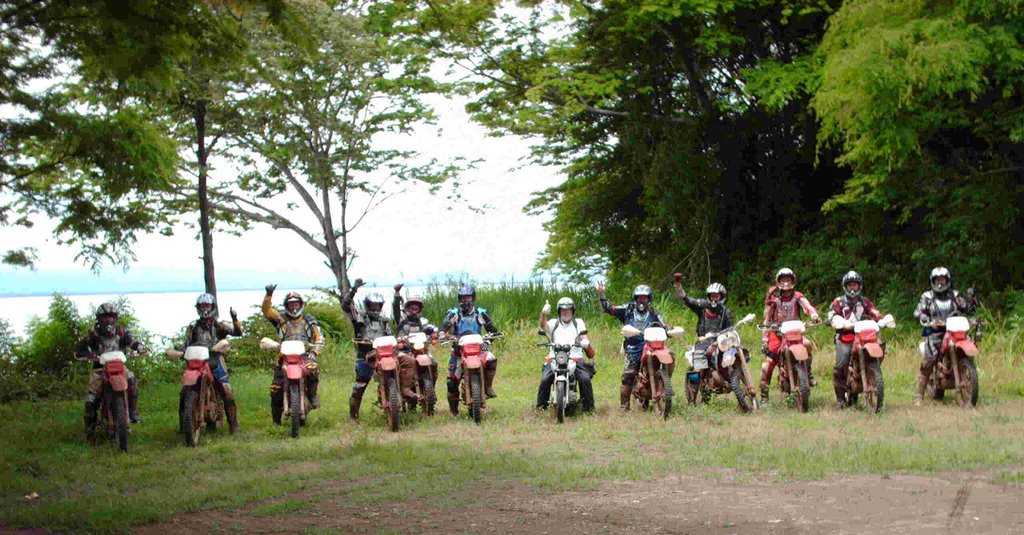
more boys on bikes
writer is the little guy in the middle
WEDNESDAY, JULY 5
San Francisco Coyote was a pleasure. I leave with regret. We had heavy rain in the night. The dirt road across the Nicoya peninsular is slippery. I wear work gloves bought at the hardware store in Jacaril and I pay great attention to the road. The final few Ks along the coast to the ferry are cratered hard-top. I stop at a cafe on the hill down to the ferry terminal. I rest my but on a comfortable chair and am at peace with breakfast and a third cup of good coffee. All hell breaks loose. Hells Angels! Or a wild bunch of late-thirties reliving their adolescence. They come armed with trail bikes. They work the throttles, BRRRRM BRRRRM ...
They are connected thru college or work or accident. Most are from the States, though one is a Brit, one from Peru and a Nicaraguan with whom I talk on the ninety minute crossing by ferry.
RED HOT CHILI PEPPERS
TUESDAY, JULY 4
The benches outside the store are a fine place for chat. My companion last night was an economics student in his final semester. In music, he is a fan of the Red Hot Chili Peppers. He and his sister are students at the country's premier State university. Away from home, they rent an apartment at $200 a month. Their parents are comfortable financially. Poorer kids share a room or a cupboard. Even this sacrifice is well beyond most budgets.
He finds responsibility for his younger sister difficult on occasion. He and his friends take little interest in politics. National politics are too corrupt. Two ex-Presidents are in jail. He is angered by the sale of Costa Rica's coasts to foreigners. As for foriegn afairs, Costa Rica is little more than a US colony. The US does what it likes in Central America. Look what they did in Panama. And what they are doing in Iraq. Except for scale, Iraq and Panama are the same.
The benches outside the store are a fine place for chat. My companion last night was an economics student in his final semester. In music, he is a fan of the Red Hot Chili Peppers. He and his sister are students at the country's premier State university. Away from home, they rent an apartment at $200 a month. Their parents are comfortable financially. Poorer kids share a room or a cupboard. Even this sacrifice is well beyond most budgets.
He finds responsibility for his younger sister difficult on occasion. He and his friends take little interest in politics. National politics are too corrupt. Two ex-Presidents are in jail. He is angered by the sale of Costa Rica's coasts to foreigners. As for foriegn afairs, Costa Rica is little more than a US colony. The US does what it likes in Central America. Look what they did in Panama. And what they are doing in Iraq. Except for scale, Iraq and Panama are the same.
COYOTE BEACH
TUESDAY, JULY 4
The Dutchman drove me over to see his property. The land stretches up a hillside. They have reserved the top half for wildlife. The lower slope is divided into one hectar lots. They have sold most of these that they wish to sell. The rate around here is $8 a square meter and you can have a good three-bed two-bath house built for $50,000.
The houses are set well back amongst trees on the Dutchman's land; you can't see them from the road. The Dutchman has lived here for the past fifteen years and tends the houses and oversees new construction. We drove down to his neighborhood restaurant a hundred meters up the road from Coyote beach. The beach is four Ks long and is divided by the river. You can wade across the mouth of the river at low tide. There are no buildings on the beach.
We ate at the restaurant and drank a few beers. Six to be exact. And we each ate a fried snapper caught that day. The bill came to $11.
The Dutchman drove me over to see his property. The land stretches up a hillside. They have reserved the top half for wildlife. The lower slope is divided into one hectar lots. They have sold most of these that they wish to sell. The rate around here is $8 a square meter and you can have a good three-bed two-bath house built for $50,000.
The houses are set well back amongst trees on the Dutchman's land; you can't see them from the road. The Dutchman has lived here for the past fifteen years and tends the houses and oversees new construction. We drove down to his neighborhood restaurant a hundred meters up the road from Coyote beach. The beach is four Ks long and is divided by the river. You can wade across the mouth of the river at low tide. There are no buildings on the beach.
We ate at the restaurant and drank a few beers. Six to be exact. And we each ate a fried snapper caught that day. The bill came to $11.
COINCIDENCE OR HUMOR?

fun juxtaposition
TUESDAY, JULY 4
Village life is fun (for me). I watch the comings and goings from a bench outside the store. The under-forties are on wheels, two or four, and mostly motorized. The elders are on horseback. A reasonable horse costs $80. Add saddle and bridle and you are mobile for $150. Fuel grows on the roadside.
Most have heard of my accident. I field a stream of enquiries as to how I am and is it true that I intend riding to Argentina. A trio from a Turtle protection group drop by to chat. One is from Mexico. They collect eggs and take them to a hatchery. They launch the baby turtles into the sea. Shrimp boats work a mile offshore. Shrimping is the preserve of the Taiwanese. The shrimp nets sweep up the baby turtles along with the shrimp and about everything else.
Turtle protectors need volunteers. The beach is beautiful.
www.tortugamarina.org
A public telephone is attached to a post. The female half of a pair of blond young foreign lovers talks at length. The male half hovers. She retreats to the shade of the tree overstanding the post - seeking a privacy of which he is nervous. A plump young woman in tight short shorts and a stretched pink top that almost covers the bits she wants covered is a pinball addict. She rides up every half hour or so on a push bike to play the left hand machine of the two in the bar area of the store. The Dutchman arrives on his quad bike. The store owner's wife invites us to lunch in their kitchen. Delicious vegetables of which I can swear to baby okra and green beans.
GENERALS ARE GOOD FOR YOU
TUESDAY, JULY 4
I talk with the two brothers of the holidaying family over breakfast. The elder brother complains of foreigners owning all the best land in Costa Rica. Neither brother cares much for foreigners. They corrupt Costa Rican society. They breed prostitution and spread their drug culture. The elder brother is a fan of the Somoza years.
"There was no crime," he tells me (not mentioning that the Somozas and their cronies stole the entire country and murdered anyone who argued). "The roads were properly maintained," he states. "Under Somoza, we had thousands of road workers. There was work for everyone." He is also a fan of Castro. "There's no crime in Cuba."
Unless depriving a people of their freedom is a crime...
Clearly his father was of the privileged in the years of the dictatorship.
I am here to report, not to argue. I nod politely.
I talk with the two brothers of the holidaying family over breakfast. The elder brother complains of foreigners owning all the best land in Costa Rica. Neither brother cares much for foreigners. They corrupt Costa Rican society. They breed prostitution and spread their drug culture. The elder brother is a fan of the Somoza years.
"There was no crime," he tells me (not mentioning that the Somozas and their cronies stole the entire country and murdered anyone who argued). "The roads were properly maintained," he states. "Under Somoza, we had thousands of road workers. There was work for everyone." He is also a fan of Castro. "There's no crime in Cuba."
Unless depriving a people of their freedom is a crime...
Clearly his father was of the privileged in the years of the dictatorship.
I am here to report, not to argue. I nod politely.
VILLAGE LIFE
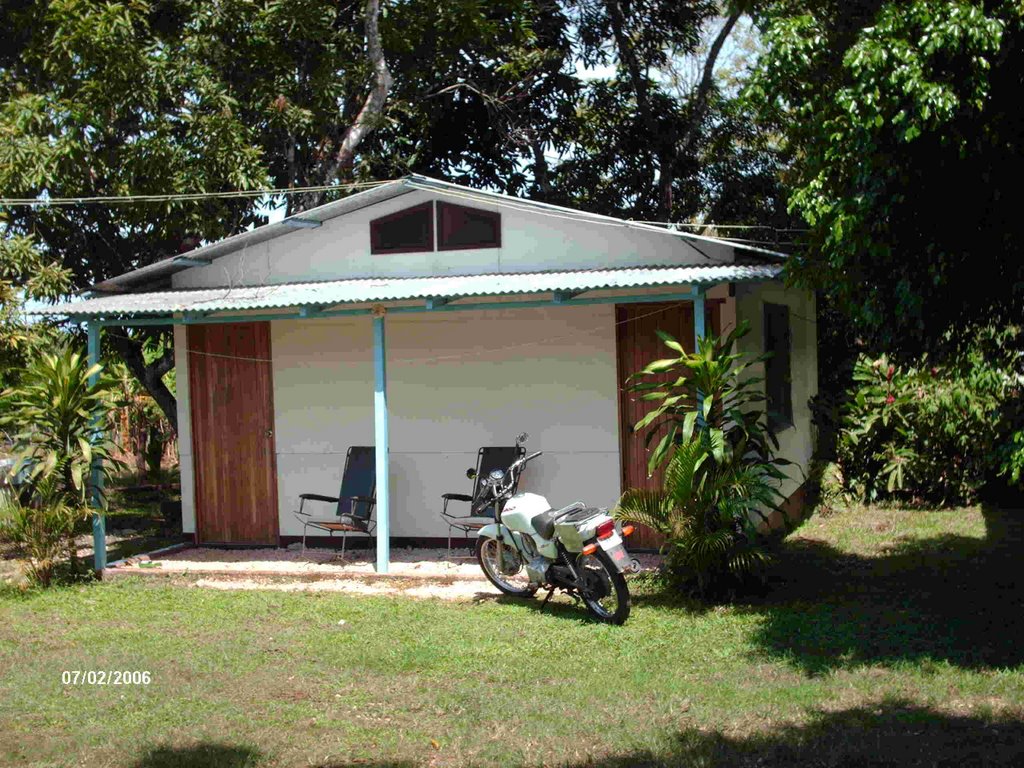
village home
MONDAY, JULY 3
I am settled into a cabin behind one of the two general stores. I have a bathroom and a fan in the village of San Francisco Coyote. The restaurant belongs to the store keeper. I eat dinner after a near three hour ride back from Jacaril town on an old US school bus. I order steak. I am faced with two thick chunks of meat each the size of my shoe soles: salad, fries, fried bananas, two beers. $4 does not seem excessive!
A Dutchman with a development on a hillside beyond the boutique hotel has ridden my bags over on his four-wheel bike. Bush tellegraph alerted him to my accident and he dropped by the general store this morning to check who I was and that I was OK.
A double brother family of Costa Rican businessmen occupy the remaining three cabins for the night: two couples, four kids from seven to sixteen, and one wife's parents. They were double booked into a rental holiday home for the first night of the school vacation.
A terrace out front of the store shades a bar and four teak tables and benches. I sit after dinner with the store owner and a twenty-somthing graduate. The store owner talks philosophy. What is the route to happiness? Do I believe in a God, an afterlife? Would I prefer coffee or another beer?
"Black coffee would be just fine," I say.
I also say that I would prefer a night in his cabins than a week preparing for death in the boutique hotel.
IN SEARCH OF A BANK
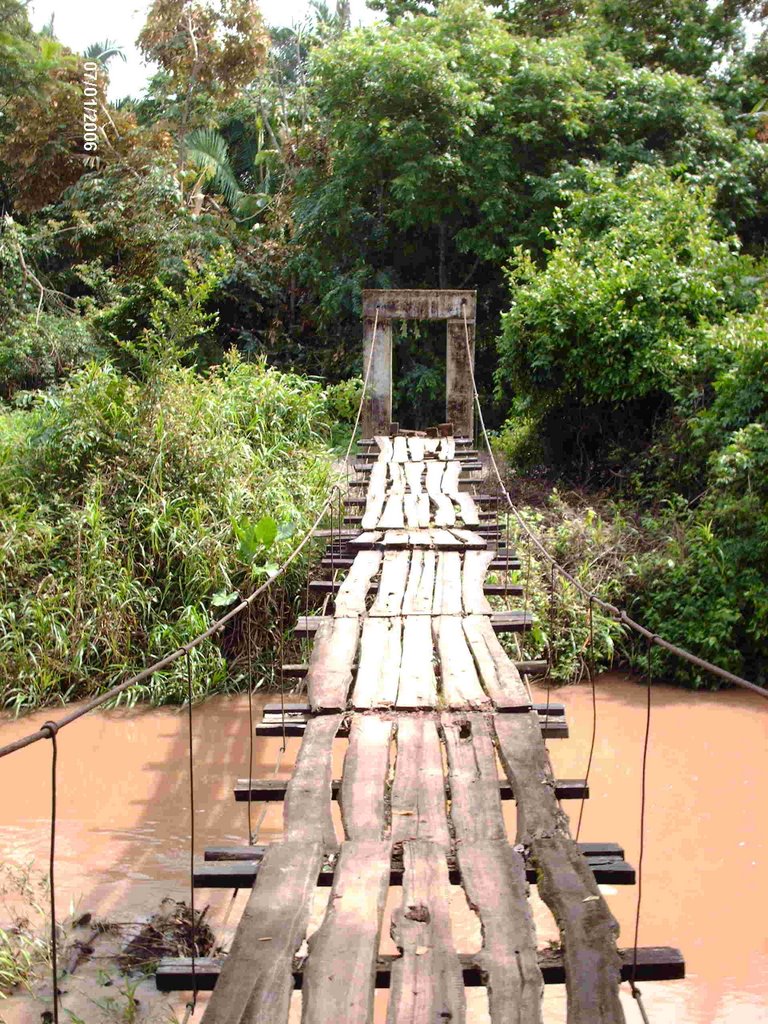
shivery footbridge
MONDAY, JULY 3
The hotel and the doctor have absorbed my cash. I don't carry credit cards. Lose or have them stolen and God knows what will happen before you reach a tellephone. Debit cards are safe. I require a bank and an ATM machine.
The hotel is on a vast ranch owned by an American billionaire. He has owned the ranch for thirty years. He flies in from his home in Hawai on his private jet each month for a few days. The hotel is a recent hobby (its losses tax deductible).
The river is high after the storm. The farm manager drives me by pick-up to the river ford. I cross the foot bridge and walk two Ks to the village of San Francisco. I find a mechanic to overhaul the bike. He directs me to a parts shop where I find replacement mirrors - genuine Honda parts in a community served by two general stores and a kiosk selling cheap jeans and T-shirts.
The nearest bank is thirty-three Ks in the town of Jicaral. The bus journey takes over two hours.
TIPPY-TOE IN CHAPEL
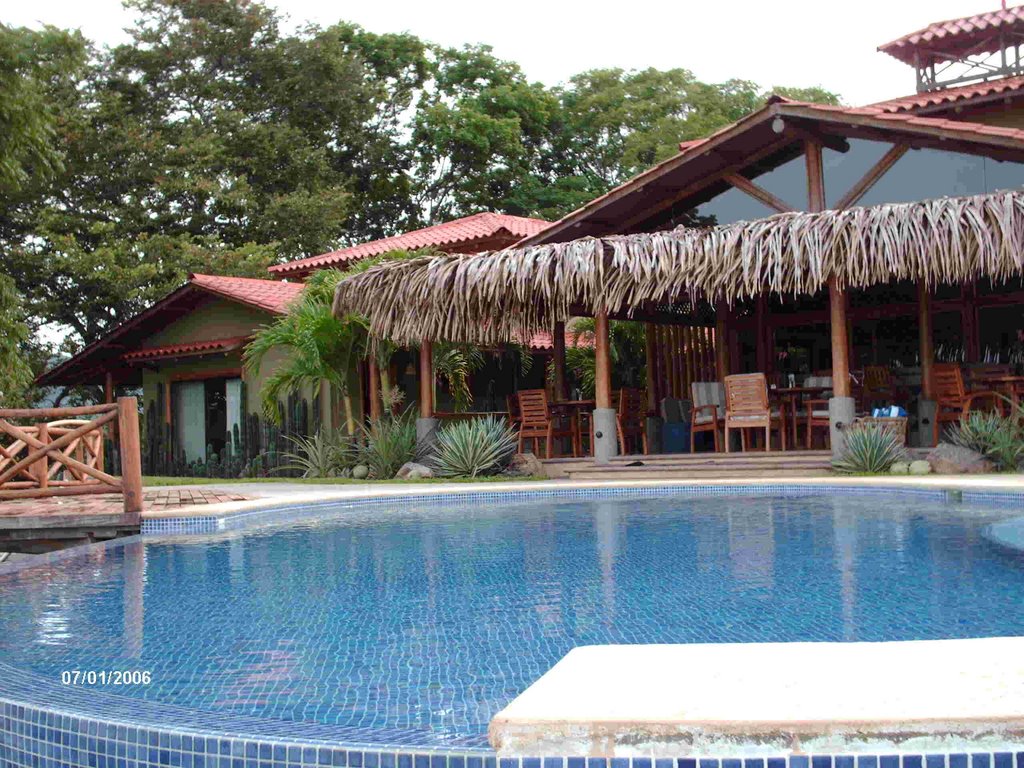
boutique hotel pool
MONDAY, JULY 3
The curtains are open to the terrace. I wake at dawn. My watch broke in the crash. No matter, this is too beautiful a time and place for bed. I am alone as I tippy-toe out to the pool terrace and see the river clear for the first time, waters brown in spate. Two curls of chocolate sand mark the corners of its mouth. Palm trees hide the beach. I sit alone by the pool and watch surf break, three white lines. A howler monkey hollers back in the trees. Bird chatter seems noisy. The tide shifts a flock of pelican off the sand. Clumsy on the ground, they are wonderfully graceful as they glide up-river into the trees. I watch a pale yellow buitterfly. Workers arrive to mend storm-damage, collect broken branches. They work in silence. The Philippina manageress presents me with a steaming mug of black coffee. I have been up an hour. It is 6 a.m.
CONRAD COUNTRY
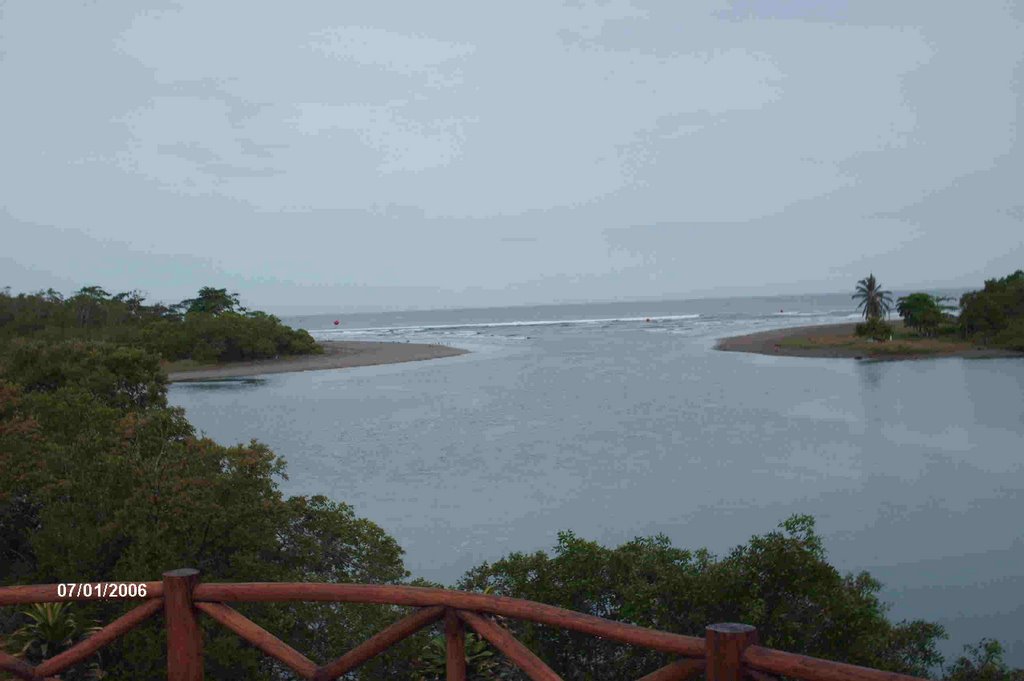
Conrad country by daylight
MONDAY, JULY 3
Thunder smashes me out of sleep. Disorientated, I lie shivering with cold. Lightning shows a picture window, terrace, trees bent under a silver downpour. The cold is air conditioning. I stagger to the windows and out to the room's private terrace. I arrived after nightfall and am unprepared for my surroundings. Lightning displays black waters of a river below the terrace. An animal shrieks. Thunder shakes the terrace. Trees quake beneath a squall. Lightning and I see, thru the rain, surf break. This is Conrad country...
BANKER TALK
SUNDAY, JULY 2
I don't eat dinner. The banker and his wife talk with me once their children are in bed. They have worked in London which they loved (or are polite), and in Miami which they hated for the domination of the new rich Cubans whom they found ostentatious and revoltingly vulgar. The banker visits Cuba regularly on business - barable, he says, for three or four days. He can pretend he is a tourist and ignore the reality that the Cubans suffer: poverty, lack of freedom.
The rash of condominiums on the peninsular is another hate. Prices will double once the coast road is tarred (paid for by the Costa Rican tax payer). Already Costa Ricans, even of their financial bracket, are priced out of the market in their own land. They have been forced to reasess their view of themselves. Costa Ricans had considered themselves different from other Latin Americans, more advanced, more cultured, more organised, more on a par with the United States with whom they were natural allies. Only a few years ago they would have identified with the US team in the World Cup, yet now the banker's friends celebrated when the US was eliminated.
The Iraq war had changed their perceptions (I quote the banker). Access to satelite TV had forced their eyes open. They watched bombs and shells fall. They saw pictures of American soldiers abusing Arabs. This was what the US had done in Panama, killed hundreds in the desire to grab one man. Arabs, Latin Americans weren't important.
This Blog may be offensive and hurtful to my daughter and to my American friends. Should I act as censor or write what I am told?
I don't eat dinner. The banker and his wife talk with me once their children are in bed. They have worked in London which they loved (or are polite), and in Miami which they hated for the domination of the new rich Cubans whom they found ostentatious and revoltingly vulgar. The banker visits Cuba regularly on business - barable, he says, for three or four days. He can pretend he is a tourist and ignore the reality that the Cubans suffer: poverty, lack of freedom.
The rash of condominiums on the peninsular is another hate. Prices will double once the coast road is tarred (paid for by the Costa Rican tax payer). Already Costa Ricans, even of their financial bracket, are priced out of the market in their own land. They have been forced to reasess their view of themselves. Costa Ricans had considered themselves different from other Latin Americans, more advanced, more cultured, more organised, more on a par with the United States with whom they were natural allies. Only a few years ago they would have identified with the US team in the World Cup, yet now the banker's friends celebrated when the US was eliminated.
The Iraq war had changed their perceptions (I quote the banker). Access to satelite TV had forced their eyes open. They watched bombs and shells fall. They saw pictures of American soldiers abusing Arabs. This was what the US had done in Panama, killed hundreds in the desire to grab one man. Arabs, Latin Americans weren't important.
This Blog may be offensive and hurtful to my daughter and to my American friends. Should I act as censor or write what I am told?
BOUTIQUE CHURCH
altar orchids in a boutique hotel
SUNDAY, JULY 2
I have eleven stitches in my hand. I have lost blood. I need a comfortable bed. And I MUST grab the opportunity to talk with a Costa Rican in the upper echelons of the country's professional classes. The bikers have brought my bike to the village. A pick-up driver gives me a lift back to the boutique hotel. The banker family are the only guests. Quiet is an understatement: non-denominational chapel in an up market funeral parlor.
The manageress is Philippina. I recognize the unhuh she uses, so soft (even when she argues the price). I negotiate the room rate down from $120 to $80. Breakfast is included. So is an acre of stone-floor, a king size bed and a bathroom for commited sybarites.
SUNDAY, JULY 2
I have eleven stitches in my hand. I have lost blood. I need a comfortable bed. And I MUST grab the opportunity to talk with a Costa Rican in the upper echelons of the country's professional classes. The bikers have brought my bike to the village. A pick-up driver gives me a lift back to the boutique hotel. The banker family are the only guests. Quiet is an understatement: non-denominational chapel in an up market funeral parlor.
The manageress is Philippina. I recognize the unhuh she uses, so soft (even when she argues the price). I negotiate the room rate down from $120 to $80. Breakfast is included. So is an acre of stone-floor, a king size bed and a bathroom for commited sybarites.
Tuesday, July 04, 2006
ROUGH ROAD TO DISASTER
SUNDAY, JULY 2
The dirt road twists between steep hills. Each village is in mid-football match. A great quantity of beer is drunk. I stop for water and am bought a coke by the barman. A mike-assisted chant comes from round the corner. The Spanish is too fast and too acented for my understanding. A few numbers are recogniseable. Psalms? Verses from the Bible? And threats that this is the audience's last chance, Absolutely the last chance! And more numbers. I presume an evangelist preacher in competition with the evident sinfulness of a football match - with a bar serving alcohol.
Wrong.
I ride round the corner into a cattle auction.
The sun is setting. I have reached that point of fatigue where taking decisions becomes near impossible. I spot a boutique hotel (so advertised) on what could be a side road.
I take the other road. It leads down hill. A left turn is signed to a beach. I hear a bike behind me. I break and turn to ask the driver´s advice. One moment of inatention. The Honda slips. I lie beneath the Honda. The leather gaiter saves my leg from frying. One mirror is smashed.
The two men on the following bike lift the Honda free. Only then do I realise that a shard of mirror has sliced my right hand.
A second bike rider insists I return for First Aid to the boutique hotel.
The wound is washed. Blood spurts. A Costa Rican family are the only guests. The husband, an investment banker, drives me to the village of San Francisco. I wait in a restaurant. Doctor and wife arrive. The wife wears a mini miniskirt. Owners, staff and clientelle of the restaurant watch while I am injected, scrubbed and sewn. The blood is amplier and more realistic than the blood in the Al Pacino movie on TV. The audience is mine.
I dislike watching the doctor at work.
Wherer else to look?
The doctor may dislike me looking at his wife's thighs.
Such are the dilemas of the walking wounded.
The dirt road twists between steep hills. Each village is in mid-football match. A great quantity of beer is drunk. I stop for water and am bought a coke by the barman. A mike-assisted chant comes from round the corner. The Spanish is too fast and too acented for my understanding. A few numbers are recogniseable. Psalms? Verses from the Bible? And threats that this is the audience's last chance, Absolutely the last chance! And more numbers. I presume an evangelist preacher in competition with the evident sinfulness of a football match - with a bar serving alcohol.
Wrong.
I ride round the corner into a cattle auction.
The sun is setting. I have reached that point of fatigue where taking decisions becomes near impossible. I spot a boutique hotel (so advertised) on what could be a side road.
I take the other road. It leads down hill. A left turn is signed to a beach. I hear a bike behind me. I break and turn to ask the driver´s advice. One moment of inatention. The Honda slips. I lie beneath the Honda. The leather gaiter saves my leg from frying. One mirror is smashed.
The two men on the following bike lift the Honda free. Only then do I realise that a shard of mirror has sliced my right hand.
A second bike rider insists I return for First Aid to the boutique hotel.
The wound is washed. Blood spurts. A Costa Rican family are the only guests. The husband, an investment banker, drives me to the village of San Francisco. I wait in a restaurant. Doctor and wife arrive. The wife wears a mini miniskirt. Owners, staff and clientelle of the restaurant watch while I am injected, scrubbed and sewn. The blood is amplier and more realistic than the blood in the Al Pacino movie on TV. The audience is mine.
I dislike watching the doctor at work.
Wherer else to look?
The doctor may dislike me looking at his wife's thighs.
Such are the dilemas of the walking wounded.
COSTA CONDO
SUNDAY, JULY 2
I see no hovels as I speed down the Panamerican Highway in Coata Rica. I note less refuse on the verge than in other Central American countries. The land is more cared for, big trees left standing to protect the soil. And, yes, there is a feel more of organisation than of chaos. I turn south at Liberia. The road passes the airport. Miles of US type hoardings in English advertise car hire and real estate. What is unreal estate?
A hardtop road takes me to Samana - a resort village on a safe beach according to my four-year-old guidebook. The resort has developed. Sunday, it is crowded with coaches. More signs for real estate, for condominiums. The signs are in English. I take the coastal road. It is dirt but good dirt. This is hill country, green and beautiful. White Brahmin cows graze paddocks. White walls and white entrance gates wall off the coast. Apparently condos in Costa Rica are vast gated communities as opposed to apartment blocks.
I see no hovels as I speed down the Panamerican Highway in Coata Rica. I note less refuse on the verge than in other Central American countries. The land is more cared for, big trees left standing to protect the soil. And, yes, there is a feel more of organisation than of chaos. I turn south at Liberia. The road passes the airport. Miles of US type hoardings in English advertise car hire and real estate. What is unreal estate?
A hardtop road takes me to Samana - a resort village on a safe beach according to my four-year-old guidebook. The resort has developed. Sunday, it is crowded with coaches. More signs for real estate, for condominiums. The signs are in English. I take the coastal road. It is dirt but good dirt. This is hill country, green and beautiful. White Brahmin cows graze paddocks. White walls and white entrance gates wall off the coast. Apparently condos in Costa Rica are vast gated communities as opposed to apartment blocks.
FRONTIER
SUNDAY, JULY 2
At the frontier I met a young Argetinian driving a white Dodge semi-sports car home. Leaving Nicaragua was a slow rather than difficult. Costa Rica was good natured, though definitely slow. I carry photocopies of everything from the size of my belly button to the circumference of my ears. The Argentinan was more innocent. He didn´t know the registration number of the Dodge engine - nor where to find it. I entered customs behind him. He caught me up on the highway some three quarters of an hour later. Perhaps we will meet again, possibly in Panama both trying to work out how to get our vehicles to Colombia at a sensible price.
At the frontier I met a young Argetinian driving a white Dodge semi-sports car home. Leaving Nicaragua was a slow rather than difficult. Costa Rica was good natured, though definitely slow. I carry photocopies of everything from the size of my belly button to the circumference of my ears. The Argentinan was more innocent. He didn´t know the registration number of the Dodge engine - nor where to find it. I entered customs behind him. He caught me up on the highway some three quarters of an hour later. Perhaps we will meet again, possibly in Panama both trying to work out how to get our vehicles to Colombia at a sensible price.
NICE AMERICAN
SATURDAY, JULY 1
I sat in San Juan at an open-air waterfront bar last night with a retired dealer in truck parts. The bar was the least pretentious on the bay. The owner, a woman in her sixties, had owned half the hill that forms the right hook of the bay. She and her family sold the hill rediculously cheap some years back. They didn´t know. Now big houses dot the hill. Meanwhile the American, bored at doing nothing and angry that developers had taken advantage of a nice woman and her family, invested in a couple of fishing launches that her sons run. Fishing hasn´t been good the past weeks. The American is considering opening a furniture store in partnership with the woman. They are not a relationship. The woman is merely someone the American likes and admires - and, as I wrote, he is bored doing nothing and enjoys being part of a community. He drank vodka breezers, I drank a beer and we ate prawns in a chili sauce. The breeze blew off the sea. The moon did its thing, as did the stars. Nothing special happened, a pleasent evening...
I sat in San Juan at an open-air waterfront bar last night with a retired dealer in truck parts. The bar was the least pretentious on the bay. The owner, a woman in her sixties, had owned half the hill that forms the right hook of the bay. She and her family sold the hill rediculously cheap some years back. They didn´t know. Now big houses dot the hill. Meanwhile the American, bored at doing nothing and angry that developers had taken advantage of a nice woman and her family, invested in a couple of fishing launches that her sons run. Fishing hasn´t been good the past weeks. The American is considering opening a furniture store in partnership with the woman. They are not a relationship. The woman is merely someone the American likes and admires - and, as I wrote, he is bored doing nothing and enjoys being part of a community. He drank vodka breezers, I drank a beer and we ate prawns in a chili sauce. The breeze blew off the sea. The moon did its thing, as did the stars. Nothing special happened, a pleasent evening...
RAT OLYMPICS
SATURDAY, JULY 1
San Juan I found an air conditioned room mid-block back from the beach for $7. The building was wood with a tin roof and old. My room faced onto the first floor terrace. The bathroom worked. The sheets were clean. I have been away from such places a while and had forgotten the coconut rats. The San Juan rats are in training for the relay races at the rat olympics. Training commences shortly before 5 a.m. First the athlete rats sprint up and down the ceiling. Soon the rat coaches get in on the act with their shrieks and chittering.
San Juan I found an air conditioned room mid-block back from the beach for $7. The building was wood with a tin roof and old. My room faced onto the first floor terrace. The bathroom worked. The sheets were clean. I have been away from such places a while and had forgotten the coconut rats. The San Juan rats are in training for the relay races at the rat olympics. Training commences shortly before 5 a.m. First the athlete rats sprint up and down the ceiling. Soon the rat coaches get in on the act with their shrieks and chittering.
GOOD RIDDANCE TO GRANADA
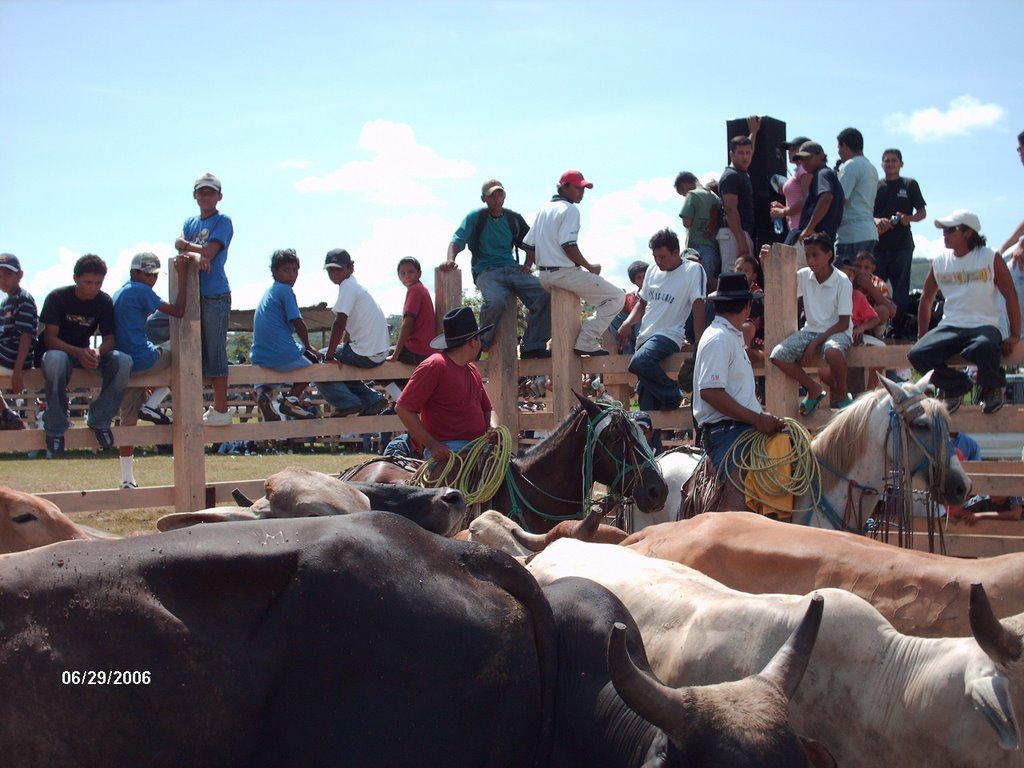
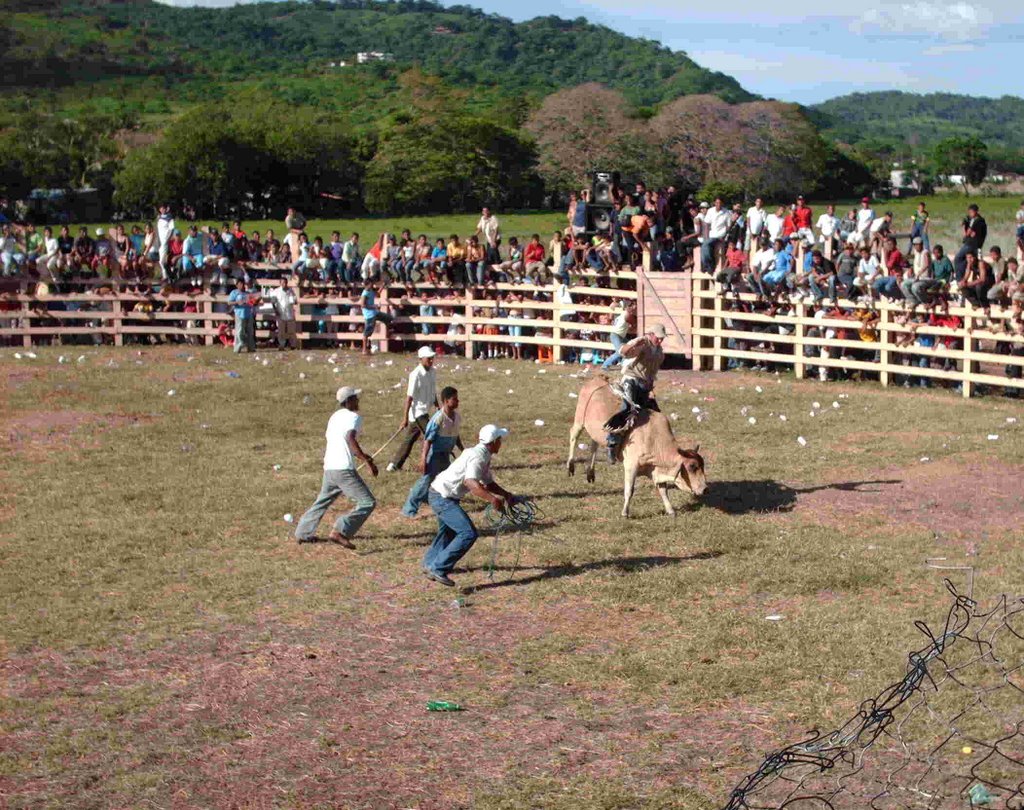
San Juan rodeo<
SATURDAY, JULY 1
A ride along the lake thru rich green ranch land studded with big trees is a fine way to clear your head. I turned off 30 Ks short of the Costa Rica frontier to San Juan. The approach to the beach town is thru country spread with giant green mole hills tufted with small trees. Hills ringed a small wood stadium. People were streaming in off the road. A cop told me they were holding a rodeo. I paid for a shade seat on the upper terrace. A brass and drum band was blasting a Latin American version of circus YahYah music. Hawkers were shouting their wares: icecream, sodas, cashew, banana chips, chittlings, barbecue meat. A brass band clarion heralded the launch from a chute of a bull calf with rider. The calf bucked a few times, became bored. I was back where I wanted to be, back in Central America.
LAST LOOK AT GRANADA
SATURDAY, JULY 1
I watched the England/Portugal football match at a corner bar with a big screen TV. The bar is a familar of all such countries. It is the hangout of US citizens resident in Nicaragua to drink cheap and get laid. I sit at the bar. A girl with silver nails and vaguely bleached hair sits at a table beside a North American in his fifties. She looks fifteen. The man comes to the bar. The girl is his trophy and he shows the girl's ID to the man sitting beside me. The ID says she is nineteen. The ID maybe the girl's and it maybe authentic. He sits back down beside her. She leans a little away from him as he strokes her arm. Later he returns to the bar for a fresh beer. Midday and his eyes are already marginally out of focus. The girl looks round. Anyone can read her thoughts: "I'll be in bed with that drunk soon, YUK!"
This is one couple. There were others much the same together with the standard solitary drunks who had missed out at AA. The North Americans were yelling for England. The few Latinos identified with Portugal. Most of them were unsureas to where Portugal is.
I watched the England/Portugal football match at a corner bar with a big screen TV. The bar is a familar of all such countries. It is the hangout of US citizens resident in Nicaragua to drink cheap and get laid. I sit at the bar. A girl with silver nails and vaguely bleached hair sits at a table beside a North American in his fifties. She looks fifteen. The man comes to the bar. The girl is his trophy and he shows the girl's ID to the man sitting beside me. The ID says she is nineteen. The ID maybe the girl's and it maybe authentic. He sits back down beside her. She leans a little away from him as he strokes her arm. Later he returns to the bar for a fresh beer. Midday and his eyes are already marginally out of focus. The girl looks round. Anyone can read her thoughts: "I'll be in bed with that drunk soon, YUK!"
This is one couple. There were others much the same together with the standard solitary drunks who had missed out at AA. The North Americans were yelling for England. The few Latinos identified with Portugal. Most of them were unsureas to where Portugal is.
FURTHER NUTS
FRIDAY, JUNE 30
Did I mention the Austrailian tax lawyer, mid forties? Free biking is his passion, riding down mountains and over share drops. Jed would understand. Maybe it's a cure for boredom. If so, it is a little extreme.
Did I mention the Austrailian tax lawyer, mid forties? Free biking is his passion, riding down mountains and over share drops. Jed would understand. Maybe it's a cure for boredom. If so, it is a little extreme.
NUTS IN GRANADA
FRIDAY, JUNE 30
You have met the toothless American with two cigarettes and a reincarnated mother. Meet another of Granada's happy hunters. This one I took to dinner. Serial killers are hot with the media. This was a serial non-killer. She had tired to kill herself on three occasions and had tried twice to kill her lover.
One failure in self-killing, OK. Next try, you go up a few extra floors before jumping out the window. As to killing her lover: they were sharing a bed. How diffcult can that be? Didn´t she store a baseball bat in the umbrella stand? I would have understood were she a vegetarion and shocked by blood. However, she ate half a barbecue chicken while relating that she had been saved by meditation, alternative medcine and studying the works of Carlos Castenedes. Carlos Catenedes is the Brown Rice Sixties, marajuhana, LSD and the hush hush secrets of Motorcycle Maintenence. I was the one with the motorcycle...
As to meditation, she was messing up on the dose. She was fine thru the chicken. We had to walk a few blocks in search of carrot cake and the dosage ran low. She transformed from Church mouse to F this and F that to the accompiment of a shrill giggle. Ouch...
You have met the toothless American with two cigarettes and a reincarnated mother. Meet another of Granada's happy hunters. This one I took to dinner. Serial killers are hot with the media. This was a serial non-killer. She had tired to kill herself on three occasions and had tried twice to kill her lover.
One failure in self-killing, OK. Next try, you go up a few extra floors before jumping out the window. As to killing her lover: they were sharing a bed. How diffcult can that be? Didn´t she store a baseball bat in the umbrella stand? I would have understood were she a vegetarion and shocked by blood. However, she ate half a barbecue chicken while relating that she had been saved by meditation, alternative medcine and studying the works of Carlos Castenedes. Carlos Catenedes is the Brown Rice Sixties, marajuhana, LSD and the hush hush secrets of Motorcycle Maintenence. I was the one with the motorcycle...
As to meditation, she was messing up on the dose. She was fine thru the chicken. We had to walk a few blocks in search of carrot cake and the dosage ran low. She transformed from Church mouse to F this and F that to the accompiment of a shrill giggle. Ouch...
THE H SCALE
FRIDAY, JUNE 30
I have been mulling over a scale against which to grade people. H10/Positive is supreme in politically correct prejudice, ignorance and idiocy. An H10/Negative is awarded for maximum awareness of reality. You have to be aware to care. M
y Texan host rated high on the H/negative scale. His property taxes back in Texas had been quadrupled, taxes for schooling Latino illegal immigrants' kids. My host's objection was to the woeful education rather than the taxes. Educate the kids successfully and they would be a credit to their communities and the USA. Educating them badly was both imoral and a sure route to future social problems.
My host had owned a business in Texas and had bought his siblings' share of the family ranch. Aged fifty he discovered hot air ballooning. He learnt to pilot balloons, gained a licence, sold up his business and spent 10 years living and flying in the heart of Kenya's Massai reserve. Recently he paddled a canoe down the San Juan river from Lake Nicaragua to the Caribbean. As for politics, he has a deep contempt for the entire Bush family. He has known them all, all his life. He is my age.
I have been mulling over a scale against which to grade people. H10/Positive is supreme in politically correct prejudice, ignorance and idiocy. An H10/Negative is awarded for maximum awareness of reality. You have to be aware to care. M
y Texan host rated high on the H/negative scale. His property taxes back in Texas had been quadrupled, taxes for schooling Latino illegal immigrants' kids. My host's objection was to the woeful education rather than the taxes. Educate the kids successfully and they would be a credit to their communities and the USA. Educating them badly was both imoral and a sure route to future social problems.
My host had owned a business in Texas and had bought his siblings' share of the family ranch. Aged fifty he discovered hot air ballooning. He learnt to pilot balloons, gained a licence, sold up his business and spent 10 years living and flying in the heart of Kenya's Massai reserve. Recently he paddled a canoe down the San Juan river from Lake Nicaragua to the Caribbean. As for politics, he has a deep contempt for the entire Bush family. He has known them all, all his life. He is my age.
BIG HOUSE
FRIDAY, JUNE 30
Stir fry in a dream house, Spanish colonial two patios deep. The owners, a male Texan married to a Brit, built a second floor above the centre section that seperates the two patios. The raised floor is invisible from the street, not does it overlook their neigbours. It is supported on earthquake proof pillars to protect the original ground-floor rooms of adobe. The one side is open. The view is perfect across ancient pantiled roofs to the massive cloud-wrapped volcano that domiates Granada. A vast unglazed window faces the opposit way and collects the breeze in proof that a well-designed space has need neither for a/c nor fans. A pool fills the rear patio, the front patio is jungle garden. The floors are baked clay. Furniture is sparse and simple. Conversation was warm while the beer was cold.
Stir fry in a dream house, Spanish colonial two patios deep. The owners, a male Texan married to a Brit, built a second floor above the centre section that seperates the two patios. The raised floor is invisible from the street, not does it overlook their neigbours. It is supported on earthquake proof pillars to protect the original ground-floor rooms of adobe. The one side is open. The view is perfect across ancient pantiled roofs to the massive cloud-wrapped volcano that domiates Granada. A vast unglazed window faces the opposit way and collects the breeze in proof that a well-designed space has need neither for a/c nor fans. A pool fills the rear patio, the front patio is jungle garden. The floors are baked clay. Furniture is sparse and simple. Conversation was warm while the beer was cold.
Subscribe to:
Posts (Atom)