TUESDAY, AUGUST 29
I am recovered. We leave Banos at 8.20 and ride across the Alto Plano. The country is green and Borderish. The hills to our right are streaked with snow. To our left, Tungurahua and its mates are blanketed in cloud. I brake to permit a family to cross the road. The mother leads a black and white Friesian cow. Two small boys herd two black pigs with fawn snouts. A daughter and shaggy donkey bring up the rear. The mother wears a dark green felt hat and a red jumper beneath a tweed coat. I raise a gloved hand in greeting and she gives me a big grin.
The land changes. The soil is grey and thin and over-farmed. Houses are small. Erosion scars the hillsides. Contour planting and contour ploughing would help – or building terraces. We ride through cloud. The women wear white festive bowler hats. Later we are back into green uplands and dairy farms and large, two story-houses. In Cuenca we find a hotel converted from a colonial house. We have rooms opening onto the rear patio and breakfast at $13 each. The water is hot. We have ridden over the Andes.
Thursday, August 31, 2006


SICK
MONDAY, AUGUST 28
I woke at 4 a.m. and threw-up. I threw-up at 4.30 and at 5 and a 5.30 and at 6. Mostly I controlled the flow and kept the cleaning to a minimum. Ming came to wake me for breakfast at 7.30. I groaned. He brought me a bottle of water and a glass of orange juice – my request. The juice was a disaster – though it completed the purging of my belly. The bug moved to my bowels. Ming brought me antibiotics. I want to go home.
I woke at 4 a.m. and threw-up. I threw-up at 4.30 and at 5 and a 5.30 and at 6. Mostly I controlled the flow and kept the cleaning to a minimum. Ming came to wake me for breakfast at 7.30. I groaned. He brought me a bottle of water and a glass of orange juice – my request. The juice was a disaster – though it completed the purging of my belly. The bug moved to my bowels. Ming brought me antibiotics. I want to go home.
TUNGURAHUA
SUNDAY, AUGUST 27
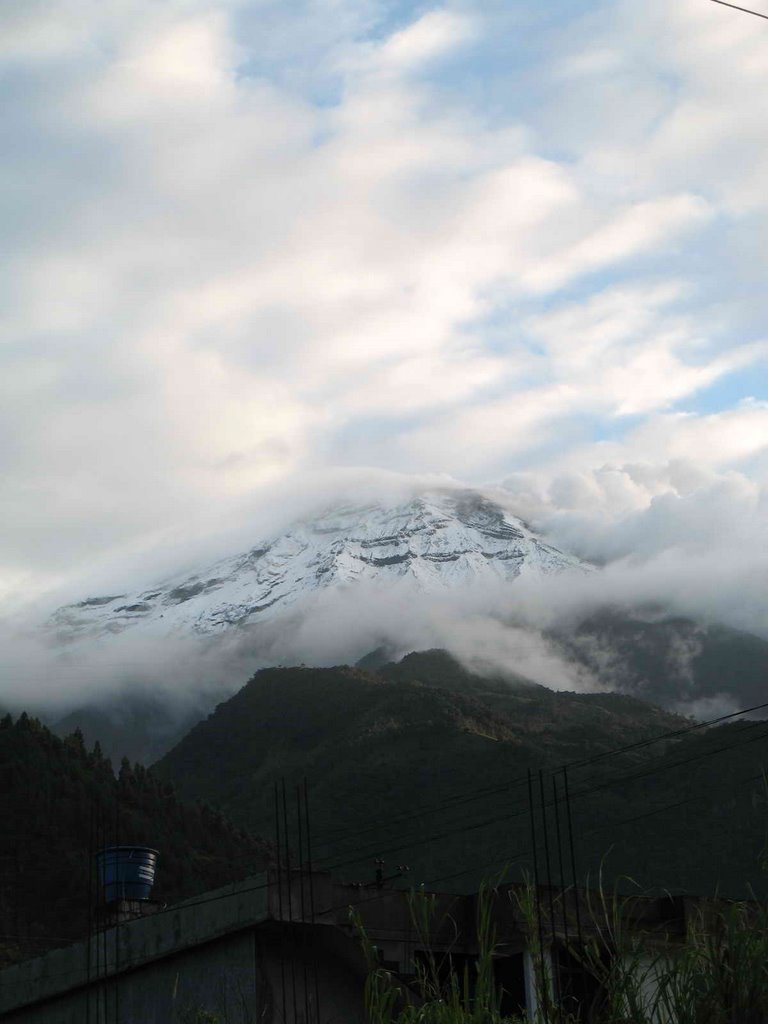
We have seen Tungurahua. We were riding back from the ranch. The top of the volcano and the lower slopes were in cloud. The evening sun struck the center section. The effect was surprising, a giant’s sponge pudding streaked in icing sugar and chocolate. The river ran black through the sluice gates at the hydroelectric station. Spray bore the stink of sulphur. Ming stopped to photograph. I yelled at him to keep going, not to inhale.
ODD

SUNDAY, AUGUST 27
My Catholic and Spanish heritage pursues me. We rode today out to a farm that Michel owned and sold to a Swiss. Michel is resting there a week. The farm is three miles down a dirt track. The track is new. Prior to the track, transport was by foot or mule or moke.
A foreign priest owned the farm and five foreign priests established a community there. A priestly cousin invited Michel to run a pharmacy at the entrance to the farm. The Versailles branch of the Knights of Malta donated the medication. Here is the heritage: my grandfather and my father were Knights, my brother is a Knight.
Insect bites did for the community – or a shaman.
Michel’s cousin bought the farm and later sold it to Michel.
The present owner, the Swiss, has let the place go to ruin.
Ming and I walked with Michel up a steep hill and across a field of rushes to the community’s church. The church is built of wood. It is narrow and has a steep roof and a small steeple. Steps lead up the back to what was the community’s library and study room. The leader of the community lived in a house a further hundred metres or so beyond the church – until the bugs got him. Now the bugs devour his house and the church.
The church and the community leader’s house and the field have a bad feel. The field is edged by jungle. We walked in amongst the trees a little way and disturbed a wild boar. Then we walked back down the hill to what was the dispensary. Michel converted the dispensing room into a bedroom. The terrace is ample. We sat at a wood table and ate too much and shared two bottles of wine. The ex-dispensary has a good feel and Michel is a good kind man. The hill and the church and the gone-community are different. Both Ming and I were disturbed. We want to know more. Asking Michel seemed impolite and dangerously intrusive.
MING
SATURDAY, AUGUST 26
I return from the river to the hotel. Ming’s Monster is parked beside the Honda. Great! Ming is resting. I wake him and we recount our adventures. We eat at Marianne’s with the two Germans and the two Canadians of my rafting trip. I order the Moroccan chicken. The other five order steaks – poivre or with mushrooms. Perfect.
I return from the river to the hotel. Ming’s Monster is parked beside the Honda. Great! Ming is resting. I wake him and we recount our adventures. We eat at Marianne’s with the two Germans and the two Canadians of my rafting trip. I order the Moroccan chicken. The other five order steaks – poivre or with mushrooms. Perfect.
DELICIOUS DAUBE
FRIDAY, AUGUST 25
I have been eating again at Marianne’s, the restaurant of Provence. Tonight I ate the daube. Delicious. And I learn more of Michel. His parents had a vineyard and a hotel in Burgundy. Michel wished to be a doctor. His father had doubts as to Michel’s aptitude. His terms for supporting Michel through his studies were that Michel also study hotel management and spend his vacations working in restaurant kitchens. The father is dead. Michel qualified but never practised. Michel’s mother lives and keeps a watchful eye on the vineyard.
I have been eating again at Marianne’s, the restaurant of Provence. Tonight I ate the daube. Delicious. And I learn more of Michel. His parents had a vineyard and a hotel in Burgundy. Michel wished to be a doctor. His father had doubts as to Michel’s aptitude. His terms for supporting Michel through his studies were that Michel also study hotel management and spend his vacations working in restaurant kitchens. The father is dead. Michel qualified but never practised. Michel’s mother lives and keeps a watchful eye on the vineyard.
Wednesday, August 30, 2006
TOAD ON THE RIVER
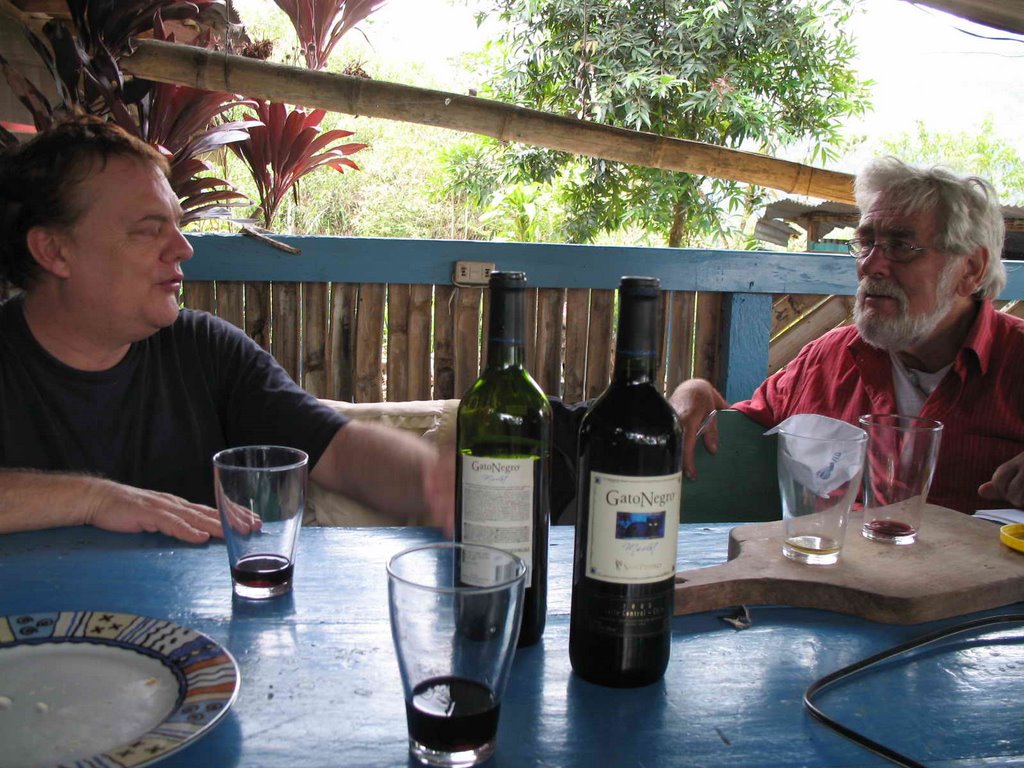
MICHEL & TOAD IN MORE NORMAL CIRCUMCTANCES
SATURDAY, AUGUST 26
I am an old man. I have little fear of death. I fear being unable to cope. Paddling is easy. We hit the first rapid. Waves ram the blunt bow of the raft up. Spray soaks us. I have a sudden memory of wizzing down-river in Kenya on truck tires. A hydrologist, Basil Bell, was measuring the river´s water flow. The local witch doctor demanded that Basil buy a goat to sacrifice to the river. The goat belonged to the witchdoctor. This memory shoots us through the first rapid and I am having fun. More than fun – this is glorious. We high-five our paddles and whack the blades in the water. We hit the next rapid. The waves are bigger. No problem. Alex and I are the rafting virgins. We grin and smack hands. I have found a sport that old men can enjoy. The river spits us out of the canyon, jungle on both sides. We swing close to the bank, orchids on the trees, a couple of optimistic vultures overhead…Yes, this is great. More rapids, more high-fiving, shouts of exultation. Our guide orders us to paddle standing. Standing on a raft is not for old men. I have sufficient difficulty standing upright on dry land.
YELLING
SATURDAY, AUGUST 26
Our guide is in his forties, a short man with a belly. He has learnt the white-water instructor spiel in English. He can instruct: how to paddle, when to paddle, when to stop paddling, and he tells us never, never, ever to let go of our paddles. He instructs us in what to do if we fall in the water (lie on our backs); what to do if someone else falls in the water. And he shouts a good deal at the footballing German – I suspect because the German is the biggest member of our party and shouting at him reassures our small guide as to his own importance. I help lift the raft into the river. People get in the side opposite me. This forces the raft my way. My paddle is under the raft – I have hold of the handle. Our guide yells at me to board. I yell back that my paddle is under the raft. He shouts at me to get in. I repeat that my paddle is under the raft. He screeches – and I understand. He speaks the necessary English. His understanding of the language is zero. So I shout at him in Spanish that he is a c…. and that my paddle is under the raft. The message reaches his brain. He pushes the raft out from the beach and my paddle is free. I board the raft. He gets in behind me. He says, in Spanish, that he’s sorry for the misunderstanding. I say that that’s fine just so long as he doesn’t drown me. He promises not to drown me. Good. We are making progress.
Our guide is in his forties, a short man with a belly. He has learnt the white-water instructor spiel in English. He can instruct: how to paddle, when to paddle, when to stop paddling, and he tells us never, never, ever to let go of our paddles. He instructs us in what to do if we fall in the water (lie on our backs); what to do if someone else falls in the water. And he shouts a good deal at the footballing German – I suspect because the German is the biggest member of our party and shouting at him reassures our small guide as to his own importance. I help lift the raft into the river. People get in the side opposite me. This forces the raft my way. My paddle is under the raft – I have hold of the handle. Our guide yells at me to board. I yell back that my paddle is under the raft. He shouts at me to get in. I repeat that my paddle is under the raft. He screeches – and I understand. He speaks the necessary English. His understanding of the language is zero. So I shout at him in Spanish that he is a c…. and that my paddle is under the raft. The message reaches his brain. He pushes the raft out from the beach and my paddle is free. I board the raft. He gets in behind me. He says, in Spanish, that he’s sorry for the misunderstanding. I say that that’s fine just so long as he doesn’t drown me. He promises not to drown me. Good. We are making progress.
Tuesday, August 29, 2006
FOLLOW OUR LEADERS
SATURDAY, AUGUST 26
We head down a dirt track to a wooden bridge. The truck is too big to cross the bridge. The rubber boat is transferred to a pick-up. The pick up crosses the bridge and disappears into the jungle. We cross on foot. The three women take the lead. Absolved of responsibility, we men trail along in their tracks and discuss serious matters - mostly football, the World Cup. We walk and we walk – maybe a mile up hill before the pick-up catches us. The pick-up had turned down a sidetrack through trees immediately on crossing the bridge. Our fearless leader was too dumb to leave one of his assistants at the turning. And we men, of course, were merely following the women. While the women were being real men and striding on ahead. This is not a good beginning.
We head down a dirt track to a wooden bridge. The truck is too big to cross the bridge. The rubber boat is transferred to a pick-up. The pick up crosses the bridge and disappears into the jungle. We cross on foot. The three women take the lead. Absolved of responsibility, we men trail along in their tracks and discuss serious matters - mostly football, the World Cup. We walk and we walk – maybe a mile up hill before the pick-up catches us. The pick-up had turned down a sidetrack through trees immediately on crossing the bridge. Our fearless leader was too dumb to leave one of his assistants at the turning. And we men, of course, were merely following the women. While the women were being real men and striding on ahead. This is not a good beginning.
NUTTY COMPANY
SATURDAY, AUGUST 26
The Germans are male nineteen-year-olds from Leipzig, the old East Germany. The guide is unaware of the teenager-imposed curfew on European teenagers rising before 11 a.m. and fetches them from their hotel. Alex will be studying politics at University. His partner in craziness studies football and hopes to be a history teacher – however he goofed off at Gymnasium and doubts whether his grades are acceptable. He has very white legs and has been collecting mosquito bites – the ones that are wet in the middle, yellowish at the edges and give pharmacists a warming scent of imminent profit.
We drive forty-five minutes in an open-sided truck with a rubber boat on the roof. The benches are situated to cram in the maximum of small indigenous Latin Americans. We are cramped sitting sideways and springs are an extra the tour operator wouldn’t sign for – bump, thump, bump.
I talk with the ringlet Canadian, Kay. She has given up extreme sports and has lost twenty pounds in pure muscle weight. I have lost sixteen pounds of pure fat Kay has been taught the politically correct generalities of the Conquest: the Spaniards were evil; they destroyed the indigenous culture. The indigenous culture was feudal; King served by a clique of the most senior nobles. Beneath came the senior provincial nobles and a layer of lesser nobles. Nobles didn’t work. Non-nobles worked their butts off. Conquistadors came of a feudal system. In America, they married the daughters of the top nobles – advancement closed to them back home. No one weeps for the destruction of the feudal system in Europe. Few weep for the fall of Soviet feudalism. The Conquistadors should be criticised for maintaining the feudal system. Many of those with education (mostly Friars) did precisely that.
The Germans are male nineteen-year-olds from Leipzig, the old East Germany. The guide is unaware of the teenager-imposed curfew on European teenagers rising before 11 a.m. and fetches them from their hotel. Alex will be studying politics at University. His partner in craziness studies football and hopes to be a history teacher – however he goofed off at Gymnasium and doubts whether his grades are acceptable. He has very white legs and has been collecting mosquito bites – the ones that are wet in the middle, yellowish at the edges and give pharmacists a warming scent of imminent profit.
We drive forty-five minutes in an open-sided truck with a rubber boat on the roof. The benches are situated to cram in the maximum of small indigenous Latin Americans. We are cramped sitting sideways and springs are an extra the tour operator wouldn’t sign for – bump, thump, bump.
I talk with the ringlet Canadian, Kay. She has given up extreme sports and has lost twenty pounds in pure muscle weight. I have lost sixteen pounds of pure fat Kay has been taught the politically correct generalities of the Conquest: the Spaniards were evil; they destroyed the indigenous culture. The indigenous culture was feudal; King served by a clique of the most senior nobles. Beneath came the senior provincial nobles and a layer of lesser nobles. Nobles didn’t work. Non-nobles worked their butts off. Conquistadors came of a feudal system. In America, they married the daughters of the top nobles – advancement closed to them back home. No one weeps for the destruction of the feudal system in Europe. Few weep for the fall of Soviet feudalism. The Conquistadors should be criticised for maintaining the feudal system. Many of those with education (mostly Friars) did precisely that.
LEGS LIKE JED'S
SATURDAY, AUGUST 26
I sit on a bumpy sofa at the tour operator. Two young physios working in London arrive. Next come a Canadian couple, sociology students. The woman is fair and wears her hair in ringlets. I recognise her legs. They are of an attractive shape. However, what are recognisable are the bumps and bruises and scars. She is a suicide addict (she would blah on about extreme sports). Introduce her to my youngest son, Jed, and they would relate immediately. They would get right into the scar game:
Yea, that was this competition or that.
The track was wet. I hit this tree.
Some idiot got in my way,
I didn’t see the cliff.
They have real cool ambulances.
Meanwhile we wait for the two Germans. Our guide for the day relates that the Germans are probably7 tired; they were mountain biking yesterday and did this swing thing off a bridge. No, not bungy jumping. You wear a harness attached to a rope and dive way out from a bridge so that you swing in huge arcs.
‘Over what?’ I ask.
‘A canyon.’
‘With rocks?’
‘Of course, with rocks.’
Why would I go white-water rafting with these maniacs?
I sit on a bumpy sofa at the tour operator. Two young physios working in London arrive. Next come a Canadian couple, sociology students. The woman is fair and wears her hair in ringlets. I recognise her legs. They are of an attractive shape. However, what are recognisable are the bumps and bruises and scars. She is a suicide addict (she would blah on about extreme sports). Introduce her to my youngest son, Jed, and they would relate immediately. They would get right into the scar game:
Yea, that was this competition or that.
The track was wet. I hit this tree.
Some idiot got in my way,
I didn’t see the cliff.
They have real cool ambulances.
Meanwhile we wait for the two Germans. Our guide for the day relates that the Germans are probably7 tired; they were mountain biking yesterday and did this swing thing off a bridge. No, not bungy jumping. You wear a harness attached to a rope and dive way out from a bridge so that you swing in huge arcs.
‘Over what?’ I ask.
‘A canyon.’
‘With rocks?’
‘Of course, with rocks.’
Why would I go white-water rafting with these maniacs?
WERE I A WOMAN
SATURDAY, AUGUST 26
A petard is something upon which you hoist yourself. Am I hoisted – or petarded? I am also suffering from palpitations. I should keep this a secret. Real men don’t suffer palpitations. Palpitations are a woman’s complaint. Women, being more sensible than men, take heed. They face what ever it is that is giving them the palpitations and conclude, No. No, we won’t do that.
Were I a woman I would not be going white-water rafting. I am not referring here to any other woman, merely and specifically to the imaginary seventy-three-year-old woman I would be were I a woman. I would be suffering from palpitations and conclude that white-water rafting wasn’t my bag.
Uneasy with my own nervousness, I sit down to breakfast up on the hotel terrace and ask the two young women serving whether the volcano scares them.
They answer that they are scared but not very scared..
They might be offended were I to ask whether they suffer from palpitations. Anyway palpitations is absent from my Spanish vocabulary. Doing the word in sign language would certainly be offensive.
And of course there is nothing voluntary in their situation. Banos is their home. Where would they go?
While all I need say is, ‘Actually I’ve changed my mind. Keep the thirty dollars.’
A petard is something upon which you hoist yourself. Am I hoisted – or petarded? I am also suffering from palpitations. I should keep this a secret. Real men don’t suffer palpitations. Palpitations are a woman’s complaint. Women, being more sensible than men, take heed. They face what ever it is that is giving them the palpitations and conclude, No. No, we won’t do that.
Were I a woman I would not be going white-water rafting. I am not referring here to any other woman, merely and specifically to the imaginary seventy-three-year-old woman I would be were I a woman. I would be suffering from palpitations and conclude that white-water rafting wasn’t my bag.
Uneasy with my own nervousness, I sit down to breakfast up on the hotel terrace and ask the two young women serving whether the volcano scares them.
They answer that they are scared but not very scared..
They might be offended were I to ask whether they suffer from palpitations. Anyway palpitations is absent from my Spanish vocabulary. Doing the word in sign language would certainly be offensive.
And of course there is nothing voluntary in their situation. Banos is their home. Where would they go?
While all I need say is, ‘Actually I’ve changed my mind. Keep the thirty dollars.’
BLOND MENACE
FRIDAY, AUGUST 26
A young and unreasonably beautiful blond lady approached me on Main Street, Banos. She asked if I spoke Spanish.
I said, ‘More or less’.
She asked how long had I been in Banos and how long did I intend staying and wasn’t I afraid of the volcano?
‘Not a bit,’ I said. You know – doing the masculine bit, hands spread to indicate the innocence of our surroundings. What could a little-bitty volcano do to a real man? Or to an unreasonably pretty young blond lady who was under the protection of such man?
She asked whether I would repeat all this for Latin American cable TV.
‘Sure,’ I said. ‘Delighted to be of help…’ both to her and to Banos.
So we did it for the camera. I added a few embellishments: the great restaurants, the mountain walks (across white-hot ashes), white-water rafting.
I had impressed her. ‘You white-water raft?’
‘Absolutely,’ I said. ‘Going tomorrow. River is in great shape.’ This is the movies. I am on camera. It is not for real. And it is for the unreasonably beautiful young blond lady. To impress her…
Half the town watches the interview. It is broadcast midday and on the 6 o’clock news. The woman tour-operator two doors up from the hotel sees it. She expresses her delight at my change of mind. She has two Canadians as well as the two Germans. With me, that makes five. Plus two girls staying in my hotel who still have to confirm…
What can I say? I try, ‘Is it safe for a man my age? You know, an old man with a heart condition? I don’t want to be a nuisance to the others.’
‘Do you take medication?’ asks the tour operator.
A ray of hope. ‘Absolutely,’ I say. ‘Four pills in the evening and one in the morning.’
‘Then that’s alright,’ says the tour operator. ‘That will be thirty dollars. Sign here.’
A young and unreasonably beautiful blond lady approached me on Main Street, Banos. She asked if I spoke Spanish.
I said, ‘More or less’.
She asked how long had I been in Banos and how long did I intend staying and wasn’t I afraid of the volcano?
‘Not a bit,’ I said. You know – doing the masculine bit, hands spread to indicate the innocence of our surroundings. What could a little-bitty volcano do to a real man? Or to an unreasonably pretty young blond lady who was under the protection of such man?
She asked whether I would repeat all this for Latin American cable TV.
‘Sure,’ I said. ‘Delighted to be of help…’ both to her and to Banos.
So we did it for the camera. I added a few embellishments: the great restaurants, the mountain walks (across white-hot ashes), white-water rafting.
I had impressed her. ‘You white-water raft?’
‘Absolutely,’ I said. ‘Going tomorrow. River is in great shape.’ This is the movies. I am on camera. It is not for real. And it is for the unreasonably beautiful young blond lady. To impress her…
Half the town watches the interview. It is broadcast midday and on the 6 o’clock news. The woman tour-operator two doors up from the hotel sees it. She expresses her delight at my change of mind. She has two Canadians as well as the two Germans. With me, that makes five. Plus two girls staying in my hotel who still have to confirm…
What can I say? I try, ‘Is it safe for a man my age? You know, an old man with a heart condition? I don’t want to be a nuisance to the others.’
‘Do you take medication?’ asks the tour operator.
A ray of hope. ‘Absolutely,’ I say. ‘Four pills in the evening and one in the morning.’
‘Then that’s alright,’ says the tour operator. ‘That will be thirty dollars. Sign here.’
GENTLE RAIN FROM HEAVEN
FRIDAY, AUGUST 26
This morning, I chatted with a woman tour operator two doors up from the hotel. She has two German clients for a half-day of white-water rafting tomorrow. She requires six. She doubts whether there are six tourists in Banos. The town exists on tourism. The town is dying. The Iraq war, the Israeli destruction of Lebanon and the price of oil cause anxiety. Add fear of terrorism. TV coverage of Tungurahua having fun is the final whammy. A gentle rain from heaven? Fine, if you have a raincoat, an umbrella, are holding hands with you sweetheart and expect soon to be sharing his or her bed. A rain of boulders is different. Boulders aren’t romantic. Nor is great big volcano spewing lava at your hotel bedroom window. You don’t want to get in bed. You want to get in you car and get the hell out of where ever all this threatening stuff is happening. As for voluntarily visiting such a place, no thanks.
However I am in Banos and I have developed a weird loyalty to the dump. Very weird. Though not so weird as to risk my life white-water rafting. This is where being in your seventies is useful. You can refuse such offers without appearing rude.
This morning, I chatted with a woman tour operator two doors up from the hotel. She has two German clients for a half-day of white-water rafting tomorrow. She requires six. She doubts whether there are six tourists in Banos. The town exists on tourism. The town is dying. The Iraq war, the Israeli destruction of Lebanon and the price of oil cause anxiety. Add fear of terrorism. TV coverage of Tungurahua having fun is the final whammy. A gentle rain from heaven? Fine, if you have a raincoat, an umbrella, are holding hands with you sweetheart and expect soon to be sharing his or her bed. A rain of boulders is different. Boulders aren’t romantic. Nor is great big volcano spewing lava at your hotel bedroom window. You don’t want to get in bed. You want to get in you car and get the hell out of where ever all this threatening stuff is happening. As for voluntarily visiting such a place, no thanks.
However I am in Banos and I have developed a weird loyalty to the dump. Very weird. Though not so weird as to risk my life white-water rafting. This is where being in your seventies is useful. You can refuse such offers without appearing rude.
Friday, August 25, 2006
CUISINE DE PROVENCE
THURSDAY, AUGUST 24
La Cuisine de Provence has been open fifteen years: twelve tables; for decoration, a few engravings, but mostly framed cartoons from the Twenties. The menu is simple: salads, two soups, pasta, steak au poivre, daube, boeuf a le Moroccan and three deserts. Michel is unmistakably French. Six o’clock in the evening and he has been at the stove since midday. Now is his hour of relaxation before the dinner clientele arrive. He sits at the table in front of the small bar. He is fair-haired and chubby - as are most chefs (other than the dieting stars of television). We chat. He offers me a glass of a good red wine from Chile. I feel at home.
I return at 8 p.m. and order the steak au poivre. Michel has taught a local slaughterer the arts of a French butcher and the steak is the first tender cut of beef that I have eaten on this trip. A Spaniard asks to share my table. A salesman in his late twenties, he is Catalan and from Barcelona. He is at the end of a five week vacation. He hates Ecuador. The people see a foreigner, they eat him (slang for overcharging). I reply that I must be privileged in being old, that Latin Americans care for the aged.
The Catalan eats crudely a vast plate of spaghetti, drinks bottled water. I ask for a second glass of wine.
The Catalan calls for the bill - neither Please nor Thank you. The bill comes and he grimaces. “Five dollars for a spaghetti.”
I say, “You can eat at a comidor, a dollar fifty.”
“I can’t eat that shit.” He stuffs his billfold back in his pants pocket and departs.
Two local musicians perform music of the Andes. The atmosphere is friendly, the people good natured. I sip a third glass of wine.
Back on the street, I clean my spectacles. I notice flames way up above the town. Tungurahua is erupting. I replace my spectacles and discover that I am looking in the wrong direction at the wrong volcano. The flames are a crucifix of electric bulbs. Banos remains a dump – it is a very pleasant dump.
La Cuisine de Provence has been open fifteen years: twelve tables; for decoration, a few engravings, but mostly framed cartoons from the Twenties. The menu is simple: salads, two soups, pasta, steak au poivre, daube, boeuf a le Moroccan and three deserts. Michel is unmistakably French. Six o’clock in the evening and he has been at the stove since midday. Now is his hour of relaxation before the dinner clientele arrive. He sits at the table in front of the small bar. He is fair-haired and chubby - as are most chefs (other than the dieting stars of television). We chat. He offers me a glass of a good red wine from Chile. I feel at home.
I return at 8 p.m. and order the steak au poivre. Michel has taught a local slaughterer the arts of a French butcher and the steak is the first tender cut of beef that I have eaten on this trip. A Spaniard asks to share my table. A salesman in his late twenties, he is Catalan and from Barcelona. He is at the end of a five week vacation. He hates Ecuador. The people see a foreigner, they eat him (slang for overcharging). I reply that I must be privileged in being old, that Latin Americans care for the aged.
The Catalan eats crudely a vast plate of spaghetti, drinks bottled water. I ask for a second glass of wine.
The Catalan calls for the bill - neither Please nor Thank you. The bill comes and he grimaces. “Five dollars for a spaghetti.”
I say, “You can eat at a comidor, a dollar fifty.”
“I can’t eat that shit.” He stuffs his billfold back in his pants pocket and departs.
Two local musicians perform music of the Andes. The atmosphere is friendly, the people good natured. I sip a third glass of wine.
Back on the street, I clean my spectacles. I notice flames way up above the town. Tungurahua is erupting. I replace my spectacles and discover that I am looking in the wrong direction at the wrong volcano. The flames are a crucifix of electric bulbs. Banos remains a dump – it is a very pleasant dump.
DUMP
THURSDAY, AUGUST 24
Banos is a small town and sits on a ledge near the bottom of a river gorge. The volcanoes that surround it are up close. The tallest and the closest, Tungurahua, has been erupting for the past few months - I pass men clearing pumice and boulders from the road on my descent into town. I have been half-frozen earlier in the day and came close to being killed by an over-testicled truck driver. Now I perceive a dump. Banos has an ugly church and two nondescript squares with nondescript gardens and a rash of mini-hotels. Most buildings are in the process of gaining a new layer or have owners who contemplate a future of further layers. The new layers require vertical steel reinforcing rods. With all this uncloaked reinforcing, you have a metallic porcupine. Most shops are small and sell similar hand-knitted items of indigenous tat. Restaurants are in over abundance, few evidence any taste in décor. Nor am I enthused by whole peeled guinea pigs cooking on sidewalk barbecues. Add scores of tour agencies all advertising on scruffy billboards the same hells: white water rafting, volcano scaling, jungle treks, swami searches, biking, quadra-biking, enduro-biking, horseback ridding and every kind of massage and bath and you have a picture common to such dumps, a picture I could do without.
I find a hotel owned by a Frenchman. The Frenchman hasn’t been in a while. A charming and very pretty receptionist tells me that he is scared of the volcano. She shows me a great room that has a table in a big window. The window gives onto two non-exploding volcanoes (the exploder is to our rear). The room has an ample bathroom. The water is piping hot. I thaw and feel better, more optimistic. I walk the town and am met by a mirage: a small restaurant that serves La Cuisine de Provence. Surely not…
Banos is a small town and sits on a ledge near the bottom of a river gorge. The volcanoes that surround it are up close. The tallest and the closest, Tungurahua, has been erupting for the past few months - I pass men clearing pumice and boulders from the road on my descent into town. I have been half-frozen earlier in the day and came close to being killed by an over-testicled truck driver. Now I perceive a dump. Banos has an ugly church and two nondescript squares with nondescript gardens and a rash of mini-hotels. Most buildings are in the process of gaining a new layer or have owners who contemplate a future of further layers. The new layers require vertical steel reinforcing rods. With all this uncloaked reinforcing, you have a metallic porcupine. Most shops are small and sell similar hand-knitted items of indigenous tat. Restaurants are in over abundance, few evidence any taste in décor. Nor am I enthused by whole peeled guinea pigs cooking on sidewalk barbecues. Add scores of tour agencies all advertising on scruffy billboards the same hells: white water rafting, volcano scaling, jungle treks, swami searches, biking, quadra-biking, enduro-biking, horseback ridding and every kind of massage and bath and you have a picture common to such dumps, a picture I could do without.
I find a hotel owned by a Frenchman. The Frenchman hasn’t been in a while. A charming and very pretty receptionist tells me that he is scared of the volcano. She shows me a great room that has a table in a big window. The window gives onto two non-exploding volcanoes (the exploder is to our rear). The room has an ample bathroom. The water is piping hot. I thaw and feel better, more optimistic. I walk the town and am met by a mirage: a small restaurant that serves La Cuisine de Provence. Surely not…
NEAR DEATH
THURSDAY, AUGUST 24
I am ridding gently down hill towards the hot springs resort of Banos when a truck driver nearly kills me. The driver was in a race with another truck. The two trucks were abreast on a road narrowed by a ribbon of fine sand bordering the curb. Brake hard in the sand and the bike will lide. The truck misses me by less than a meter. Son of a bitch…may he die a painful and inglorious death.
Though I am presumptuous in complaining of a solitary near-death experience.
The volcano, Tungurahua, has spent the past few months attempting to kill the citizens of Banos. The volcano has done a fine job in killing the resort’s economy. This is high season and the town is empty bar a few volcano watchers and the usual dimwits who never watch TV news or read a paper. Of which category am I? Make your pick.
I am ridding gently down hill towards the hot springs resort of Banos when a truck driver nearly kills me. The driver was in a race with another truck. The two trucks were abreast on a road narrowed by a ribbon of fine sand bordering the curb. Brake hard in the sand and the bike will lide. The truck misses me by less than a meter. Son of a bitch…may he die a painful and inglorious death.
Though I am presumptuous in complaining of a solitary near-death experience.
The volcano, Tungurahua, has spent the past few months attempting to kill the citizens of Banos. The volcano has done a fine job in killing the resort’s economy. This is high season and the town is empty bar a few volcano watchers and the usual dimwits who never watch TV news or read a paper. Of which category am I? Make your pick.
LATACUNGA
THURSDAY, AUGUST 24
Latacunga is cold. A nice pair of cops tell me to park my bike up against theirs in the No Parking zone on the main square. The garden in the centre of the square is beautiful, complex and immaculately maintained. The interior of the cathedral is austere. The colonial mansion of the Marquises of Miraflores is built of grey volcanic stone. The mansion has been restored and opened to the public. The restorers have done a great job. Imagine a down-market theme restaurant for the Party elite in the old Soviet Union.
Latacunga is cold. A nice pair of cops tell me to park my bike up against theirs in the No Parking zone on the main square. The garden in the centre of the square is beautiful, complex and immaculately maintained. The interior of the cathedral is austere. The colonial mansion of the Marquises of Miraflores is built of grey volcanic stone. The mansion has been restored and opened to the public. The restorers have done a great job. Imagine a down-market theme restaurant for the Party elite in the old Soviet Union.
ICED EQUATOR
THURSDAY, AUGUST 24
Ecuador is on the equator. In my subconscious, I equate the equator with sweat, sunburn and mosquitoes. I am ridding towards an erupting volcano spewing white-hot pumice. Definitely warm. I wear a thick shirt, three undershirts and a sweater, long johns and thick chinos, a bright blue rain suit. Reasonable protection?
Not even halfway to reasonable.
I am ridding at 70 Ks an hour into a head wind. My gloves are too short in the wrist to overlap the cuffs of the baby blue jacket. The wind races straight up my sleeves. It is a vicious wind. God knows from whence it blows. Probably off some ice-bound mountain of which Ecuador suffers a surfeit. Ah, yes, and another point: I am crossing a fell with the road peeking at 3400 meters. Take the highest mountain in the United Kingdom, triple it and subtract a smidgen. This is the type of idiotic sum I do in my head to stop dwelling on how cold I am. How cold am I? Freezing.
I am heading for Latacunga, 80 Ks south of Quito.
Latacunga is down a few meters.
Ecuador is on the equator. In my subconscious, I equate the equator with sweat, sunburn and mosquitoes. I am ridding towards an erupting volcano spewing white-hot pumice. Definitely warm. I wear a thick shirt, three undershirts and a sweater, long johns and thick chinos, a bright blue rain suit. Reasonable protection?
Not even halfway to reasonable.
I am ridding at 70 Ks an hour into a head wind. My gloves are too short in the wrist to overlap the cuffs of the baby blue jacket. The wind races straight up my sleeves. It is a vicious wind. God knows from whence it blows. Probably off some ice-bound mountain of which Ecuador suffers a surfeit. Ah, yes, and another point: I am crossing a fell with the road peeking at 3400 meters. Take the highest mountain in the United Kingdom, triple it and subtract a smidgen. This is the type of idiotic sum I do in my head to stop dwelling on how cold I am. How cold am I? Freezing.
I am heading for Latacunga, 80 Ks south of Quito.
Latacunga is down a few meters.
BE CAREFUL
Be careful. Guidebooks can wreck a trip with their warnings of danger. So can hotel staff. My advice? Ask a cop.
The cops in the Historic Quarter of Quito mostly come armed with Rottweillers. We were presented with a Rottweiller as protection when living in the Dominican Republic. I warned my son, Jed, aged three at the time, that the Rottweiller was not a play dog. Jed mounted astride the poor beast and bashed it over the head with a coconut. Unsurprisingly, the beast looked stunned.
I recounted this tale to a cop. He grinned and said that, Yes, Rottweillers were in truth big softies.
As to walking after dark, the cop advised, “Not alone and late at night…” a warning applicable to most big cities.
I dined in an upmarket restaurant by the Cathedral ($22) and walked an hour. The food was excellent, a salad of heart of palm, fresh asparagus, avocado and the normal greens and reds. Next came a fat fillet of fish in caper sauce. The manager passed by and asked if everything was alright. I looked down at my plate wiped clean with garlic bread and we both laughed. As to the great churches and monasteries of the city, they are superb and lit brilliantly, domes and spires pure magic against the night sky. The United States inherited nothing of equivalent cultural importance from the Founding Fathers. Even the tale of a few witch burnings appears minor when compared to a friar forced to eat his own eyes. Less you suspect me of being anti the USA, the Founding Fathers were Brits…
The cops in the Historic Quarter of Quito mostly come armed with Rottweillers. We were presented with a Rottweiller as protection when living in the Dominican Republic. I warned my son, Jed, aged three at the time, that the Rottweiller was not a play dog. Jed mounted astride the poor beast and bashed it over the head with a coconut. Unsurprisingly, the beast looked stunned.
I recounted this tale to a cop. He grinned and said that, Yes, Rottweillers were in truth big softies.
As to walking after dark, the cop advised, “Not alone and late at night…” a warning applicable to most big cities.
I dined in an upmarket restaurant by the Cathedral ($22) and walked an hour. The food was excellent, a salad of heart of palm, fresh asparagus, avocado and the normal greens and reds. Next came a fat fillet of fish in caper sauce. The manager passed by and asked if everything was alright. I looked down at my plate wiped clean with garlic bread and we both laughed. As to the great churches and monasteries of the city, they are superb and lit brilliantly, domes and spires pure magic against the night sky. The United States inherited nothing of equivalent cultural importance from the Founding Fathers. Even the tale of a few witch burnings appears minor when compared to a friar forced to eat his own eyes. Less you suspect me of being anti the USA, the Founding Fathers were Brits…
WHO AM I
I enjoyed female companionship today, an Ecuadorian, a professor of Spanish. She is a mature lady, of my age or more. Dark spectacles protect her eyes and she is neatly dressed in matching woollens and proper shoes. We meet because I hold a church door open for her. Together, we visit two churches and two museums. She asks my nationality and whether I am Catholic. I reply that, Yes, I am Catholic and that I am English. It is an easy answer. The truth is far more complex. In the solitude of this journey, riding a bike day after day through strange territory, often feeling my years, I have thought much of what I am and what I have made of myself. I am a writer – that first and foremost. By culture, I am Catholic, though drawn to the Sufi tradition of Islamic mysticism. I am a European with roots deep in the soil of Worcestershire and Herefordshire, yet I often feel more at ease in the French language. I feel a great affinity with and admiration for the Spain of my Spanish forefathers, the Spain of the Conquest, and I feel at home here in Hispanic America. So there you have it: in every sense, a meztiso
QUITO
Scrap of conversation overheard when being driven in a cab to the Honda agency:
The speaker is in her early twenties, a natural blond, slender and pretty, North American. She grasps firmly to the arm of a tall handsome Ecuadorian, mid-thirties, dressed in good taste that cost money. “My novio says…” was all we overheard.
“Two novios,” says the cab driver and we break-up laughing.
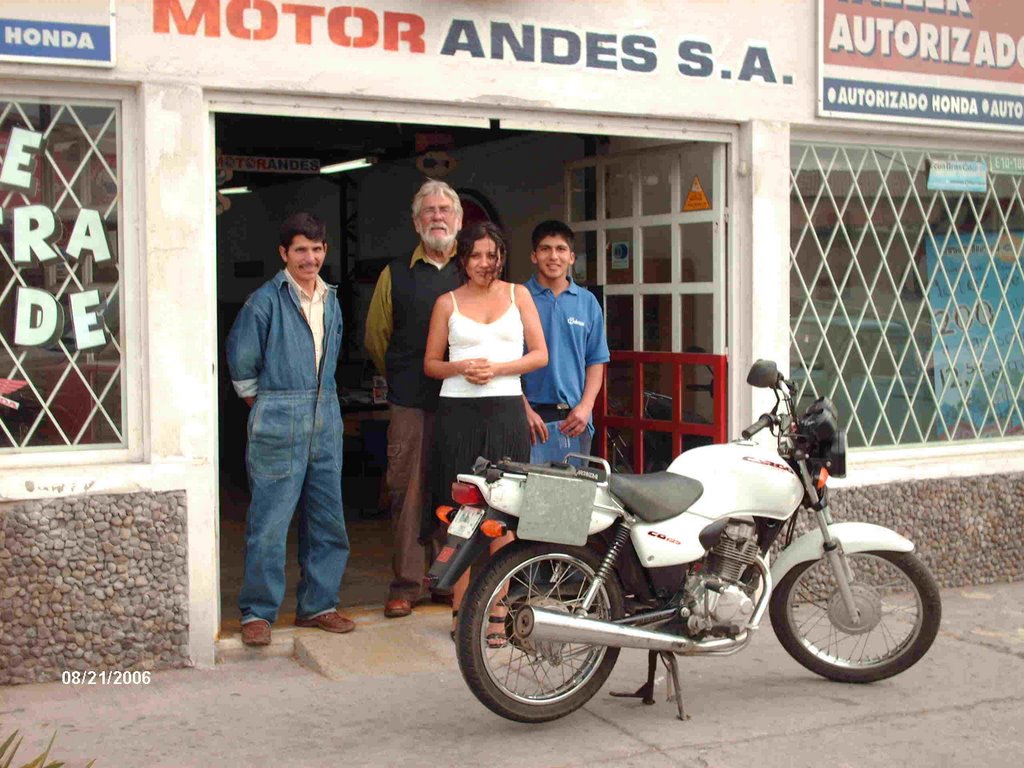
MOTO ANDES serviced the Honda, oil change, brakes, chain tension, etcetera. The chief mechanic showed me how to set the valves and clean the petrol filter. They billed me $17.
QUITO
Two days in Quito and I have walked the Historic Quarter, visited half a dozen museums and a dozen churches. Highlights? The Chapel of the Rosary in Santo Domingo. Disappointments? The Jesuit temple. The Chapel of the Rosary is a place of prayer through which tourists tiptoe. The Jesuit temple is a museum in which the rare religious tiptoes amongst the tourists.
The refectory in the monastery of Santo Domingo is another must. The walls are panelled with portraits of friars in their moments of martyrdom. Roasted, beheaded, stabbed, strangled, stretched – it is all up there on the walls, great décor to admire while eating dinner. My favourite is the monk forced to eat his own eyes…
The carved wood ceiling in the choir loft at the church of San Francisco is superb; the ceramics at the Museo Nacional del Banco Central in the New City and the brilliant layout of the museum; the luminosity in some of the ceramics and in the oil painting on alabaster in the Museo de San Francisco.
Ghastly are the paintings in the 1920s mansion of the heiress, Maria Augusta Urrutia. Noted for her charitable works, her weirdest act of charity was in supporting an Ecuadorian artist whose vast paintings are a mix of pre-Raphaelite without talent and worse art nouveau. The architecture is little better (the patios are mean) and the house lacks a single comfortable chair.
The refectory in the monastery of Santo Domingo is another must. The walls are panelled with portraits of friars in their moments of martyrdom. Roasted, beheaded, stabbed, strangled, stretched – it is all up there on the walls, great décor to admire while eating dinner. My favourite is the monk forced to eat his own eyes…
The carved wood ceiling in the choir loft at the church of San Francisco is superb; the ceramics at the Museo Nacional del Banco Central in the New City and the brilliant layout of the museum; the luminosity in some of the ceramics and in the oil painting on alabaster in the Museo de San Francisco.
Ghastly are the paintings in the 1920s mansion of the heiress, Maria Augusta Urrutia. Noted for her charitable works, her weirdest act of charity was in supporting an Ecuadorian artist whose vast paintings are a mix of pre-Raphaelite without talent and worse art nouveau. The architecture is little better (the patios are mean) and the house lacks a single comfortable chair.
Monday, August 21, 2006
PROS
MONDAY, AUGUST 21
I am in Quito, capitol of Ecuador. I have a room with an angled view across the square to the church of Santo Domingo. From my bed I can see a massive statue of the Virgin that watches over Quito from a hill top. The water in the shower is hot and the shower has a shower rose. I have internet in the hotel. Here, as prommised, are the facts of that night off the Colombian coast:
TUESDAY, AUGUST 7
No land in sight and ten foot rollers all afternoon and in to the night as we cross the gulf. Cloud covers the moon and we sail without lights. Tension is thick and heavy as a loaf of wet bread. We spy lights ahead. 3 a.m and we peer into the dark. A deeper blackness gains shape. Rocks and walls rather than trees. Five big open outboard launches speed alongside. Two huge men are the first to board. Twenty black stevedores follow. Side tarpaulins are furled. The tarps off the cargo are yanked clear. The big men stand on truck tyres to conduct the unloading. Everything is labelled. Stevedores shout the name on a bale or carton. MM shouts the launch number. These are pros. They have done this a hundred times or a thousand times. The speed impresses. MM screams for extra care as two big jetskis are manhandled into one launch. Two outboard motors follow - high horsepower by the size of the cartons. This is an upmarket launch, side rails, centre wheel. I watch as it speeds off into the night. The skipper warns us to tell immigration and customs that we came by launch from the Panamanian border.
I am in Quito, capitol of Ecuador. I have a room with an angled view across the square to the church of Santo Domingo. From my bed I can see a massive statue of the Virgin that watches over Quito from a hill top. The water in the shower is hot and the shower has a shower rose. I have internet in the hotel. Here, as prommised, are the facts of that night off the Colombian coast:
TUESDAY, AUGUST 7
No land in sight and ten foot rollers all afternoon and in to the night as we cross the gulf. Cloud covers the moon and we sail without lights. Tension is thick and heavy as a loaf of wet bread. We spy lights ahead. 3 a.m and we peer into the dark. A deeper blackness gains shape. Rocks and walls rather than trees. Five big open outboard launches speed alongside. Two huge men are the first to board. Twenty black stevedores follow. Side tarpaulins are furled. The tarps off the cargo are yanked clear. The big men stand on truck tyres to conduct the unloading. Everything is labelled. Stevedores shout the name on a bale or carton. MM shouts the launch number. These are pros. They have done this a hundred times or a thousand times. The speed impresses. MM screams for extra care as two big jetskis are manhandled into one launch. Two outboard motors follow - high horsepower by the size of the cartons. This is an upmarket launch, side rails, centre wheel. I watch as it speeds off into the night. The skipper warns us to tell immigration and customs that we came by launch from the Panamanian border.
BORDER
Monday, August 21
I was up today at 6 a.m., scratching my $4 bug bites. I dragged the clothes back on that I wore yesterday, took my morning pill and fled outside. I want the bike serviced - two hours until the Honda concessionaire opens. I search a breakfast place with doors. Ipialesians, at least the restaurateurs, dislike doors. Maybe doors keep customers out. They might keep the cold out. Perhaps Ipialesians enjoy cold. I eat scrambled eggs and drink coffee in the most crowded restaurant open at that hour - the more people, the more heat. Not in Ipiales. Ipiales is on a one-city campaign to off set global warming. I wait outside the Honda concessionaire until 8:30 before someone tells me the shop is shut for the day - a private fiesta of some kind. So much for Ipiales. I load up and flee for the border. And there, immediately outside town, is that hallmark of Anglo-Italian enterprise: a Forte Travel Lodge! True, I swear to God...
The Colombian customs and Immigration officials are routinely courteous.
I have been warned of Ecuadorian officialdom. I have been told to expect endless delays and endless tiresomness. I draw up at the customs post. The tall uniformed customs man who approaches is a travel fantasist. He wants details of my trip. What had I enjoyed most? What were the disapointments, the scares? We chat. A second uniform joins us. The first accompanies me to a window to have the import papers for the bike done. The inspector shows me where the engine and chassis numbers are on the Honda - something I ought to know. At Immigration I fall in with a group of Ecuadorians heading for a salsa fest in Cali. And with a Scotish couple from Perthshire. He has travelled the Carter Bar and confirms the similarities. I had counted on two hours at the border. I was out in one. My guide book warns of a police post outside the next town and that drivers should have their papers ready. The police post was there. The policeman grinned at me and waved me thru. And something had happened. I was feeling insanely pleased. Insane because a steady drizzle stung my cheeks and I was cold. The road had climbed from the frontier. The hills were cloud topped. Visibility was poor. Why was I feeling pleased? Sure, the hills were familiar. I could show my brother a photograph and he would presume that I had been in the Cheviots. However there was something new, something really cheering. It took me a while, maybe a few Ks. Then suddenly I understood. Ecuador has hedges.
I was up today at 6 a.m., scratching my $4 bug bites. I dragged the clothes back on that I wore yesterday, took my morning pill and fled outside. I want the bike serviced - two hours until the Honda concessionaire opens. I search a breakfast place with doors. Ipialesians, at least the restaurateurs, dislike doors. Maybe doors keep customers out. They might keep the cold out. Perhaps Ipialesians enjoy cold. I eat scrambled eggs and drink coffee in the most crowded restaurant open at that hour - the more people, the more heat. Not in Ipiales. Ipiales is on a one-city campaign to off set global warming. I wait outside the Honda concessionaire until 8:30 before someone tells me the shop is shut for the day - a private fiesta of some kind. So much for Ipiales. I load up and flee for the border. And there, immediately outside town, is that hallmark of Anglo-Italian enterprise: a Forte Travel Lodge! True, I swear to God...
The Colombian customs and Immigration officials are routinely courteous.
I have been warned of Ecuadorian officialdom. I have been told to expect endless delays and endless tiresomness. I draw up at the customs post. The tall uniformed customs man who approaches is a travel fantasist. He wants details of my trip. What had I enjoyed most? What were the disapointments, the scares? We chat. A second uniform joins us. The first accompanies me to a window to have the import papers for the bike done. The inspector shows me where the engine and chassis numbers are on the Honda - something I ought to know. At Immigration I fall in with a group of Ecuadorians heading for a salsa fest in Cali. And with a Scotish couple from Perthshire. He has travelled the Carter Bar and confirms the similarities. I had counted on two hours at the border. I was out in one. My guide book warns of a police post outside the next town and that drivers should have their papers ready. The police post was there. The policeman grinned at me and waved me thru. And something had happened. I was feeling insanely pleased. Insane because a steady drizzle stung my cheeks and I was cold. The road had climbed from the frontier. The hills were cloud topped. Visibility was poor. Why was I feeling pleased? Sure, the hills were familiar. I could show my brother a photograph and he would presume that I had been in the Cheviots. However there was something new, something really cheering. It took me a while, maybe a few Ks. Then suddenly I understood. Ecuador has hedges.
IPIALES
SUNDAY, AUGUST 20
At nearly 3000 meters in altitude, Ipiales is cold. A thin drizzle doesn't help as I consult the guidebook. I pass a hotel and find that it is recommended by some masochistic lunatic. It is a $4 dump. I don't have the energy to search further. I dump the bags on a bed. I don't unpack. I find an internet cafe, do my mail and eat a piece of rubberised bootleather and cold gooey rice in an icy restaurant where all the locals are wearing ponchos and keep their hats on in case their hair freezes. My readers may wonder what there is to do in Ipiales on a Sunday evening. I don't have a clue. I was in bed by 9 p.m. Thank God there were two beds in my room. I transferred the blankets from the spare bed to my bed and huddled down.
At nearly 3000 meters in altitude, Ipiales is cold. A thin drizzle doesn't help as I consult the guidebook. I pass a hotel and find that it is recommended by some masochistic lunatic. It is a $4 dump. I don't have the energy to search further. I dump the bags on a bed. I don't unpack. I find an internet cafe, do my mail and eat a piece of rubberised bootleather and cold gooey rice in an icy restaurant where all the locals are wearing ponchos and keep their hats on in case their hair freezes. My readers may wonder what there is to do in Ipiales on a Sunday evening. I don't have a clue. I was in bed by 9 p.m. Thank God there were two beds in my room. I transferred the blankets from the spare bed to my bed and huddled down.
MOUNTAINS, MOUNTAINS, EVERYWHERE...
SUNDAY, AUGUST 20
The day starts out chill. The road rises a while then drops fast in a series of swooping curves, dairy farms, coffee, everything green with a few splashes of blossom colour, blues, pinks, vivid burganvilla. Big mountains left and right, harsh as they close in on the road and suddenly I am in near desert and the temperature way up in the 30s. The road follows a river with bathing pools advertised and Sunday people in swim clothes carrying towels and a couple of small kids wearing inflated animal rings on the main street, or only street, of a gas-station/bus-stop sort of town.
The valley narrows to a gorge and up we go again, up and down, weaving through mountains scoured of soil and crumpled in a giant´s hand, sharp folds the road takes in hairpin after hairpin. A terrifying bridge over which I dare not look down, then up again on the last long climb. The bike rides oddly. My gut tightens. I ease into the concrete ditch on the side of the road. The rear wheel is punctured. Damn, damn, damn...
On the way up, I had noticed a farm on the left hand side. I ride back slowly, stop at the gate and walk down a concrete ramp to the farmhouse. The farmer meets me at the door, a square, well-muscled man in his forties - a child´s plastic wheely toy out in the yard, no sign of a wife. Sure, he tells me, Of course I can park the bike back of the house. I need anything? A drink? Any help?
I'm fine, I reply, though I am nervous. I last took a wheel off a bike somewhere back in the early sixties. I tell myself that mechanics is logic. I get the tools out and set to work. No problems. The farmer tells me to leave my kit in the house, insists on driving me to the next town to have the tyre fixed and insists on waiting while the tyre is fixed, then drives me back.
Thank you, farmer.
He is a widower with two daughters, the eldest with children of her own (hence the wheely toy in the yard). He farms onions and pigs. The pig manure keeps the soil rich and he grows two crops a year on the terrace by his house and on a couple of terraces lower down the gorge. He has a good house, modern kitchen, modern bathroom. The floors are tiled, the furniture a little formal. He drives a Mitsubishi jeep, ten-years-old and imaculately maintained. He is dressed in clean chinos, clean boots, and a fresh white T-shirt. He notices that I find his Spanish difficult and speaks carefully. He is about as far from the Hollywood version of a Colombian as you could get. He knows the image outsiders have of Colombia and Colombians and it irritates the hell out of him.
To me he is one more typically kind, generous and thoughtful Colombian. I have met none other on my journey through a country everyone warned me against.
The day starts out chill. The road rises a while then drops fast in a series of swooping curves, dairy farms, coffee, everything green with a few splashes of blossom colour, blues, pinks, vivid burganvilla. Big mountains left and right, harsh as they close in on the road and suddenly I am in near desert and the temperature way up in the 30s. The road follows a river with bathing pools advertised and Sunday people in swim clothes carrying towels and a couple of small kids wearing inflated animal rings on the main street, or only street, of a gas-station/bus-stop sort of town.
The valley narrows to a gorge and up we go again, up and down, weaving through mountains scoured of soil and crumpled in a giant´s hand, sharp folds the road takes in hairpin after hairpin. A terrifying bridge over which I dare not look down, then up again on the last long climb. The bike rides oddly. My gut tightens. I ease into the concrete ditch on the side of the road. The rear wheel is punctured. Damn, damn, damn...
On the way up, I had noticed a farm on the left hand side. I ride back slowly, stop at the gate and walk down a concrete ramp to the farmhouse. The farmer meets me at the door, a square, well-muscled man in his forties - a child´s plastic wheely toy out in the yard, no sign of a wife. Sure, he tells me, Of course I can park the bike back of the house. I need anything? A drink? Any help?
I'm fine, I reply, though I am nervous. I last took a wheel off a bike somewhere back in the early sixties. I tell myself that mechanics is logic. I get the tools out and set to work. No problems. The farmer tells me to leave my kit in the house, insists on driving me to the next town to have the tyre fixed and insists on waiting while the tyre is fixed, then drives me back.
Thank you, farmer.
He is a widower with two daughters, the eldest with children of her own (hence the wheely toy in the yard). He farms onions and pigs. The pig manure keeps the soil rich and he grows two crops a year on the terrace by his house and on a couple of terraces lower down the gorge. He has a good house, modern kitchen, modern bathroom. The floors are tiled, the furniture a little formal. He drives a Mitsubishi jeep, ten-years-old and imaculately maintained. He is dressed in clean chinos, clean boots, and a fresh white T-shirt. He notices that I find his Spanish difficult and speaks carefully. He is about as far from the Hollywood version of a Colombian as you could get. He knows the image outsiders have of Colombia and Colombians and it irritates the hell out of him.
To me he is one more typically kind, generous and thoughtful Colombian. I have met none other on my journey through a country everyone warned me against.
EXHAUSTED
SUNDAY, AUGUST 20
I lay in bed early this morning with a depression for company. I felt old and I am very tired. I wanted to give up, go home, sleep in my own bed with Bernadette, talk with my four sons, cuddle my grandchild (the genius, Charlie Bump), drive over the Malvern Hills to see my brother and sister-in-law, cook for everyone, sit amongst my own books, mow the lawn, prune the roses, bore everyone to tears.
I can't give up.
That was the point in riding over that first pass in Mexico.
If I could reach the crest, I could reach Tierra del Fuego.
And riding a bike is far easier than writing a novel.
So I got up and dressed in warm clothes,finished packing for the umpteenth time and carried the bags downstairs, strapped them on the bike and wheeled the bike thru the lobby and out to the road. The staff watched as I lifted the choke on the carb. The bike fired first kick. I felt better. Right, let's do it! 370 Ks to Ipiales, Brmmm, Brmmm, Brmmm.
I lay in bed early this morning with a depression for company. I felt old and I am very tired. I wanted to give up, go home, sleep in my own bed with Bernadette, talk with my four sons, cuddle my grandchild (the genius, Charlie Bump), drive over the Malvern Hills to see my brother and sister-in-law, cook for everyone, sit amongst my own books, mow the lawn, prune the roses, bore everyone to tears.
I can't give up.
That was the point in riding over that first pass in Mexico.
If I could reach the crest, I could reach Tierra del Fuego.
And riding a bike is far easier than writing a novel.
So I got up and dressed in warm clothes,finished packing for the umpteenth time and carried the bags downstairs, strapped them on the bike and wheeled the bike thru the lobby and out to the road. The staff watched as I lifted the choke on the carb. The bike fired first kick. I felt better. Right, let's do it! 370 Ks to Ipiales, Brmmm, Brmmm, Brmmm.
Saturday, August 19, 2006
POPAYAN
popayan patio
SATURDAY, AUGUST 19
I doubt whether any of my readers have heard of Popayan. It is a modern city developed round an unspoilt 16th century core that occupies a round topped hill. All the houses are painted white in the historic zone. The streets run at right angles. Look down any street and you see greenery at the end, either trees or hills or mountains. The plaza occupies the crest of the dome. The plaza has a cathedral and the standard competing banks and government buildings. It also has an arborium. A bronze statue of a martyr of the War of Independence is the kernel. A ring of massive conifers surrounds the statue. These are ringed by a circle of royal palms. The outer ring offers a mixture of different trees, two of which are clothed in pink blossom. Offices, factories and universities are in the modern barrios so the city center is semi deserted much of the day and the churches are closed. In Colombia, churches open for the celebration of the Eucharist or for mass, weddings or funerals. They are not offered by the priests as tourist atractions. I did a funeral at 4.30 in San Francisco, a celebration of the Eucharist in the cathedral, the parts of three masses at San Augustin, La Encaration and Santo Domingo and a full mass uphill at the tiny La Ermita - the priest was young and it would have been rudely noticeable to leave with only twenty-two in the congregation. The church felt good and the priest delivered a kind sermon. A juvenile U2 sound-alike performed in one of the other churches - I don't recall which. Would guitars have been standard fare when the churches were built? Apart from which, what can I write? That Popyan has it in spades over any other Spanish Colonial city I have visited on this trip. The feel of the place is right. It is a place where you could live. It isn't purely, or even more than minimally, a tourist destination. It is a city where local people work and study and bare families and struggle to survive. It is clean and the architecture in the center is beautiful. The people are friendly. I was directed to a great restaurant last night and today I found a cafe with six pool tables and seven slightly bigger tables without pockets and an advertisement at trhe door for an anthology of poetry. A bunch of tables in the entrance were occupied mostly by elderly gentlemen drinking beer: you can't make a living serving coffee in Colombia; too many places give it away free. This evening I mingled for a while with the young at a cultural center. Tomorrow I head for the border.
SATURDAY, AUGUST 19
I doubt whether any of my readers have heard of Popayan. It is a modern city developed round an unspoilt 16th century core that occupies a round topped hill. All the houses are painted white in the historic zone. The streets run at right angles. Look down any street and you see greenery at the end, either trees or hills or mountains. The plaza occupies the crest of the dome. The plaza has a cathedral and the standard competing banks and government buildings. It also has an arborium. A bronze statue of a martyr of the War of Independence is the kernel. A ring of massive conifers surrounds the statue. These are ringed by a circle of royal palms. The outer ring offers a mixture of different trees, two of which are clothed in pink blossom. Offices, factories and universities are in the modern barrios so the city center is semi deserted much of the day and the churches are closed. In Colombia, churches open for the celebration of the Eucharist or for mass, weddings or funerals. They are not offered by the priests as tourist atractions. I did a funeral at 4.30 in San Francisco, a celebration of the Eucharist in the cathedral, the parts of three masses at San Augustin, La Encaration and Santo Domingo and a full mass uphill at the tiny La Ermita - the priest was young and it would have been rudely noticeable to leave with only twenty-two in the congregation. The church felt good and the priest delivered a kind sermon. A juvenile U2 sound-alike performed in one of the other churches - I don't recall which. Would guitars have been standard fare when the churches were built? Apart from which, what can I write? That Popyan has it in spades over any other Spanish Colonial city I have visited on this trip. The feel of the place is right. It is a place where you could live. It isn't purely, or even more than minimally, a tourist destination. It is a city where local people work and study and bare families and struggle to survive. It is clean and the architecture in the center is beautiful. The people are friendly. I was directed to a great restaurant last night and today I found a cafe with six pool tables and seven slightly bigger tables without pockets and an advertisement at trhe door for an anthology of poetry. A bunch of tables in the entrance were occupied mostly by elderly gentlemen drinking beer: you can't make a living serving coffee in Colombia; too many places give it away free. This evening I mingled for a while with the young at a cultural center. Tomorrow I head for the border.
GLORIOUS TO POPAYAN

san augustin
FRIDAY, AUGUST 18
A right turn off the Freeway takes you 80 Ks through hills to Popayan. A cop on a Yamaha tooted me and waved as he sped by up the first hill. Warming - and I think of the horrid little American with the yacht at Portobello. Of Colombia, he said, “The cops will shake you down.”
The road to Popayan follows the crest of a ridge for part of the way. The sky was dark directly overhead; to the east a long clerical-grey blanket lay across the peaks of the Cordillera Central. The mountains to the west were further away, their spiky summit sun-lit, pale grey cloud clinging to their lower slopes. Between lay a hilly land of paddock and woods over which gaps in the cloud let through the sun so that the hills were a patchwork, both light and sombre.
On one hill, a Renault, overtaking across the double yellow lines, had hit a truck head on and been thrown against the retaining barrier. Cops were measuring skid marks. A parked ambulance presumably contained the dead. I caught up with a second ambulance, lights flashing, on the next climb and followed it into Popayan
At 1760 meters, Popayan is cool and served the sugar planters as a hill station. The center is white Spanish Colonial. Dusk and I searched for a Colonial type hotel with atmosphere as recommended by the FOOTPRINT guide book. The first didn’t exit where the book said it existed, the second was full and I couldn’t find the third. I pulled up beside a late teenager on a scooter eating a creamy desert out of a plastic container. She lead me to the hotel, full. So she took me a short way out of the center to a modern hotel without atmosphere but clean and with parking and hot water at $10 a night.
My guide is a final year medical student, her first name: Lady…
CALI
FRIDAY, AUGUST 18
For outsiders, Cali is remembered for the notorious Cartel. For citizens, Cali is the salsa capital of the world. For me it is one more big modern city and to be avoided. There must be a peripheral freeway. I missed it. I was saved from panic by the driver of a new double-cab pickup who led me through the center to the avenue that leads to the Pan American Highway. The friendliness of fellow drivers and bikers was confusing. At one time I was sandwiched between a bus and a pickup loaded with matresses, both drivers yelling questions on my journey. Answering both while keeping up with my guide - not easy!
For outsiders, Cali is remembered for the notorious Cartel. For citizens, Cali is the salsa capital of the world. For me it is one more big modern city and to be avoided. There must be a peripheral freeway. I missed it. I was saved from panic by the driver of a new double-cab pickup who led me through the center to the avenue that leads to the Pan American Highway. The friendliness of fellow drivers and bikers was confusing. At one time I was sandwiched between a bus and a pickup loaded with matresses, both drivers yelling questions on my journey. Answering both while keeping up with my guide - not easy!
BUGA BASILICA
FRIDAY, AUGUST 18
Glorious day. I ride towards Cali across what I believe to be a flat valley. Hedges part-hide mansions built by coffee barons in golden years. With coffee prices rock-bottom, For Sale or For Rent sighns are common. A gorge opens to the right. A gorge opens to the left. I am on a promintory that narrows and down I ride to a vast plain of sugar fields and cotton. A small stream borders a field of cotton. Giant bamboos grow along the stream bank. The cotton is in bud, the surface of the field white. The feathery fronds of the bamboo are a pale brilliant green.
I stop at Buga.
Here, on the Guadalajara river, Christ appeared to the early Spanish settlers in the years from 1570 to 1575. A huge red-brick basilica celebrates the visitations. The basilica was completed in the early 1900s. It has been brought right up to date with lighted red sighns outside marking the bookstore and the office that receives applications for masses of remembrance. This is religion for the TV age in competition with the TV evangelists. Video is projected on flat screens, the screens attached to the pillars. Electronic noticeboards display the time of masses. The arches supporting the main dome are lined with electric Christmas lights. Gold leaf abounds and so do worshippers; the pews each side of the central aisle are three-quarter full for midday mass. The priest is in mid sermon when I enter. He is in mid sermon when I leave. I gaze down from the entrance at an avenue of shopping arcades. All the shops sell religious tat. The streets leading left and right of the basilica are similarly lined. The whole forms a cross on which is crucified both religious and artistic taste. A recreation of the tower of the original church stands beside the basilica, the church built by the original settlers. It is small, simple and unadorned.
Glorious day. I ride towards Cali across what I believe to be a flat valley. Hedges part-hide mansions built by coffee barons in golden years. With coffee prices rock-bottom, For Sale or For Rent sighns are common. A gorge opens to the right. A gorge opens to the left. I am on a promintory that narrows and down I ride to a vast plain of sugar fields and cotton. A small stream borders a field of cotton. Giant bamboos grow along the stream bank. The cotton is in bud, the surface of the field white. The feathery fronds of the bamboo are a pale brilliant green.
I stop at Buga.
Here, on the Guadalajara river, Christ appeared to the early Spanish settlers in the years from 1570 to 1575. A huge red-brick basilica celebrates the visitations. The basilica was completed in the early 1900s. It has been brought right up to date with lighted red sighns outside marking the bookstore and the office that receives applications for masses of remembrance. This is religion for the TV age in competition with the TV evangelists. Video is projected on flat screens, the screens attached to the pillars. Electronic noticeboards display the time of masses. The arches supporting the main dome are lined with electric Christmas lights. Gold leaf abounds and so do worshippers; the pews each side of the central aisle are three-quarter full for midday mass. The priest is in mid sermon when I enter. He is in mid sermon when I leave. I gaze down from the entrance at an avenue of shopping arcades. All the shops sell religious tat. The streets leading left and right of the basilica are similarly lined. The whole forms a cross on which is crucified both religious and artistic taste. A recreation of the tower of the original church stands beside the basilica, the church built by the original settlers. It is small, simple and unadorned.
DOWN
THURSDAY, AUGUST 17
Reach the crest of the pass and the wind hits. Visibility clears. Pale fluffy cloud, way below, roles against the mountain face. Overhead, darker cloud threatens rain. I have underestimated time needed for the climb and head downhill in a race against nightfall. I have to brake to a halt three times or be crushed by oncoming trucks both overtaking and swinging wide on the curve. The city of Armenia lies at the foot of the mountains. A young cop stops me in heavy traffic on a bridge into the city. By law, Colombian bikers display on their chests and back their bike plate numbers. I don't. Why don't I? A senior cop arrives and tells the young cop to stop being stupid. He then stops a local bus to check with the driver what street a hotel is on.
I have comented previously on the extraordinary helpfulness of Colombians and of their friendliness and the interest they take in my journey. I do so again. They help and they help and they help...
Reach the crest of the pass and the wind hits. Visibility clears. Pale fluffy cloud, way below, roles against the mountain face. Overhead, darker cloud threatens rain. I have underestimated time needed for the climb and head downhill in a race against nightfall. I have to brake to a halt three times or be crushed by oncoming trucks both overtaking and swinging wide on the curve. The city of Armenia lies at the foot of the mountains. A young cop stops me in heavy traffic on a bridge into the city. By law, Colombian bikers display on their chests and back their bike plate numbers. I don't. Why don't I? A senior cop arrives and tells the young cop to stop being stupid. He then stops a local bus to check with the driver what street a hotel is on.
I have comented previously on the extraordinary helpfulness of Colombians and of their friendliness and the interest they take in my journey. I do so again. They help and they help and they help...
QUINDIO PASS
THURSDAY, AUGUST 17
Wow! 3350 meters in altitude with Colombian drivers playing chicken all the way. Colombians regard double yellow lines in the road as a challenge. Drivers of huge trucks overtake on blind curves, add a car on the outside hard-shoulder and a couple of bikes whipping through on the nearside hard-shoulder and you have the picture - I forgot one detail, the almost share drop. And one more detail: that everyone drives in the same manner and they understand each other and are miraculously good natured. Did I mention the cops? The cops are dressed in camouflage and would be invisble but for phosphorecent chest stripes. They stop the occasional bus and check papers. Mostly they are unmpires ready to call foul on one or other driver in a collision. Meanwhile local farmers carry on their trade as if they were farming a flat field rather than a precipice. Lose your footing and you slide a few thousand feet. Terrifying! The men are small and dark and wear hats and boots and ponchos. Vegetables are the product. Posts and wires for tomato vines march up a near vertical slope, a dozen pack horses carry sacks of potatos.
Farming gives way to forest for the final few Ks. I have both my jackets back on. Cloud closes in. Self and Honda are confident...
Wow! 3350 meters in altitude with Colombian drivers playing chicken all the way. Colombians regard double yellow lines in the road as a challenge. Drivers of huge trucks overtake on blind curves, add a car on the outside hard-shoulder and a couple of bikes whipping through on the nearside hard-shoulder and you have the picture - I forgot one detail, the almost share drop. And one more detail: that everyone drives in the same manner and they understand each other and are miraculously good natured. Did I mention the cops? The cops are dressed in camouflage and would be invisble but for phosphorecent chest stripes. They stop the occasional bus and check papers. Mostly they are unmpires ready to call foul on one or other driver in a collision. Meanwhile local farmers carry on their trade as if they were farming a flat field rather than a precipice. Lose your footing and you slide a few thousand feet. Terrifying! The men are small and dark and wear hats and boots and ponchos. Vegetables are the product. Posts and wires for tomato vines march up a near vertical slope, a dozen pack horses carry sacks of potatos.
Farming gives way to forest for the final few Ks. I have both my jackets back on. Cloud closes in. Self and Honda are confident...
THROUGH BOGOTA
THURSDAY, AUGUST 17
I added an extra vest and a second pair of trousers and was cold as I rode away from the hotel at 7 a.m. this morning. Mist shrouded the road for the first 20 Ks. Sun broke through and I found myself in a land of lush green hills that was even more reminiscent of Westmoreland and the Scotish Borders. I funked Bogota. I am not in the mood for big cities. I entered on a freeway and left on a freeway. Two cops on a bike pulled alongside at the midway point to ask where I was going and wish me good luck as did the young driver of a new blue GM Corsa. Beyond Bogota the road drops, following a river. Each side of the road sprouts weekend homes and hotels and restaurants with pools. The traffic is continuous. Colombians must enjoy noise. I stop and peel off a pair of pants, two jackets and a shirt. A great flat hot plain lies ahead. I ride between huge paddy fields, vast fields of cotton and a few fields of targon that my informant believes is used in brewing beer. Much of the road is shaded by trees. I pass Giradot and cross a long bridge that feels as if it is a thousand feet above a river that flows through a narrow gorge of greenery. Ibaque is next, then the Quindio Pass - 3350 meters at the crest.
I added an extra vest and a second pair of trousers and was cold as I rode away from the hotel at 7 a.m. this morning. Mist shrouded the road for the first 20 Ks. Sun broke through and I found myself in a land of lush green hills that was even more reminiscent of Westmoreland and the Scotish Borders. I funked Bogota. I am not in the mood for big cities. I entered on a freeway and left on a freeway. Two cops on a bike pulled alongside at the midway point to ask where I was going and wish me good luck as did the young driver of a new blue GM Corsa. Beyond Bogota the road drops, following a river. Each side of the road sprouts weekend homes and hotels and restaurants with pools. The traffic is continuous. Colombians must enjoy noise. I stop and peel off a pair of pants, two jackets and a shirt. A great flat hot plain lies ahead. I ride between huge paddy fields, vast fields of cotton and a few fields of targon that my informant believes is used in brewing beer. Much of the road is shaded by trees. I pass Giradot and cross a long bridge that feels as if it is a thousand feet above a river that flows through a narrow gorge of greenery. Ibaque is next, then the Quindio Pass - 3350 meters at the crest.
TUNGA AGAIN
At Tunga last night I was part of a group at the hotel sitting on couches in the lobby and drinking great coffee. The couches were upholstered in shiny brown fake leather. Two elderly farmers (OK, probably ten years younger than me) were buying a new trailer for what they call here a Mule or a tractor-mule – the part of a trailer-truck that has the engine and the driver. The trailer was an investment. They wore thick grey ponchos all evening. They sat side by side on a couch half listening to the conversation and half watching the TV news. They were with a younger guy, fifties, tall and sort of city, who had a trailer catalogue. A fourth man was from Bogota and worked for a company curing and selling hams. The usual questions came: where was I going, where had I started out, what were my impressions of Colombia? I said that I had only known of Colombia from the movies and books. The Colombia I had ridden through came as a surprise. It seemed so normal and so agriculturally rich and developed.
“Americans only know Colombia for cocaine,” the city guy said.
“And Europeans,” The ham man added. “All foreigners think the same.”
“It’s the movies, I said.
“American movies,” the city guy said. “Americans finance the drug trade and they blame Colombia. Drugs is an American problem.”
I had heard the same in Guatemala from both a senior police officer and the head of a security company: that 90% of crime in Guatemala was financed by the US.
This morning the ham guy took two small painted amulets of the Virgin and Child from round his neck and gave them to me for protection on my travels. Colombians are extraordinarily kind.
“Americans only know Colombia for cocaine,” the city guy said.
“And Europeans,” The ham man added. “All foreigners think the same.”
“It’s the movies, I said.
“American movies,” the city guy said. “Americans finance the drug trade and they blame Colombia. Drugs is an American problem.”
I had heard the same in Guatemala from both a senior police officer and the head of a security company: that 90% of crime in Guatemala was financed by the US.
This morning the ham guy took two small painted amulets of the Virgin and Child from round his neck and gave them to me for protection on my travels. Colombians are extraordinarily kind.
Thursday, August 17, 2006
TUNGA
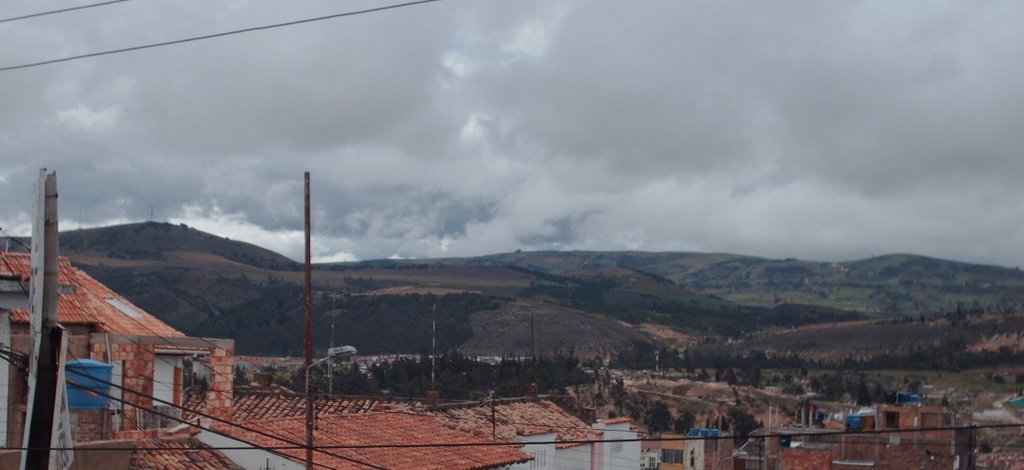
WEDNESDAY, AUGUST 16
A University City, Tunja is full of students. In architecture it is mix of the historic sublime and mediocre modern. I attended 7 a.m. mass this morning at Villa de Leyva in the parochial church on the plaza (the only time it was open during my visit). The church is big and plain. I like plain. We were a congregation of twelve. I felt nothing. Santa Domingo is small and panelled wall-to-wall with carved wood, richly gilded. I don’t like ornate yet I was overawed – and I felt at home in the two wonderful early colonial mansions. One has a view from the upper gallery of the Carta Bar except that this is Colombia rather than Scotland. We are at 2,800 meters above sea level and I walk a couple of hours without feeling breathless. And I buy a smart rain jacket marked down to $28.
Small, dark cafes abound where students can discuss metaphysics, revolution, rap artists or footballers. I find a light cafe and eat fresh strawberries without cream or sugar. Two pretty young women enter. They select a huge pastry filled with berries and cream and topped with ice cream. I warn them that such joys are short-lived
Tivasosa is 48 Ks Northeast of Tunja. The town is small, tidy and clean. The central square is pretty, no more. The mayor is a man, so is the Chief of Police. So much for my informant! I ride back to Tunja. Friesian cattle graze small fields protected by small woods. The hills are so Westmoreland, I expect to meet Tom Louther on the road walking a lercher. Even the thin drizzle is familiar and I am cold despite the addition of the new jacket! I am also happy - loneliness has no place in this landscape.
ONWARD
WEDNESDAY, AUGUST 16
I eat breakfast at the Hotel Villa del Sol. The owners and staff are in the kitchen. The quietness with which they speak and work reminds me of the San Bas Coona. I expect cold up on the pass to Tujan and dress in long-coms, thick Chinos, high socks, thermal vest, cord shirt, short-sleeve jumper, wind-cheater. I was tired on Monday and anxious to reach Villa de Leyva and suffered the mountains merely as a barrier to cross. I am fresh today and glory in the climb. Centuries of erosion has stripped the mountains bare. The rock has a rose tint which darkens as cloud shadow snakes over the ravines where a few small vegetable gardens nestle. Reach the crest and I am back in Westmorland and the Scotish borders. I stop at a police post to discover the altitude. A cop tells me, close to four thousand meters. He and his partner shake my hand and wish me well on my travels.
I eat breakfast at the Hotel Villa del Sol. The owners and staff are in the kitchen. The quietness with which they speak and work reminds me of the San Bas Coona. I expect cold up on the pass to Tujan and dress in long-coms, thick Chinos, high socks, thermal vest, cord shirt, short-sleeve jumper, wind-cheater. I was tired on Monday and anxious to reach Villa de Leyva and suffered the mountains merely as a barrier to cross. I am fresh today and glory in the climb. Centuries of erosion has stripped the mountains bare. The rock has a rose tint which darkens as cloud shadow snakes over the ravines where a few small vegetable gardens nestle. Reach the crest and I am back in Westmorland and the Scotish borders. I stop at a police post to discover the altitude. A cop tells me, close to four thousand meters. He and his partner shake my hand and wish me well on my travels.
Tuesday, August 15, 2006
CLOSET ARABS

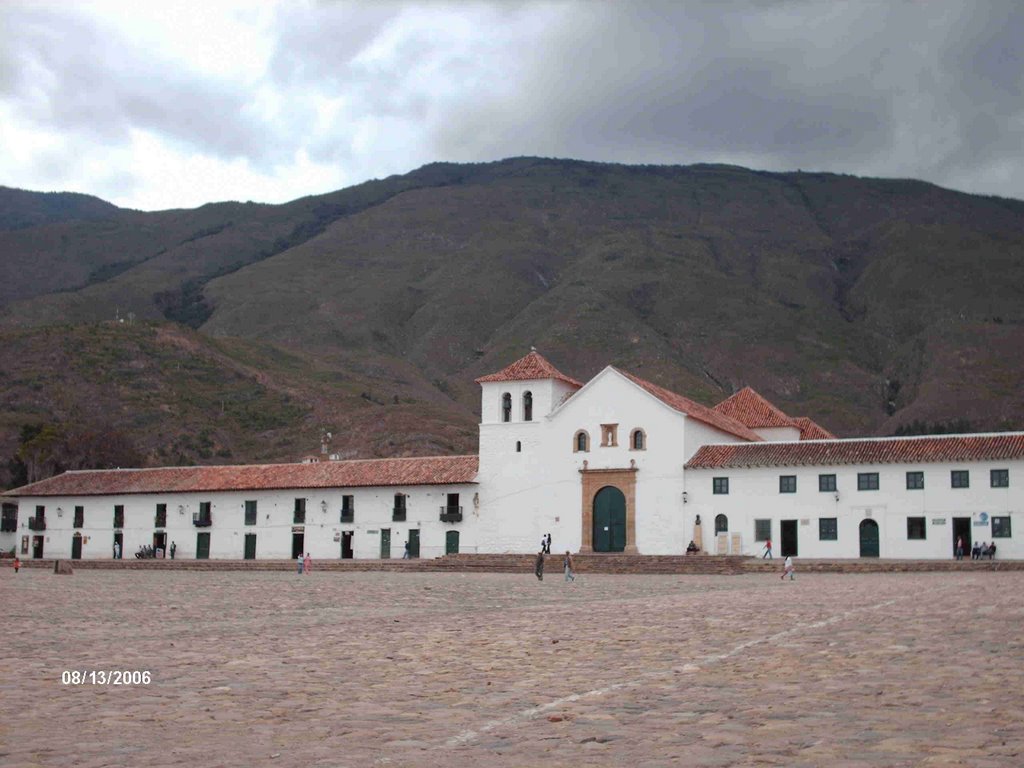
plaza
TUESDAY, AUGUST 15
Villa de Leyva is a classic example of early Hispanic urban planning. All streets meet at right angles. No house is sufficiently tall to block the breeze from its neighbours. The exteriors are simple – display of wealth was both dangerous and vulgar. Peek through doorways and you glimpse greenery and perhaps feel a soft breeze cooled by a fountain or pond. So, yes, Villa de Leyva is very Spanish. It is also very Arab.
Hundreds of years of Moorish occupation must have left few Spaniards of pure Hispanic blood (what ever that is). I am part Spanish. Thus, almost certainly, I am part Arab – and also Italian, German, Scots and God knows what besides.
That Spanish/Arab part imagines those settlers in 1570. They were men of small stature, small education and many superstitions. I scan the parched mountains that surround the flat green valley of which the town is kernel. I imagine that the mountains must have made those settlers from across an immense ocean finally feel safe: safe because the mountains enclosed an understandable space, and a space they could defend. I wonder how many (or if any) closet Arabs were of their number. Historians tell us of closet Jews. We remain in ignorance of Moslems. Strange…
MEMORY FLOODS
carmelite nunnery
TUESDAY, AUGUST 15
I attended two clinics in Panama to have the stitches removed from my hand. Two further fragments have surfaced. I walk two blocks to the hospital in Villa de Leyva. According to the doctor, my body will reject the fragments. Once they surface, I can pluck them out with tweezers. I cross the plaza to admire the Carmelite convent. Founded in 1645, the convent remains occupied by nuns of the Order. The walls of the houses opposite are recently whitewashed. Spattering of whitewash on the cobbles shoots me back in memory to a rented house in Ibiza Old Town with my two elder sons, Antony and Mark. I am overcome by a longing to hold them in my arms as they were then, silken-skinned midgets bronzed and bleached by Mediterranean sea and sun. In my longing they meld with their half-brothers at the same age. The sense of loss leaves me exhausted and I sit on an oblong marker stone in the plaza. French Chef Bertrand and his family pass by and I take their photograph. The pain ebbs. The sun shines. I watch people cross the cobbles. A group of Spanish-speaking Black people are obvious tourists. Few Black Colombians live up here in the mountains. Villa de Leyva is Indian, white Hispanic and a mix of the two. Yes, and a sprinkling of incomers drawn by beauty and a low cost of living. I need Bernadette. I head for an internet café and check e-mail. Bernadette reports that Mark and Josh have been discussing universities on the telephone. Melding…

TUESDAY, AUGUST 15
I attended two clinics in Panama to have the stitches removed from my hand. Two further fragments have surfaced. I walk two blocks to the hospital in Villa de Leyva. According to the doctor, my body will reject the fragments. Once they surface, I can pluck them out with tweezers. I cross the plaza to admire the Carmelite convent. Founded in 1645, the convent remains occupied by nuns of the Order. The walls of the houses opposite are recently whitewashed. Spattering of whitewash on the cobbles shoots me back in memory to a rented house in Ibiza Old Town with my two elder sons, Antony and Mark. I am overcome by a longing to hold them in my arms as they were then, silken-skinned midgets bronzed and bleached by Mediterranean sea and sun. In my longing they meld with their half-brothers at the same age. The sense of loss leaves me exhausted and I sit on an oblong marker stone in the plaza. French Chef Bertrand and his family pass by and I take their photograph. The pain ebbs. The sun shines. I watch people cross the cobbles. A group of Spanish-speaking Black people are obvious tourists. Few Black Colombians live up here in the mountains. Villa de Leyva is Indian, white Hispanic and a mix of the two. Yes, and a sprinkling of incomers drawn by beauty and a low cost of living. I need Bernadette. I head for an internet café and check e-mail. Bernadette reports that Mark and Josh have been discussing universities on the telephone. Melding…
VILLA DE LEYVA

bertand & family
MONDAY, AUGUST 14
Villa de Leyva, a chill evening and the vast cobbled plaza is deserted. It is a space that demands movement, cattle, horses, market stalls. Its emptiness threatens my composure. I feel very alone as I walk up hill to a restaurant recommended by the woman of all tasks at the hotel. She is a woman to be admired and trusted, very matter-of-fact. She tells of her daughter, five-years-old. No, no husband - most men here are irresponsible. Better to remain single than share life with someone for whom you have no respect.
She is a good guide to a good meal. I have fasted all day and order charusco. The steak is vast, tender and full of flavour. I flirt with a young woman (two-years-old). Her father is French, chief chef at the French Embassy in Washington. The mother is Colombian. They met while Bertrand was chef at the embassy in Bogota. He and I drink coffee together. He talks of his future. He has a reputation in Washington. He would earn top money in a restaurant. The thought of living in the US horrifies him. Everything revolves around money. I hear Ming speak and the Korean monk (see blog: COMMUNITY UNDER THREAT). Bertrand would like to try Chile. An opening at the embassy would give them time to look around. He has already researched fees at a good private school: $2,500 per annum. His wife wants to move home to Colombia.
TO TUNJA
MONDAY, AUGUST 14
Turn a corner and I have changed climate and landscape. Here all is green. Trees shade coffee bushes and stream hangings of silver grey moss. Dairy cows graze upland paddocks. Honey is for sale beside the road, apples, pears. I pass patches of tobacco, the drying barns open-sided - what tobaco grows at this altitude, so different from the humid climate of Cuba to which I am accustomed? These uplands seem used in a similar manner to land in Europe - rather than the industrialised agriculture of the US, treasured fields created by centuries of backbreaking toil. I think of up-state New York and those small fields of the early settlers now abandoned as uneconomic and abandoned to woodland. I wish Anya was here. The highway leads to Bogota. I take a left fork to Tunja. The road rises to around 2500 meters. I ride thru a narrow defile, a stiff chill wind blows in my face and the Honda is a little breathless. Beyond are fell lands that recall the Cheviots and Westmorland, though without the dry stone walls. We drop into Tunja then climb again into barren mountain. A final drop takes us into a wide bowl. Villa de Leyva is to the right. All the houses are white washed. Most are single story. Cobbles are small; the stones surfacing the streets are big and the Honda bumps under its load of Toad and luggage. I find a pretty room with bathroom, $20 for two nights, at the hotel Villa del Sol. The hotel is spotless, the shower pipeing hot.
Turn a corner and I have changed climate and landscape. Here all is green. Trees shade coffee bushes and stream hangings of silver grey moss. Dairy cows graze upland paddocks. Honey is for sale beside the road, apples, pears. I pass patches of tobacco, the drying barns open-sided - what tobaco grows at this altitude, so different from the humid climate of Cuba to which I am accustomed? These uplands seem used in a similar manner to land in Europe - rather than the industrialised agriculture of the US, treasured fields created by centuries of backbreaking toil. I think of up-state New York and those small fields of the early settlers now abandoned as uneconomic and abandoned to woodland. I wish Anya was here. The highway leads to Bogota. I take a left fork to Tunja. The road rises to around 2500 meters. I ride thru a narrow defile, a stiff chill wind blows in my face and the Honda is a little breathless. Beyond are fell lands that recall the Cheviots and Westmorland, though without the dry stone walls. We drop into Tunja then climb again into barren mountain. A final drop takes us into a wide bowl. Villa de Leyva is to the right. All the houses are white washed. Most are single story. Cobbles are small; the stones surfacing the streets are big and the Honda bumps under its load of Toad and luggage. I find a pretty room with bathroom, $20 for two nights, at the hotel Villa del Sol. The hotel is spotless, the shower pipeing hot.
BLESSED VIRGIN OF THE HEADLAMPS
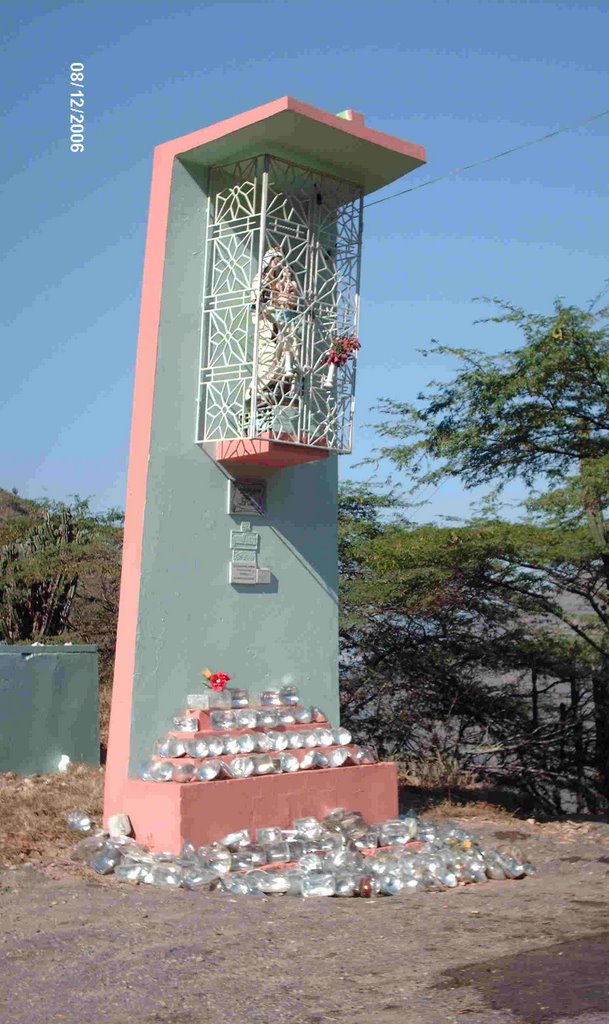
MONDAY, AUGUST 14
A statue to the Virgin Mary stands on the inside of a curve near the top of the ascent. Healdlamps rather than flowers are the offerings. Some of the lamps are connected to a power supply. The statue must be a beacon to night drivers. I stop at a cafe at the summit of the pass and ask the lady why headlamps for the Virgin.
"They last longer than candles," she tells me. She asks where I have come from and where I am going and refuses payment for my coffee.
GLORIOUS
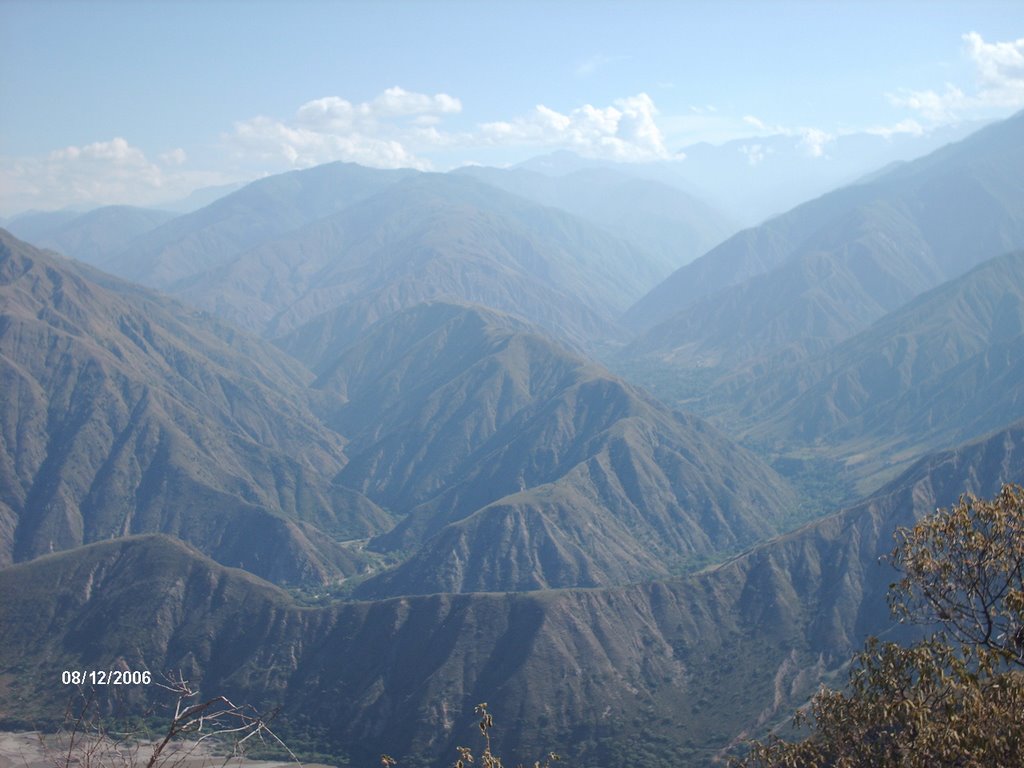
near the top
MONDAY, AUGUST 14
The highway from Bucamananga follows a green river valley a short way before hitting mountains. The Honda and Toad are well rested. We face only 300 Ks to Villa de Leiva. No reason to hurry and I am one with the bike as we swoop into the curves. We climb and climb. These are dry mountains. Brilliant sun sparkles on the rock. Even the air feels brittle. Views are astounding.
BIODIESEL
SUNDAY, AUGUST 13
Good things come in threes - so the saying goes. The Pole with the Brit is a software engineer. Ming is an electronic engineer. Tonight I ate my dinner on Giron´s central square with a chemical engineer. A Bolivian of German and Serbian heritage, he lives in Giron and has established the first biodiesel plant in Colombia. Palm nuts provide the raw material. Three of his plants have been sold in Bolivia. Though in his sixties, he remains as enthusiastic as a kid (dumb statement - so many kids profess to being permanently bored).
Good things come in threes - so the saying goes. The Pole with the Brit is a software engineer. Ming is an electronic engineer. Tonight I ate my dinner on Giron´s central square with a chemical engineer. A Bolivian of German and Serbian heritage, he lives in Giron and has established the first biodiesel plant in Colombia. Palm nuts provide the raw material. Three of his plants have been sold in Bolivia. Though in his sixties, he remains as enthusiastic as a kid (dumb statement - so many kids profess to being permanently bored).
BETTER THAN TV
story teller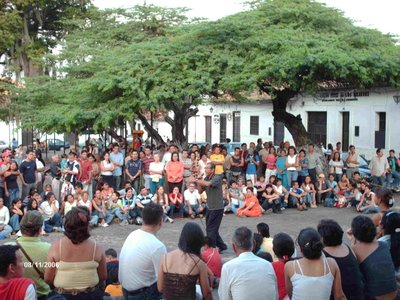
SUNDAY, AUGUST 13
Giron is bliss. I walk and walk and people greet me with smiles and a Good evening. I find two smaller squares. Both are shaded. The first is overlooked by a small, simple, 16th century church. A story teller performs in the square to an attentive and appreciative crowd. He relates the fable of a German immigrant family and their Alsation. The punch line is that there is no point to life without heart. I watch the kids seated crosslegged on the cobbles. Spellbound is a good discription. No wriggling, no Mum, fetch me a coke...

SUNDAY, AUGUST 13
Giron is bliss. I walk and walk and people greet me with smiles and a Good evening. I find two smaller squares. Both are shaded. The first is overlooked by a small, simple, 16th century church. A story teller performs in the square to an attentive and appreciative crowd. He relates the fable of a German immigrant family and their Alsation. The punch line is that there is no point to life without heart. I watch the kids seated crosslegged on the cobbles. Spellbound is a good discription. No wriggling, no Mum, fetch me a coke...
GODIN
paseo
SUNDAY, AUGUST 13
420 Ks and I shower, rest an hour and shower again before venturing out. Sunday and the passeo is in full flow. This is how it should be, people thronging the streets, the young courting, eating food off street stalls (corn, grilled meat, beef sausages, icecream). Bells ring. The religious enter the church for mass. Others cross themselves.
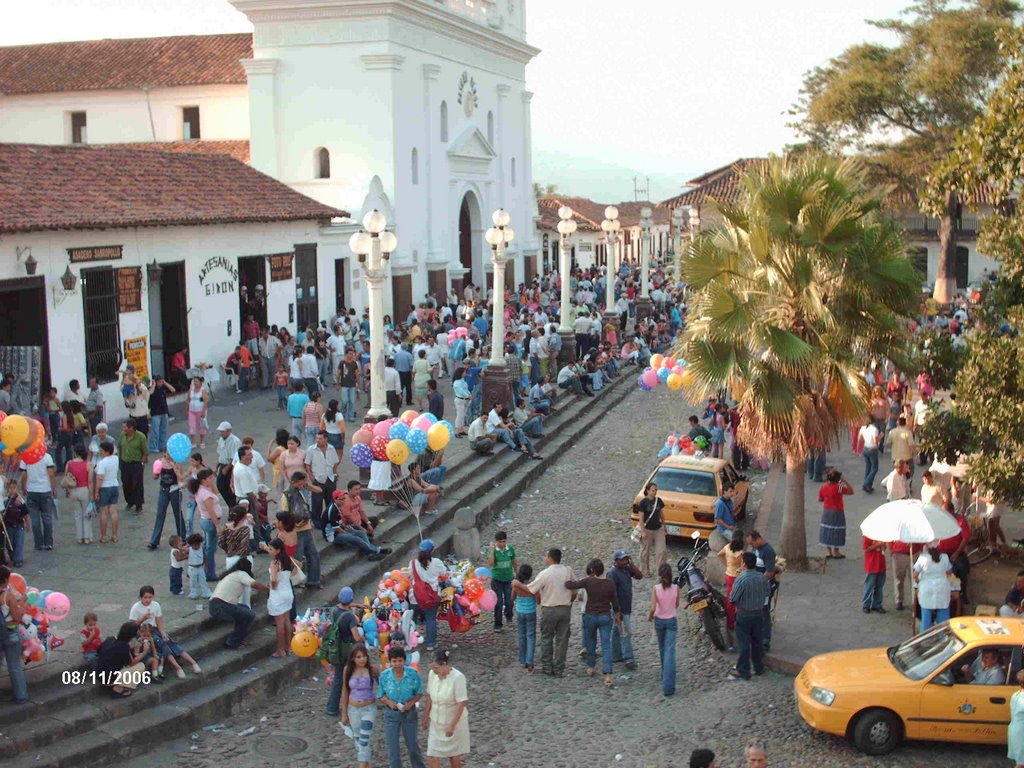
SUNDAY, AUGUST 13
420 Ks and I shower, rest an hour and shower again before venturing out. Sunday and the passeo is in full flow. This is how it should be, people thronging the streets, the young courting, eating food off street stalls (corn, grilled meat, beef sausages, icecream). Bells ring. The religious enter the church for mass. Others cross themselves.
GODIN
DOOR TO MY ROOM
SUNDAY, AUGUST 13
I have ridden 420 Ks. The final section was thru hill country, green with notices on the road side advertising swimming holes in the rivers and camp sites. I am too tired to enjoy and spot with relief the right fork to Giron a few Ks short of Bucaramanga on Highway 45A. Giron is an all-white Andaluce town transported to a bowl in the Colombian mountains. A small river runs thru. All roads are cobbled. Most houses are single story; all have pantiled roofs and wood shutters. I find a room on the first floor of a beautiful boutique hotel on the Plaza Central ($8). Trees shade the plaza. Sunday and the town is full of day trippers.
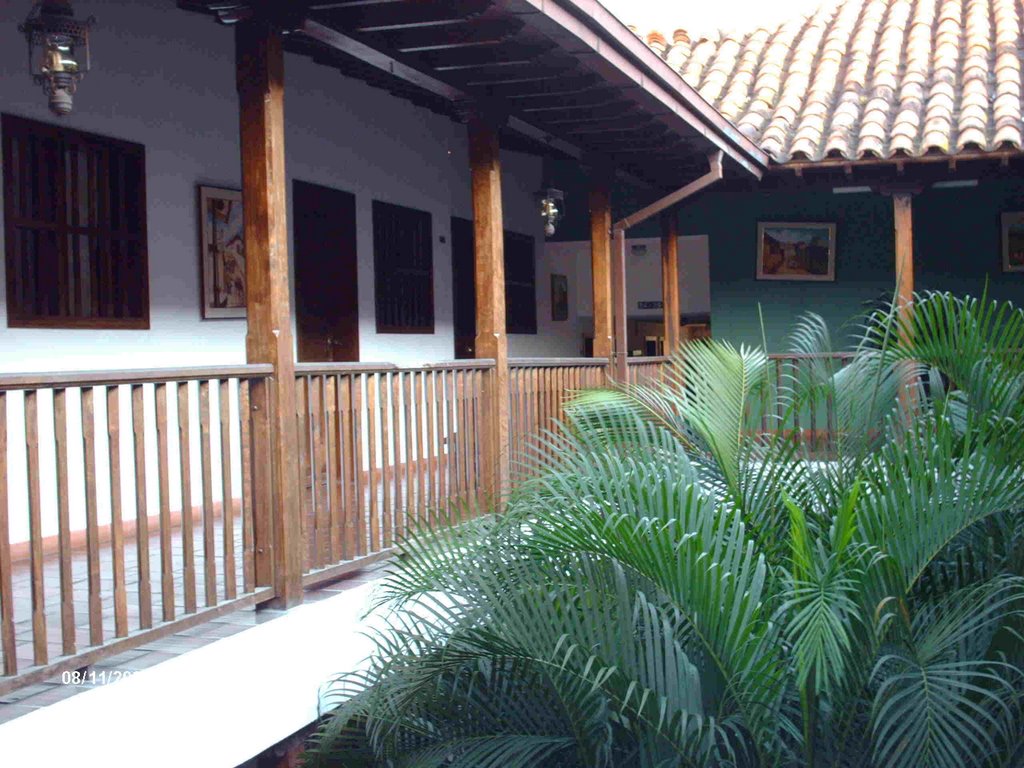
SUNDAY, AUGUST 13
I have ridden 420 Ks. The final section was thru hill country, green with notices on the road side advertising swimming holes in the rivers and camp sites. I am too tired to enjoy and spot with relief the right fork to Giron a few Ks short of Bucaramanga on Highway 45A. Giron is an all-white Andaluce town transported to a bowl in the Colombian mountains. A small river runs thru. All roads are cobbled. Most houses are single story; all have pantiled roofs and wood shutters. I find a room on the first floor of a beautiful boutique hotel on the Plaza Central ($8). Trees shade the plaza. Sunday and the town is full of day trippers.
BAD PR
SUNDAY, AUGUST 13
Both Ming and I had imagined the Darien gap as impenetrable swamp. We saw fold upon fold of jungle-covered mountain. Colombia has an image problem and Hollywood is a lousy PR agent. The image Hollywood projects is of brave citizens of the US (Harrison Ford) fighting cocaine barons of Medellin and Calli. The scenery is jungle. The men wear grease in their hair. Tom Clancy is a promoter of the same image. I am on the road by 6.15 and travel for six hours thru a vast parkland of great trees and lush paddocks, fat cattle and sleek horses. Everything is cared for and there is almost no litter - but why fences, I wonder. Surely here, where shrubs grow fast, hedges would be more economic and more decorative. To my left rise mountains – dangerous territory. Trees line the road and I ride in a green tunnel from which soldiers in camouflage emerge every kilometre or so to wave at the weird old man with a beard on the small white Mexican bike. I pass plantations of oil palms. Crossing a river, I note that cormorants float low in the water. I recognise, but can’t put a name to, a pair of birds, black with thin curved beaks. Nor can I name a small raptor with white patches on tail and wings. Fun to carry a bird book – I don’t have space.
Both Ming and I had imagined the Darien gap as impenetrable swamp. We saw fold upon fold of jungle-covered mountain. Colombia has an image problem and Hollywood is a lousy PR agent. The image Hollywood projects is of brave citizens of the US (Harrison Ford) fighting cocaine barons of Medellin and Calli. The scenery is jungle. The men wear grease in their hair. Tom Clancy is a promoter of the same image. I am on the road by 6.15 and travel for six hours thru a vast parkland of great trees and lush paddocks, fat cattle and sleek horses. Everything is cared for and there is almost no litter - but why fences, I wonder. Surely here, where shrubs grow fast, hedges would be more economic and more decorative. To my left rise mountains – dangerous territory. Trees line the road and I ride in a green tunnel from which soldiers in camouflage emerge every kilometre or so to wave at the weird old man with a beard on the small white Mexican bike. I pass plantations of oil palms. Crossing a river, I note that cormorants float low in the water. I recognise, but can’t put a name to, a pair of birds, black with thin curved beaks. Nor can I name a small raptor with white patches on tail and wings. Fun to carry a bird book – I don’t have space.
Sunday, August 13, 2006
MORE TRUCKS
SATURDAY, AUGUST 13
Navigating the truck-infested highway is exhausting. I stop early at a town that has no reason for existence other than servicing trucks and drivers. I find a reasonable room with bath, fan and lock-up parking for $6. I sit on the terrace and drink soda with fresh lime. A gang of curious ten-year-olds and a young waitress sit with me. They question me on life in England, bikes and travel. I question them on family, school and ambitions - and the waitress on boyfriends, wages and her opinions of the town (jail from which she hasn't sufficient schooling to escape).
I drink a beer with dinner, a rich chicken and vegetable soup followed by steak and onions with plain boiled rice. Add the fresh-lime soda and the bill comes to $2.80. Trucks thunder by. None of the drivers are black - why do I notice such things? Early to bed: I intend reaching Giron tomorrow (420 Ks): a small Spanish colonial town that is a national monument.
Navigating the truck-infested highway is exhausting. I stop early at a town that has no reason for existence other than servicing trucks and drivers. I find a reasonable room with bath, fan and lock-up parking for $6. I sit on the terrace and drink soda with fresh lime. A gang of curious ten-year-olds and a young waitress sit with me. They question me on life in England, bikes and travel. I question them on family, school and ambitions - and the waitress on boyfriends, wages and her opinions of the town (jail from which she hasn't sufficient schooling to escape).
I drink a beer with dinner, a rich chicken and vegetable soup followed by steak and onions with plain boiled rice. Add the fresh-lime soda and the bill comes to $2.80. Trucks thunder by. None of the drivers are black - why do I notice such things? Early to bed: I intend reaching Giron tomorrow (420 Ks): a small Spanish colonial town that is a national monument.
TRUCKS
SATURDAY, AUGUST 13
Highway 45 to Bogota splits from the Santa Marta highway fifty Ks from Baranquilla. Truck traffic is heavy. Many trucks are empty. I discover later that these are returning to the coal mines at . The mines are US owned. My informant is an ardent supporter of Venezuellan President, Chavez. He tells me, "Gringos take everything and leave us with nothing but desease (presumably silicosis)."
The empty trucks spit coal fragments. My faces stings. My gloves and shirt are black. Traffic is too heavy for enjoyment of the countryside. Soldiers guard the road, seldom a kilometre between posts. Police man road blocks. Most police wave me thru. The two that stop me don´t ask for my papers. They are curious as to how far I have travelled and how far I intend traveling. I have a stock reply: What should an old guy do with his remaining years? Watch TV? Or get out and learn and meet knew people?
They ask what my wife thinks of my travels.
I reply that Bernadette is relieved to have me out of the house for a while.
Highway 45 to Bogota splits from the Santa Marta highway fifty Ks from Baranquilla. Truck traffic is heavy. Many trucks are empty. I discover later that these are returning to the coal mines at . The mines are US owned. My informant is an ardent supporter of Venezuellan President, Chavez. He tells me, "Gringos take everything and leave us with nothing but desease (presumably silicosis)."
The empty trucks spit coal fragments. My faces stings. My gloves and shirt are black. Traffic is too heavy for enjoyment of the countryside. Soldiers guard the road, seldom a kilometre between posts. Police man road blocks. Most police wave me thru. The two that stop me don´t ask for my papers. They are curious as to how far I have travelled and how far I intend traveling. I have a stock reply: What should an old guy do with his remaining years? Watch TV? Or get out and learn and meet knew people?
They ask what my wife thinks of my travels.
I reply that Bernadette is relieved to have me out of the house for a while.
YUK!
SATURDAY, AUGUST 13
From Baranquilla, I continue along the coast towards Santa Marta. The highway runs between sea and lagoons. Fisher families live either side of the highway. They live in flimsy shacks crammed one against the other on salt flats that frequently flood. The shacks must be damp. The heat here on the coast is intense. The air stinks of hot wet salt and last week´s fish. Canoes under small square sail slip across the silken surface of the lagoons. Photograph them and you have beauty. Photograph reality and you come close to Hell.
From Baranquilla, I continue along the coast towards Santa Marta. The highway runs between sea and lagoons. Fisher families live either side of the highway. They live in flimsy shacks crammed one against the other on salt flats that frequently flood. The shacks must be damp. The heat here on the coast is intense. The air stinks of hot wet salt and last week´s fish. Canoes under small square sail slip across the silken surface of the lagoons. Photograph them and you have beauty. Photograph reality and you come close to Hell.
KINDNESS IN BARANQUILLA
HONDA
LEAVING CARTAGENA
SATURDAY, AUGUST 13
Mobile and South America lies ahead. The sky is blue. The few clouds are charming puffs of white. I have escaped the rain.
Though wet, Central America was easy. The countries are small and crossed in two or three days. South America is big. Colombia is big, even that half that has roads.
In heading directly south to Medellin, Ming retrod our first day´s travel. I decide to circle. I head north-east along a coast of beaches and brilliant blue sea to Baranquilla. I spot a Honda agency in Baranquilla. I need a replacement mirror for one broken while unloading from the Hell ship. No mirrors - however the agents (husband and wife) insist on giving the Honda a quick service - free. A young mechanic works while we chat. My travel impresses. I feel a fraud. I have ridden a bike, no big deal. I have enjoyed myself, met interesting people, made new friends, made a few dumb mistakes.
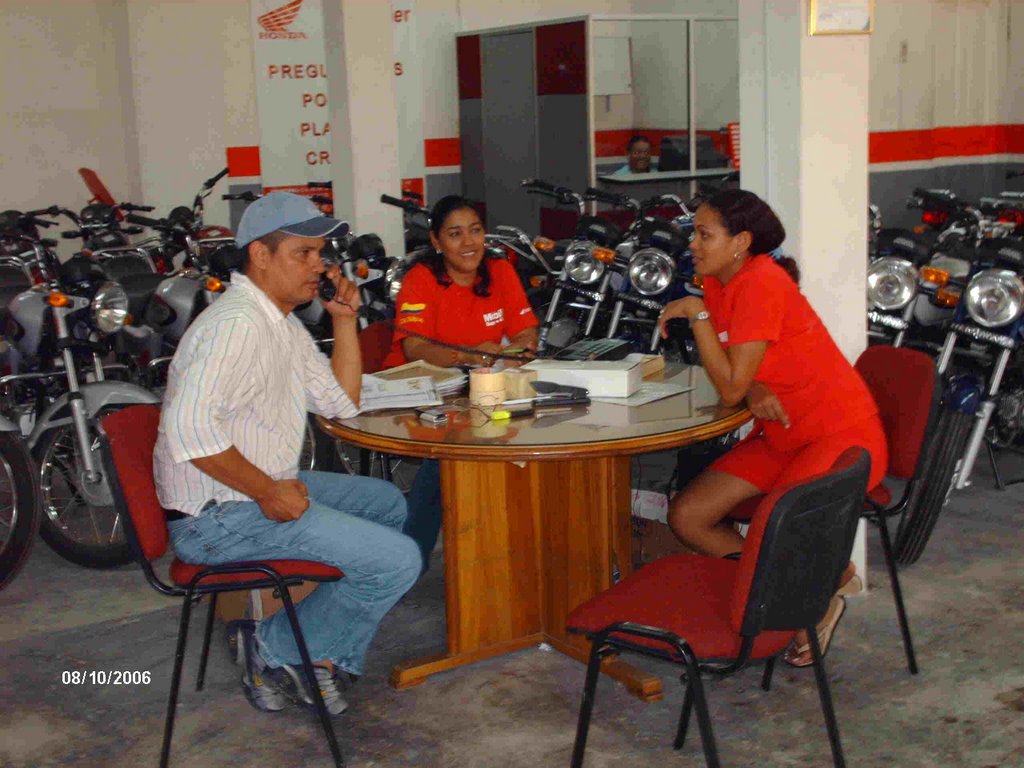
LEAVING CARTAGENA

SATURDAY, AUGUST 13
Mobile and South America lies ahead. The sky is blue. The few clouds are charming puffs of white. I have escaped the rain.
Though wet, Central America was easy. The countries are small and crossed in two or three days. South America is big. Colombia is big, even that half that has roads.
In heading directly south to Medellin, Ming retrod our first day´s travel. I decide to circle. I head north-east along a coast of beaches and brilliant blue sea to Baranquilla. I spot a Honda agency in Baranquilla. I need a replacement mirror for one broken while unloading from the Hell ship. No mirrors - however the agents (husband and wife) insist on giving the Honda a quick service - free. A young mechanic works while we chat. My travel impresses. I feel a fraud. I have ridden a bike, no big deal. I have enjoyed myself, met interesting people, made new friends, made a few dumb mistakes.
Saturday, August 12, 2006
PRAWNS

MING LEAVES
SATURDAY, AUGUST 12
Yesterday was work. I walked and walked: first to the marina to thank those who helped Ming and I with advice when we first arrived. My Mexican bags had holes. I bought new and watched a cobbler for a couple of hours while he added reinforcing. I found a good map and a book of Spanish verbs at a bookstore in the Historic quarter. I brought the blog up to date. The supermarkets sell fat-free yoghurt. I buy two, take them to a juice stall and have the lady spin me a smoothy. In the evening I walk past the secondhand bookstores on the square to the prawn and oyster stalls and dine on a huge prawn cocktail at $2. Each stall has a few plastic chairs, good for people watching. For cabaret I watch teams of speed bladers circle a banked concrete hippodrome. Finally I head back into the Historic quarter for a beer. A genius did the lighting of the cathedral. The three domes for the Trinity and the clock above the main entrance glow a pale soft gold against the midnight blue of the sky. Ming has gone but Ming is here. The calm with which he ponders leaves a comfortable aftertaste.
Friday, August 11, 2006
CELEBRATION

Monk with Toad
WEDNESDAY, AUGUST 8
We have rooms at the Hotel San Philipe for $14. The hotel faces across Centenary Square to the Old City. The elevator works. The rooms are large and air conditioned and have good bathrooms with warm water showers. We have three beds each - all airconditioned rooms have three beds. I wish to know what particular Colombian custom this satifies. The receptionist giggles.
I, who wake for a pee three or four times a night, sleep the sleep of the just, eight hours straight. Ming does likewise. We breakfast at the hotel (ham and eggs, juice, coffee: $2.20). We walk the old city. We stroll unafraid for five hours in the morning and a further three hours in the afternoon. We visit museums and churches and peep into private houses and ask permission to visit the shaded patios of official and unofficial buildings. Cartagena is Spanish Colonial at its best, painted in soft pastels of blue, white, red and ochre. The buildings are cared for. There is little litter. Beautiful, beautiful, beautiful...And the people.
The people of Cartagena are light and laughter and sensuos movement.
In the evening we drink cold local beer in a square beneath the city walls before progressing to an open-air restaurant where we order the dish for which Cartagena cuisine is famous: a fish and shellfish stew. The stew is rich with prawns and pulpo and clams. We are surrounded by the perfect architecture of the 16th century. We have escaped from the Hell of the ship and of Colon and find ourselves in heaven. We have shared an adventure that was often stressful, mostly uncomfortale and sometimes dangerous. We have become friends - not in a casualHey, do you know my friend, Ming sort of friendship but a friendship of true affection and of shared thoughts. Tomorrow we will part. Ming has a friend to meet and I have my work. We plan to meet in Bolivia.
COLOMBIAN OFFICIALS DON'T SHOOT
TUESDAY, AUGUST 7
We have enjoyed little sleep over the past three days. We have waded ashore. We have ridden for eight hours. Ming is in shorts and a T-shirt. I wear a long-sleeve red cotton shirt and Chinos that had seen better days when they were new. We are unwashed. We stink. And we are illegals.
We follow the sighns to the Historic center of Cartagena. The road swings round the bay and we spot a yacht marina. We need advice and Colombians who deal with yachts deal with customs and immigration. Alirio de Avila Lora is boss of wharehouseing and imports at TODOMAR MARINA S.A. He listens to our story and despatches us behind a guide on a small Suzuki to the Office of Immigration. We explain our case to an official. His boss must decide our fate. We wait nervously on an old sofa in an outer office. Four female officials occupy the office. One is dealing with two young foreign women one of whom is bored and reads a book while her friend has her fingerprints entered. Reading strikes me as neither politic nor polite. A middle-aged Itallian is complaining loudly at another desk. His voice is brutal and he jabs fingers at documents he presents and at papers the woman official peruses. The woman catches my eye and raises her eyebrows in exasperatioon. I reply with a grin of sympathy. The exhausted Ming has dozed off and is tilting sideways. I dig him in the ribs. The boss returns. Once more we recount our story., apologise for our appearance, explain that we came directly from the road. He asks how long we intend staying in Colombia.
We say, Ten days, possibly two weeks.
We return to the outer office. I ask one of the women what nationalities she finds most courteous and which are the most asrrogant. She sanswers without need for thought: all Ecuadorians are courtous. Italians are invatriably rude and arogant.
The boss returns our passports. He has written 60 days on a Cartagena entry stamp. "Hurry," he tells us, "and you will reach the Customs offices before they close."
Our guide on the Suzuki has been guarding the bikes. He leads us to the Customs. We are directed to a large open-plan office. We relate our adventure to an official who finds us hilarious. He gathers his fellow officials. They find us hilarious. Ming is the center of atraction. Ming is a make of celluar tellephone imported from China. What does Ming mean?
"It is my name," Ming says.
"But it has a meaning?"
"People," Ming says. "Ming is people."
We are part of an ongoing joke beween our official and the boss. The boss is a dark tall elegant man. He speaks with Ming in English - not about our bikes or illegal arrival in Colombia - about matters of language and Ming's past. Meanwhile import papers for our bikes acrue signatures as they circle from desk to desk. A beautiful young woman enters their numbers in a ledger. The boss adds a final signature and we can leave. I say to the boss that I am reluctasnt to leave when faced by such beauty. The boss laughs. The woman asks for a translation.
"Be satisfied," her boss sys, "satisfied that it was extreemly complimentary."
I kiss her hand and we leave. We are legal.
I remark to Ming that, were this England, we would have been filling forms for a month.
Ming says, "In the States some would have shot us."
We have enjoyed little sleep over the past three days. We have waded ashore. We have ridden for eight hours. Ming is in shorts and a T-shirt. I wear a long-sleeve red cotton shirt and Chinos that had seen better days when they were new. We are unwashed. We stink. And we are illegals.
We follow the sighns to the Historic center of Cartagena. The road swings round the bay and we spot a yacht marina. We need advice and Colombians who deal with yachts deal with customs and immigration. Alirio de Avila Lora is boss of wharehouseing and imports at TODOMAR MARINA S.A. He listens to our story and despatches us behind a guide on a small Suzuki to the Office of Immigration. We explain our case to an official. His boss must decide our fate. We wait nervously on an old sofa in an outer office. Four female officials occupy the office. One is dealing with two young foreign women one of whom is bored and reads a book while her friend has her fingerprints entered. Reading strikes me as neither politic nor polite. A middle-aged Itallian is complaining loudly at another desk. His voice is brutal and he jabs fingers at documents he presents and at papers the woman official peruses. The woman catches my eye and raises her eyebrows in exasperatioon. I reply with a grin of sympathy. The exhausted Ming has dozed off and is tilting sideways. I dig him in the ribs. The boss returns. Once more we recount our story., apologise for our appearance, explain that we came directly from the road. He asks how long we intend staying in Colombia.
We say, Ten days, possibly two weeks.
We return to the outer office. I ask one of the women what nationalities she finds most courteous and which are the most asrrogant. She sanswers without need for thought: all Ecuadorians are courtous. Italians are invatriably rude and arogant.
The boss returns our passports. He has written 60 days on a Cartagena entry stamp. "Hurry," he tells us, "and you will reach the Customs offices before they close."
Our guide on the Suzuki has been guarding the bikes. He leads us to the Customs. We are directed to a large open-plan office. We relate our adventure to an official who finds us hilarious. He gathers his fellow officials. They find us hilarious. Ming is the center of atraction. Ming is a make of celluar tellephone imported from China. What does Ming mean?
"It is my name," Ming says.
"But it has a meaning?"
"People," Ming says. "Ming is people."
We are part of an ongoing joke beween our official and the boss. The boss is a dark tall elegant man. He speaks with Ming in English - not about our bikes or illegal arrival in Colombia - about matters of language and Ming's past. Meanwhile import papers for our bikes acrue signatures as they circle from desk to desk. A beautiful young woman enters their numbers in a ledger. The boss adds a final signature and we can leave. I say to the boss that I am reluctasnt to leave when faced by such beauty. The boss laughs. The woman asks for a translation.
"Be satisfied," her boss sys, "satisfied that it was extreemly complimentary."
I kiss her hand and we leave. We are legal.
I remark to Ming that, were this England, we would have been filling forms for a month.
Ming says, "In the States some would have shot us."
ODD COUPLE
TUESDAY, AUGUST 7
We ride thru ranch lands towards Tolu. The ranch houses are of a richer class than those I have seen on this journey. There is greater taste in the use of the land - Countryside as art as in much of the United Kingdom. There is less litter.
The Bank of Colombia is in the plaza central in Tolu. A kind ATM machine spits Pesos at us. We head on to Cartagena. We are illegals. We hit a road block every twenty or so kilometres. Most times the cops wave and wave us through. Those that do stop us do so because they want to admire Ming's Suzuki. They find us an odd couple and they laugh easily. Perhaps we are odd. Slender Chinese Ming, the putative Zen Bhudist monk, is ageless and rides a vast bike. Fat Toad on his Pizza delivery Honda is Caucasian and clearly well past his prime. As travelling companions go, definitely odd...
We ride thru ranch lands towards Tolu. The ranch houses are of a richer class than those I have seen on this journey. There is greater taste in the use of the land - Countryside as art as in much of the United Kingdom. There is less litter.
The Bank of Colombia is in the plaza central in Tolu. A kind ATM machine spits Pesos at us. We head on to Cartagena. We are illegals. We hit a road block every twenty or so kilometres. Most times the cops wave and wave us through. Those that do stop us do so because they want to admire Ming's Suzuki. They find us an odd couple and they laugh easily. Perhaps we are odd. Slender Chinese Ming, the putative Zen Bhudist monk, is ageless and rides a vast bike. Fat Toad on his Pizza delivery Honda is Caucasian and clearly well past his prime. As travelling companions go, definitely odd...
COLOMBIA, LAND OF DREAMS
TUESDAY, AUGUST 7
Ming and I and the bikes are loaded off the hell ship into an outboard-powered launch at 4.30 of a pitch-black morning. The boatman is an onlooker while three black men do the work. The outboard won’t start. The boatman curses and yanks the starter cord a dozen times. The motor fires. The boatman engages forward gear. The motor stalls. The boatman curses and yanks the cord again while the crew of the hell ship watch and bawl advice. Neither Ming nor I are confident. Finally we splutter away from the ship. We run at most a quarter mile to a beach below rocks and a ruined stone wall. Two of the black men leap into the water and hold the launch steady against the surge. Ming and I presume we have arrived and prepare to disembark. The boatman disabuses us. The black men want twenty dollars. We have negotiated the price to be paid on arrival. Apparently this isn’t arrival. Rather than argue in the dark, I pay ten and we head back out to sea. We run parallel to a heavy swell. Cloud covers the moon. The launch rolls, the launch pitches, the motor stutters. This is not good. It is an adventure. Not all adventures are good.
Twenty anxious minutes pass before a thin scattering of lights in the distance indicate a coast. Clouds clear. The moon is almost full. We discern low buildings, a ramp, a dozen men waiting. The crossing, if it was a crossing, has taken forty-five minutes. The outboard stalls. There are no oars. Waves threaten to fling the launch on the rocks. The launch skipper yells at his assistant who fights the bows straight with a long punt pole. The shore men are all black. They are shirtless and wear shorts or pants rolled above the knee. They wade out, grab the launch by the stern and run it up the sand. They lift the Honda first, carrying it clear of the water and up the stone ramp. The Suzuki weighs a ton. The men gasp and complain, yet keep the bike dry.
The ramp serves a village of low mud shacks. One of the men fetches fresh water and rinses salt from the bikes while we explain the mathematics of the price agreed on the Hell ship minus the ten paid the two men already disembarked. The men are wonderfully good natured, friendly, curious. They laugh amongst themselves and laugh at the weak jokes I attempt and they accept the math. I long to ask how come black people do all the heavy work. Is this an all black village? Or is Colombia similar in to the rest of the world?
The Honda fires first kick. The Suzuki is electric start. We ride down a deserted street of dry rutted mud with first light paling the horizon. An hour later we are in a small town, San Bernando. We find a police station. A disinterested cop listens to our story and studies our passports in that way officials have when they would rather be doing something else. He finds Ming's 650 Suzuki Endurance with its nine-gallon gas tank more interesting.
Where do we intend going?
Cartagena.
Then go to Cartagena.
We need food and drink. Our dollars are useless. The bank won’t open for another ninety minutes. We ride to the next and larger town. We eat fresh-baked sweet rolls and drink great coffee on a small square across from a bank. Colombians surround us. They, too, are friendly and curious. After Colon, this is heaven.
The bank opens. They don’t change dollars. The four ATM machines in town are down.
Our predicament is discussed on the cafe terrace. A small boy leads me through the market to a hardware store. The elderly owner has a Jewish name and wears a gold crucifix on a gold neck chain. He changes twenty dollars at a punitive rate of exchange. We pay for breakfast and ride towards the coastal resort town, Tolu, midway to Cartagena.
I lead. Ming follows. Cops stop us at a road-block. They ignore the Honda. They ignore our passports. The Suzuki has their total attention and their total admiration. Are they bikeists or biggists? Your call…
Ming and I and the bikes are loaded off the hell ship into an outboard-powered launch at 4.30 of a pitch-black morning. The boatman is an onlooker while three black men do the work. The outboard won’t start. The boatman curses and yanks the starter cord a dozen times. The motor fires. The boatman engages forward gear. The motor stalls. The boatman curses and yanks the cord again while the crew of the hell ship watch and bawl advice. Neither Ming nor I are confident. Finally we splutter away from the ship. We run at most a quarter mile to a beach below rocks and a ruined stone wall. Two of the black men leap into the water and hold the launch steady against the surge. Ming and I presume we have arrived and prepare to disembark. The boatman disabuses us. The black men want twenty dollars. We have negotiated the price to be paid on arrival. Apparently this isn’t arrival. Rather than argue in the dark, I pay ten and we head back out to sea. We run parallel to a heavy swell. Cloud covers the moon. The launch rolls, the launch pitches, the motor stutters. This is not good. It is an adventure. Not all adventures are good.
Twenty anxious minutes pass before a thin scattering of lights in the distance indicate a coast. Clouds clear. The moon is almost full. We discern low buildings, a ramp, a dozen men waiting. The crossing, if it was a crossing, has taken forty-five minutes. The outboard stalls. There are no oars. Waves threaten to fling the launch on the rocks. The launch skipper yells at his assistant who fights the bows straight with a long punt pole. The shore men are all black. They are shirtless and wear shorts or pants rolled above the knee. They wade out, grab the launch by the stern and run it up the sand. They lift the Honda first, carrying it clear of the water and up the stone ramp. The Suzuki weighs a ton. The men gasp and complain, yet keep the bike dry.
The ramp serves a village of low mud shacks. One of the men fetches fresh water and rinses salt from the bikes while we explain the mathematics of the price agreed on the Hell ship minus the ten paid the two men already disembarked. The men are wonderfully good natured, friendly, curious. They laugh amongst themselves and laugh at the weak jokes I attempt and they accept the math. I long to ask how come black people do all the heavy work. Is this an all black village? Or is Colombia similar in to the rest of the world?
The Honda fires first kick. The Suzuki is electric start. We ride down a deserted street of dry rutted mud with first light paling the horizon. An hour later we are in a small town, San Bernando. We find a police station. A disinterested cop listens to our story and studies our passports in that way officials have when they would rather be doing something else. He finds Ming's 650 Suzuki Endurance with its nine-gallon gas tank more interesting.
Where do we intend going?
Cartagena.
Then go to Cartagena.
We need food and drink. Our dollars are useless. The bank won’t open for another ninety minutes. We ride to the next and larger town. We eat fresh-baked sweet rolls and drink great coffee on a small square across from a bank. Colombians surround us. They, too, are friendly and curious. After Colon, this is heaven.
The bank opens. They don’t change dollars. The four ATM machines in town are down.
Our predicament is discussed on the cafe terrace. A small boy leads me through the market to a hardware store. The elderly owner has a Jewish name and wears a gold crucifix on a gold neck chain. He changes twenty dollars at a punitive rate of exchange. We pay for breakfast and ride towards the coastal resort town, Tolu, midway to Cartagena.
I lead. Ming follows. Cops stop us at a road-block. They ignore the Honda. They ignore our passports. The Suzuki has their total attention and their total admiration. Are they bikeists or biggists? Your call…
Thursday, August 10, 2006
DAMNED
MONDAY, AUGUST 7
Ming and I tried for sleep up on the canopy. Rain drove us in. The revolting deckhand had occupied my nook. I slept in fits in one of the loose car seats. The ex-military man swung in a hammock nearby. His farts would have startled a deaf horse. Ming feared little better. We rise with dawn to see a canoe speed thru the reefs. Our canoe...
We rush to English-speaking David's house. It is not his house. Coona houses belong to women. The man moves in to his wife´s house - or, in David´s case, his mother-in-law´s house. The mother-in-law is baking bread. High-school David´s wife sits in a hammock. She and David have one small toddler. A second is on its way. David is picking coconuts on the mountain with his father-in-law and his wife´s younger brother.
Mother-in-law is deeply serious, a thinker, and commited to the community.
She had wanted an education for her daughter. Education is important. Throughout the world, women are considered only as part human and part beast of burden. Only education will free them. She is less wonderous than Coona men, more practical. She talks of another daughter in Panama city who has a mestizo child and has taken on Latino ways. It happens, she says, though mostly it is the men who leave. The community demands responsibility from each member. Few men are responsible. While she talks, she feeds us delicious bread and fish smoked in a rolled leaf.
We leave to speak with MM. MM is on the telephone.
David arrives from the mountain with a sack of coconuts. The owner of our canoe has crossed to another island to meet the flight from Panama City. He will return in the early afternoon - if the plane is on time.
The crew hustle us to board. MM has the all clear. The Hell ship is sailing. Our options have run out.
Ming and I tried for sleep up on the canopy. Rain drove us in. The revolting deckhand had occupied my nook. I slept in fits in one of the loose car seats. The ex-military man swung in a hammock nearby. His farts would have startled a deaf horse. Ming feared little better. We rise with dawn to see a canoe speed thru the reefs. Our canoe...
We rush to English-speaking David's house. It is not his house. Coona houses belong to women. The man moves in to his wife´s house - or, in David´s case, his mother-in-law´s house. The mother-in-law is baking bread. High-school David´s wife sits in a hammock. She and David have one small toddler. A second is on its way. David is picking coconuts on the mountain with his father-in-law and his wife´s younger brother.
Mother-in-law is deeply serious, a thinker, and commited to the community.
She had wanted an education for her daughter. Education is important. Throughout the world, women are considered only as part human and part beast of burden. Only education will free them. She is less wonderous than Coona men, more practical. She talks of another daughter in Panama city who has a mestizo child and has taken on Latino ways. It happens, she says, though mostly it is the men who leave. The community demands responsibility from each member. Few men are responsible. While she talks, she feeds us delicious bread and fish smoked in a rolled leaf.
We leave to speak with MM. MM is on the telephone.
David arrives from the mountain with a sack of coconuts. The owner of our canoe has crossed to another island to meet the flight from Panama City. He will return in the early afternoon - if the plane is on time.
The crew hustle us to board. MM has the all clear. The Hell ship is sailing. Our options have run out.
PRAWNS WITH CHILI
SUNDAY, AUGUST 6
Ming and I ask the two women on duty at the community store whether prawns are available.
Certainly - and lobster and fresh fish.
Our juices bubble in anticipation
But not tonight, say the women. A girl child has been born in the village. Girls are the core of the Coona community. The birth of a girl demands much ceremony. Everyone is tired. Tomorrow we can eat prawns.
With chili?
Certainly with chili.
Ming and I love this island. We love the people. We love their good manners and their quietness and their consideration - and we love the thought of escape from the Don Sebas. We will spend two days here before shipping the bikes by canoe to Turbo. We will swim from a clean beach. We will eat camarones a el diablo. The crew summon us to eat on board. Ming and I would rather starve. Tomorrow morning we will talk with the owner of the canoe.
Ming and I ask the two women on duty at the community store whether prawns are available.
Certainly - and lobster and fresh fish.
Our juices bubble in anticipation
But not tonight, say the women. A girl child has been born in the village. Girls are the core of the Coona community. The birth of a girl demands much ceremony. Everyone is tired. Tomorrow we can eat prawns.
With chili?
Certainly with chili.
Ming and I love this island. We love the people. We love their good manners and their quietness and their consideration - and we love the thought of escape from the Don Sebas. We will spend two days here before shipping the bikes by canoe to Turbo. We will swim from a clean beach. We will eat camarones a el diablo. The crew summon us to eat on board. Ming and I would rather starve. Tomorrow morning we will talk with the owner of the canoe.
DAVID
SUNDAY, AUGUST 6
Evening on an island with a hill. The Cable & Wireless office is a thatched hut with stick walls. Connection may be slow and there are four plastic chairs. A stick screen divides the chairs from two cabins. MM is bellowing at the telephone. Will we sail tomorrow? MM doesn't know. Nor does he know our precise destination - or the destination is a secret. Of the two boats alongside the village wharf, one has made two approaches to the Colombian mainland only to be warned off. Ming and I imagine being arrested, the only legals.
A young Coona sits with us. He introduces himself as David. He speaks competent English. He is nineteeen-years-old and in his last year of high school in Panama City where his dad works as a carpenter. David has a web site and intends working in the islands as a tourist guide.
Behind us, the village kids are at the movies (watching a cd in a community hut - for the Coona everything has its place). The kids are very quiet. Ming peeks in. The movie is a Hong Kong Kung Fu.
Evening on an island with a hill. The Cable & Wireless office is a thatched hut with stick walls. Connection may be slow and there are four plastic chairs. A stick screen divides the chairs from two cabins. MM is bellowing at the telephone. Will we sail tomorrow? MM doesn't know. Nor does he know our precise destination - or the destination is a secret. Of the two boats alongside the village wharf, one has made two approaches to the Colombian mainland only to be warned off. Ming and I imagine being arrested, the only legals.
A young Coona sits with us. He introduces himself as David. He speaks competent English. He is nineteeen-years-old and in his last year of high school in Panama City where his dad works as a carpenter. David has a web site and intends working in the islands as a tourist guide.
Behind us, the village kids are at the movies (watching a cd in a community hut - for the Coona everything has its place). The kids are very quiet. Ming peeks in. The movie is a Hong Kong Kung Fu.
ESCAPE

SUNDAY, AUGUST 6
Ming and I are ashore on an island with a hill. We have eaten next to nothing since boarding in Colon. We have slept briefly. We haven´t bathed and we haven´t defecated - the lavatory is as vile as the crew's humor. A Coona man asks where we come from and where we intend travelling. He is polite, cultured. He owns a thirty-foot dugout canoe and two outboard motors. Women buy in Colon's Free Zone. The Coona runs them into Colombia. He has made two trips this week.
We are not smugglers. We are legal - a strange concept to this Coona.
We long to be put ashore at a regular port in Colombia, a port with immigration officers willing to stamp our passports and customs officers happy to document our bikes.
Very weird...
The Coona ponders: Well maybe, though it is unusual. Perhaps this once.
How much?
Again he ponders: Say one-hundred-fifty dollars for Ming, self, Suzuki and Honda.
How long?
Depending on the weather, five hours, possibly six.
Ming and I imagine the hellish alternative: darkness, rolling deck, blackmailed over unloading charges, a launch to an unknown beach. $150 is cheap.
Can we talk in the morning?
Certainly, says the Coona, Talk anytime.
IS THE SKIPPER FIGHTENED OF THE DARK?
SUNDAY, AUGUST 6
Mid afternoon and the skipper creeps thru a narrow chanel between reefs to shelter in the lee of the only hill in the San Blas islands. Next comes much yelling as he runs the Don Sebas aground while approaching a concrete wharf where two ships already lie.
I wondered this afternoon whether dislike of sailing by night is a Coona thing? Or is the skipper doubtful of his ability to thread the reefs? I asked to see the chart. There is no chart. Ah! Nor are there any lifebelts. The dinghy is powered by a temperemental outboard and has no oars. I relate this information to Ming the Unpeturbed. Ming is unpeturbed. Logic protects him. We wanted an adventure. We are having an adventure.
Mid afternoon and the skipper creeps thru a narrow chanel between reefs to shelter in the lee of the only hill in the San Blas islands. Next comes much yelling as he runs the Don Sebas aground while approaching a concrete wharf where two ships already lie.
I wondered this afternoon whether dislike of sailing by night is a Coona thing? Or is the skipper doubtful of his ability to thread the reefs? I asked to see the chart. There is no chart. Ah! Nor are there any lifebelts. The dinghy is powered by a temperemental outboard and has no oars. I relate this information to Ming the Unpeturbed. Ming is unpeturbed. Logic protects him. We wanted an adventure. We are having an adventure.
TIGER ISDLAND
SATURDAY, AUGUST 5
Mid evening, a fullish moon, and Ming and I walk thru Tiger Island village. MM is shouting on the telephone at a cabin by the community meeting house. Cable & Wireless is the provider. The connection is by radio. I have twenty minutes left on my Cable & Wireless plastic and could call home. Bernadette has a rough day ahead and might consider being woken at 4 a.m. as more unfriendly than loving. Seats in a semicircle face across swept sand beyond the community house to a table on which stand a HiFi or LowFi system. A Coona man asks if we need bread. All Coona appear to speak quietly and I don´t at first understand that the bread is merely an excuse. His true wish is to show us a badge on the door of his hut. The badge was given him by a biker stuck on the island for a month waiting for a boat. It is the badge of the Latin American Biker´s Association, Montevideo, Uruguay. The Coona man recounts the occurence of the Latin American biker with an almost childike simplicity I recall present in the marina fisherman persecuted by the irritable mother-in-law. Childish? Simple? Or full of wonder at a world we take for granted and dispoil?
Mid evening, a fullish moon, and Ming and I walk thru Tiger Island village. MM is shouting on the telephone at a cabin by the community meeting house. Cable & Wireless is the provider. The connection is by radio. I have twenty minutes left on my Cable & Wireless plastic and could call home. Bernadette has a rough day ahead and might consider being woken at 4 a.m. as more unfriendly than loving. Seats in a semicircle face across swept sand beyond the community house to a table on which stand a HiFi or LowFi system. A Coona man asks if we need bread. All Coona appear to speak quietly and I don´t at first understand that the bread is merely an excuse. His true wish is to show us a badge on the door of his hut. The badge was given him by a biker stuck on the island for a month waiting for a boat. It is the badge of the Latin American Biker´s Association, Montevideo, Uruguay. The Coona man recounts the occurence of the Latin American biker with an almost childike simplicity I recall present in the marina fisherman persecuted by the irritable mother-in-law. Childish? Simple? Or full of wonder at a world we take for granted and dispoil?
CREW
SATURDAY, AUGUST 5
Ming and I are the foreigners on board the Hell ship and basically dumb. Next are two oldies, one of whom is marked by posture as ex-military. He is a tall man, mahognay-skinned, balding, clipped military moustache and a bush of white sprouting from his ears. Our conversation is limited to his barked greetings in English. These are his only English words. Speaking Spanish to me would show ignorance or weakness on his part so we have no conversation. His companion is a small black man, monosylibic.
The handsom young Latino and the skinny black man who threw up close by my shoes make a couple. Mostly they sleep. When awake, they clamber onto the canopy and return with glazed eyes.
A tattooed ex-prisoner in his late twenties joins them on occasion. He is heavily muscled and forever exercises his neck in the way boxers do in the movies. He has been out a while and his jail muscles have grown a layer of fat.
I suspected a small middle-aged Latino man with hooked nose and sunken mouth to have lost his teeth. Not so. He is the most companionable of those on board and sits with me in the bows. He has been working in Panama. He is returning home with a gift for his wife: the carefully wrapped sections of a wooden bed frame, a double bed.
Of the crew, the cook is fifties, balding and under-weight - not surprising given the food. He wears shorts and a safron shirt and squats on deck to scrub his pots at the tap, chop meat, fish, peel yucca, slice onions. MM shouts. The captain and the engineer are brothers. The captain speaks quietly and seldom. The engineer never speaks. The assistant engineer/deckhand is a musclebound dolt who considers himself a brilliant humourist. All his jokes are gross and illustrated with gross actions. Most involve effeminate males. His number-one friend is the companion of the young girl. The girl appears only when we dock. While at sea, she is postrate in a small dank airless six-bunk cabin aft of the wheelhouse and opening onto the galley area. Little wonder that she throws up. Her man is off-black, late twenties, with a good body and ready mouth. He also is an addict of jokes at the expense of the effeminate. He has a loud voice and acts his jokes. I find him vile from day one - a judgement supported when he boasts of his conquests and of putting the girl to work - a pimp.
Ming and I seek peace on the afterdeck canopy. The smokers visit briefly for refills. Midnight and rain forces us back onto the cargo. The discomfort is barely eased by brief interludes of sleep.
Ming and I are the foreigners on board the Hell ship and basically dumb. Next are two oldies, one of whom is marked by posture as ex-military. He is a tall man, mahognay-skinned, balding, clipped military moustache and a bush of white sprouting from his ears. Our conversation is limited to his barked greetings in English. These are his only English words. Speaking Spanish to me would show ignorance or weakness on his part so we have no conversation. His companion is a small black man, monosylibic.
The handsom young Latino and the skinny black man who threw up close by my shoes make a couple. Mostly they sleep. When awake, they clamber onto the canopy and return with glazed eyes.
A tattooed ex-prisoner in his late twenties joins them on occasion. He is heavily muscled and forever exercises his neck in the way boxers do in the movies. He has been out a while and his jail muscles have grown a layer of fat.
I suspected a small middle-aged Latino man with hooked nose and sunken mouth to have lost his teeth. Not so. He is the most companionable of those on board and sits with me in the bows. He has been working in Panama. He is returning home with a gift for his wife: the carefully wrapped sections of a wooden bed frame, a double bed.
Of the crew, the cook is fifties, balding and under-weight - not surprising given the food. He wears shorts and a safron shirt and squats on deck to scrub his pots at the tap, chop meat, fish, peel yucca, slice onions. MM shouts. The captain and the engineer are brothers. The captain speaks quietly and seldom. The engineer never speaks. The assistant engineer/deckhand is a musclebound dolt who considers himself a brilliant humourist. All his jokes are gross and illustrated with gross actions. Most involve effeminate males. His number-one friend is the companion of the young girl. The girl appears only when we dock. While at sea, she is postrate in a small dank airless six-bunk cabin aft of the wheelhouse and opening onto the galley area. Little wonder that she throws up. Her man is off-black, late twenties, with a good body and ready mouth. He also is an addict of jokes at the expense of the effeminate. He has a loud voice and acts his jokes. I find him vile from day one - a judgement supported when he boasts of his conquests and of putting the girl to work - a pimp.
Ming and I seek peace on the afterdeck canopy. The smokers visit briefly for refills. Midnight and rain forces us back onto the cargo. The discomfort is barely eased by brief interludes of sleep.
COONA FOOTBALL TORNEO
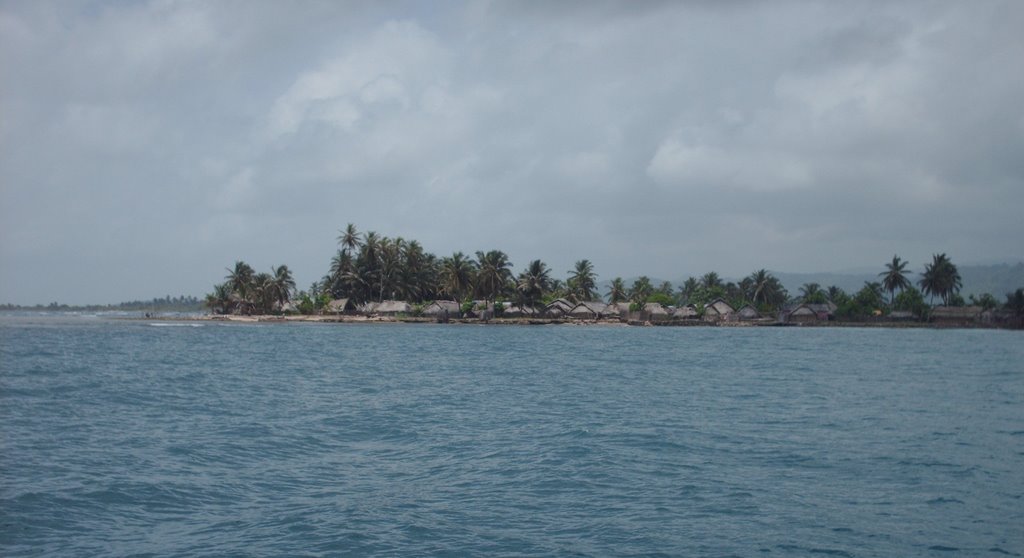
SATURDAY, AUGUST 5
We approach Tigre Island the day of the Coona inter-community football torneo. The football field is the only open space on the island. Dusk and we watch the players pelt helterskelter in pursuit of, to us, an invisble ball. Our captain eases the Don Sebas to the crude wooden wharf. Three Coona men sit on the wharf. They ignore the Don Sebas. The ship nudges the wharf and a sailor hurls a line. The line falls in the water. Only then does a Coona rise and wait for the next throw. I sense no hostility. Lack of interest is nearer the mark. Ming and I stroll thru the village to the football field. The huts are thatch roof, stick walls, sand floors and no litter. We are greeted with quiet politeness by all those we pàss. They are small people, Tibetan in feature, though dark skinned. The women are noticeably square of shoulder and wear footless stockings of strung beads.
A fence protects the open area surounding the football field. A notice proclaims a tourist zone. A row of ten small huts is the community´s tourist accomadation. A small, simple, thatch restaurant faces the huts from across the field. The shaded terrace is in two sections, male and female. Two young blond German women eat dinner in the female zone. Two teenage Coona maidens sit at a second table with their backs to the football match. Fish, yucca, rice and fried bananas are on the menu. Ming and I order bottled water. The water comes chilled from an old kerosene icebox. The plastic seals on the bottles are torn. Presumably the bottles have been refilled from the village well. The two German women have their backs to us and intend keeping their backs to us. Travel is competitive amongst many backpackers. These young women were the sole foreigners on Tigre Island. This is their adventure. We are unwelcome. The crew from the San Bas arrive at the edge of the field. They are boisterous and out of place.
SAN BAS ISLANDS
SATURDAY, AUGUST 5
I consult Ming as to whether this vast circle of islands is an atol? Ming´s doctorate is in electronic engineering rather than geography. His intelectually honest is restful. When questioned on something of which he is ignorant, he says, "I don´t know." Then he considers the question for a while, turning it this way and that. We share a broad ignorance of the San Bas islands. We know that they are Coona territory. The outer islands are seldom more than a hundred yards in length, uninhabited and the most romantic. Low mounds of pale, freshly-washed sand, they sprout a single topknot of skinny coconut palms. Foam breaks over rock and coral between some islets. In the lee of the reef lie yachts at anchor in silken waters where the breeze keeps the mosquitos and sandflies at bay. The inner islands are larger, often fringed with mangrove, and harbour communities, thatch huts packed close.
I consult Ming as to whether this vast circle of islands is an atol? Ming´s doctorate is in electronic engineering rather than geography. His intelectually honest is restful. When questioned on something of which he is ignorant, he says, "I don´t know." Then he considers the question for a while, turning it this way and that. We share a broad ignorance of the San Bas islands. We know that they are Coona territory. The outer islands are seldom more than a hundred yards in length, uninhabited and the most romantic. Low mounds of pale, freshly-washed sand, they sprout a single topknot of skinny coconut palms. Foam breaks over rock and coral between some islets. In the lee of the reef lie yachts at anchor in silken waters where the breeze keeps the mosquitos and sandflies at bay. The inner islands are larger, often fringed with mangrove, and harbour communities, thatch huts packed close.
Wednesday, August 09, 2006
HIGH SEAS
SATURDAY, AUGUST 5
We sail from Colon at 4.30 a.m. My fellow male passengers sleep on top of the cargo. They resemble a line of sardines. I bought a foam exercise mat in Panama City. I find space on the edge of the cargo below a car seat and a fold-up bicicle. I have to get up in the night. I pee over the rail, then lie awake. Sailing is a relief. Deck cargo adds to the ship´s roll on heavy swells from the North. A pretty pale mulatta in her late teens is the only woman. She is first to throw up. So does a thin black man who smokes both dope and a white powder up on the steel canopy shading the after deck - he narrowly avoids my shoes. A young male Latino is a further casualty. Ming speaks of a headache. I sit forward of the wheelhouse on a steel hatch in the early afternoon and watch the coast. Curious as to our progress, I ask MM where we are. We have passed Portobelo. He points to Mirimar and tells me we will sleep the night at one of the San Blas islands. We round a point and see the first of the San Blas spread in a vast circle. The islands protect us from the swell. I consider alerting Ming. He lived his first nineteen years in Indonesia. He is familiar with small tropical islands, coconut palms, mosquitos, beaches infested with sandflies. I let him sleep.
We sail from Colon at 4.30 a.m. My fellow male passengers sleep on top of the cargo. They resemble a line of sardines. I bought a foam exercise mat in Panama City. I find space on the edge of the cargo below a car seat and a fold-up bicicle. I have to get up in the night. I pee over the rail, then lie awake. Sailing is a relief. Deck cargo adds to the ship´s roll on heavy swells from the North. A pretty pale mulatta in her late teens is the only woman. She is first to throw up. So does a thin black man who smokes both dope and a white powder up on the steel canopy shading the after deck - he narrowly avoids my shoes. A young male Latino is a further casualty. Ming speaks of a headache. I sit forward of the wheelhouse on a steel hatch in the early afternoon and watch the coast. Curious as to our progress, I ask MM where we are. We have passed Portobelo. He points to Mirimar and tells me we will sleep the night at one of the San Blas islands. We round a point and see the first of the San Blas spread in a vast circle. The islands protect us from the swell. I consider alerting Ming. He lived his first nineteen years in Indonesia. He is familiar with small tropical islands, coconut palms, mosquitos, beaches infested with sandflies. I let him sleep.
KILLING FIELD
FRIDAY, AUGUST 4
A crescent of lamps and palm trees give Colon´s nightime waterfront a spurious normalicy. Latino dance music blares from the cafe at the end of the 5th Street wharf. A light breeze rises cool off the sea. I can count sixteen ships out in the roads and listen to the throb of a tug´s diesel engine. The Immigration officer has visited. Much shouting accompanied his discovery of two extra men and a young woman not entered on crew or passenger list. He has departed with the captain and our passports. We were dure to sail by midnight or 2 a.m. MM is yelling at his cell phone.
A crescent of lamps and palm trees give Colon´s nightime waterfront a spurious normalicy. Latino dance music blares from the cafe at the end of the 5th Street wharf. A light breeze rises cool off the sea. I can count sixteen ships out in the roads and listen to the throb of a tug´s diesel engine. The Immigration officer has visited. Much shouting accompanied his discovery of two extra men and a young woman not entered on crew or passenger list. He has departed with the captain and our passports. We were dure to sail by midnight or 2 a.m. MM is yelling at his cell phone.
SHIP FROM HELL

FRIDAY, AUGUST 4
Ming and I and the bikes are on board. What a performance. First come the extras. Twenty dollars to load each bike. Ming is quiet and polite and speaks little Spanish. The boat crew mistake good manners for weakness. Mistake. Ming knows his mind and doesn´t shift without considerable thought. We argue twenty dollars each down to fiteen for both (I do the talking).
The big black woman in the big-belly wharf master´s office tries to hit for an extra ten dollars for customs clearance. I tell her to show me the regulation in the book. Finally she surrenders sulkily. Colon, Colon, why art thou Colon...And why do down-town Colonese behave so shittily? Not all. The gate guards are great, the extended family who run the bar/cafe at the gate are great.
As for the ship, we sail at midnight or 2 a.m. Meanwhile we sleep on cargo stacked on the after deck. I will refer in these Blogs to the money man as MM. He is medium brown, paunchy, clipped hair, wears spectacles and is for ever on a celular telephone. Electronics are a mystery to him (I presume)so he shouts at the telephone to make sure his message reaches whoever he is talkig with. Shouting has become habitual and he carries it over into general conversation. I fear an argument over payment for unloading the bikes. I attempt to clarify exactly where and when and how we disembark. MM decides that I am stupid. "Look," he says, "we are contrabandistas (smugglers). We come in to the coast and unload when we receive the all clear. Three days, five, twenty..."
"At a wharf."
"On the beach."
"Oh," I say.
I tell Ming.
Ming is a student of Zen Bhudism. He smiles and says, "We wanted an adventure."
GORGEOUS GIGGLY BRITS ARE GREAT
FRIDAY, AUGUST 4
My last day in Colon and Ernesto has been driving me round in his 4X4. I was over at his house yesterday evening. Back at the hotel the owner´s son, Javier, had waited up. Javier runs the restaurant and bar. He and I sat at the bar drinking beer and yackking untill 2 a.m. Untrue to write that I will miss Colon. No one could miss Colon. However I have made good friends, kind and generous, with whom it will be a priviledge to keep in touch.
Add to the above, the Polish software engineer with a yacht and his Giggly Brit. I say His, because she is his - not as a posession but as one says, My love. They are in love. I notice so many small signs, the touch of a finger, the way their eyes meet, the ease with which they laugh together. We met outside Rey´s supermarket today. They had read on the Blog of my boat delay and had been planning to run me down to Cartagena on the 28 foot sailboat. A Honda 125 would fit just.
Meanwhile they were searching for three dollar shirts for him and a skirt for her. For now he wore a T shirt that had lost its sleaves and gained a history of boat maintenance: varnish, red lead primer, teak stain. While the Brit wore what might once have been a see-thru nightdress cut off above the belly.
I learn from them that the unpleasant little American yachtman with attitude had been thrown out of every bar on the Rio Dulce, Guatemala. I try to imagine what would get a man thrown out of a bar on the Rio Dulce. Frontera is the AA capital of Guatemala. In their day, these AA members were serious drunks, men and women who could start a riot while bearly capable of crawling across the floor. They never got thrown out. So I guess he was thrown out for simply being who he is and booring his fellow drinkers half to death.
My last day in Colon and Ernesto has been driving me round in his 4X4. I was over at his house yesterday evening. Back at the hotel the owner´s son, Javier, had waited up. Javier runs the restaurant and bar. He and I sat at the bar drinking beer and yackking untill 2 a.m. Untrue to write that I will miss Colon. No one could miss Colon. However I have made good friends, kind and generous, with whom it will be a priviledge to keep in touch.
Add to the above, the Polish software engineer with a yacht and his Giggly Brit. I say His, because she is his - not as a posession but as one says, My love. They are in love. I notice so many small signs, the touch of a finger, the way their eyes meet, the ease with which they laugh together. We met outside Rey´s supermarket today. They had read on the Blog of my boat delay and had been planning to run me down to Cartagena on the 28 foot sailboat. A Honda 125 would fit just.
Meanwhile they were searching for three dollar shirts for him and a skirt for her. For now he wore a T shirt that had lost its sleaves and gained a history of boat maintenance: varnish, red lead primer, teak stain. While the Brit wore what might once have been a see-thru nightdress cut off above the belly.
I learn from them that the unpleasant little American yachtman with attitude had been thrown out of every bar on the Rio Dulce, Guatemala. I try to imagine what would get a man thrown out of a bar on the Rio Dulce. Frontera is the AA capital of Guatemala. In their day, these AA members were serious drunks, men and women who could start a riot while bearly capable of crawling across the floor. They never got thrown out. So I guess he was thrown out for simply being who he is and booring his fellow drinkers half to death.
THROAT SLIT IN COLON
THURSDAY, AUGUST 3
Ming the Merciless has a red line across his throat. Three kids jumped him. All three carried knives. One held a knife to Ming´s throat. The remaining two emptied Ming´s pockets: five dollars. Is Colon dangerous? Too damn right!
The harbour master on the 5th Street wharf shows me the .38 revolver in his desk drawer. Out of the office, he carries the revolver tucked in his belt. Today he is wearing black baggy shorts and a gold on black Ghana shirt that balloons over his belly. I don´t like to ask how he expects to make a quick draw from under his belly. Fact is he would be dead, buried and gone to wherever such men go before laying a finger on the revolver´s butt...
Ming the Merciless has a red line across his throat. Three kids jumped him. All three carried knives. One held a knife to Ming´s throat. The remaining two emptied Ming´s pockets: five dollars. Is Colon dangerous? Too damn right!
The harbour master on the 5th Street wharf shows me the .38 revolver in his desk drawer. Out of the office, he carries the revolver tucked in his belt. Today he is wearing black baggy shorts and a gold on black Ghana shirt that balloons over his belly. I don´t like to ask how he expects to make a quick draw from under his belly. Fact is he would be dead, buried and gone to wherever such men go before laying a finger on the revolver´s butt...
MING THE MERCILESS
THURSDAY, AUGUST 3
I have met the "Chino". His name is Ming. He is forty-years-old, of Chinese parents born in Indonesia and a US citizen. He is an electronic engineer with a doctorate and has been granted a year´s sabatical by Hewlett-Packard in the hope that he will free himself of the travel bug. He rides a 650 Suzuki Endurance with a nine gallon gas tank. He claims that the 650 is way too big and heavy for the trip.
I have met the "Chino". His name is Ming. He is forty-years-old, of Chinese parents born in Indonesia and a US citizen. He is an electronic engineer with a doctorate and has been granted a year´s sabatical by Hewlett-Packard in the hope that he will free himself of the travel bug. He rides a 650 Suzuki Endurance with a nine gallon gas tank. He claims that the 650 is way too big and heavy for the trip.
Subscribe to:
Posts (Atom)