THURSDAY, OCTOBER 12
What began as a bad day has been a great day. I stopped for lunch at a shack in the middle of nowhere. A bunch of trucks and pickups were parked outside, a good sign. The drivers sat at two long tables laid with tablecloths. A young pregnant woman was serving platters of steamed trout and bottles of red and white wine.
I sat at a table without a tablecloth and was offered steak and salad or salad and steak. I took the steak and salad. A driver, not of the party, joined me. He was familiar with the place and the pregnant woman’s daughter, a six-year-old, kissed his cheek and fetched him a glass and a bottle of soda. Our food came at the same time and we left together. The driver didn’t know what the party was but was anxious to be on the road ahead of the wine drinkers. I had a rear wheel puncture right by the gas station in the next town. A neighbouring puncture specialist fixed the tube for $1.60. I rode on through Nequeen and took Route 237 towards San Carlos de Bariloche. Late evening and I suffered a couple of sharp rain squalls. The evening sun lit the underside of dark grey cloud over the lake at Villa el Chocon and turned the water into a shimmering sheet of slate-coloured glass. The light on the water was too intense to discern the far shore.
Saturday, October 14, 2006


COCHICO
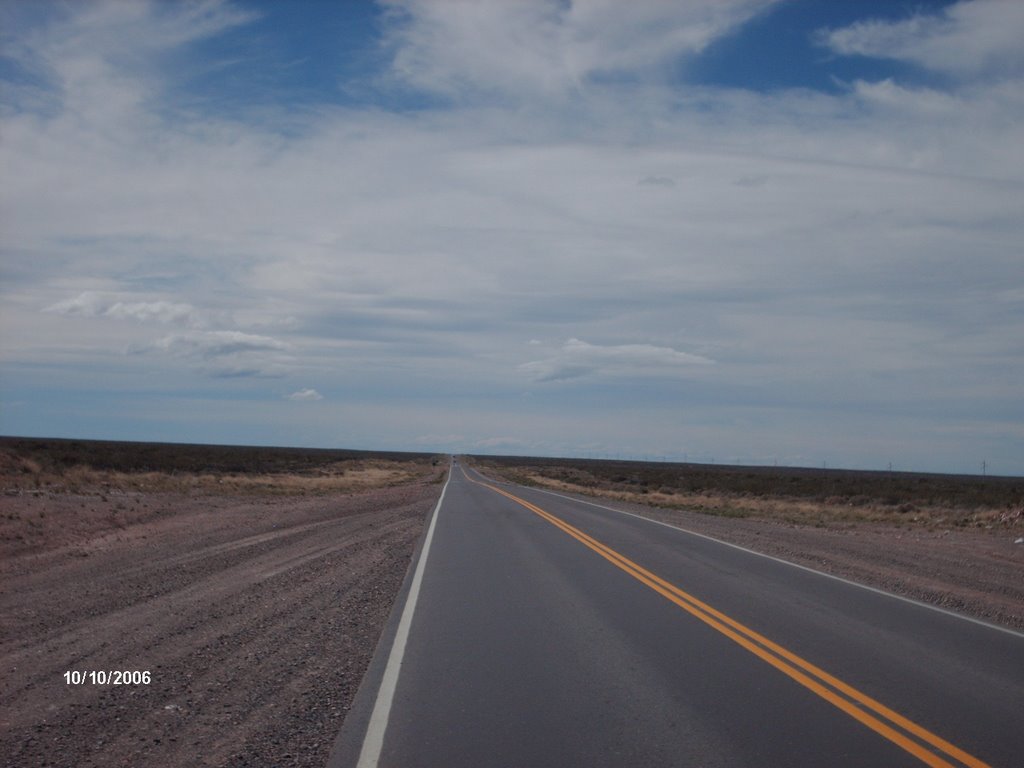
road north
THURSDAY, OCTOBER 12
Cochico is eight shacks and a police barrier. A young cop tells me to pull off the road below a dead pickup. The shack behind the pickup serves coffee. I look for a sign. Only a couple of thin dogs. The door is tacked together from old planks that have been used elsewhere. I tap. A balding head appears and is followed by a hand that scratches the scalp.
The door opens fully and the head extends into a man of my generation. He is fresh from bed and hasn’t completed his ablutions. Coffee? Of course I can have coffee.
He shows me into what passes for a restaurant: five tables, a bar, a TV, and a fireplace big enough to roast a sheep. The unglazed windows are protected by three layers of netting to keep the sand out. The light is dim.
The owner seats me at a table and shuffles off to where ever the kitchen is. He returns after a while with two cups. He hasn’t had time or the inclination or memory to wash his face or brush what is left of his hair. He asks if I want a biscuit or a sandwich or a slice of cake.
“No,” I say, “No, I don’t think that I want a biscuit or a sandwich or a slice of cake.”
He sets the cups down on the table and sits opposite me. Where have I come from? Where am I going? How long have I been travelling? Do I have a wife? Children?
He has four children. All live and work near by – except for a daughter, 27, who is studying in San Juan. The other daughter is married to the ambulance driver. His wife has a job as cook somewhere else (he expects me to know what or where the somewhere else is). He does the cooking in the restaurant. His kids dump the grandchildren on him. He seems extraordinarily contented.
I imagine how good it would be to have my two elder sons close by and Anya running a local stud. Have the door always open. Have Sarah drop the genius off of a morning. Have everyone at table for Sunday lunch. It is the life I imagined for myself when I was young. I have made a real mess.
DEEP BLACK

road south
THURSDAY, OCTOBER 12
7 a.m. and the road leads dead straight across scrub desert. A cold fierce head wind drags smoky patterns of fine sand across the tar. I bend forward over the fuel tank and edge the speedometer up to 70 KPH. The sand gets in my eyes and in my nostrils and in my ears. The road is endless. The country is featureless. Thousands of kilometres remain. Depressing, depressing, depressing…
I check the speedometer. I have ridden six kilometres.
I check the speedometer. I have ridden eight kilometres.
I mark a post on the horizon. I won’t check the speedometer again until I reach the post.
A pale spot becomes a truck. The truck becomes a monster. The bike shudders. Ten kilometres…
I need coffee.
Cochico, at 90 Ks, is the first place on the road map.
90 Ks at 70 KPH?
But it isn’t 70 KPH. I sit up and the speed drops to 60.
All bikers must suffer this type of depression one time or another, mostly when they are young and haven’t dressed for the weather or are riding the wrong bike for what ever it is they are trying to do.
COWARDLY BRIT
WEDNESDAY, OCTOBER 11
General Alvear is a small modern town with a large tree-shaded plaza. Why this need to memorialise the military? What did General Alvear do?
I find a hotel room, hot water, $7. I check the Internet and learn that England has lost to Croatia. For years the sports journalists and fans have blamed a foreigner, Sven Goran Ericsson, for any failure of the national team. Perhaps the Swede did well given the paucity of talent.
I eat steak and salad and return to the hotel. A small neat man in his sixties sits on the sofa in the reception. He wears blue chinos, a blue jumper, blue socks and blue bedroom slippers. His moustache is parted in the middle and teased out into two points. The manager presents him as her friend (hence the slippers). Senor Hostility would be a better introduction. He settles himself on the sofa in the manner of fighter pilot settling in the cockpit.
“You are English.”
“Yes,” I say.
“You English are arrogant. You don’t wish to be part of Europe. You believe you are superior.”
I am pro Europe – what should I say? I suggest that some Brits are nervous of being associated with nations where political corruption is the norm: that this fear is common to most members of the six nations comprising the original European community.
“Your Blair is more corrupt than anyone. More corrupt than Belusconi. He and Belusconi are friends. Look at Iraq - he is a liar, your Blair. There is proof that more than six hundred and fifty thousand civilians have been killed. What do you say to that?”
Senor Hostility is softening me up. Soon he will shift attack to the Falklands/Malvinas war.
“I agree,” I say, “Absolutely...now, please, if you’ll excuse me, I have to be up and on the road by six-thirty.”
So sneaks away the cowardly Brit…
General Alvear is a small modern town with a large tree-shaded plaza. Why this need to memorialise the military? What did General Alvear do?
I find a hotel room, hot water, $7. I check the Internet and learn that England has lost to Croatia. For years the sports journalists and fans have blamed a foreigner, Sven Goran Ericsson, for any failure of the national team. Perhaps the Swede did well given the paucity of talent.
I eat steak and salad and return to the hotel. A small neat man in his sixties sits on the sofa in the reception. He wears blue chinos, a blue jumper, blue socks and blue bedroom slippers. His moustache is parted in the middle and teased out into two points. The manager presents him as her friend (hence the slippers). Senor Hostility would be a better introduction. He settles himself on the sofa in the manner of fighter pilot settling in the cockpit.
“You are English.”
“Yes,” I say.
“You English are arrogant. You don’t wish to be part of Europe. You believe you are superior.”
I am pro Europe – what should I say? I suggest that some Brits are nervous of being associated with nations where political corruption is the norm: that this fear is common to most members of the six nations comprising the original European community.
“Your Blair is more corrupt than anyone. More corrupt than Belusconi. He and Belusconi are friends. Look at Iraq - he is a liar, your Blair. There is proof that more than six hundred and fifty thousand civilians have been killed. What do you say to that?”
Senor Hostility is softening me up. Soon he will shift attack to the Falklands/Malvinas war.
“I agree,” I say, “Absolutely...now, please, if you’ll excuse me, I have to be up and on the road by six-thirty.”
So sneaks away the cowardly Brit…
LITERATURE IS PASSÉ
WEDNESDAY, OCTOBER 11
I am due to meet with the regional President of the journalists’ union in San Rafael. His cell phone is permanently busy. The road south traverses flat fields. The mountains are vertical flats and equally boring. San Rafael has nothing to recommend it. I ride on.
Olive groves and terraces of ancient olive trees are familiars of European literature. Literature is passé. Argentina is agro-corporation. Kilometre upon kilometre of young olive trees march to the horizon either side of the road. I break for coffee at a service station. A young woman serves me. She is one of four daughters, no brothers. I have four sons. We compare ages, occupations. Twenty or more shade-netted plant nurseries occupy the far corner of the intersection: baby olive trees fresh from the genetic lab. The owners are Spanish. The town has become dependent on them. These same Spaniards have planted three thousand hectares of almonds. My informant is unsure as to how many thousand hectares of olives have been planted. The young woman tells me that a labourer earns $270 monthly. She asks what a farm labourer earns in England. I guess at $500 a week. I sip my coffee and wonder what the future holds for the European farmer, the Spaniard husbanding olives and almonds on a few cherished hectares. Is he aware of the intention of his compatriots here in Argentina? Perhaps a TV producer could put them together. Imagine a judge as chairperson. Is investing in the destruction of your campatriots’ living an act of treason? Or merely sensible business practice? God Bless The Global Economy, Screw The Loser…
I am due to meet with the regional President of the journalists’ union in San Rafael. His cell phone is permanently busy. The road south traverses flat fields. The mountains are vertical flats and equally boring. San Rafael has nothing to recommend it. I ride on.
Olive groves and terraces of ancient olive trees are familiars of European literature. Literature is passé. Argentina is agro-corporation. Kilometre upon kilometre of young olive trees march to the horizon either side of the road. I break for coffee at a service station. A young woman serves me. She is one of four daughters, no brothers. I have four sons. We compare ages, occupations. Twenty or more shade-netted plant nurseries occupy the far corner of the intersection: baby olive trees fresh from the genetic lab. The owners are Spanish. The town has become dependent on them. These same Spaniards have planted three thousand hectares of almonds. My informant is unsure as to how many thousand hectares of olives have been planted. The young woman tells me that a labourer earns $270 monthly. She asks what a farm labourer earns in England. I guess at $500 a week. I sip my coffee and wonder what the future holds for the European farmer, the Spaniard husbanding olives and almonds on a few cherished hectares. Is he aware of the intention of his compatriots here in Argentina? Perhaps a TV producer could put them together. Imagine a judge as chairperson. Is investing in the destruction of your campatriots’ living an act of treason? Or merely sensible business practice? God Bless The Global Economy, Screw The Loser…
MENDOZA
MONDAY/TUESDAY, OCTOBER 9-10
Mendoza is a clean safe modern city of shaded streets and watered parks and squares cooled by fountains. Plaza San Martin is the centre. I check half a dozen hotels before taking a $13 room on the 3rd floor at the Imperial for two nights. The room has a full size window and hot shower. The towels rate as adequate, the elevator works, staff are helpful. I write eight hours straight at a table in the ground-floor restaurant (prices are reasonable for acceptable food). Three further hours on the internet and I am up to date with Blogs and correspondence. Late evening I sit at a sidewalk café and people-watch. The temperature is ideal, no flies nor mosquitoes. I think of Mendoza as a European city. I am wrong. In any European city I would see African and Asian faces. Here there remains a thin sprinkling of dark mestizo amongst older citizens. Amongst the young, Europe is triumphant, the indigenous visible only in a slight tanning of skin and in a bright blackness of eye. Dress is casual. The young are confident in their sensuality. These are beautiful people and they are having fun. I meet two bikers in the street, Canadians from Nova Scotia on big BMWs. They have done the trip in two months. I have ridden one half the distance in five. The BMWs have comfortable seats.
Mendoza is a clean safe modern city of shaded streets and watered parks and squares cooled by fountains. Plaza San Martin is the centre. I check half a dozen hotels before taking a $13 room on the 3rd floor at the Imperial for two nights. The room has a full size window and hot shower. The towels rate as adequate, the elevator works, staff are helpful. I write eight hours straight at a table in the ground-floor restaurant (prices are reasonable for acceptable food). Three further hours on the internet and I am up to date with Blogs and correspondence. Late evening I sit at a sidewalk café and people-watch. The temperature is ideal, no flies nor mosquitoes. I think of Mendoza as a European city. I am wrong. In any European city I would see African and Asian faces. Here there remains a thin sprinkling of dark mestizo amongst older citizens. Amongst the young, Europe is triumphant, the indigenous visible only in a slight tanning of skin and in a bright blackness of eye. Dress is casual. The young are confident in their sensuality. These are beautiful people and they are having fun. I meet two bikers in the street, Canadians from Nova Scotia on big BMWs. They have done the trip in two months. I have ridden one half the distance in five. The BMWs have comfortable seats.
FLAT

flat either way
MONDAY, OCTOBER 9
Modern machinery and concrete sew the desert with water channels. From the sand sprout vineyards and citrus orchards and serial crops. This is Argentina: the scale is vast, the fields are flat. Close-by soar the snow-capped Andes. I long for a visual foreplay of wooded foothills.
Tuesday, October 10, 2006
DOWNMARKET LOURDES
OCTOBER 8
My wristwatch fell off some time yesterday. I bought the watch in Panama at a street stall for $9. The one window in my room at the Chepes hostal has Venetian blinds that don’t open. I need a morning call. I have parked in the garage behind the hostal owner’s car. She has to leave early.
What is early?
“By nine – half past at latest.”
Is late rising religious?
Was Evita a late riser?
She did much of her early work in bed.
The road crosses 160 Ks of desert. I count three curves, each less than ten degrees. I stop at the first town. Town? A mini-Lourdes built round a hilltop shrine dedicated to the saint of travellers. Believers arrive by bus. I am served the most disgusting cup of coffee of this entire trip, the most revolting enpanadas and the toilet facilities are filthy. The saint is a fraud. Were she genuine, she would strike these exploiters dead.
My wristwatch fell off some time yesterday. I bought the watch in Panama at a street stall for $9. The one window in my room at the Chepes hostal has Venetian blinds that don’t open. I need a morning call. I have parked in the garage behind the hostal owner’s car. She has to leave early.
What is early?
“By nine – half past at latest.”
Is late rising religious?
Was Evita a late riser?
She did much of her early work in bed.
The road crosses 160 Ks of desert. I count three curves, each less than ten degrees. I stop at the first town. Town? A mini-Lourdes built round a hilltop shrine dedicated to the saint of travellers. Believers arrive by bus. I am served the most disgusting cup of coffee of this entire trip, the most revolting enpanadas and the toilet facilities are filthy. The saint is a fraud. Were she genuine, she would strike these exploiters dead.
CHEPES
OCTOBER 7
I have ridden 730 Ks today from Tafi del Valle to Chepes. I couldn’t see a reason to stop. Present a Texan with a slice of this land and he would refer to it as his ranch. Normal people recognise desert. Vegetation is sparse and grey rather than green. Sand blows across the road and gets in your ears and in your eyes. The road runs straight to the horizon and all the way back to the horizon. A dot on the road finally materialises into a truck. A car driven fast overtakes and remains in view twenty minutes later.
A road sign welcomes me to Florida. A dust track leads off to the right and crosses disused rail track. I pass a second sign the other side of the road – Florida is history.
The road crosses a dry lake. A fence runs across the lake parallel to the road. Two Aberdeen Angus bullocks walk beside the fence. They halt and look at me. I poop my klaxon. Perhaps they break wind.
Why didn’t I take the scenic route? The scenic route is riple – Honda and I don’t ride riple.
Chepes is a road junction. It used to be a rail junction. The railway died. What else can I write of Chepes? Dusty streets, a motorised procession of celebrating football fans. I found a hostal at $7. A big beer and steak dinner set me back $3. The steak was on the run from a steel foundry. I stuck my hand in a ceiling fan and sprayed blood over my bed.
I have ridden 730 Ks today from Tafi del Valle to Chepes. I couldn’t see a reason to stop. Present a Texan with a slice of this land and he would refer to it as his ranch. Normal people recognise desert. Vegetation is sparse and grey rather than green. Sand blows across the road and gets in your ears and in your eyes. The road runs straight to the horizon and all the way back to the horizon. A dot on the road finally materialises into a truck. A car driven fast overtakes and remains in view twenty minutes later.
A road sign welcomes me to Florida. A dust track leads off to the right and crosses disused rail track. I pass a second sign the other side of the road – Florida is history.
The road crosses a dry lake. A fence runs across the lake parallel to the road. Two Aberdeen Angus bullocks walk beside the fence. They halt and look at me. I poop my klaxon. Perhaps they break wind.
Why didn’t I take the scenic route? The scenic route is riple – Honda and I don’t ride riple.
Chepes is a road junction. It used to be a rail junction. The railway died. What else can I write of Chepes? Dusty streets, a motorised procession of celebrating football fans. I found a hostal at $7. A big beer and steak dinner set me back $3. The steak was on the run from a steel foundry. I stuck my hand in a ceiling fan and sprayed blood over my bed.
DAFODILS
OCTOBER 7
I leave Tafi del Valle at 7 a.m. One elderly man in a thick fawn coat and wool hat sweeps refuse back into a bin dogs have riffled. No one else stirs. The city folk of Salta were equally late in rising. 8 a.m. had the feel of 6 a.m. in an English city. Argentineans siesta and shops stay open until 10 or 11 p.m. British shop assistants would strike. Even first generation Asian kids would rebel.
The road dips passed a lake, rises then follows a stream down through a thickly forested gorge. The trees are peculiar. The leaves are sparse and small and curled. I have ridden a couple of Ks before realisation strikes. Strikes is an understatement for being smitten visually by a mass of yellow daffodils. The trees are deciduous; this is early Spring; I am in a temperate micro climate. Sunrise tints the leaves with pink. One more gift of beauty from South America…
20 Ks further and I reach a tropic floor of cane fields, citrus and wheat. The road crosses west into the next valley. Desert…
I leave Tafi del Valle at 7 a.m. One elderly man in a thick fawn coat and wool hat sweeps refuse back into a bin dogs have riffled. No one else stirs. The city folk of Salta were equally late in rising. 8 a.m. had the feel of 6 a.m. in an English city. Argentineans siesta and shops stay open until 10 or 11 p.m. British shop assistants would strike. Even first generation Asian kids would rebel.
The road dips passed a lake, rises then follows a stream down through a thickly forested gorge. The trees are peculiar. The leaves are sparse and small and curled. I have ridden a couple of Ks before realisation strikes. Strikes is an understatement for being smitten visually by a mass of yellow daffodils. The trees are deciduous; this is early Spring; I am in a temperate micro climate. Sunrise tints the leaves with pink. One more gift of beauty from South America…
20 Ks further and I reach a tropic floor of cane fields, citrus and wheat. The road crosses west into the next valley. Desert…
TAFI DEL VALLE
OCTOBER 6
This is my first fun night since eating out with Ming in Cartagena, Colombia. Cartegena was full of holidaying Colombians. In Tafi, this restaurant is full of holidaying Argentineans. We three are the only foreigners in the restaurant. We are guests. We want to stay, fine. We want to leave, that’s also fine. We are unimportant. We are peripheral to the economy.
Any other stop on the Gringo route and all the guests would be foreigners, essential income, prey to be targeted, territory to be occupied.
There is no fun in being prey, territory, or a target.
I prefer to be people.
In Tarif I am returned to the human race.
This is my first fun night since eating out with Ming in Cartagena, Colombia. Cartegena was full of holidaying Colombians. In Tafi, this restaurant is full of holidaying Argentineans. We three are the only foreigners in the restaurant. We are guests. We want to stay, fine. We want to leave, that’s also fine. We are unimportant. We are peripheral to the economy.
Any other stop on the Gringo route and all the guests would be foreigners, essential income, prey to be targeted, territory to be occupied.
There is no fun in being prey, territory, or a target.
I prefer to be people.
In Tarif I am returned to the human race.
TAFI DEL VALLE
OCTOBER 6
Tafi is a tiny tourist resort. Middle class Argentinians escape there from the heat of the plains. I meet with travelling companions. He is Scots New Zealand, Sara is Italian. We dine together at a restaurant where a gay magician acts as compere. The magician is brilliant. He leans over our table and makes coins and scarves appear and disappear. He works with his sleeves rolled up. Sara and I enjoy and admire. Our companion calculates how the tricks are done. The magician must ware a false palm.
Meanwhile two men from the next table sing to us. The elder, a grey-hair sixties, sings soft Argentine traditional packed with sob and soul. For a pro, he would be good. Amateur, he is amazing. The younger, a late forties Dudley More, is equally talented. He plays and sings pop Latino rock. Call a title, he knows the song. I watch his wife. She has seen him perform a thousand times. She has admired (probably why she fell for him). They are out to dinner, a party of six friends. They are up from San Juan. She hoped for a quiet weekend, a slow cuddle. Now she is faced with the same old need for confidence boosting every artist needs and craves. How did I do? Did I get the notes right? Did people like me? Really like me? I didn’t stay on too long? They didn’t get bored? Yeah, yeah, yeah…
And I see Bernadette reading my latest email.
How did you like the female circumcision Blog?
Sorry…
Tafi is a tiny tourist resort. Middle class Argentinians escape there from the heat of the plains. I meet with travelling companions. He is Scots New Zealand, Sara is Italian. We dine together at a restaurant where a gay magician acts as compere. The magician is brilliant. He leans over our table and makes coins and scarves appear and disappear. He works with his sleeves rolled up. Sara and I enjoy and admire. Our companion calculates how the tricks are done. The magician must ware a false palm.
Meanwhile two men from the next table sing to us. The elder, a grey-hair sixties, sings soft Argentine traditional packed with sob and soul. For a pro, he would be good. Amateur, he is amazing. The younger, a late forties Dudley More, is equally talented. He plays and sings pop Latino rock. Call a title, he knows the song. I watch his wife. She has seen him perform a thousand times. She has admired (probably why she fell for him). They are out to dinner, a party of six friends. They are up from San Juan. She hoped for a quiet weekend, a slow cuddle. Now she is faced with the same old need for confidence boosting every artist needs and craves. How did I do? Did I get the notes right? Did people like me? Really like me? I didn’t stay on too long? They didn’t get bored? Yeah, yeah, yeah…
And I see Bernadette reading my latest email.
How did you like the female circumcision Blog?
Sorry…
DYNAMITE CAMELS
OCTOBER 6
I intend sleeping the night in Santa Maria. Santa Maria is a small market town in the centre of nowhere. The road I take is surfaced with ripli. Ripli is Argentinian for corrugated dirt. Honda and I share an antipathy for dirt.
Should I have known that Santa Maria is holding a world conference of Camels? Morales, President of Boliva, was due to attend. Now he is attending funerals of Bolivian miners dead in a fratricidal battle between miners from a co-operative and miners in the State sector. Miners from the co-op are militant. They detest the subsidies and State contracts that advantage miners in the public sector. Their weapons are sticks of dynamite.
Morales or no Morales, every hotel in Santa Maria is full with freeloaders of the conference circuit. A pleasant elderly gentleman with few teeth mans the tourist office in the central square. He is a keen biker and owns an Alpina. He bought the Alpina as a rebuild job. It lies in bits in his garage. It has been in bits for the past fifteen years. It requires spare parts. Parts require money. He doesn’t have any. And he is getting older. Sixties? Hopefully my visit will rekindle his dreams. He advises Tarif as an alternative destination. 90 Ks, and I have two hours of daylight. Does he hate me? Is my liberty salt in the wounds of his disappointments? Why else would he fail to mention that the 90 Ks includes altiplano and a mountain pass? The sky up there is overcast. The temperature falls faster than lead. My tears snap and tinkle on the rutted tar.
I intend sleeping the night in Santa Maria. Santa Maria is a small market town in the centre of nowhere. The road I take is surfaced with ripli. Ripli is Argentinian for corrugated dirt. Honda and I share an antipathy for dirt.
Should I have known that Santa Maria is holding a world conference of Camels? Morales, President of Boliva, was due to attend. Now he is attending funerals of Bolivian miners dead in a fratricidal battle between miners from a co-operative and miners in the State sector. Miners from the co-op are militant. They detest the subsidies and State contracts that advantage miners in the public sector. Their weapons are sticks of dynamite.
Morales or no Morales, every hotel in Santa Maria is full with freeloaders of the conference circuit. A pleasant elderly gentleman with few teeth mans the tourist office in the central square. He is a keen biker and owns an Alpina. He bought the Alpina as a rebuild job. It lies in bits in his garage. It has been in bits for the past fifteen years. It requires spare parts. Parts require money. He doesn’t have any. And he is getting older. Sixties? Hopefully my visit will rekindle his dreams. He advises Tarif as an alternative destination. 90 Ks, and I have two hours of daylight. Does he hate me? Is my liberty salt in the wounds of his disappointments? Why else would he fail to mention that the 90 Ks includes altiplano and a mountain pass? The sky up there is overcast. The temperature falls faster than lead. My tears snap and tinkle on the rutted tar.
GORGEOUS GORGE
OCTOBER 6
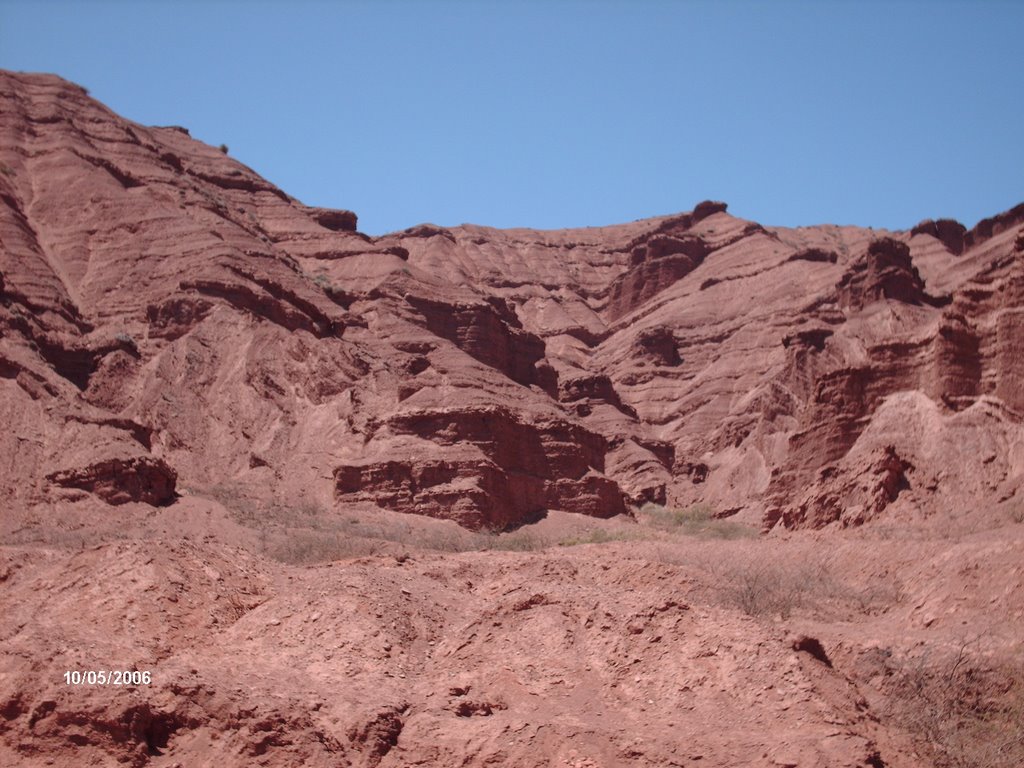
The gorge of El Rio de los Conchas is a must for a biker. Temperature is ideal. The road is set up right. The curves and climbs and descents are perfect. Take time out to admire the scenery. What scenery! The walls of the gorge are red rock ground and stretched and wrenched. The thorn trees and scrub along the river seem sprayed with emerald dust and lit with strobe lights. I share the gorge with a pedal-bike race. Cops clear the route. Three riders have a kilometre lead over the pack. A couple at the back catch a drag from attendants in a van. An ambulance brings up the rear.
Weird taste to ride through such beauty with your head down and blinded with sweat.
The riders might think me weird to be riding a pizza delivery bike the length of Latin America.
DONA LADA
typical street
OCTOBER 6
The altiplano is beautiful to the traveller. He passes by. He doesn’t stop. There is nowhere to stop. In Argentina, village after village tempts. I head south from Salta. Colonel Moldes comes first – surely an odd name for a town. Argentina is full of such names: Colonel This and General That.
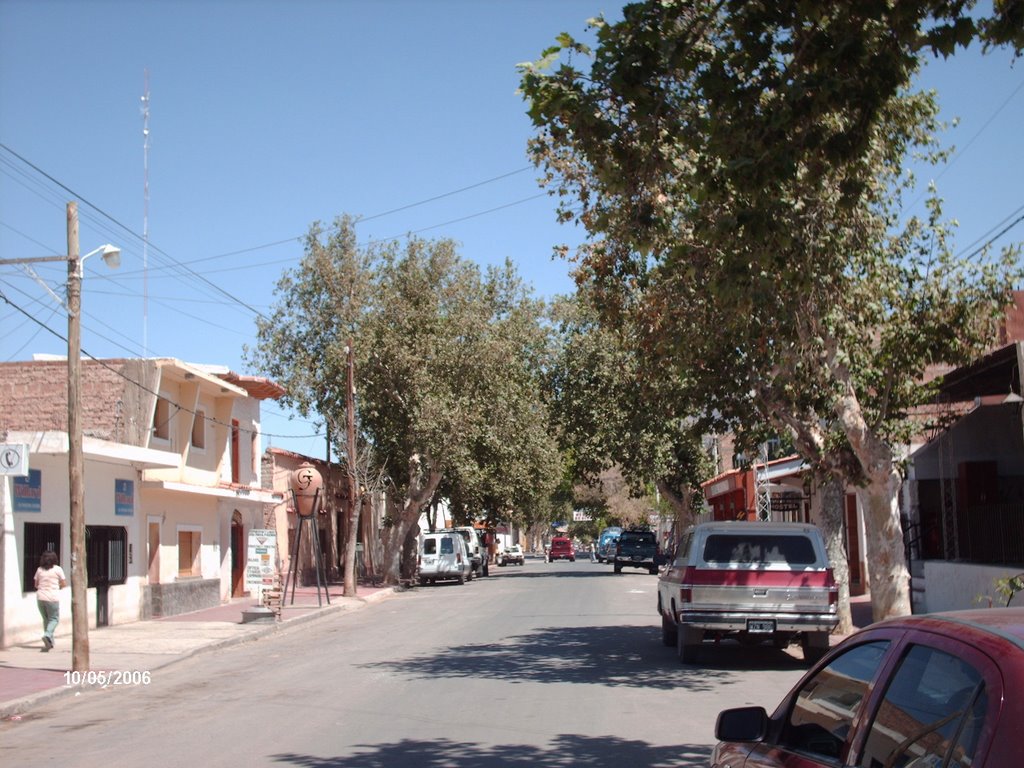
Colonel Moldes is too charming to be military. Trees shade the main street. Pillared arcades shade the sidewalk. I stop for coffee at the Hospedaje Dona Lada. Birds enjoy the palm trees in the small park where a bust of the Colonel holds sway. The coffee is excellent. The young woman who serves is delightful. Each passer-by greets me. This is bliss. I could stay a week. Townspeople would talk to me in the evenings. I would learn something of Argentina. Big cities don’t work. People are too busy. I am invisible. I learn nothing.
What is the cost? $8 for a single with bath.
I paid double in Salta and had my pocket picked.
TOUGH
OCTOBER 5
I lie in bed - 7.30 a.m. The hotel room is small and dark and dank. Plumbing gurgles. A man converses in German and in Spanish. The Spanish is with a member of the hotel staff. The German complains that his bedside light doesn’t work, that the lavatory won’t flush, that the ceiling fan screeches. He wants a discount on the room rate – or his wife/girlfriend demands that he demand a discount.
My bladder is demanding.
And my laptop is demanding. It waits on the table. I hate my laptop. It is a Panasonic ToughBook and indestructible. It weighs a ton. It travels in the box on the bike’s luggage rack. The box is black. Midday the box becomes an oven. Heat murdered the batteries. I have to work indoors. I tried working last night. The chair sandwiched between the bed and the table has a cracked seat. The crack pinched my arse.
I feel inside my pyjama pants for evidence of the pinch.
I find three spots.
Before riding, I need to put cream on the spots.
I don’t want to ride.
I have been riding for months.
Tierra del Fuego is a further 5000 Ks.
Bernadette thinks that I should ride back in the New Year to New York.
My heart will give out.
I feel for my pulse.
Where the shit is my pulse?
8 a.m. - I must get up.
My years will stick knives in my spine and in my ankles.
I will slip on the soap on the wet floor of the bathroom and crack my head open.
Where did I leave my teeth?
I need my spectacles.
Being old isn’t fun.
I want to be home. I want to sprawl on the couch and watch TV and hug the kids (if they allow) and rest my head in Bernadette’s lap and know that soon she and I will go upstairs to bed.
Salta is half the world away.
I lie in bed - 7.30 a.m. The hotel room is small and dark and dank. Plumbing gurgles. A man converses in German and in Spanish. The Spanish is with a member of the hotel staff. The German complains that his bedside light doesn’t work, that the lavatory won’t flush, that the ceiling fan screeches. He wants a discount on the room rate – or his wife/girlfriend demands that he demand a discount.
My bladder is demanding.
And my laptop is demanding. It waits on the table. I hate my laptop. It is a Panasonic ToughBook and indestructible. It weighs a ton. It travels in the box on the bike’s luggage rack. The box is black. Midday the box becomes an oven. Heat murdered the batteries. I have to work indoors. I tried working last night. The chair sandwiched between the bed and the table has a cracked seat. The crack pinched my arse.
I feel inside my pyjama pants for evidence of the pinch.
I find three spots.
Before riding, I need to put cream on the spots.
I don’t want to ride.
I have been riding for months.
Tierra del Fuego is a further 5000 Ks.
Bernadette thinks that I should ride back in the New Year to New York.
My heart will give out.
I feel for my pulse.
Where the shit is my pulse?
8 a.m. - I must get up.
My years will stick knives in my spine and in my ankles.
I will slip on the soap on the wet floor of the bathroom and crack my head open.
Where did I leave my teeth?
I need my spectacles.
Being old isn’t fun.
I want to be home. I want to sprawl on the couch and watch TV and hug the kids (if they allow) and rest my head in Bernadette’s lap and know that soon she and I will go upstairs to bed.
Salta is half the world away.
PUNISHED
OCTOBER 5
Midnight and I fetch a glass of water from the water cooler in the hotel lobby. Light is dim. The cooler has two taps. One tap appears a darker blue than the other. I put my four heart pills on my tongue, raise the glass, prepare to swallow. The water is boiling. I spit. The darker tap is water for tea or mate. My lower lip is scalded. Great!
Midnight and I fetch a glass of water from the water cooler in the hotel lobby. Light is dim. The cooler has two taps. One tap appears a darker blue than the other. I put my four heart pills on my tongue, raise the glass, prepare to swallow. The water is boiling. I spit. The darker tap is water for tea or mate. My lower lip is scalded. Great!
I AM A RACIST
OCTOBER 4
I confess. I am a racist. I am in Salta. I am in a recognisably European city of sidewalk cafes and clean parks and smart shops. I have escaped unscathed from the terrorist and bandit territory of indigenous America. I relax. I am robbed. Hah!
I report the loss of my wallet at the police station on the cathedral plaza. I am recompensed with two kisses. The police officer is young and pretty and kind. She says that I am in great shape for an Oldie – that Bernadette must be a wonderful wife to have looked after me so well.
A second police officer groans under the weight of her pregnancy. I recall Bernadette visiting a dear friend on his deathbed. John was gynaecologist. He was also a rugby player and dismissive of women’s aches and pains. Dying of cancer, he complained to Bernadette that every part of him hurt.
“At last you know what it feels like to be pregnant,” said Bernadette.
I report this tale to Salta’s female police officers. Bernadette is their hero.
I confess. I am a racist. I am in Salta. I am in a recognisably European city of sidewalk cafes and clean parks and smart shops. I have escaped unscathed from the terrorist and bandit territory of indigenous America. I relax. I am robbed. Hah!
I report the loss of my wallet at the police station on the cathedral plaza. I am recompensed with two kisses. The police officer is young and pretty and kind. She says that I am in great shape for an Oldie – that Bernadette must be a wonderful wife to have looked after me so well.
A second police officer groans under the weight of her pregnancy. I recall Bernadette visiting a dear friend on his deathbed. John was gynaecologist. He was also a rugby player and dismissive of women’s aches and pains. Dying of cancer, he complained to Bernadette that every part of him hurt.
“At last you know what it feels like to be pregnant,” said Bernadette.
I report this tale to Salta’s female police officers. Bernadette is their hero.
Friday, October 06, 2006
RASTA RUBBISH
WEDNESDAY, OCTOBER 4
Two streets leading down from Salta’s cathedral square are closed to traffic. I stroll through a hippy craft market circa Ibiza, 1970. The leather necklaces and pendants, wrist strings and bracelets are indistinguishable from the wares in every other street craft market. The people are indistinguishable. Their conversation is indistinguishable, as is their certainty in their uniqueness. These people are different. They have dropped out. In the year 2006 – wow! One man is Rastaring another’s hair - symbol of that most idiotic of all faiths, worship of Haille Selassie, King of Kings. Haille Selassie was Amharic. The Amharas believe that they are the only true white race (we are red). They have two words for black people: slave or outcast. Typical Amhahra proverb: Should you come out of your house and see a black man, go back in for a black man brings bad luck.
Two streets leading down from Salta’s cathedral square are closed to traffic. I stroll through a hippy craft market circa Ibiza, 1970. The leather necklaces and pendants, wrist strings and bracelets are indistinguishable from the wares in every other street craft market. The people are indistinguishable. Their conversation is indistinguishable, as is their certainty in their uniqueness. These people are different. They have dropped out. In the year 2006 – wow! One man is Rastaring another’s hair - symbol of that most idiotic of all faiths, worship of Haille Selassie, King of Kings. Haille Selassie was Amharic. The Amharas believe that they are the only true white race (we are red). They have two words for black people: slave or outcast. Typical Amhahra proverb: Should you come out of your house and see a black man, go back in for a black man brings bad luck.
WHITE AS AN IRISH NUN
WEDNESDAY, OCTOBER 4
Joy! Salta has sidewalk cafés on the cathedral square that serve excellent coffee. I order a fruit salad, sip coffee, and people watch. I have been in a largely mestizo world for the past five months. Argentina is different. You see white people, white, white, white. A tall man selling fruit in the market is as white as an Irish nun in a closed order. Is he scared of the sun, frightened of skin cancer? What does he do at weekends? Watch football on TV?
Joy! Salta has sidewalk cafés on the cathedral square that serve excellent coffee. I order a fruit salad, sip coffee, and people watch. I have been in a largely mestizo world for the past five months. Argentina is different. You see white people, white, white, white. A tall man selling fruit in the market is as white as an Irish nun in a closed order. Is he scared of the sun, frightened of skin cancer? What does he do at weekends? Watch football on TV?
SALTA
WEDNESDAY, OCTOBER 4
I am in Salta. I have a room two blocks off the square at the Residencia Elena. The room opens off a patio full of flowers. The water is hot. The ceiling fan squeaks. The room rate is $20 for a couple. I am alone and pay $16.50. I don’t complain. I have ridden 400 Ks over country that is flat and boring. Agriculturally it is organised well in vast fields of sugar, some plant with a yellow flower, wheat and citrus. Mountains pretend to approach only to retreat into the haze. Entering the city is easy. The centre in clearly signed.
I am in Salta. I have a room two blocks off the square at the Residencia Elena. The room opens off a patio full of flowers. The water is hot. The ceiling fan squeaks. The room rate is $20 for a couple. I am alone and pay $16.50. I don’t complain. I have ridden 400 Ks over country that is flat and boring. Agriculturally it is organised well in vast fields of sugar, some plant with a yellow flower, wheat and citrus. Mountains pretend to approach only to retreat into the haze. Entering the city is easy. The centre in clearly signed.
EVITALAND
WEDNESDAY, OCTOBER 4
I am in the Argentine. Or I am in Argentina? I prefer the former. Crossing the border was routine, though time consuming. I have one more border to cross, that dividing Tierra del Fuego. Two young Frenchmen at the Bolivian frontier recounted their fears of the complications entailed in travelling by bike. There are no complications. A biker requires proof of ownership, a national driving licence, lots of photocopies, patience and a good attitude. Attitude is essential. Officials scent arrogance or impatience or contempt faster than hounds scent a fox. Same with the police. I have been treated with courtesy throughout this journey. I have ridden sixteen thousand kilometres. Other than at a frontier, I have been asked for my papers only once, on the approach to the Ecuadorian border with Peru.
I am in the Argentine. Or I am in Argentina? I prefer the former. Crossing the border was routine, though time consuming. I have one more border to cross, that dividing Tierra del Fuego. Two young Frenchmen at the Bolivian frontier recounted their fears of the complications entailed in travelling by bike. There are no complications. A biker requires proof of ownership, a national driving licence, lots of photocopies, patience and a good attitude. Attitude is essential. Officials scent arrogance or impatience or contempt faster than hounds scent a fox. Same with the police. I have been treated with courtesy throughout this journey. I have ridden sixteen thousand kilometres. Other than at a frontier, I have been asked for my papers only once, on the approach to the Ecuadorian border with Peru.
LUIS YUDI
TUESDAY, OCTOBER 3
Yuquiba is an odd place in which to meet a soulmate. Early evening and we sit together at the sidewalk café. He introduces himself: Luis Yudi.
Jewish?
Arab. Orthodox Christian.
Luis was seven when the family emigrated from Syria. Now he is in his early sixties. We are both early school leavers. Self educated, we are suspicious of what we are told. University graduates are less inquiring: a degree lies in the lecturer’s notes.
The exchange of opinions is serious stuff. Before speaking, Luis gathers himself and hunches his shoulders and dips his head the way a boxer does.
He is proudly Arab and full of odd scraps of Arab history. Did I know that Gibraltar is named after an Arab Admiral?
He has contempt for George W Bush and the US administration. Their ignorance offends him. The President’s use of the term crusade is typical. The crusaders were liberal in whom they pillaged and butchered: Muslim, Orthodox Christian, Jew.
He has visited England and Scotland. He has warm memories of London. He judges as reprehensible Blair’s failure to denounce Israel’s recent destruction of Lebanon. Does Britain no longer have its own foreign policy?
He is, of course, a true Semite. Most Israelis are mestizo. Yet to be sympathetic to the Palestinian ordeal and to criticise Israel is to be anti-Semitic.
And, though a businessman, he is also a writer. He has written a treatise on the Bolivian constitution. Eight copies of the book have been printed and bound. He fetches a copy from his house. He has dedicated the copy:
Para el amigo Gandolfi para que en tu tesis la midas con optimo calificaciones…
Luis, I thank you.
Travelling has value.
Yuquiba is an odd place in which to meet a soulmate. Early evening and we sit together at the sidewalk café. He introduces himself: Luis Yudi.
Jewish?
Arab. Orthodox Christian.
Luis was seven when the family emigrated from Syria. Now he is in his early sixties. We are both early school leavers. Self educated, we are suspicious of what we are told. University graduates are less inquiring: a degree lies in the lecturer’s notes.
The exchange of opinions is serious stuff. Before speaking, Luis gathers himself and hunches his shoulders and dips his head the way a boxer does.
He is proudly Arab and full of odd scraps of Arab history. Did I know that Gibraltar is named after an Arab Admiral?
He has contempt for George W Bush and the US administration. Their ignorance offends him. The President’s use of the term crusade is typical. The crusaders were liberal in whom they pillaged and butchered: Muslim, Orthodox Christian, Jew.
He has visited England and Scotland. He has warm memories of London. He judges as reprehensible Blair’s failure to denounce Israel’s recent destruction of Lebanon. Does Britain no longer have its own foreign policy?
He is, of course, a true Semite. Most Israelis are mestizo. Yet to be sympathetic to the Palestinian ordeal and to criticise Israel is to be anti-Semitic.
And, though a businessman, he is also a writer. He has written a treatise on the Bolivian constitution. Eight copies of the book have been printed and bound. He fetches a copy from his house. He has dedicated the copy:
Para el amigo Gandolfi para que en tu tesis la midas con optimo calificaciones…
Luis, I thank you.
Travelling has value.
FEMALE CIRCUMCISION
TUESDAY, OCTOBER 3
Yuquiba is a border town and a bazaar. Shops overflow onto the sidewalk my hotel’s side of the street. A young woman walks ahead, mid-twenties. Her build is too square for fashionable taste. She wears short blue shorts, sleeveless sports top, flip-flops. Add two teaspoons of creamy milk to a cup of good coffee and you have her skin tone. Her confidence and her independence strike me. Admiration is unimportant. She has dressed to please herself. I imagine her giving a nod to her reflection in the mirror: “Yeah, girl, you look good.”
I sit at a sidewalk café in the evening and watch other women pass. This female confidence is new. The mid-thirties and younger have it. They are freed of servitude. They create their own role.
Menonite women cling to serfdom. They speak softly, avoid eye contact. Whether gift of God or genetics, beauty leads to sin. Cover it up. Hats and head scarves are obligatory. The route to hell lies in the glimpse of a pink earlobe.
The hijab? A close relation to female circumcision…
Yuquiba is a border town and a bazaar. Shops overflow onto the sidewalk my hotel’s side of the street. A young woman walks ahead, mid-twenties. Her build is too square for fashionable taste. She wears short blue shorts, sleeveless sports top, flip-flops. Add two teaspoons of creamy milk to a cup of good coffee and you have her skin tone. Her confidence and her independence strike me. Admiration is unimportant. She has dressed to please herself. I imagine her giving a nod to her reflection in the mirror: “Yeah, girl, you look good.”
I sit at a sidewalk café in the evening and watch other women pass. This female confidence is new. The mid-thirties and younger have it. They are freed of servitude. They create their own role.
Menonite women cling to serfdom. They speak softly, avoid eye contact. Whether gift of God or genetics, beauty leads to sin. Cover it up. Hats and head scarves are obligatory. The route to hell lies in the glimpse of a pink earlobe.
The hijab? A close relation to female circumcision…
Tuesday, October 03, 2006
PLASTIC PACIFIER
TUESDAY, OCTOBER 3
Monday I had a tail wind and cruising at 100 Ks was easy on a great road across dry forest patched with rough fields. Hot as an oven and I stopped where ever bottled water was available from an icebox. The only service station midway was out of gas. The next gas station was a further 100 Ks and I bought 4 litres from a drum at the next village as insurance.
Today I face a head wind and 80 Ks is a maximum. Cold drizzle stings my cheeks. I stop at the roadside and pull on jacket and rainwear. Miserable, I pull into Yuquiba and find a hotel on the square, bathroom and cable for £3.70. A great restaurant on the square has an upstairs packed with Menonites in fresh blue overalls and straw Stetsons. They don’t drive cars, trucks or tractors. A Menonite baby is sucking on a plastic pacifier.
Monday I had a tail wind and cruising at 100 Ks was easy on a great road across dry forest patched with rough fields. Hot as an oven and I stopped where ever bottled water was available from an icebox. The only service station midway was out of gas. The next gas station was a further 100 Ks and I bought 4 litres from a drum at the next village as insurance.
Today I face a head wind and 80 Ks is a maximum. Cold drizzle stings my cheeks. I stop at the roadside and pull on jacket and rainwear. Miserable, I pull into Yuquiba and find a hotel on the square, bathroom and cable for £3.70. A great restaurant on the square has an upstairs packed with Menonites in fresh blue overalls and straw Stetsons. They don’t drive cars, trucks or tractors. A Menonite baby is sucking on a plastic pacifier.
LONG RIDE
MONDAY, OCTOBER 2
My target is Yuquiba on the border with the Argentine. I fail to pick the left turn at Kilometre 13 and ride 30 Ks on the hill road to Sucre. Dumb! So I stop the night 90 Ks short of the border at Villamontes. I try the Hotel Rancho first. It is recommended by the guidebooks. A surly receptionist gives a $26 room rate. The next two hotels are full. Finally I stop at the Hostal La Oyerencia on Avenida Heroes del Chaco: $9 for a large roomwith fan, hot water in a good bathroom, cable with CNN. I have ridden 1,000 Ks in two days.
My target is Yuquiba on the border with the Argentine. I fail to pick the left turn at Kilometre 13 and ride 30 Ks on the hill road to Sucre. Dumb! So I stop the night 90 Ks short of the border at Villamontes. I try the Hotel Rancho first. It is recommended by the guidebooks. A surly receptionist gives a $26 room rate. The next two hotels are full. Finally I stop at the Hostal La Oyerencia on Avenida Heroes del Chaco: $9 for a large roomwith fan, hot water in a good bathroom, cable with CNN. I have ridden 1,000 Ks in two days.
YUM!
SUNDAY, OCTOBER 1
The first 200 Ks to Santa Cruz are biker heaven, easy climbs, swooping curves. I break at Villa Tunari. Midday and fish is on the menu, fresh from the river and grilled over charcoal - $4 with freshly squeezed orange juice. Yum! 470 Ks to Santa Cruz. Beyond the mountains the road runs straight across ranch land, dairy farms and huge fields of sugar cane. The heat is splendid: no need for a jumper or leather jacket. Dusk as I reach town. Sunday and the Boys on the Bikes are out and rowdy. I grin and pull in beside a clutch of Harleys revving at the sidewalk.
One of the riders (bearded) returns my grin and says, “Yeah, I know…”
I find a $9 hotel with hot water a block off the plaza. I unload and park the bike in a parking lot two doors down. A young man has carried my gear up to my room. That I didn’t ask adds to the pleasure.
I lick great coffee ice cream on the cathedral plaza. The population appears marginally paler skinned than in Cochabamba. The cathedral is vast; the ceiling is inlaid with wood; standing room only for 8 p.m. mass.
The first 200 Ks to Santa Cruz are biker heaven, easy climbs, swooping curves. I break at Villa Tunari. Midday and fish is on the menu, fresh from the river and grilled over charcoal - $4 with freshly squeezed orange juice. Yum! 470 Ks to Santa Cruz. Beyond the mountains the road runs straight across ranch land, dairy farms and huge fields of sugar cane. The heat is splendid: no need for a jumper or leather jacket. Dusk as I reach town. Sunday and the Boys on the Bikes are out and rowdy. I grin and pull in beside a clutch of Harleys revving at the sidewalk.
One of the riders (bearded) returns my grin and says, “Yeah, I know…”
I find a $9 hotel with hot water a block off the plaza. I unload and park the bike in a parking lot two doors down. A young man has carried my gear up to my room. That I didn’t ask adds to the pleasure.
I lick great coffee ice cream on the cathedral plaza. The population appears marginally paler skinned than in Cochabamba. The cathedral is vast; the ceiling is inlaid with wood; standing room only for 8 p.m. mass.
DIFFERENT COUNTRY

different country
SUNDAY, OCTOBER 1
A TV crew will film my departure from Cochabamba. I pack, load the bike and wait in the central square. The cathedral is the far side, police headquarters on my left. A brass band plays. Cops wander over to inspect the bike.
SUNDAY, OCTOBER 1
I tell them I intend riding the lowland road via Villa Turani to Santa Cruz.
Villa Turani has been a centre for the US DEA - THE WAR ON DRUGS as corrupt and corrupting, ill conceived and unsuccessful as THE WAR ON TERROR.
The cops warn that I may be stopped by civilians posing as narcotics agents. There are no agents in civilian clothes. I must insist that the fakes accompany me to the police station in the next town.
What if they are armed?
“Insist,” insists a cop
Sun shines. The TV journalist waves from the far side of the artificial lake. The lake water is clean. The flowerbeds are beautifully kept.
“Right,” I say, “Yes, right, I’ll insist.”
The band plays.
The cops shake my hand and wish me well.
Saturday, September 30, 2006
MORALES
SATURDAY, SEPTEMBER 30
Political correctness and the H quotient have been in play. The BBC’s correspondent described last week's strike of the southern provinces of Bolivia as a strike of white Bolivians against the indiginous population of the North. Odd, I find no mention on the BBC’s site of the miners’ blockade. Perhaps the correspondent is seeking to define the miners’ colour.
I have been in Cochabamba for two and a half days. I have walked the streets, sat at cafés, eaten in restaurants. Where are these pure bloods of European descent? This white majority of the BBC correspondent’s imagination?
My own perceptions are limited and probably equally erroneous. Cochabamba is a fun city. It is a city loved and cared for by its residents. Flowering trees line clean streets. After La Paz, you feel that you are in a different country. Here are a few quotations:
“There will be civil war.”
“What can you expect when the President is an Indian.”
“Better an intelligent crook than an honourable incompetent.”
“The Americans should do something.”
“The Americans are to blame, always interfering.”
The poor of La Paz love Morales.
So do Europe’s liberal intelligencia.
I am ignorant.
I have no facts.
I have no opinion.
Political correctness and the H quotient have been in play. The BBC’s correspondent described last week's strike of the southern provinces of Bolivia as a strike of white Bolivians against the indiginous population of the North. Odd, I find no mention on the BBC’s site of the miners’ blockade. Perhaps the correspondent is seeking to define the miners’ colour.
I have been in Cochabamba for two and a half days. I have walked the streets, sat at cafés, eaten in restaurants. Where are these pure bloods of European descent? This white majority of the BBC correspondent’s imagination?
My own perceptions are limited and probably equally erroneous. Cochabamba is a fun city. It is a city loved and cared for by its residents. Flowering trees line clean streets. After La Paz, you feel that you are in a different country. Here are a few quotations:
“There will be civil war.”
“What can you expect when the President is an Indian.”
“Better an intelligent crook than an honourable incompetent.”
“The Americans should do something.”
“The Americans are to blame, always interfering.”
The poor of La Paz love Morales.
So do Europe’s liberal intelligencia.
I am ignorant.
I have no facts.
I have no opinion.
JED
SATURDAY, SEPTEMBER 30
I take lunch at the home of a Bolivian icon, a footballer, a goalkeeper. He is younger than I by a few years yet walks with a frame and is clumsy with his hands. “Cortisone,” he explains, “Playing when injured.”
We drink and talk while the TV displays extreme sports. I watch the crashes, kids bleeding, and come near to vomiting with fear for Jed, my youngest son. Jed, the mountain border, on first name terms with ambulance crews…
I take lunch at the home of a Bolivian icon, a footballer, a goalkeeper. He is younger than I by a few years yet walks with a frame and is clumsy with his hands. “Cortisone,” he explains, “Playing when injured.”
We drink and talk while the TV displays extreme sports. I watch the crashes, kids bleeding, and come near to vomiting with fear for Jed, my youngest son. Jed, the mountain border, on first name terms with ambulance crews…
CLASSIC BIKE CLUB

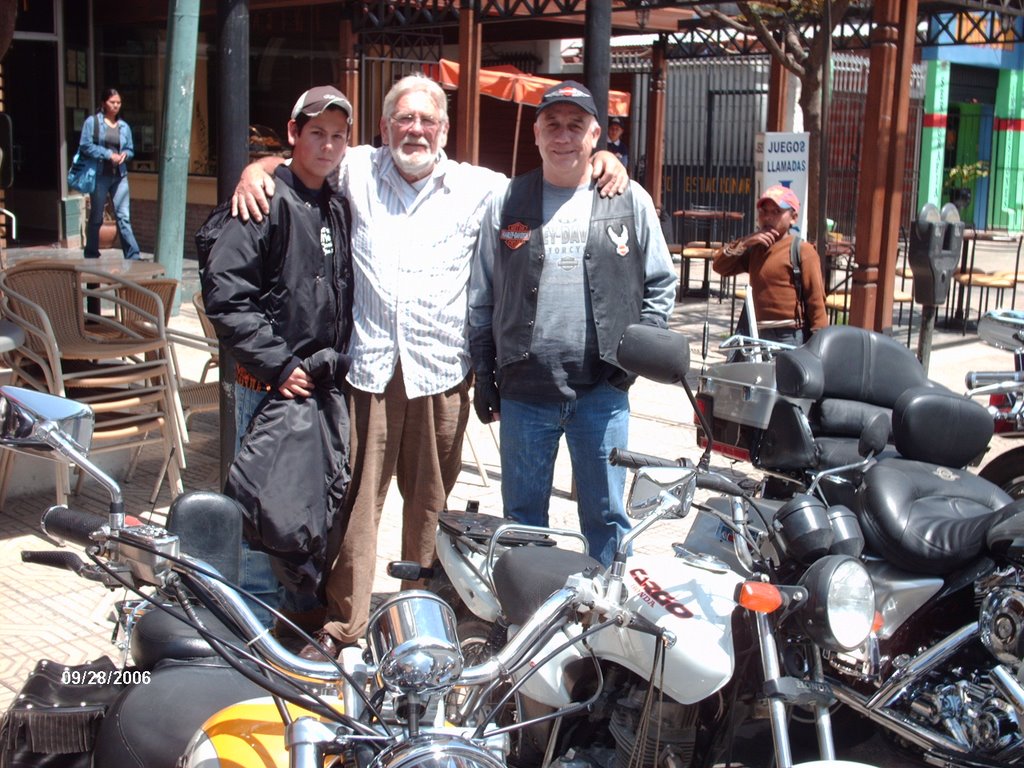
SATURDAY, SEPTEMBER 30
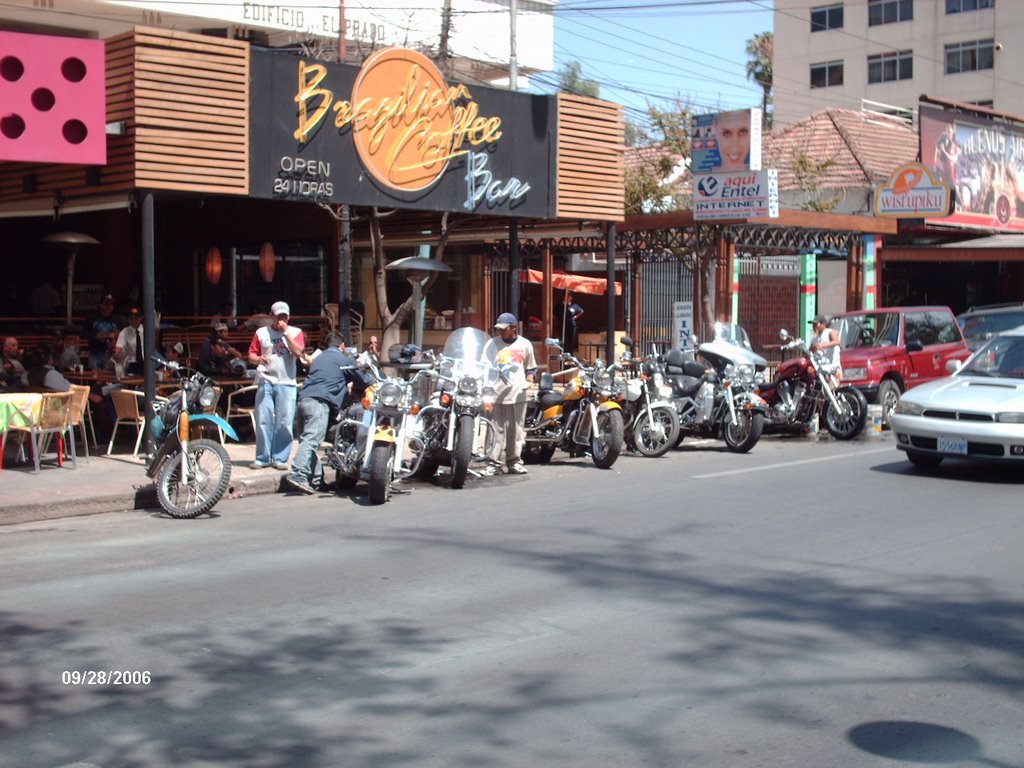
The sun shines. I sit at a café with members of Cochobamba’s Classic Bike Club. They insist I fetch my bike from the hotel garage. It is barely visible parked amongst its wealthy relatives, more a guinea pig than a Hog. These men are wealthy. The custom seats on their Harleys and massive Hondas cost more than my 125. We exchange tales of accidents; politics are off the menu. Frustrating, as I long to learn their opinions.
SUNSHINE
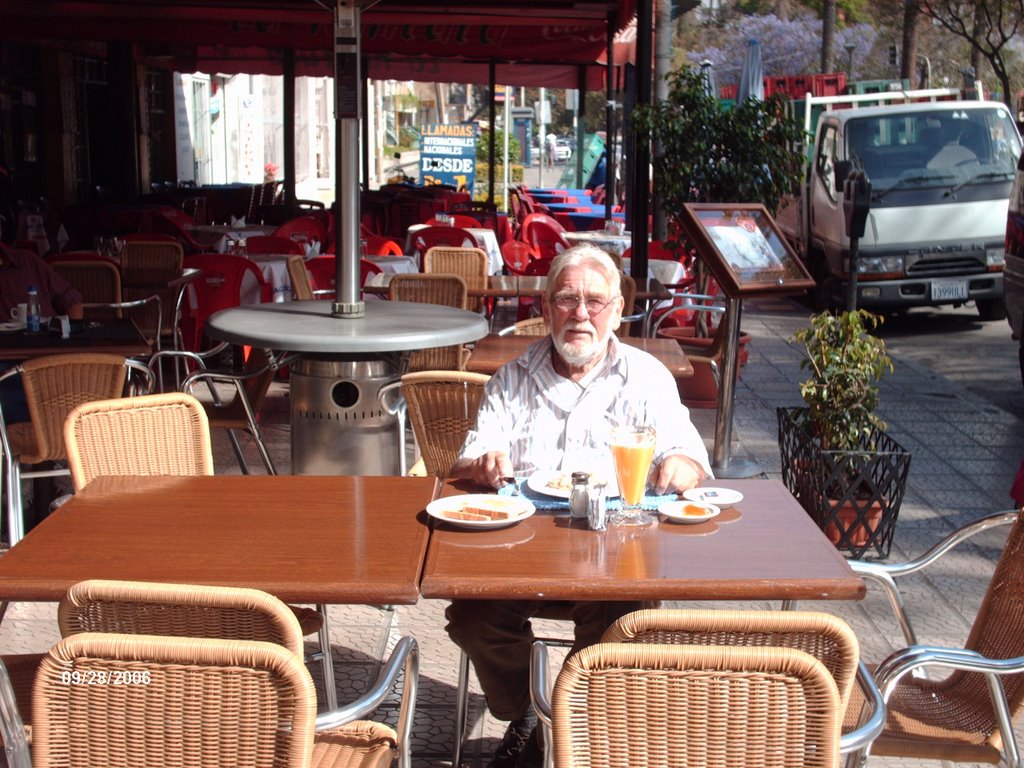
SATURDAY, SEPTEMBER 30
I sit in the sun and eat breakfast this morning at a sidewalk café. I am warm. Cochabamba is heaven. Rereading my Blogs of the past month or more, I realise that I have talked with few people. Opening conversations with strangers demands emotional energy. Cold is a sapper of energy. All those clothes form a barrier. Now, in the sun, I am brave. I talk after breakfast with an Argentinean architect, constructor of a cinema complex. Jewish. We talk of the conquest and the Jewish emigration from Spain to Latin America and of the Islamic influence on early Hispanic Colonial architecture and of the friendships and business friendships and alliances between Jewish and Arab immigrants in Argentina. The architect speaks of the Malvinas/Falklands war, of the young men whose lives were sacrificed to the demands of a drunk and to a woman’s need for a key to reelection.
HONDA

FRIDAY, SEPTEMBER 29
S.I.M. are the Honda agents. I watch the Honda being serviced. The mechanic is meticulous. I am about to start the bike. The mechanic tells me not to touch the throttle. I kick and the bike burbles. The bill is $12.
Friday, September 29, 2006
ALTITUDE
THURSDAY, SEPTEMBER 28
The road climbed beyond the blockade. Snow sprinkled the fell. The snowline lay well below the road. Cloud spat ice at my cheeks. My fingers froze. I didn’t give a damn. Honda and I have set a new personal record: fifteen thousand, four hundred feet (4700 meters). We have covered 420 Ks. Honda is resting at a very smart Honda Agency. I am in a hotel on the square. The owners of the hotel are Croatian and friends of Jorge Stambuk whom I met in Crinon, Colombia; he of the bio-diesel plant. The hotel bares that essential of a proper European family hotel: Madame sits behind the front desk and takes the money. I have a large room and large bathroom. The water is hot. The décor is 1930. My relationship to Jorge Stanbuk earns me a 20% discount. I am very comfortable.
The road climbed beyond the blockade. Snow sprinkled the fell. The snowline lay well below the road. Cloud spat ice at my cheeks. My fingers froze. I didn’t give a damn. Honda and I have set a new personal record: fifteen thousand, four hundred feet (4700 meters). We have covered 420 Ks. Honda is resting at a very smart Honda Agency. I am in a hotel on the square. The owners of the hotel are Croatian and friends of Jorge Stambuk whom I met in Crinon, Colombia; he of the bio-diesel plant. The hotel bares that essential of a proper European family hotel: Madame sits behind the front desk and takes the money. I have a large room and large bathroom. The water is hot. The décor is 1930. My relationship to Jorge Stanbuk earns me a 20% discount. I am very comfortable.
BLOCKADE
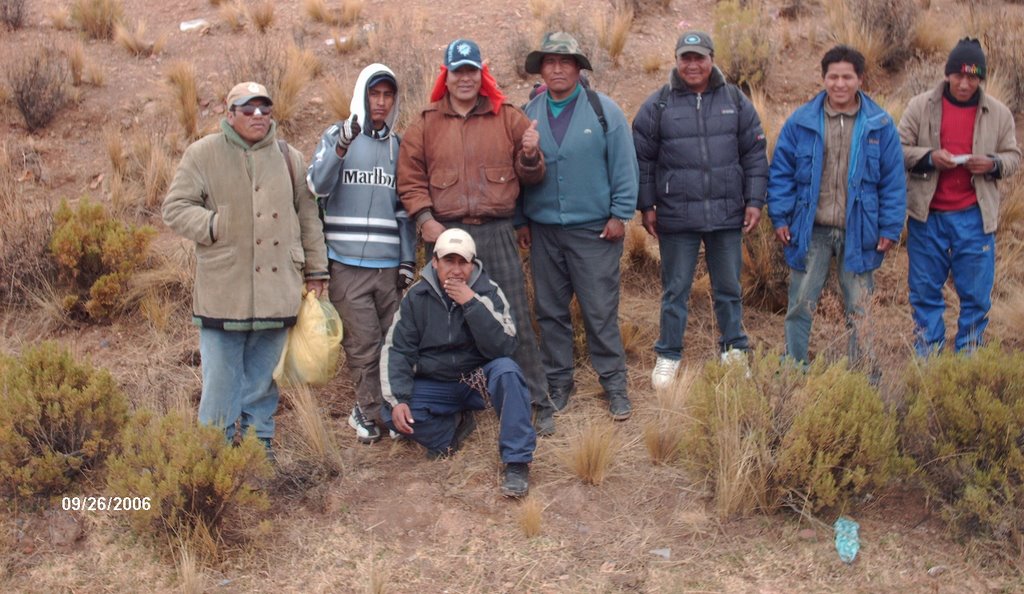
picket
THURSDAY, SEPTEMBER 28
Bolivia’s Morales is the President of the urban poor, the subsistence farmers and the manual workers. A magic wand should go with the job. It doesn’t. Morales is behind on his promises. His electorate are impatient. The miners have blockaded the road to Chocabamba. This is the third day of the blockade. Cars can manage a U turn. Trucks and busses are stuck. They are stuck in a double column twenty five Ks long. Local women have opened up roadside eateries. Bus passengers are dragging their gear in hope of a cab. I weave through to the rock barrier. A union meeting is breaking up. I boast that my eldest son is a union official. A group collects on a bank to have their photograph taken. A miner takes the camera and photographs me in the centre of the picket. Sadly he doesn’t push the button.
FREEZING
THURSDAY, SEPTEMBER 28
I waddle because I have dressed for the altitude. First the lower half: underpants, longjohns, two pairs of Chinos, dull-blue waterproof pants, red rugby socks, Church’ shoes. The top: two undershirts, one cord shirt, one sleeveless jumper, two long-sleeve jumpers, scarf, leather jacket, bright-blue waterproof jacket, wool gloves, leather gauntlets. Why am I freezing?
I waddle because I have dressed for the altitude. First the lower half: underpants, longjohns, two pairs of Chinos, dull-blue waterproof pants, red rugby socks, Church’ shoes. The top: two undershirts, one cord shirt, one sleeveless jumper, two long-sleeve jumpers, scarf, leather jacket, bright-blue waterproof jacket, wool gloves, leather gauntlets. Why am I freezing?
ADVENTURE
THURSDAY, SEPTEMBER 28
La Paz is in a hole. A road leads in. A road leads out. Escape is simple. I ride a hundred Ks before pulling in at a roadhouse. I park beside an outsize Bolivian-registered four by four fitted with all the Chelsea extras: spots on the roof, spots on the bull bar, winch, cowcatcher, rocket launcher, smoke grenades, ejector seats. The passenger-side smoked window slides down. A neat Bolivian blond asks where I’ve come from. “Mexico? On that bike? Magnificant.”
I, of course, looked humble.
“Where are you going? Argentina? Tierra del Fuego? Wow! Us too. That’s really great.”
The guy (ponytail) drums a finger on the padded leather steering wheel.
The blond takes the message. The smoked window slides up.
I dismount and waddle into the roadhouse.
La Paz is in a hole. A road leads in. A road leads out. Escape is simple. I ride a hundred Ks before pulling in at a roadhouse. I park beside an outsize Bolivian-registered four by four fitted with all the Chelsea extras: spots on the roof, spots on the bull bar, winch, cowcatcher, rocket launcher, smoke grenades, ejector seats. The passenger-side smoked window slides down. A neat Bolivian blond asks where I’ve come from. “Mexico? On that bike? Magnificant.”
I, of course, looked humble.
“Where are you going? Argentina? Tierra del Fuego? Wow! Us too. That’s really great.”
The guy (ponytail) drums a finger on the padded leather steering wheel.
The blond takes the message. The smoked window slides up.
I dismount and waddle into the roadhouse.
Wednesday, September 27, 2006
MUSEUMS & CHURCHES
WEDNESDAY, SEPTEMBER 29
I talked last night with a German, a Professor of philosophy. He has a new book finished and is taking a short break. Flying directly in to La Paz often brings on altitude sickness. The Professor is suffering – or I bored him to bed.
I was a good tourist all afternoon: two museums, two churches and a cathedral. The cathedral is gloomy. One of the museums is under repair. However the coffee in the coffee shop at the museum and church of San Francisco is the best I have drunk in more than a month. Today I visited more museums and am overdosed. The streets are steep and walking at over 4000 meters is tough on an old man. What did I see? More crude and unimaginative Inca gold, beautiful Tiwanachu ceramics. However – fifteen hundred years of working with clay, no potter’s wheel and so limited a palette.
I talked last night with a German, a Professor of philosophy. He has a new book finished and is taking a short break. Flying directly in to La Paz often brings on altitude sickness. The Professor is suffering – or I bored him to bed.
I was a good tourist all afternoon: two museums, two churches and a cathedral. The cathedral is gloomy. One of the museums is under repair. However the coffee in the coffee shop at the museum and church of San Francisco is the best I have drunk in more than a month. Today I visited more museums and am overdosed. The streets are steep and walking at over 4000 meters is tough on an old man. What did I see? More crude and unimaginative Inca gold, beautiful Tiwanachu ceramics. However – fifteen hundred years of working with clay, no potter’s wheel and so limited a palette.
HOSTAL REPUBLICA, LA PAZ
TUESDAY, SEPTEMBER 28
A viciously cold wind blows across the altiplano. For protection, the Spaniards built La Paz at the bottom of a gorge and when rush hour was three horses and a mule. Imagine pouring the traffic of a major city into so constricted a space. On a bike I advanced maybe a hundred metres in twenty minutes. I am staying two nights at the Hostal Republic two blocks off the Cathedral square. The hostal once was the private house of an ex President. An estate agent would describe it as a two-patio two-floor Spanish colonial. I have a single room on the upper floor overlooking the rear patio. The shower is reasonably hot and the towels are excellent. The building is romantic; $16 is a reasonable room rate. The help found a plank so I could ride the Honda up the steps. The patios are cobbled and the Honda is happy.
A viciously cold wind blows across the altiplano. For protection, the Spaniards built La Paz at the bottom of a gorge and when rush hour was three horses and a mule. Imagine pouring the traffic of a major city into so constricted a space. On a bike I advanced maybe a hundred metres in twenty minutes. I am staying two nights at the Hostal Republic two blocks off the Cathedral square. The hostal once was the private house of an ex President. An estate agent would describe it as a two-patio two-floor Spanish colonial. I have a single room on the upper floor overlooking the rear patio. The shower is reasonably hot and the towels are excellent. The building is romantic; $16 is a reasonable room rate. The help found a plank so I could ride the Honda up the steps. The patios are cobbled and the Honda is happy.
FERRY
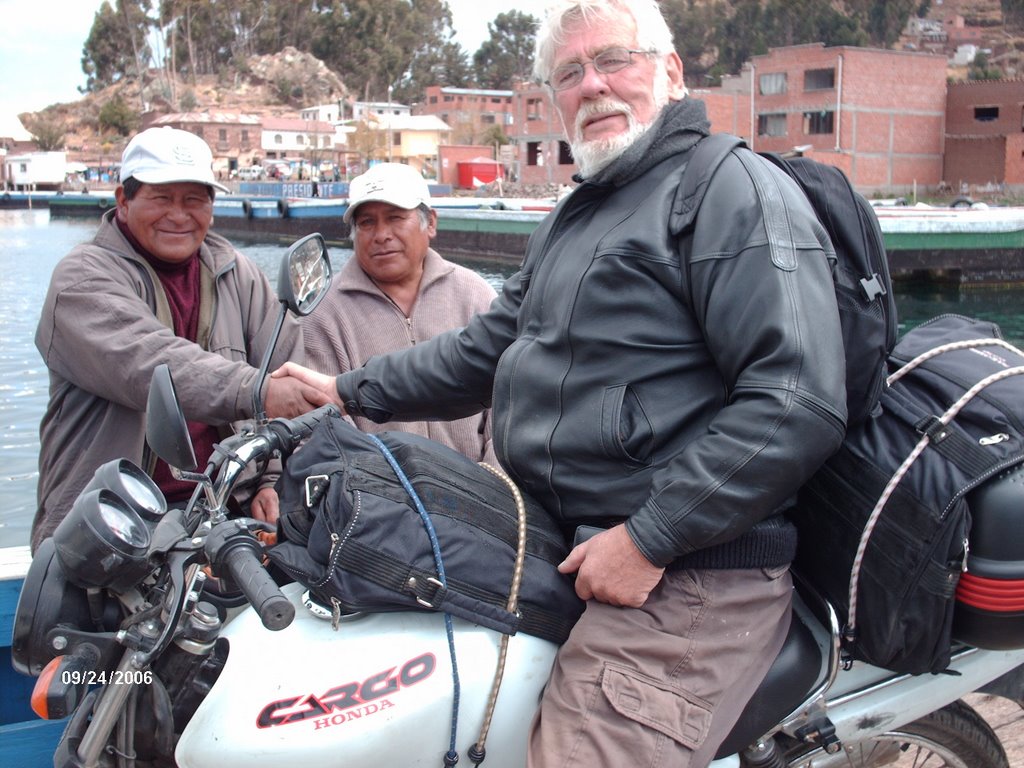
TUESDAY, SEPTEMBER 28
Wooden barges ferry trucks and busses across the straits. The barges are outboard powered and the passage is some four hundred meters. Ten or more of the barges wait in line. The crew won’t cross for a lone biker. A minibus drives onto the lead ferry and the captain waves me on board. The coxswain asks about my journey. He wants his photograph taken with me and the bike. One of his crewmen takes the picture. He is a novice with a camera and cuts off part of my head. The coxswain is happy with the result.
TWO INCHES
TUESDAY, SEPTEMBER 28
I eat a chicken roll and drink a large mug of hot black coffee in the cafeteria by the ferry quay. The woman serving me lost an eye; the socket has been sewn shut. She asks if I am sometimes frightened riding alone. I say that, No, I’m fine, just so long as I avoid the guide books.
A dozen women sell fruit and whatever from stalls outside the cafeteria. One of them demonstrates the size of whatever she is discussing by holding her two forefingers a couple of inches apart.
“Me,” I say from the doorway, pointing a finger at myself. “That’s not very kind.”
A few seconds pass in which the women don’t believe what they’ve heard. Then they break up. One has the laugh of an excited chicken. An old crone is doubled over: “Mala, mala, mala,” she shrieks.
I eat a chicken roll and drink a large mug of hot black coffee in the cafeteria by the ferry quay. The woman serving me lost an eye; the socket has been sewn shut. She asks if I am sometimes frightened riding alone. I say that, No, I’m fine, just so long as I avoid the guide books.
A dozen women sell fruit and whatever from stalls outside the cafeteria. One of them demonstrates the size of whatever she is discussing by holding her two forefingers a couple of inches apart.
“Me,” I say from the doorway, pointing a finger at myself. “That’s not very kind.”
A few seconds pass in which the women don’t believe what they’ve heard. Then they break up. One has the laugh of an excited chicken. An old crone is doubled over: “Mala, mala, mala,” she shrieks.
TITICACA
TUESDAY, SEPTEMBER 28
The road follows a high contour above Lake Titicaca. Thick rain-clouds to the east die the waters wine dark; a lone white motor launch draws a white trail. West is sunshine and the water is brilliant blue. My guidebook reports that the lake is mystical, that the terraces on the peninsular are Inca and the La Paz has the best market for buying ingredients for witchcraft. My guidebook also reported that the customs officers were crooks and warned that I would be raped, strangle mugged, abducted by guerrillas and shot by paramilitaries. Forget the book and the mystic and the Incas. Stick with the facts: the fells are beautiful and the lake is beautiful. I am immensely privileged in riding these hills on such a glorious morning.
The road follows a high contour above Lake Titicaca. Thick rain-clouds to the east die the waters wine dark; a lone white motor launch draws a white trail. West is sunshine and the water is brilliant blue. My guidebook reports that the lake is mystical, that the terraces on the peninsular are Inca and the La Paz has the best market for buying ingredients for witchcraft. My guidebook also reported that the customs officers were crooks and warned that I would be raped, strangle mugged, abducted by guerrillas and shot by paramilitaries. Forget the book and the mystic and the Incas. Stick with the facts: the fells are beautiful and the lake is beautiful. I am immensely privileged in riding these hills on such a glorious morning.
FEMINISM
TUESDAY, SEPTEMBER 28
Cocabamba is on a peninsular. The peninsular is mountainous and projects from Peruvian territory so it is a de facto island. You take a ferry to Bolivia proper. Cocabamaba is 25 Ks from the ferry port. The road climbs to 4100 meters. Early morning is cold – especially for a biker. The road is under repair. Men lug stones. They don’t wear gloves. Nor do the women who man the wheelbarrows. The hems of the women’s pettycoats and skirts show beneath yellow slickers. I consider myself a feminist. This wasn’t the equality I envisaged.
Cocabamba is on a peninsular. The peninsular is mountainous and projects from Peruvian territory so it is a de facto island. You take a ferry to Bolivia proper. Cocabamaba is 25 Ks from the ferry port. The road climbs to 4100 meters. Early morning is cold – especially for a biker. The road is under repair. Men lug stones. They don’t wear gloves. Nor do the women who man the wheelbarrows. The hems of the women’s pettycoats and skirts show beneath yellow slickers. I consider myself a feminist. This wasn’t the equality I envisaged.
COCABAMBA
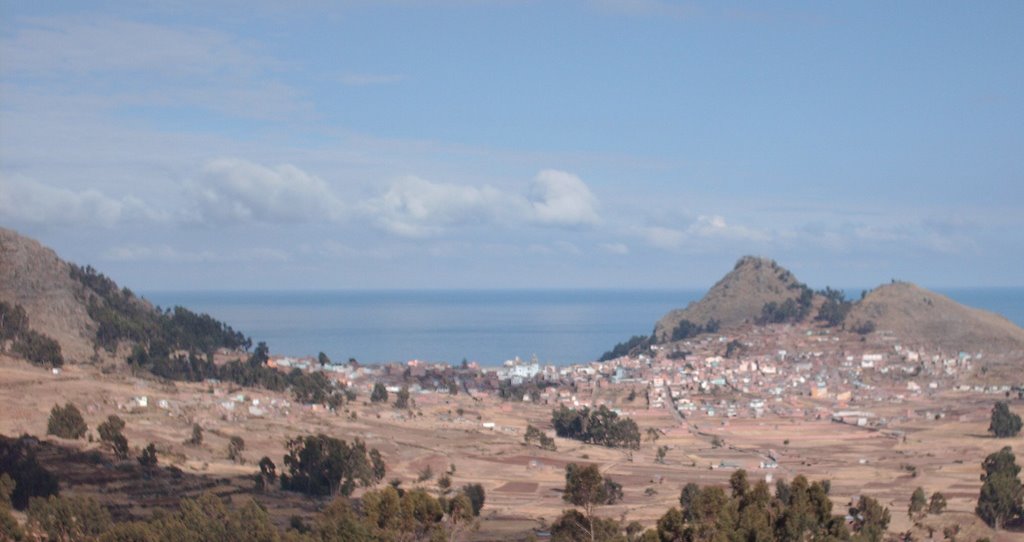
MONDAY, SEPTEMBER 26
Cocabamba is built on the saddle between two hills. The town slopes steeply down to the shore and reminds me of a Mediteranean fishing village come tourist resort. The townsfolk seem friendlier, happier and more fun-loving than Peruvians. They may eat tourists, but they exercise charm; Peruvians prefer the bludgeon. A big white Cathedral dominates the town. The tiled domes of the towers and the vast courtyard should belong to a mosque. The simplicity of the Cathedral’s interior is equally Arabic.
I booked into the Colonial, big room with lake view and hot shower. The bedside lamp didn’t work. I switched rooms. The shower didn’t work. However the beds were great and a room rate of $5 that includes Continental breakfast isn’t exorbitant. A wet Brit on Gap Year confronted me on the stairs. He had been swimming in the lake. He claimed that the water was shallow and therefor warm. I was shivering from a bike ride. A second young Brit and two young North Americans made a foursome in the hotel garden. I would have enjoyed hearing their stories. Unfortunately, I carry a fatal disease, Age, and they chose the table furthest from where I sat. Sad.
Tuesday, September 26, 2006
HI, BOLIVIA
MONDAY, SEPTEMBER 25
The vicious corrupt Bolivian customs officer is a gardener. He is dressed in a wool jumper and is pushing a wheelbarrow. He directs me to Immigration where I fill in the standard tourist fiche (five minutes). I return to the Customs office. The customs officer parks his wheelbarrow and we complete a transit permit for the Honda. Though patient, he is keen to get back to his barrow. He stamps and signs the permit and points me to the transit police for a counter signature. Total time at the Bolivian border? Barely fifteen minutes. For this I have worried. I suspect that the writer of my guidebook is an irritating and arrogant young man – a type officials hate on sight. Or perhaps I have been lucky. Perhaps my age helps. They imagine my dying on them and the paper work and they think, Quick! move the old fool on.
The vicious corrupt Bolivian customs officer is a gardener. He is dressed in a wool jumper and is pushing a wheelbarrow. He directs me to Immigration where I fill in the standard tourist fiche (five minutes). I return to the Customs office. The customs officer parks his wheelbarrow and we complete a transit permit for the Honda. Though patient, he is keen to get back to his barrow. He stamps and signs the permit and points me to the transit police for a counter signature. Total time at the Bolivian border? Barely fifteen minutes. For this I have worried. I suspect that the writer of my guidebook is an irritating and arrogant young man – a type officials hate on sight. Or perhaps I have been lucky. Perhaps my age helps. They imagine my dying on them and the paper work and they think, Quick! move the old fool on.
ADIEU PERU
MONDAY, SEPTEMBER 25
Peruvian Immigration takes all of two minutes. Customs is a problem. Our friendly and helpful customs officer from the frontier with Ecuador completed the exit part of the Honda’s transit permit rather than the entry.
“A tall man, talks a lot,” suggests the present officer as he scans the signature.
“Yes,” I say. “A very amiable man.”
“Very amiable,” agrees his fellow official. “Amiable is all he is. I’ve served with him.”
I wait while he writes an explanation of the error on pink paper. I add my signature. He affixes the report to the transit permit. We shake hands. I am out of Peru.
Peruvian Immigration takes all of two minutes. Customs is a problem. Our friendly and helpful customs officer from the frontier with Ecuador completed the exit part of the Honda’s transit permit rather than the entry.
“A tall man, talks a lot,” suggests the present officer as he scans the signature.
“Yes,” I say. “A very amiable man.”
“Very amiable,” agrees his fellow official. “Amiable is all he is. I’ve served with him.”
I wait while he writes an explanation of the error on pink paper. I add my signature. He affixes the report to the transit permit. We shake hands. I am out of Peru.
VICTIM
MONDAY, SEPTEMBER 25
The writer of my guidebook warns of corrupt practices at the Bolivian frontier with Peru. The writer mentions motorcyclists as victims. Yeah, have a nice day. The road follows the lake shore. I see thirty or more men seated on benches at the rear of an adobe house. The men are similarly dressed in black suits and black fedoras. They are silent and solemn. This must be a wake. They should take lessons from the Irish.
The road climbs behind a hill. Concrete steps mount the hill. Each step represents a Station of the Cross. Two tall radio masts dominate the hilltop. The shrine is insignificant.
I pause and look back across a bay. The water reflects the deep blue of the sky. A thousand mirrors gleam on the far shore - tin roofs catching the sunlight.
I note two rough-coated white donkeys on a pale beach.
And I worry. Ten Ks to the frontier. Here comes the victim.
The writer of my guidebook warns of corrupt practices at the Bolivian frontier with Peru. The writer mentions motorcyclists as victims. Yeah, have a nice day. The road follows the lake shore. I see thirty or more men seated on benches at the rear of an adobe house. The men are similarly dressed in black suits and black fedoras. They are silent and solemn. This must be a wake. They should take lessons from the Irish.
The road climbs behind a hill. Concrete steps mount the hill. Each step represents a Station of the Cross. Two tall radio masts dominate the hilltop. The shrine is insignificant.
I pause and look back across a bay. The water reflects the deep blue of the sky. A thousand mirrors gleam on the far shore - tin roofs catching the sunlight.
I note two rough-coated white donkeys on a pale beach.
And I worry. Ten Ks to the frontier. Here comes the victim.
FUNERAL PARLOR

made in britain 2nd steamship brought to Puna
SUNDAY, SEPTEMBER 24
I count eighteen restaurants on Puna’s pedestrian street. All but Rica’s Café are geared to tourists. Look in through any window, there we sit, we, the rich (by Peruvian standards). The restaurants employ hustlers. The altitude is above three thousand meters and the hustlers wrap up in ankle-length overcoats and matching mufflers. Charcoal grey is an unfortunate colour. Look at the menu, what do you expect? Price list from a funeral parlour. Watch out for the extras…
CULTURAL COLONIALISM
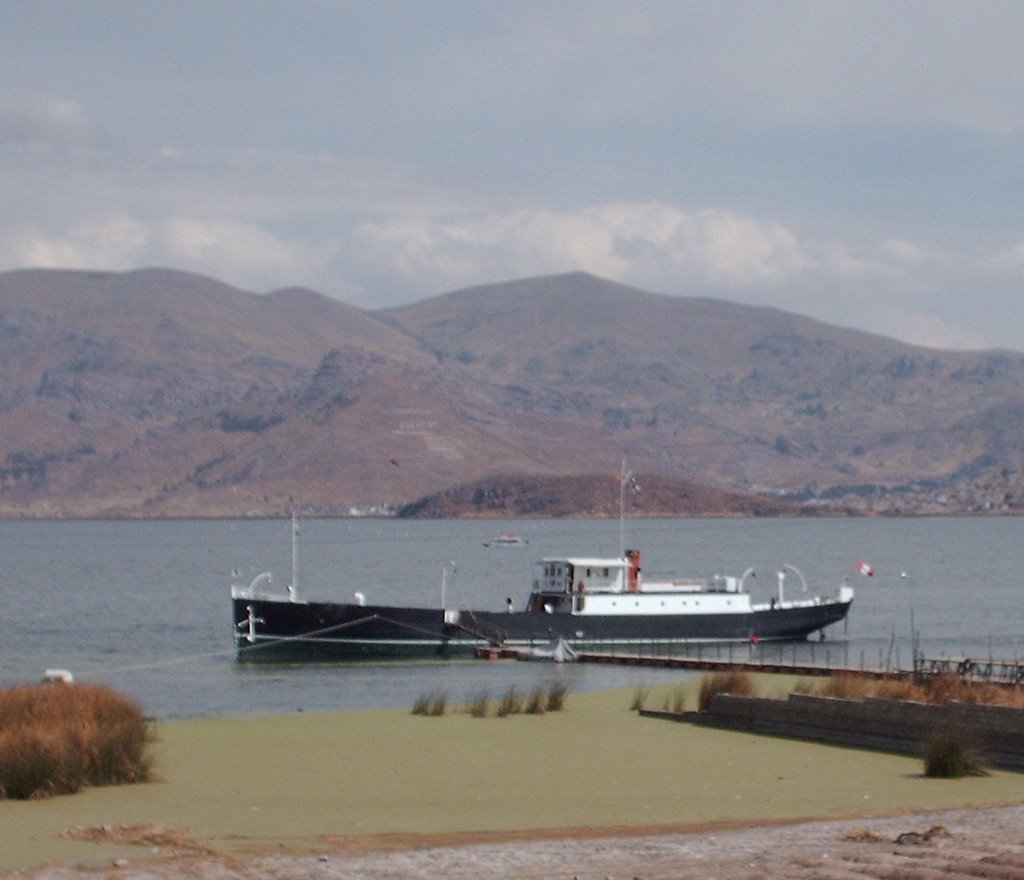
made in britain
carried in pieces
up to Puna on mules
SUNDAY, SEPTEMBER 24
Cultural Colonialism hits randomly. I watch a family of six Peruvians in a small restaurant. A young woman angles her head and flashes a smile at her father. She wants something. The flirtation is pure Hollywood. On the pedestrian street, a tall, exceptionally dark-skinned young man is unique amongst his Puna contemporaries in wearing HipHop.
Saturday, September 23, 2006
HATS
SATURDAY, SEPTEMBER 23
Puna is great for hats. Most common are choclate soup plates baring one of those round buns that have swollen above the baking tin. I admire a pink bowler with silk ribbon edging the underside of the brim. Another favourite is a mini black bowler with a tassel warn at a jaunty angle by a plump lady in her fifties. She is dressed in black. White petticoats fluff up her skirt. A shy thin woman wears a yellow hat of plastic straw sprinkled with glitter. A teenage boy favours a red wool cloche. Then there is the man in the grey fedora who, hands in pockets, poses as an Italian Mafioso. Backpackers favour a design on white wool, the top drawn to a point, a tuft on the crest and earflaps. An elderly grey Stetson talks to two junior baseball caps. Strangest is a wide brim golden pentagon; blue lines mark the segments. Can it be a hat or is it a lampshade out for a walk? The owner is a severe schoolmistressy woman near retirement.
Puna is great for hats. Most common are choclate soup plates baring one of those round buns that have swollen above the baking tin. I admire a pink bowler with silk ribbon edging the underside of the brim. Another favourite is a mini black bowler with a tassel warn at a jaunty angle by a plump lady in her fifties. She is dressed in black. White petticoats fluff up her skirt. A shy thin woman wears a yellow hat of plastic straw sprinkled with glitter. A teenage boy favours a red wool cloche. Then there is the man in the grey fedora who, hands in pockets, poses as an Italian Mafioso. Backpackers favour a design on white wool, the top drawn to a point, a tuft on the crest and earflaps. An elderly grey Stetson talks to two junior baseball caps. Strangest is a wide brim golden pentagon; blue lines mark the segments. Can it be a hat or is it a lampshade out for a walk? The owner is a severe schoolmistressy woman near retirement.
PUNA
FRIDAY, SEPTEMBER 22
Sun sets as I ride the final kilometres into Puna. The drop in temperature is instant. I could weep icicles. A fiesta grips the city centre. The road to my chosen hotel is blocked. A cop suggests the Gran Puna Inn. A young concierge runs to open the locked glass doors and laughs as he slides on the polished floor. $25 is beyond my budget. The manager settles for $20 to include a buffet breakfast. He and the concierge lift the Honda over the curb and into the lobby. My room is on the fourth floor, no elevator. The stairs are steep. I fear for my unmedicated heart. The concierge offers me coca leaves infused in hot water.
The room is spacious. So is the bathroom. The shower runs hot. The bath towels are thick and vast. The bath mat is a miraculous extra as are an electric radiator and Cable TV. I hope for the Ryder Cup. No luck.
Sun sets as I ride the final kilometres into Puna. The drop in temperature is instant. I could weep icicles. A fiesta grips the city centre. The road to my chosen hotel is blocked. A cop suggests the Gran Puna Inn. A young concierge runs to open the locked glass doors and laughs as he slides on the polished floor. $25 is beyond my budget. The manager settles for $20 to include a buffet breakfast. He and the concierge lift the Honda over the curb and into the lobby. My room is on the fourth floor, no elevator. The stairs are steep. I fear for my unmedicated heart. The concierge offers me coca leaves infused in hot water.
The room is spacious. So is the bathroom. The shower runs hot. The bath towels are thick and vast. The bath mat is a miraculous extra as are an electric radiator and Cable TV. I hope for the Ryder Cup. No luck.
ALTIPLANO
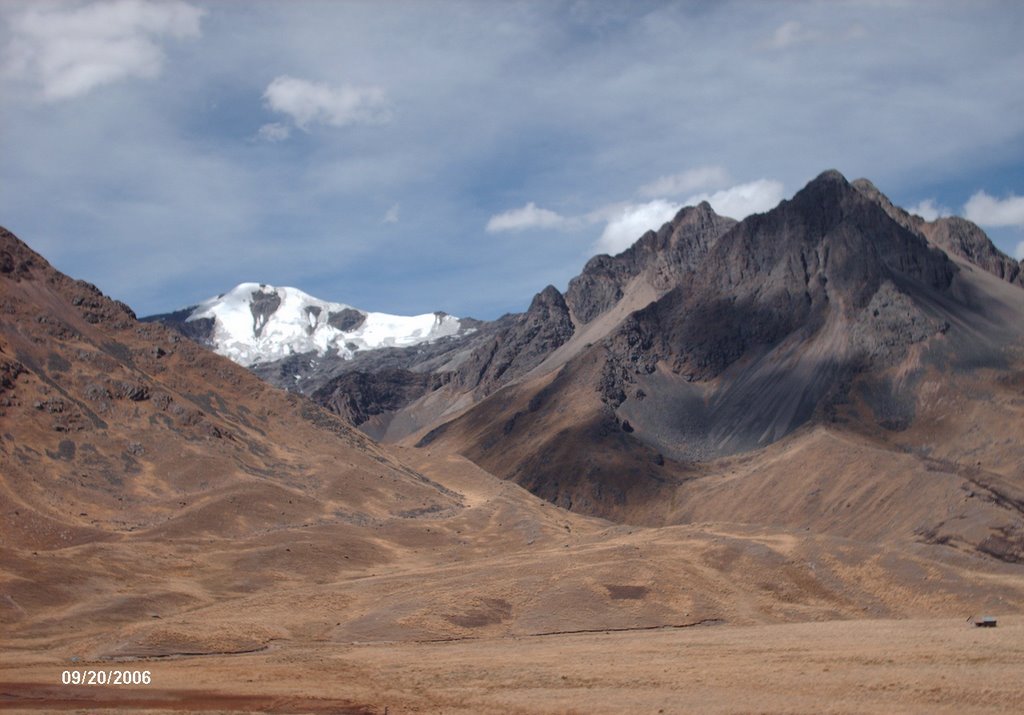
north of the cusco-puna road
FIDAY, SEPTEMBER 22
The road is straight, the surface excellent. The Honda cruises at 80 KPH. I inhale fresh chill air and revel in the intense beauty of the altiplano. The mountains are dark rock. A wedge of snow appears. The herds are mostly alpacca. I can differentiate them from lamas. I enquired of a herdswoman. The alpacca are shorter and have bulkier coats. The herdswoman’s home was an adobe hovel. That is the truth of the alto plano: poor soil, nights of vicious cold. Many hovels stand empty. The people have fled certain poverty. The squatter towns of Puna, Cusco or Lima tempt with the possibility of a marginally better life.
LIVESTOCK
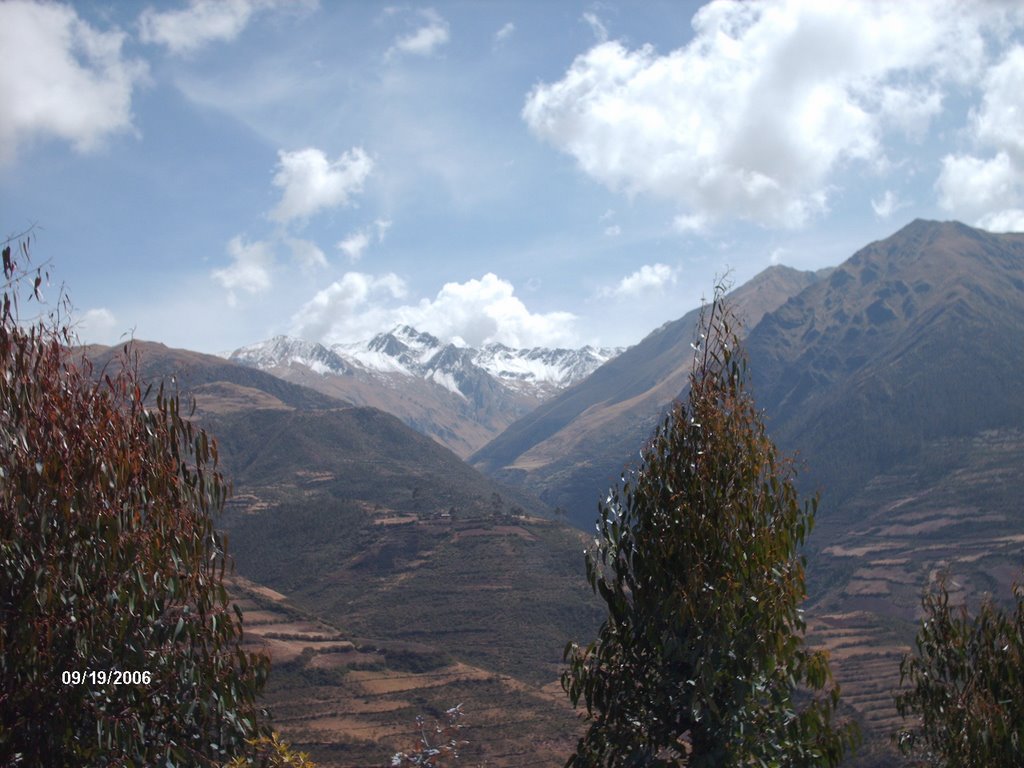
last valley before cusco
FRIDAY, SEPTEMBER 22
In Cusco I am income, two legged livestock. I will learn nothing of Peru. On arrival at the Hostal Marani the Dutch manager asked me to tell her in the morning whether I wished to stay a further day. I tell her this morning. She tells me the hotel is fully booked. I have my excuse. Thirty minutes and I am packed and on the road to Puna.
Road and rail share a wide river valley. At first there are fields. The road climbs and I am back on the altiplano. The clarity of light is extraordinary, the deep blue of the sky and feel of unlimited space. I stop at a plush roadhouse to use the lavatory. A Belgium coach party enjoys a buffet lunch. The tour guide travelled solo for three years. He found passage on a US registered yacht from Panama to Cartagena. He is due in Patagonia next month. He will email me his schedule. His tour group gathers round the Honda. We shake hands. They wish me happy travelling.
ART
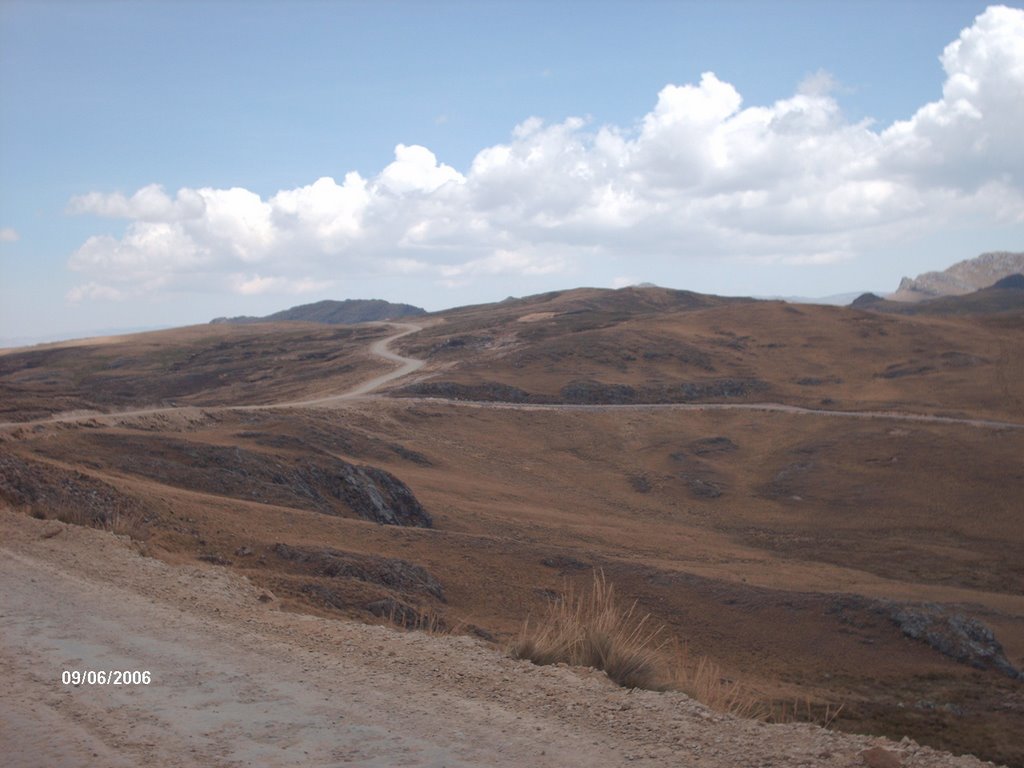
across the fells
THURSDAY, SEPTEMBER 21
A short ride takes me up to Cusco. The cathedral is superb. A canvas is being relined. Teaching restoration is a department of the School Of Belles Artes. Study is free – unlike Ecuador. Peru has endless art in need of restoration and many trained restorers. Funds to pay the restorers are in short supply. I talk with the head of restoration. We talk of the artistic explosion that accompanied the conquest. Indigenous artists were given the tools and were freed from constraint. They leapt from lugging boulders to creating the Rosario chapel. Their work will be marvelled at as long as this planet survives. Then came the Inquisition. Thinking outside the box was again prohibited. Spain and Latin America atrophied.
INCA

family home
THURSDAY, SEPTEMBER 21
Nasca was a break. Now I am back travelling. I have failed to get a handle on Peru. I am disturbed by the contrast between extreme poverty and dirt and that Peru is a tourist Mecca. Inca worship is in fashion. I am out of fashion. I see a thousand years without change, without discovery. I look at Inca stonework and wonder how many slaves were killed and maimed on the construction site. To shift a 30ton boulder up a mountain rather than use cut blocks seems to me a failure. I take on trust an expert’s opinion as to the era of a ceramic or scrap of woven cloth; my interest is minimal.
ANDES
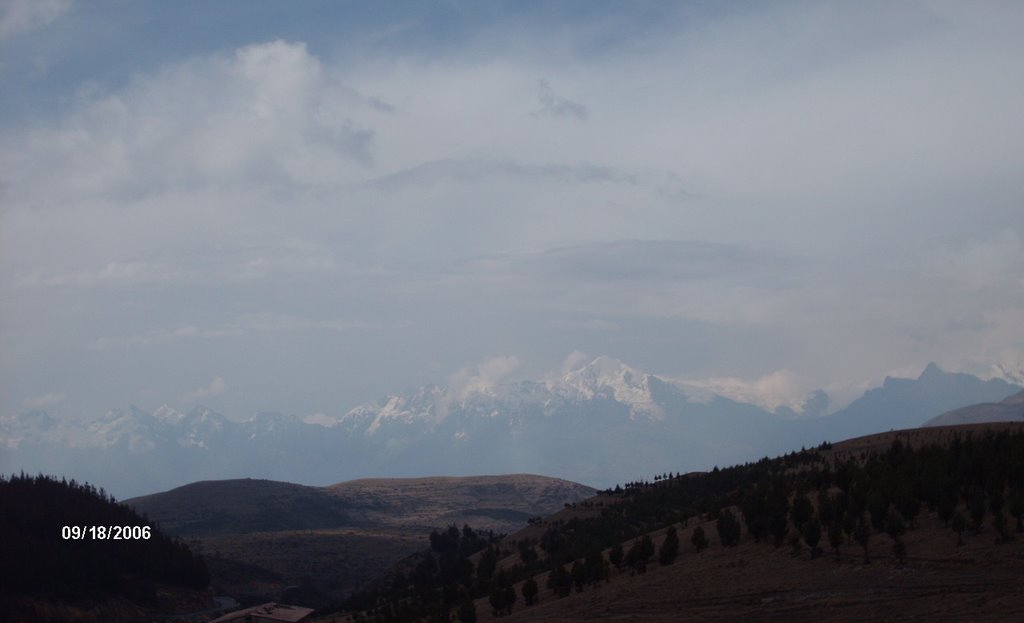
WEDNESDAY, SEPTEMBER 20
The alto plano ends. The road winds and backtracks down a steep mountain face. The drop is dizzying. I quake when forced by a truck to the outside of a curve. At bottom the road follows a river gorge. The gorge funnels the wind. Tiny patches of tilled soil edge the water - fields would be a misnomer. A woman shares the shade of a fruit tree with two sheep. She returns my wave. The gorge narrows to nothing and the road climbs. The Honda is valiant. Up we go, up and up. We hit the top and wow! The majestic sweep of the high Andes is spread across the horizon. The view of snow capped peaks is magnificent. Surprise is total. The road drops again and follows another river. 100 Ks to Cusco… Exhausted, I pull into a roadside inn. They have a room with a bath ($7). They also have flies. The flies bite. Each bite raises a purple bruise with a minute blood-drop dead centre. The bites itch. The beef at dinner is a further candidate for the Peruvian arms industry. I am out of cardiac medication. I can’t sleep. I lie awake and itch and obsess over the state of my heart.
ANGER
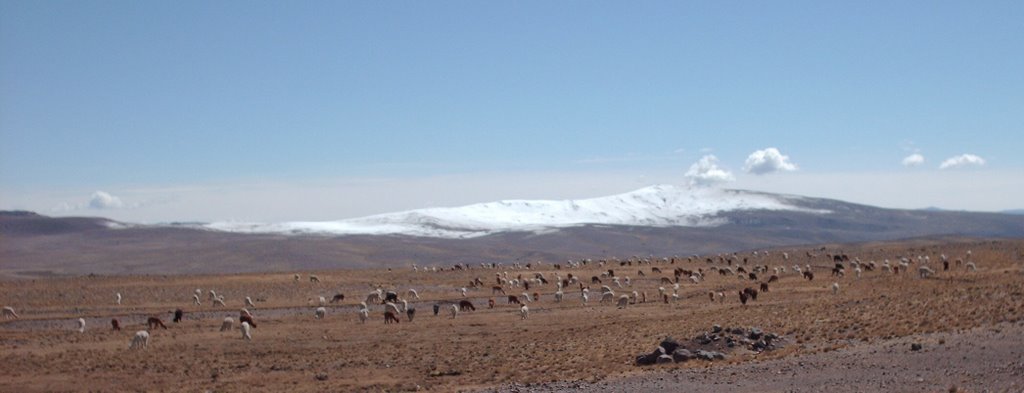
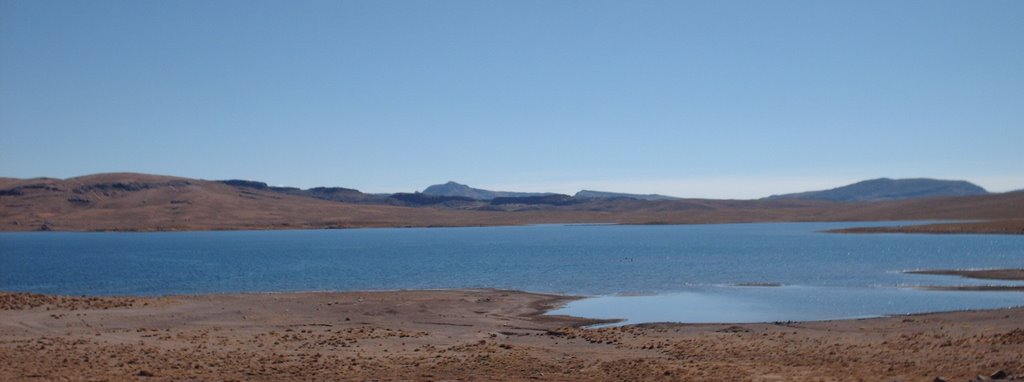
alpacca
tarn
WEDNESDAY, SEPTEMBER 20
The road flows over high fells. I can see for miles. Way in the distance a lone truck creeps over a crest. A tarn to the left of the road reflects the deep blue of the sky. Small groups of vicuna graze the tufted grass. A couple of shaggy ponies watch from a rise. Snow covers a soft ridge between black rock peaks. A herdswoman chivvies a flock of alpacca. Riding here is easy. Free to muse, I dwell on yesterday’s conversation with the engineer. I wrote yesterday’s blog in anger. Anger has been inescapable on much of this journey. I have been riding through the United States’ back yard, a back yard the US has been tilling for the past two hundred years. Successive Administrations have suborned Governments supported the vilest of dictators, trained military for whom murder and torture are the norm. Bush supports torture as necessary. Where does US society stand? Behind their President? Behind that great TV hero of 24 Hours, an all-American Hero brave enough to torture prisoners? This is the good guy. No wonder the US military are confused. No wonder that Latin Americans are sickened by the US’s claim to hold the moral high ground. I long to see Bush and Romsfeld and Cheney strapped to waterboards. Blair I would dunk in a witch’s chair.
Friday, September 22, 2006
TORTURE
An electrical engineer sits at the next table at the Estancia restaurant in Pequia. He has three sons. The eldest is also an engineer; the second is an architect; the third is studying computer science at university. My companion is a great reader and a student of current affairs. He asks my nationality and says, “Your Tony Blair is a tremendous liar.”
“Yes,” I say.
“And now Bush makes torture legal. How do you feel?”
Few people I meet on this journey differentiate between the US and Britain. Blair has implicated us totally. How do I feel? I feel deeply sullied.
My daughter, Anya, complains that I accuse all Americans of torture. I accuse all Americans of complicity in torture. We Britains are accomplices. This is Blair’s doing. He has made us accomplices to so much evil and to so much stupidity. Yes, I feel sullied, but also enraged that one man should take my nation down such a filth-strewn road.
“Yes,” I say.
“And now Bush makes torture legal. How do you feel?”
Few people I meet on this journey differentiate between the US and Britain. Blair has implicated us totally. How do I feel? I feel deeply sullied.
My daughter, Anya, complains that I accuse all Americans of torture. I accuse all Americans of complicity in torture. We Britains are accomplices. This is Blair’s doing. He has made us accomplices to so much evil and to so much stupidity. Yes, I feel sullied, but also enraged that one man should take my nation down such a filth-strewn road.
ARMS INDUSTRY
Pequia is 160 Ks from Nasca. Mid afternoon and I am exhausted. I ride up a dirt street in search of a hotel. This is market day or all days are market days. Small dark people bundled in sweaters and wool jackets overflow the sidewalk. Men and women wear brown felt hats. Doorways overflow with used clothes. The one hotel is on a street being laid with drains. The sidewalk is too narrow for the Honda and a meter above the digging. I park the Honda indoors at the hotel owner’s house. She directs me to a restaurant. The Peruvian arms industry could build tanks out of the beef. I chomp and read the newspaper. Pillaging of the military and police pension fund occupies the first four pages.
VICUNAS

The road crosses a dark bristly fell of tufted grass. I can see for miles. I wonder why vicuna graze beside the road. Do they enjoy traffic?
GLOBAL WARMING
The road from Nasca twists up through dry mountains, a climb of over 3000 meters. I find a neat clean café at the top. Bowls of brilliant wild flowers liven the counter. The owner is in his sixties. He has lived here all his life. In his youth the hills were green. Farmers kept dairy cattle. Little rain has fallen over the past twenty years. The cattle have gone. Global warming…
CUSCO
I have seen innumerable photographs of the Nasca lines. I have read the theories and the fictions. I have wondered at the obsessivness of archaeologists. Tourists view the lines from the air. $50 is the price. Few locals can spare $50. None of the staff at the Hostal have seen the lines. I cooked for the staff and raced up and down sand dunes with Juan Carlos, Victor and Carmen. They made me welcome, treated me as a friend, made me feel at home. I had a ball – no need for lines. I thank them and I thank the people of Nasca - what joy to wander the streets at night without fear of assault. Now I am in Cusco. My guidebook warns of frequent rapes and strangle mugging and mugging by cab drivers and of pickpockets and con artists. I am staying at a Dutch owned Hostal, the Marani on Carmen Alto. Profits go to the Hope Foundation, a worthy cause. The Honda rests in an ample and pleasant patio. The street is narrow and cobbled. All streets are narrow and cobbled. Most are steep. Many have steps. Every doorway opens to a restaurant, a tour seller or an internet connection. Prices are high. I see foreigners everywhere. Down on the Plaza de Armas The Cross Keys is a Brit-owned pub. The Rat Hole is a biker’s bar, the owner from Arizona. Hustlers abound. This is what Antigua, Guatemala, has become.
Monday, September 18, 2006
COCK FIGHTING
SUNDAY, SEPTEMBER 17
We are at the cock fights. The small sand arena is ringed by banks of concrete benching. The benches are full: grandads, mums and dads, teens, babes scarcely out of arms. The faces fascinate me - and the postures. They are so familiar: the bad tempered minor official; the four men over-drinking beer from the bottle; the teenager girl, a novice smoker, attempting to appear sophisticated as she puffs inexpertly on a cigarette.
An overweight mother makes a second dash to the cafeteria. First she gives her five-year-old son a good shaking and plonks him on the tier behind us: “Move from there and I’ll murder you.”
The faces may be darker, no other difference from any European crowd.
I recall the baseball game in Dallas. There I felt myself on unknown territory. I discovered no clues by which to assess what or who people were. Uniformity was the rule, faces equally groomed, equally bland, jeans or khaki drill obligatory.
PRAWNS AND CRAB
SUNDAY, SEPTEMBER 17
I have been cooking. I pretend that I am cooking for the staff at the Hostal Via Morburg. I am cooking for myself. Friday I bought live crab in the market and prepared a sauce: olive oil, onion, tomato, celery, garlic, red peppers, root ginger, chilli, fresh coriander. Yesterday I cooked prawns. Today I am using the remains of the prawns to flavour a pasta sauce. Two young sophisticates from the capital arrived late last night: Victor is first cousin to Juan Carlos. His novia, Carmen, is a dancer in a modern dance group. Sunday lunch of prawn pasta makes up for the lack of water (the pump is electric). Full-bellied, we commit ourselves to Juan Carlos and his buggy. We race down a dry river. Carmen is dismissive of the parched countryside. Then we hit the dunes. The dunes transform Carmen into a fanatic. Drop her three-quarters of the way up a dune with a three hundred meter slide ahead - disastisfied, she clambers the extra hundred meters to the summit. Jed would do the same. I have watched him. Every meter of altitude counts, every extra degree of gradient.
While the kids play, I sit on a dune crest and watch the breeze obliterate our footsteps. The view is superb and extraordinary. The temperature is perfect. No flies, no mosquitoes…Nasca deserves more than the standard one night stop on the tourist trail.
I have been cooking. I pretend that I am cooking for the staff at the Hostal Via Morburg. I am cooking for myself. Friday I bought live crab in the market and prepared a sauce: olive oil, onion, tomato, celery, garlic, red peppers, root ginger, chilli, fresh coriander. Yesterday I cooked prawns. Today I am using the remains of the prawns to flavour a pasta sauce. Two young sophisticates from the capital arrived late last night: Victor is first cousin to Juan Carlos. His novia, Carmen, is a dancer in a modern dance group. Sunday lunch of prawn pasta makes up for the lack of water (the pump is electric). Full-bellied, we commit ourselves to Juan Carlos and his buggy. We race down a dry river. Carmen is dismissive of the parched countryside. Then we hit the dunes. The dunes transform Carmen into a fanatic. Drop her three-quarters of the way up a dune with a three hundred meter slide ahead - disastisfied, she clambers the extra hundred meters to the summit. Jed would do the same. I have watched him. Every meter of altitude counts, every extra degree of gradient.
While the kids play, I sit on a dune crest and watch the breeze obliterate our footsteps. The view is superb and extraordinary. The temperature is perfect. No flies, no mosquitoes…Nasca deserves more than the standard one night stop on the tourist trail.
POWER CUT
 school fete
SUNDAY, SEPTEMBER 17
Building relationships is intrinsic to travel. Yesterday morning I attended the school fete. I had intended flying over the Nasca lines this morning, finishing the Blog and leaving early Monday morning for Cusco. My plans are frustrated by an electricity cut that will continue until late afternoon. The ATM machines are down. I have no money.
TOBY

barabara doing well
honeymooners with pet toad
SATURDAY, SEPTEMBER 16
The female staff at the Hostal Via Morburg describe Juan Carlos as a Toby. A Toby is a good-looking young man, amiable, lots of charm and perhaps a little too easy. I will remember Juan Carlos with fondness as a merely moderately dangerous maniac. He speeds down desert tracks at 100 KPH in an oversize blue dune buggy. He attacks dunes with the buggy. Most times he reaches the top. For serious sport, he rides a board down the dunes. These are not dunes as normal people imagine dunes. Juan Carlos’ favourite is 1,700 metres high. I need to put that in writing less readers believe they are reading a typo: one-thousand-seven-hundred meters. This is a dune taller than the highest mountain in Great Britain. Juan Carlos rides down this dune on a one-meter-twenty board. The sand is soft. My youngest son, Jed, rides down non-sand mountains on a board with wheels. He and Juan Carlos are soul brothers - or suffer from a similar mental illness. I was out with Juan Carlos early this morning. He had an Italian couple as passengers, Barbara and Eduardo, honeymooners. Both speak good English. They are novices at sandboarding. They tried out on a small dune, the equivalent of a Blue Run. They had a ball. So did I – though I didn’t board. The desert is spectacular and being driven by Juan Carlos has the adrenaline flowing. Anyone visiting Nascar can find him through the manageress at the Hostal. I don’t know what he charges but a ride in his beach buggy must be better value than $50 to lose your breakfast in a small plane circling over lines in the dust.
Boarding a 1,700 meter dune is a once in life time experience.
Saturday, September 16, 2006
IMAGINATION
miner with golden nuggets
FRIDAY, SEPTEMBER 15
Nasca has lines. Before the town had lines, it had sand, dust and rocks. The lines attract tourists. Tourists tramp over the pampas. Their footprints wreck the lines. Now the lines are forbidden territory. Fly over them in a small bumpy plane or watch them on video. Walking is out.
Tour companies are in despair. What else can they show their prey? They search desperately for new lines, unforbidden lines.
The manageress of the Hostal Via Morburg is invited by a tour agency to sample their new tour. She invites me to join the freebee. First we visit a gold mine. The actual mine is three-quarters of the way up a shale precipice and inaccessible. The tour company has blasted a tunnel at the bottom of the precipice. This fake mine is our target. The tunnel is man-height and ten feet deep. The manageress is more practised at pretending interest. I prefer talking to one of the miners. The miner earns $580 a month. He lives in a shack on site and works a five and half day week. He climbs the cliff to the mine. A tunnel 350 metres long leads to the workforce. The miner has golden socks. The socks are the closest he’ll get to personal wealth. The mine owner is North American. I am not being snide at the expense of the US. I am reporting fact.
Our guide stops on the return from the mine to show us his latest discovery. We are in a valley of boulders, shale and bare rock. “Look,” he says, pointing at a chunk of mountainside. “You can see the sun and its rays.”
Our guide’s partner in the tour agency points in a different direction, though with equal enthusiasm. “There, look, a cuy. See? That’s the tail.”
I am polite. I look. I see rock. The rock has the commonplace marks any rock face has.
The hotel manageress attempts loyalty to Nasca. Unfortunately she catches my eye.
NASCA
fearless two
FRIDAY, SEPTEMBER 15
I have struck lucky in Nasca. I am staying at the Hostal Via Morburg (known as Hotel WalkInn. Why?) I have a small room with twin beds. The beds are comfortable and the wiring to the electric water heater on the shower appears vaguely safe. A small swimming pool with clean water occupies much of one patio. All good. Better yet are the staff one of whom has a daughter. The daughter is six. Last night I was her novio. Today I am Grandfather. Is this an upgrade or a downgrade? I am also a fearless explorer in partnership with the hotel administrator.
Friday, September 15, 2006
COPS
on the road
THURSDAY, SEPTEMBER 14
440 Ks to Nasca, city of lines! Most of the journey is across desert. I leave Lima at 7 a.m. and am in Nasca at 4.30 p.m. I ate lunch (a steak and onions, rice $2.20) at a crossroads. A cop joined me. I understand why I have contact with so many police. They are accustomed to asking questions. They see this old guy on a Mexican registered bike. They say, Hey, did you really ride from Mexico? Where are you from? Where are you going? How old are you? Are you married? How many kids do you have? What does your wife say, you being away so long? What job do you have? How much do you earn? What does this trip cost?
Non-cops are shy of being intrusive. They gather in the background, listen.
This cop is young. He earns $300 a month. Enough to live on? Barely. He and I sit in the sun and drink orange juice and chat. The chat is interrupted by the cop rising to blow his whistle each time a bus passes. Why? Because blowing a whistle goes with the job.
WITHOUT PREDJUDICE

WEDNESDAY, SEPTEMBER 13
I will recall Lima for two beautiful patios and a grove of olive trees. Some of the trees are sufficiently holed and wizened to be survivors of the original planting by the Spanish founders of the city. The trees stand in a public park to the south of the city centre. The district is upmarket. The trees are surrounded by well kempt lawns. Private security guards are much in evidence. The poor are absent. A cab driver pointed out the houses built by millionaires on privately expropriated corners of this public land – land reform for the super rich. Their young speed on skateboards round a public fountain.
The patios suffer a different arrogance. Imagine the temerity required to overshadow their beauty with the most mundane of late 20th century construction – such is the arrogance of architects and property developers.
SINS
TUESDAY, SEPTEMBER 12
I sinned in persecuting a young woman at a tourist information office close by the cathedral. She is three months into a job she enjoys. She is sweetly well meaning. She enquires of tourists their experiences of Peru and writes their polite replies in a large book. I told of the refuse and the poverty. Though I knew the answer, asked whether she had been educated at a State or private school. Private, of course. The neat tweed suit was sufficient evidence.
Ashamed at my wickedness, I sought to shrive my soul - evening mass at San Pedro. The church is Hispanic American baroque and a delight. The congregation feared for the celebrant, an elderly Monsignor in his pink cap. Would he rise from his chair after the reading of Epistle and Gospel? Would he manage the steps from altar to dais? Whether he recalled the words was immaterial. As to the service, his voice was too soft, the prayers indecipherable and buried within the coughs and shuffles of the congregation. This was a Tuesday evening; I counted over a hundred celebrants. Men were in the majority.
I sinned in persecuting a young woman at a tourist information office close by the cathedral. She is three months into a job she enjoys. She is sweetly well meaning. She enquires of tourists their experiences of Peru and writes their polite replies in a large book. I told of the refuse and the poverty. Though I knew the answer, asked whether she had been educated at a State or private school. Private, of course. The neat tweed suit was sufficient evidence.
Ashamed at my wickedness, I sought to shrive my soul - evening mass at San Pedro. The church is Hispanic American baroque and a delight. The congregation feared for the celebrant, an elderly Monsignor in his pink cap. Would he rise from his chair after the reading of Epistle and Gospel? Would he manage the steps from altar to dais? Whether he recalled the words was immaterial. As to the service, his voice was too soft, the prayers indecipherable and buried within the coughs and shuffles of the congregation. This was a Tuesday evening; I counted over a hundred celebrants. Men were in the majority.
HOSTAL ROMA
TUESDAY, SEPTEMBER 12
The Peruvian cops of the Pan Americano are correct: truck drivers and coach drivers shown neither respect nor mercv for the rider of a small bike. The Freeway into Lima is terrifying. However the spires and domes of the cathedral are visible above the rooftops. I turn right across the river and am in Lima’s historic centre. The Hostal Roma is on Rica. I find it and am shown to a very basic room. Too basic. The Hostal comes with the blessing of Journey Latin America and the Footprint guidebook. $16 is way over priced. I complain and am moved to a room with marginally more space and a bathtub of white tiles. The water is hot. The towel is adequate. Staff lift the Honda up the steps into the vestibule. Much is forgiven.
POT LUCK
TUESDAY, SEPTEMBER 12
I take a late lunch at a four-table village restaurant: excellent tongue stew with rice, orange juice, coffee, $2.20. Meals offer pot luck in whom I meet. Mada, 6, and Rosita, 12, join me. Mada shows me her schoolbook. Her handwriting is neat and her drawings are good and humorous. Rosita has left her schoolwork at home - or is shy of its quality (she has her backpack). They repeat for me the mantra: Education is the road woman’s liberty. I give Mada $0.80 for chocolate. Mada spends $0.20 on two huge chocolate coated chupachupas. She will give the change to her mother.
I take a late lunch at a four-table village restaurant: excellent tongue stew with rice, orange juice, coffee, $2.20. Meals offer pot luck in whom I meet. Mada, 6, and Rosita, 12, join me. Mada shows me her schoolbook. Her handwriting is neat and her drawings are good and humorous. Rosita has left her schoolwork at home - or is shy of its quality (she has her backpack). They repeat for me the mantra: Education is the road woman’s liberty. I give Mada $0.80 for chocolate. Mada spends $0.20 on two huge chocolate coated chupachupas. She will give the change to her mother.
MESS
TUESDAY, SEPTEMBER 12
The road passes vast chicken farms. Desert land is cheap. No need to clean up or reuse. Barns are full awhile, then abandoned. Wind tears the sheeting. The barns become raggedy and spectral. Finally only the skeleton remains. This, too, buckles beneath the wind.
SLAVE LABOUR
wage slaves
TUESDAY, SEPTEMBER 12
I stop for breakfast at a restaurant in the middle of nowhere. The restaurant is an industrial building with windows on three sides. Continual wind has twisted the arched side doors and broken the glass panes. Two waitresses huddle from the wind at a table protected by a pillar on the extreme right of the big space. Fifty tables are laid with red tablecloths. I am the lone customer. Did the owner expect coach traffic?
The waitresses invite me to sit with them. I order American breakfast from the menu: fried eggs, fresh orange juice, rolls with butter and jam, coffee. I ask for the eggs to be fried English style (soft yokes) - such are the last small futile claims of English independence.
The waitresses are young and pretty and giggly. They earn $70 a month plus room and board. $70 is slave money. Yes, they say, but needs must. They are unarmed by education yet TV informs them of alternative worlds – there is the cruelty. One had a novio. He left. What is their future? Marriage to a passing truck driver? Oh for a magic wand…
ILLUSION OF INDIVIDUALITY
TUESDAY, SEPTEMBER 12
I ride the desert again. A young man stands beside the road. He wears freshly-laundered red jogging pants, blue top, white baseball cap reversed and clean trainers with their laces loose. He is miles from anywhere; miles, even, from the nearest bush. He stands with his hands in his pockets. His dress and posture are familiar from a thousand bus stops, London, Paris, New York: the confident kid ready to bop.
A few miles separate the kid from a middle-aged couple tending a roadside shrine to a son, a brother. No car, did they come by bus or by collectivo? How often do they make this pilgrimage? Does loss dominate their lives?
I ride the desert again. A young man stands beside the road. He wears freshly-laundered red jogging pants, blue top, white baseball cap reversed and clean trainers with their laces loose. He is miles from anywhere; miles, even, from the nearest bush. He stands with his hands in his pockets. His dress and posture are familiar from a thousand bus stops, London, Paris, New York: the confident kid ready to bop.
A few miles separate the kid from a middle-aged couple tending a roadside shrine to a son, a brother. No car, did they come by bus or by collectivo? How often do they make this pilgrimage? Does loss dominate their lives?
Wednesday, September 13, 2006
ELECTRICUTION
MONDAY, SEPTEMBER 11
Peru is big. Trujillo to Lima is 560 Ks and this is a short leg. Lima-Cusco comes next: 1100 Ks. I stop at a small town which may have a name – if so, I missed it. A small single room with bathroom sets me back $7. The shower is electrically heated. I check the wiring and stay dirty. The internet café is safer. The guys and girls recommend a fish restaurant. They instruct a motor-rickshaw driver where to take me. The driver doesn’t listen. He is into shock. Here is a real foreigner. An old man with a beard. The driver is already rehearsing the tale he will tell his kids back home. So he turns left at the end of the block. He should turn right. I tell him he should turn right. What’s the point? He has no idea where the restaurant is. He can’t recall its name. So I walk.
I find the restaurant and order a mixed cebiche: mostly fish and pulpo, a few prawns, strong on quantity. Add a big bottle of Crystal larger and the bill comes to $4.
I am half way to Lima. I am warm. I am not breaking wind. I prepare to sleep the sleep of the just and dream of Ming bouncing over a rock road high in the Andes. Hah!
Peru is big. Trujillo to Lima is 560 Ks and this is a short leg. Lima-Cusco comes next: 1100 Ks. I stop at a small town which may have a name – if so, I missed it. A small single room with bathroom sets me back $7. The shower is electrically heated. I check the wiring and stay dirty. The internet café is safer. The guys and girls recommend a fish restaurant. They instruct a motor-rickshaw driver where to take me. The driver doesn’t listen. He is into shock. Here is a real foreigner. An old man with a beard. The driver is already rehearsing the tale he will tell his kids back home. So he turns left at the end of the block. He should turn right. I tell him he should turn right. What’s the point? He has no idea where the restaurant is. He can’t recall its name. So I walk.
I find the restaurant and order a mixed cebiche: mostly fish and pulpo, a few prawns, strong on quantity. Add a big bottle of Crystal larger and the bill comes to $4.
I am half way to Lima. I am warm. I am not breaking wind. I prepare to sleep the sleep of the just and dream of Ming bouncing over a rock road high in the Andes. Hah!
NURSEMAIDS
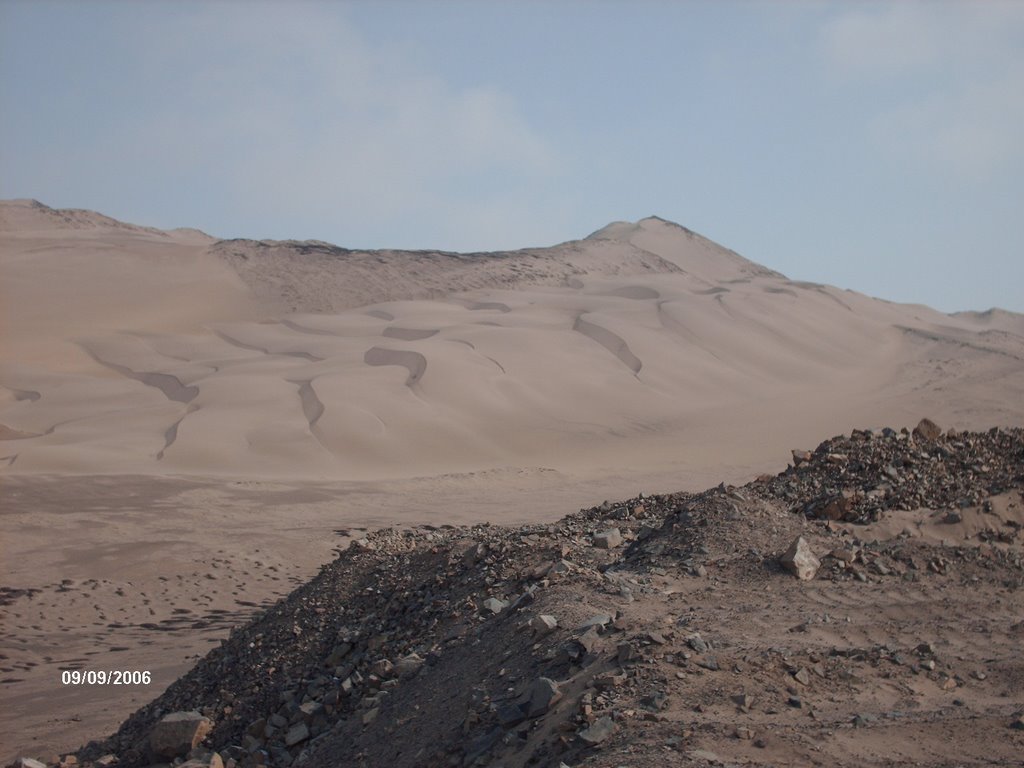 sculpted sand
MONDAY, SEPTEMBER 11
Ming, the Adventurous, scorned the Pan American highway as too easy a ride. He is way up in the Andes scaring sheep. I take to the shifting sands of the littoral. The phrase sits easy on the tongue. Truth is seldom poetic. I am riding across real desert in a real sandstorm. The sand stings my cheeks. Visibility is fifty metres max. Cops are nursemaiding me.
The first lot are surprised to see an old man with a sand-filled beard appear out of the mist of sand. They wave me down. Am I OK? Where am I going? Where have I come from? Mexico? On this little Honda? Never…
Except for the sea trip, I insist.
The cops think I’m nuts. A shortened version of the Hell ship voyage convinces them.
They radio ahead a few Ks to the next squad car. These cops disbelieve the first cops. In due course I appear out of the sandstorm. They wave me down. Is it true? That I rode from Mexico? That I am riding to Tierra del Fuego? That I am over seventy?
Absolutely.
They shake their heads and mutter the Peruvian cop equivalent of Wow! They shake my hand and clap me on the back and tell me to be careful on the Pan American highway in a sandstorm. Bus and truck drivers have no respect for small bikes. Better keep to the hard shoulder.
I would be impolite in mentioning that truckers dump garbage on the hard shoulder.
So the ride continues all morning and through the first hours of the afternoon: squad car to squad car, worries as to my wellbeing, wonder at my adventure. The storm clears in mid afternoon. I see the desert. The sea wind has scoured the hills bare over millenniums and sculpted the sand into curls and peaks and steep ridges. Long lines of surf unfold across the beaches to my right. Despite the garbage, it is extraordinarily beautiful. I am having a great time.
WIND
MONDAY, SEPTEMBER 11
Ming is headed for the mountains. He has studied his map over the weekend and is confident the road is asphalt. I have doubts and my bowels enter a plea for mercy. Altitude disturbs them (my bowels). I break wind with the enthusiam of a cow loosed in a field of alfalfa.
Ming is headed for the mountains. He has studied his map over the weekend and is confident the road is asphalt. I have doubts and my bowels enter a plea for mercy. Altitude disturbs them (my bowels). I break wind with the enthusiam of a cow loosed in a field of alfalfa.
MEDICATION
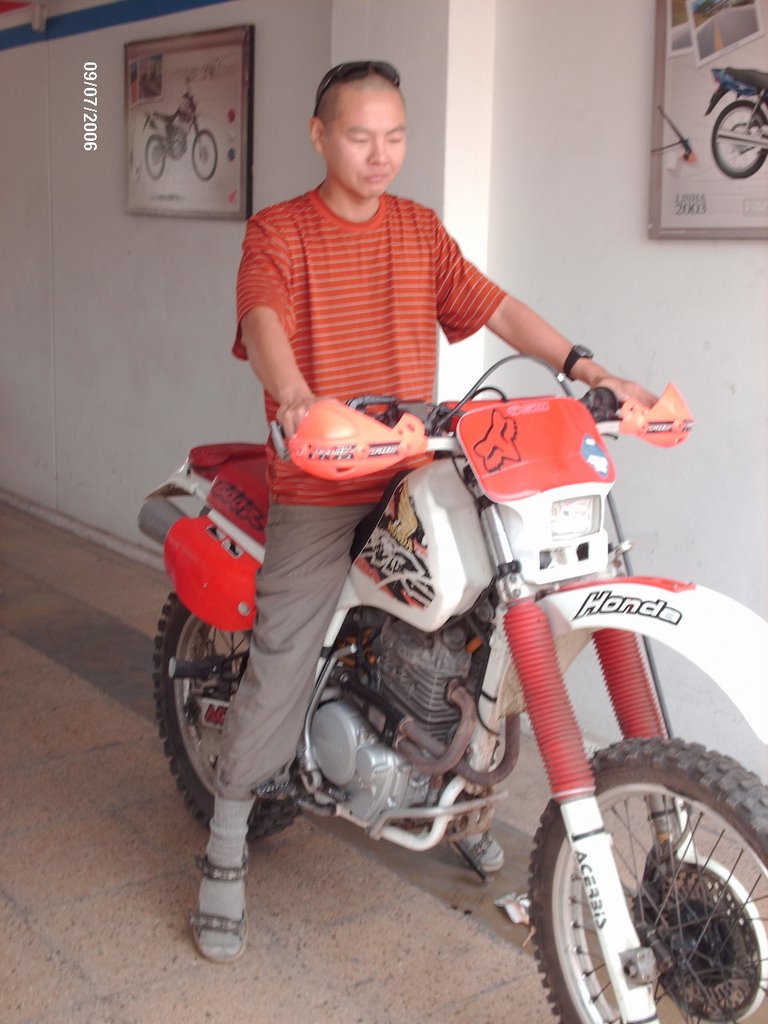 color coordinated monk
HONDA MEDICATION.
Up there in the Andes a Peruvian road rock tore loose one hinge on the Honda’s rear rack box. I don’t know which rock. Maybe it was a pothole. I ask HardCorP where I can have the hinge fixed. The technical manager checks the box. The fibreglass is weakened. A new hinge will tear loose. He heads for a biker’s store. I follow. Ming brings up the rear. I am on a small bike and Trujillo traffic is scary. Being sandwiched between two maniacs on barking 650s is downright terrifying. The tech manager rides a race even when cruising round the block for a glass of milk. Other drivers are the enemy. One-way streets are a challenge. Red lights are for nurserymaids. Across town takes twenty minutes. To Hell with a bike shop. My nerves are shot. I need a pharmacy.
HARDCORE
 hardcore
WEEKEND IN TRUJILLO, SEDPTEMBER 9/10
I have serviced my soul, the Honda, my belly and the Blog. The soul was easiest. Churches abound. El Carmen was a delight and full for Saturday evening mass. The cathedral is splendid from the outside. I found the interior cold and Sunday service disappointing.
Honda HardCorP on Avenida Nicolas de Pierola serviced the bike. The mechanic wore slacks and polished shoes and a clean short-sleeve shirt – sufficient cause for suspicion. So I watched. I watched keenly. He did everything by the book. He changed the oil, adjusted the valves, changed the plug, adjusted the points, greased this, oiled that, on and on for three hours. He did so while squatting on his polished heels and without getting a single drop of oil on his clothes or on the floor.
He dismounted the rear wheel, had a fresh tyre and tube fitted, remounted the wheel and remained clean. I mount the wheel, I have to sit in the dirt and balance the wheel between my feet. Dirty? Imagine an old man digging with bare hands for oil in a tar patch.
HardCorp’s General Manager is a champion Trials rider.
The technical manager rides a 650 Trial bike with the baffles removed from the exhaust. A full assault by a battalion of Special Forces would be quiet in comparison. His taking my innocent pizza delivery Honda for a trial run was akin to rape.
New rear tyre, tube and a spare tube, new plug, oil change and a full 3000 K service set me back $56. Back home I would pay $56 to have a bike mechanic sneer.
Sunday, September 10, 2006
PRAWN REWARD
FRIDAY, SEPTEMBER 8
Trujillo has a good feel. It is a bright, open city. The buildings are painted in strong pastel colours. Much of the center is Hispanic Colonial. Our hotel is The Colonial on Indipendencia, two blocks from the main plaza. I am on the ground floor. Ming on the first. I have two windows, one onto the rear patio. Our bikes are parked beside the fountain in the front patio. We stroll on past the tourist restaurants and up a pedestrian street to a small square with a fountain in the middle and four trees. We eat prawn cebiche at a table on the sidewalk. I follow with a steak. Ming orders calamare and rice. Ming drinks wine, I stick with beer. The bill? $8! We feel very proud of ourselves.
Trujillo has a good feel. It is a bright, open city. The buildings are painted in strong pastel colours. Much of the center is Hispanic Colonial. Our hotel is The Colonial on Indipendencia, two blocks from the main plaza. I am on the ground floor. Ming on the first. I have two windows, one onto the rear patio. Our bikes are parked beside the fountain in the front patio. We stroll on past the tourist restaurants and up a pedestrian street to a small square with a fountain in the middle and four trees. We eat prawn cebiche at a table on the sidewalk. I follow with a steak. Ming orders calamare and rice. Ming drinks wine, I stick with beer. The bill? $8! We feel very proud of ourselves.
HELL OF A ROAD
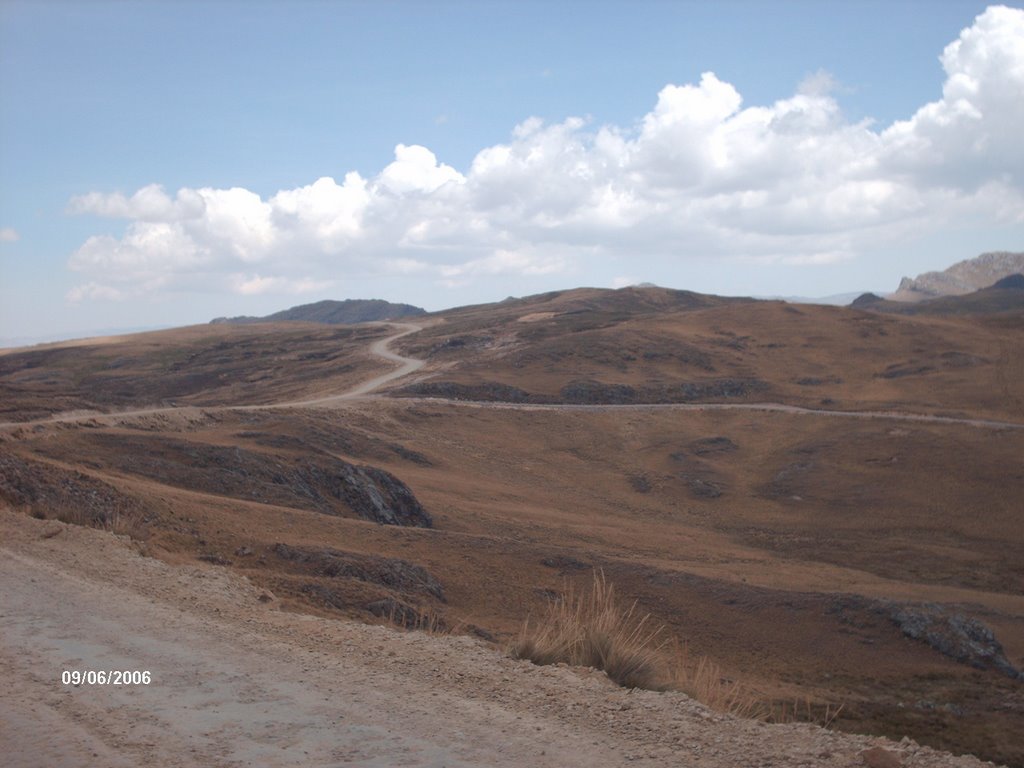
FRIDAY, SEPTEMBER 8
The dirt yesterday was a surprise. I hadn’t prepared myself. I didn’t know how long the dirt would continue or how much worse it might get. I felt that I was holding Ming back. Today I know. We have 160 Ks of dirt. I leave thirty minutes ahead of Ming. The road is rutted at the corners. The ruts are filled with fine powder. I ease into the corners and often use my feet to steady the bike. The straights are loose stone and bumps and holes. Some parts are only the width of a truck. The drop is terrifying. The road climbs and climbs and finally frees its self to cross dry windswept fells. I have ridden 40 Ks in the first two hours. Rather than depressed, I feel elated. This is tough. I am in my seventies. I am riding a small road bike. The grey crags ahead are lifted from the Scottish highlands. A reed-fringed tarn awakens teenage memories of casting for trout. The climb ends at 13,700 feet. I must be achieving some kind of Old Man’s record.
PARISH PRIEST
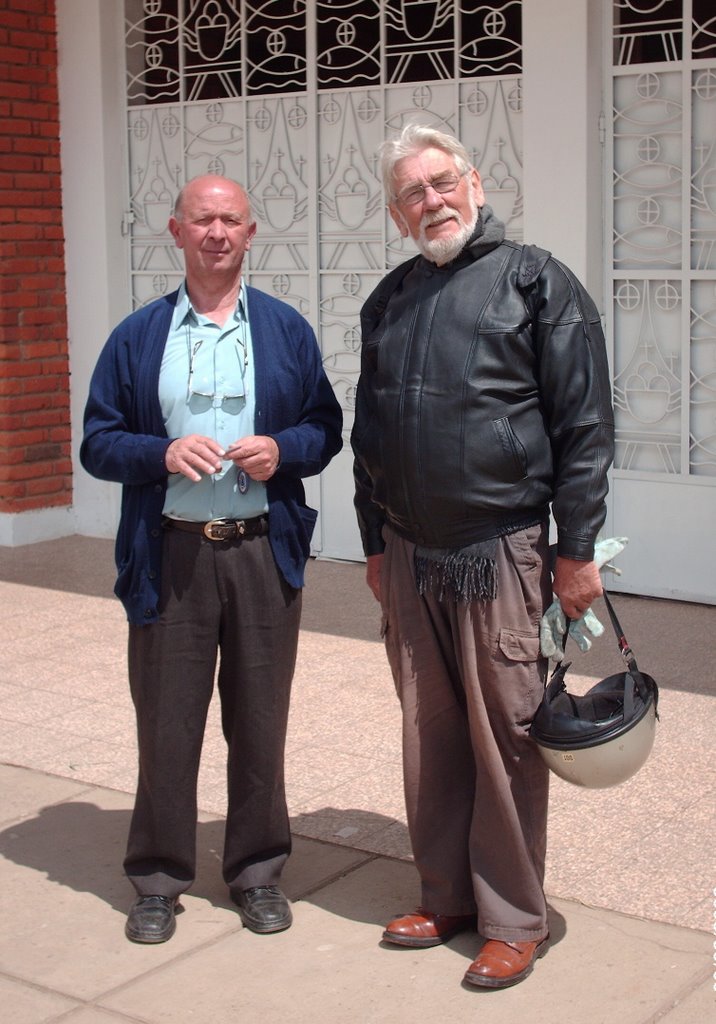
priest & self
FRIDAY, SEPTEMBER 8
The cathedral is in the worthy hands of a priest raised in Spain’s Rioca. He has spent 22 years in Peru. As a young priest, he travelled his first parish by mule. When he came to Huamachuco, the cathedral existed as concrete pillars and a curved roof. The parishioners made the bricks and built the walls. None of them like the cathedral. They wish to build a facade more in keeping with the Plaza. A concrete crossbeam supporting the choir loft is a major obstacle.
‘That beam would survive a nuclear war,’ complains the priest.
We talk of the many Protestant sects proselytising in the Province.
The priest’s sole desire is that people come to God. What route they choose is immaterial: Hindu, Buddhist (looking at Ming), whatever…
This might be an unpopular view with a conservative Vatican.
I suspect the priest is too busy struggling with the earthly and spiritual difficulties of his flock to give much care for such strictures. He struck both Ming and I as a remarkable man, kindly and gentle and deeply committed. How wonderful were he to see a new facade built.
TREMENDOUS TRAGEDY
FRIDAY, SEPTEMBER 8
The faithful and those without faith are united in their dislike of Huamachuco’s new cathedral. Architecturally it is out of place. It is a late 20th century industrial building in a 17th century setting. The gates are locked. The janitor will open at 8 a.m. I wait and talk with an elderly schoolteacher. She is an earnest lady, kindly. She cradles a large bunch of roses for the cathedral. A teacher’s monthly salary of $260 is insufficient to help buy medicine for her parents or small gifts for her grandchildren. She asks where I am going. I answer, ‘To Trujillo.’
She tells me that the road should be paved. Funds were apportioned more than ten years ago. Officials embezzled the funds and decamped for Europe. Now the road is in a disastrous state. Huamachuco is become an island. She nods in agreement with herself a she relates the theft of the road funds. ‘Corruption is the tremendous tragedy of our country, senor. Corruption is present at every level of Government – even here in the municipality.’
The janitor is a poor timekeeper.
I go in search of a priest.
The faithful and those without faith are united in their dislike of Huamachuco’s new cathedral. Architecturally it is out of place. It is a late 20th century industrial building in a 17th century setting. The gates are locked. The janitor will open at 8 a.m. I wait and talk with an elderly schoolteacher. She is an earnest lady, kindly. She cradles a large bunch of roses for the cathedral. A teacher’s monthly salary of $260 is insufficient to help buy medicine for her parents or small gifts for her grandchildren. She asks where I am going. I answer, ‘To Trujillo.’
She tells me that the road should be paved. Funds were apportioned more than ten years ago. Officials embezzled the funds and decamped for Europe. Now the road is in a disastrous state. Huamachuco is become an island. She nods in agreement with herself a she relates the theft of the road funds. ‘Corruption is the tremendous tragedy of our country, senor. Corruption is present at every level of Government – even here in the municipality.’
The janitor is a poor timekeeper.
I go in search of a priest.
HUAMACHUCO

hanger/cathedral

plaza
THURSDAY, SEPTEMBER 7
Ming reaches Huamachuco three hours ahead of the bus. He finds an excellent hotel, the Colonial ($7.60). He asks a cop outside the cop shop on the Plaza for directions to the bus terminal. The cop drives Ming to the terminal in the police pick-up.
We have piping hot water in our bathrooms. We eat an excellent dinner at a small steakhouse on the square midway between the police station and the cathedral. The original cathedral was built of adobe. It fell down. The new cathedral resembles an aircraft hanger for small planes.
The sky is clear. The moon is almost full. Ming is in the mood for wine. Dinner for two accompanied by a litre of surprisingly good Peruvian red sets us back $10. We like Huamachuco. We don’t feel cheated. Strange that two towns in the Andes, both Hispanic Colonial, should be so different in atmosphere.
HORNA OMNIBUS
THURSADAY, SEPTEMBER 7
I have three hours to wait before the bus departs. I watch SEABISCUIT on TV in the cafe on the corner of the plaza. A gang of kindly helpers lay the Honda on its side in the rear luggage compartment. The omnibus takes three-and-a-half hours to reach Huamachuco. The distance is 60 Ks. The surface is awful. Some corners are so tight that the bus has to back up. I 'pay $1.60 as a passenger and $9 for the bike. I sit next to a young lady with a plump face and a quiet voice. Her petticoats splay her skirt and she wears a broad-brimmed straw hat with a high crown. She grabs my knee on a couple of bad curves, curves where the edge is so close you look straight down the side of the bus into the abyss. A video of a jungle horror movie plays on TV. The dialogue is English drowned by Latino pop from the HiFi speakers. I feel a fool having to ask my quiet-voiced companion to repeat herself as she comments on the passing scenery. She clearly believes that, in my old age, I am simpleminded - or all foreigners are simple.
‘That is a lake’, she says. ‘There are many trout.’
‘That is the river.’
‘That is the irrigation ditch’
‘That is wheat.’
‘That is rice.’
‘Those are sheep.’
‘Pardon me,’ I say and she repeats with patience, ‘Those are tiles for the roof.’
‘There they are making adobe bricks.’
‘That is a pig.’
My fellow passengers listen and add to the commentary. My companion comments to our neighbours on the information she is feeding me and on my lack of understanding. These layers of conversation become increasingly complicated. The bike ride has left me exhausted. Falling asleep would be extremely rude.
I have three hours to wait before the bus departs. I watch SEABISCUIT on TV in the cafe on the corner of the plaza. A gang of kindly helpers lay the Honda on its side in the rear luggage compartment. The omnibus takes three-and-a-half hours to reach Huamachuco. The distance is 60 Ks. The surface is awful. Some corners are so tight that the bus has to back up. I 'pay $1.60 as a passenger and $9 for the bike. I sit next to a young lady with a plump face and a quiet voice. Her petticoats splay her skirt and she wears a broad-brimmed straw hat with a high crown. She grabs my knee on a couple of bad curves, curves where the edge is so close you look straight down the side of the bus into the abyss. A video of a jungle horror movie plays on TV. The dialogue is English drowned by Latino pop from the HiFi speakers. I feel a fool having to ask my quiet-voiced companion to repeat herself as she comments on the passing scenery. She clearly believes that, in my old age, I am simpleminded - or all foreigners are simple.
‘That is a lake’, she says. ‘There are many trout.’
‘That is the river.’
‘That is the irrigation ditch’
‘That is wheat.’
‘That is rice.’
‘Those are sheep.’
‘Pardon me,’ I say and she repeats with patience, ‘Those are tiles for the roof.’
‘There they are making adobe bricks.’
‘That is a pig.’
My fellow passengers listen and add to the commentary. My companion comments to our neighbours on the information she is feeding me and on my lack of understanding. These layers of conversation become increasingly complicated. The bike ride has left me exhausted. Falling asleep would be extremely rude.
CITY GIRL
THURSDAY, SEPTEMBER 7
Early mornings are best. I am alert and physically fresh. The road crosses pale upland pastures where both air and soil are thin. Cows are lethargic. Dogs don’t bother barking. Our destination is Huamachuco. The small town of San Marcos is our first halt. We breakfast at a restaurant on the square: eggs, rolls, coffee, fresh juice ($1.20). Ming has thawed and the sun is up. We feel good. Then we hit dirt. The map doesn’t say dirt. Short stretches of dirt are common in Latin America. Lack of road maintenance is the cause. The tar surface crumbles. Heavy machinery isn’t available. Easier and cheaper to strip the area. I am confident that this will be a short stretch. The surface is loose stone, powder and deep ruts.
It goes on and goes on.
The Honda hates dirt. I do 30 KPH on the less rough straights, 20 on the climbs, down to 10 on curves. The front wheel bucks in ruts and over rocks. The rear wheel kicks me in the butt. God knows what the countryside looks like. One moment’s inatention and the bike will slide. The slide could be over a precipice and a thousand foot drop.
50 Ks brings us to Cajabamba. I am exhausted. I am not having fun.
We stop for fresh orange juice at a café. The owner tells us the dirt continues to Huamachuco, three more hours. She suggests we put the bikes on the Horna Transport omnibus (omnibus is Peruvian for a standard coach). We try. Horna will take the Honda. The Suzuki is too large; it won’t fit. At least the Suzuki is built for the rough stuff. The Honda is a city girl.
Early mornings are best. I am alert and physically fresh. The road crosses pale upland pastures where both air and soil are thin. Cows are lethargic. Dogs don’t bother barking. Our destination is Huamachuco. The small town of San Marcos is our first halt. We breakfast at a restaurant on the square: eggs, rolls, coffee, fresh juice ($1.20). Ming has thawed and the sun is up. We feel good. Then we hit dirt. The map doesn’t say dirt. Short stretches of dirt are common in Latin America. Lack of road maintenance is the cause. The tar surface crumbles. Heavy machinery isn’t available. Easier and cheaper to strip the area. I am confident that this will be a short stretch. The surface is loose stone, powder and deep ruts.
It goes on and goes on.
The Honda hates dirt. I do 30 KPH on the less rough straights, 20 on the climbs, down to 10 on curves. The front wheel bucks in ruts and over rocks. The rear wheel kicks me in the butt. God knows what the countryside looks like. One moment’s inatention and the bike will slide. The slide could be over a precipice and a thousand foot drop.
50 Ks brings us to Cajabamba. I am exhausted. I am not having fun.
We stop for fresh orange juice at a café. The owner tells us the dirt continues to Huamachuco, three more hours. She suggests we put the bikes on the Horna Transport omnibus (omnibus is Peruvian for a standard coach). We try. Horna will take the Honda. The Suzuki is too large; it won’t fit. At least the Suzuki is built for the rough stuff. The Honda is a city girl.
LEATHER
THURSDAY, SEPTEMBER 7
I have been travelling four months. I have been cold everyday passed in the mountains. I bought a leather jacket yesterday. Ming provided the argument. He asked how I expected to survive riding 2000 Ks through Patagonia. The jacket cost $55. I was certain that I could find a jacket at a lower price, though this discounts the cost of hunting in both time and energy. So I bought. Today we rode out of town at six-thirty. The road climbed. Ming froze. I was enveloped in the warmth both of my new leather jacket and of sartorial superiority. I look good. Farmers wave. In Patagonia I will add my rain suit.
I have been travelling four months. I have been cold everyday passed in the mountains. I bought a leather jacket yesterday. Ming provided the argument. He asked how I expected to survive riding 2000 Ks through Patagonia. The jacket cost $55. I was certain that I could find a jacket at a lower price, though this discounts the cost of hunting in both time and energy. So I bought. Today we rode out of town at six-thirty. The road climbed. Ming froze. I was enveloped in the warmth both of my new leather jacket and of sartorial superiority. I look good. Farmers wave. In Patagonia I will add my rain suit.
SPARTAN SPA
WEDNESDAY, SEPTEMBER 6
Cajamarca remains dingy. We ride 6 Ks to the sulphur baths at Banos. $10 buys the full treatment at the spa. First we are told to walk back and forth for ten minutes on a bed of loose cobbles. The exercise stretches calf muscles and instep. Better still, it takes no effort by the white-coated female staff. Nor does the next twenty minutes in single-seater plastic Jacuzzis. A mean massage completes the treatment – mean in time. Fifteen minutes does little for Biker’s Back. In the good old pre-Hispanic days, the Inca would have had the staff’s heads lopped.
Cajamarca remains dingy. We ride 6 Ks to the sulphur baths at Banos. $10 buys the full treatment at the spa. First we are told to walk back and forth for ten minutes on a bed of loose cobbles. The exercise stretches calf muscles and instep. Better still, it takes no effort by the white-coated female staff. Nor does the next twenty minutes in single-seater plastic Jacuzzis. A mean massage completes the treatment – mean in time. Fifteen minutes does little for Biker’s Back. In the good old pre-Hispanic days, the Inca would have had the staff’s heads lopped.
LAST INCA
TUESDAY, SEPTEMBER 5
30 Ks of mountain road remain and my rear tyre has a slow puncture. Ming has a pump. We pump and I sprint. I overtake a convoy of tanker trucks heading for the new gold mine. Cornering becomes difficult. We pump again. The tyre loses air more rapidly. Damn! Sprint and pump. We reach the head of the pass. The terracotta roofs of Cajamarca spread below in a broad valley. I stop at the first puncture repair shop. Ming rides on ahead. The kid who fixes the wheel is a cock-fighting fanatic. He fixes the tube while I admire two of his cocks tethered on a tiny patch of grass. Two fresh punctures are in line with previous holes. The kid tells me to buy a new tyre. I pay him $1.80 for patching the punctures. I add $2 and tell the kid the extra is to wager on the next cock fight. He giggles happily. Ming is back. He has found rooms at a hotel where the cash goes to charity. We reach the hotel. In Ming’s absence, the manageress has let all rooms for the night to a German tour group. So much for charity.
We find another hotel, big rooms, rude manager ($14). The hand basin in my bathroom leaks onto the floor. The towel might dry a damp mouse. Walls need painting. Floor requires a clean. No undersheet and the mattress is stained. Yuk! And the town is somehow dingy. Atahualpa, last of the Incas, was trapped here and executed. Now the inhabitants concentrate on tourists. Beggars beg, street traders pester, everything is overpriced.
My advice? Give the town a miss.
Any positives? A restaurant on the downhill side of the central plaza, Salas. Customers are local bourgeoisie. Food is excellent (main courses $3-$7), waiters ancient, welcoming and professional.
30 Ks of mountain road remain and my rear tyre has a slow puncture. Ming has a pump. We pump and I sprint. I overtake a convoy of tanker trucks heading for the new gold mine. Cornering becomes difficult. We pump again. The tyre loses air more rapidly. Damn! Sprint and pump. We reach the head of the pass. The terracotta roofs of Cajamarca spread below in a broad valley. I stop at the first puncture repair shop. Ming rides on ahead. The kid who fixes the wheel is a cock-fighting fanatic. He fixes the tube while I admire two of his cocks tethered on a tiny patch of grass. Two fresh punctures are in line with previous holes. The kid tells me to buy a new tyre. I pay him $1.80 for patching the punctures. I add $2 and tell the kid the extra is to wager on the next cock fight. He giggles happily. Ming is back. He has found rooms at a hotel where the cash goes to charity. We reach the hotel. In Ming’s absence, the manageress has let all rooms for the night to a German tour group. So much for charity.
We find another hotel, big rooms, rude manager ($14). The hand basin in my bathroom leaks onto the floor. The towel might dry a damp mouse. Walls need painting. Floor requires a clean. No undersheet and the mattress is stained. Yuk! And the town is somehow dingy. Atahualpa, last of the Incas, was trapped here and executed. Now the inhabitants concentrate on tourists. Beggars beg, street traders pester, everything is overpriced.
My advice? Give the town a miss.
Any positives? A restaurant on the downhill side of the central plaza, Salas. Customers are local bourgeoisie. Food is excellent (main courses $3-$7), waiters ancient, welcoming and professional.
CHERISHED

TUESDAY, SEPTEMBER 5
The Pan-American Highway follows the coast. On the littoral no one waves. Why would they? God created their environment on a bad hair day. People have turned it into a vast rubbish dump. Politicians, motorists and their privileged passengers dismiss the inhabitants as part of the rubbish.
Cajamarca is 180 Ks inland and at an altitude of 2,750 meters. The road follows a river. The valley is narrow. The hills are naked rock against which stand lines of fruit trees shading the water channels that irrigate every inch of flat land. Each small field is a victory won through generations. Each field is loved and cherished. The emerald of rice paddy gleams against grey rock-face. Mango trees glitter with gold.
Subscribe to:
Posts (Atom)