Monday, July 23, 2007

MEAT


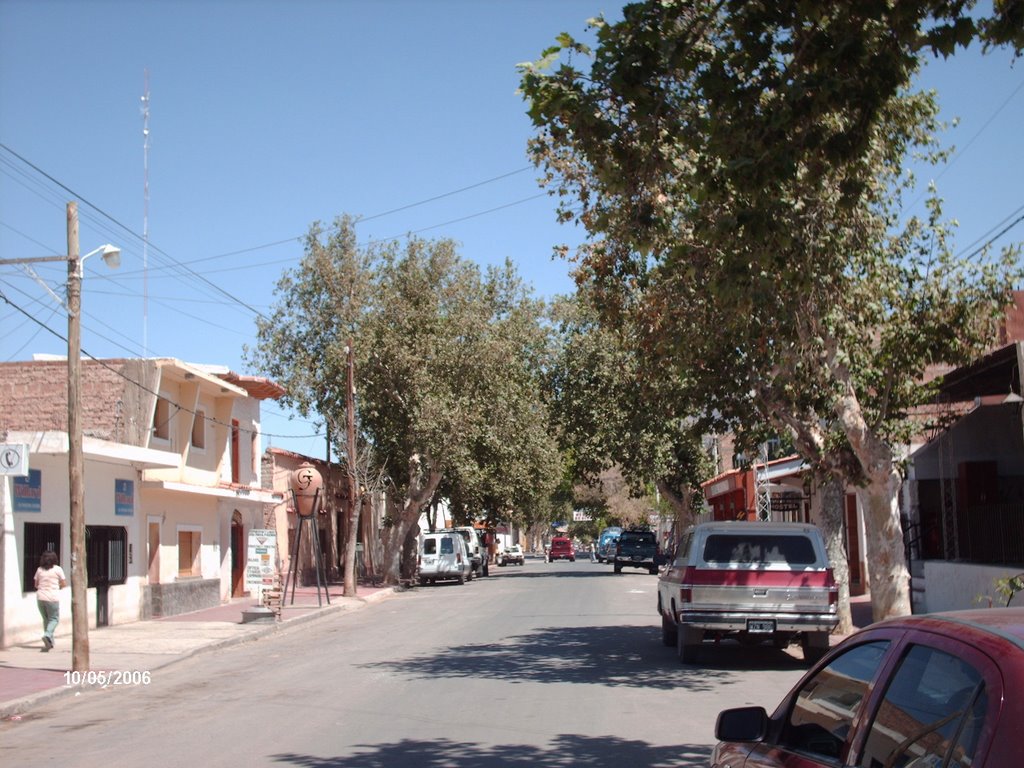
Facades on Avenida de Mayo


THURSDAY, JULY 19
My first night in BA and I eat at my favourite workman´s cafe half a block off Av. de Mayo. The place isn´t much - ten or so bar stools at each of three narrow tables. Late, it is good for people watching, joining conversations and learning a little of peoples´lives. I order meat and salad. The salad fills a deep plastic bowl. The meat is half the size of a brick. It comes roast and tender. What cut? God knows. Meat is meat. Add a big bottle of larger and the bill is $2.50.
Fat and full, I head for bed and dreams of what Aerolineas Argentinas and Air Comet have done with my bike box.

GRAN HOTEL ESPANA


THURSDAY, JULY 19
The Gran Hotel Espana at Tacuari 80 (centre of picture) is a small fine fin de secle building - good stained glass and lots of marble. I have a quiet room at the back on the fifth floor. The radiator is hot, so is the water. The ceiling fan is for summer.
Tiled floors in bathroom and bedroom are a danger to old men.
I take a shower and walk with great care on wet feet.
The rate is US$20 at 3 pesos to the dollar.
Of the managers, one studied law. He is a both a cynic and sceptic.
The other manager is insulting. He has seen the photograph on the BLOG in which I am dressed in Alpinestars black thermals and which Bernadette thought very James Bond. Gustavo sees a strong resemblance to a garden gnome.

Sunday, July 22, 2007

DON´T FLY AIR COMET


gran'dad under starter's order:


JULY 18/19
In preparing for this journey, I consult my grandson, Charlie Boo. Rather than bones, Charlie Boo throws pieces of his animal puzzle. Eighteen-month old sages take the long view and Charlie seems pleased. I should warn him that I am flying Air Comet to Madrid for an onward connection with Aerolineas Argentina.
The Air Comet flight out of London is delayed two hours and thirty minutes. No one from the airline meets the flight at Madrid. A mini tribe of despairing Bolivians or Peruvians are camped on the floor by the Air Comet enquiries desk. A further fifty or so of the less pessimistic stand in line. Neither queue nor camping offers hope.
A woman at Argentine Airlines check-in counter sends me back to Air Comet. I try a second check-in counter - then a third. The third woman smiles and issues me a boarding pass for a flight delayed from 1 a.m. to 4.35 a.m. and comps me a free dinner. Midnight and the self-service restaurant has left-overs that a Napoleonic soldier would have avoided on the retreat from Moscow. Everything else is closed. The water dispenser won´t dispense.
I curl up on a bench in the departure lounge. Thank God, I´m not travelling with small children.
We take-off from Madrid at 8 a.m. in a replacement plane that has to refuel in Natale, Brazil. The replacement cabin crew hate us.
Breakfast is a small yellow lump rimmed with dry red sludge. The bread is stale. Lunch is a stale ham & cheese sandwich. Dinner is a stale cheese sandwich without ham. This is the 19th. The food trolleys are dated the 17th.
I doze for a while, wake and wonder whether I am dead and that purgatory is a never ending flight.
We land at Buenos Aeries at six in the evening - no baggage from London. Much of the baggage that does appear should have been on a previous flight. Passengers queue at the baggage reclamation office: families with small kids, a school rugby team deprived of their sports gear. One of the ground staff tells me this is a daily occurrence both with Aerolineas Argentina and Air Comet.
I have been forty eight hours with out proper sleep. A room at the Grand Hotel Espana feels as good as a suite at the Ritz.

Saturday, July 14, 2007

JAMES BOND & HIPPOS


Bernadette says that my Alpinestars thermal underwear is a James Bond outfit for night attack.
I doubt whether Bernadette sees me as a James Bond look-alike – even in slinky black.
A hippopotamus comes closer to the mark.
I have asked Jed to photograph me in the garden.
Jed refuses. An ancient dad dressed in skin-tight thermals comes low in his choice of garden sculpture.
He says, “Dad, don’t dare go outside dressed like that.”
Bernadette poses me amongst the lilies.
I associate lilies with funerals.

Shrimp…shrimp…shrimp…

Friday, July 13, 2007

SHRIMP

I am seventy-four and feared that I can no longer cope.
When I was young (back in the 1950s), I dreamt of organizing the world. Now, in my seventies, I accept reality: under Bernadette’s direction, organizing myself is marginally possible.
Bernadette is committed to a surprise birthday party in Rotterdam this weekend and leaves tomorrow.
I fly out of the UK to Buenos Aires on the 18th.
Buenos Aires has had snow for the first time in 100 years.
Tierra del Fuego will be a frozen hell.
I have forty thousand kilometers to ride.
In younger days I might have encouraged myself with visions of golden breasts and buttocks.
Now I shelter in meditation. Ohm was the fashion in my youth.
Ohm doesn’t work for me.
I have my own magic key to oneness with the universe. I close my eyes : in near trance, I imagine the beaches of HispanicAmerica. I imagine small beachside restaurants. No need for menu. Only one excuse exists for this insane journey: shrimp.
Shrimp ceviche, devilled shrimp, shrimp, shrimp, shrimp.
Culture?
Tomorrow…Maybe.

Monday, July 09, 2007

GREAT BOOTS

Improvement In Preparedness

Our cottage is suddenly infected with the foul odor of covetousness. A precious package arrived at midday: splendid biker boots, thermal underwear, T-shirts and a cap, all from Alpinestars. I have locked them away from the jealous hands of my younger sons.

FEAR OF A COLD CLIMATE

The manuscript of OLD TOAD ON A BIKE sits on Clare Christian’s desk at The Friday Project. I delivered it by hand last Thursday. For the past few nights I have been obsessing over what I left out or forgot to include. In writing fiction, protagonists discipline the content. Writing travel, the writer is the protagonist. I need to be more disciplined. Hopefully I will do better with the second volume.

I fly out of the UK to Buenos Aires on the 19th.

Have I packed? No.

Am I ready? No.

How do I feel at the prospect of traveling alone from Ushuaia to upstate New York? Scared.

Mostly I am scared of falling ill. Health Insurance doesn’t cover bikers in their 70s.

A fatal accident should be reasonably cheap and convenient for my wife, Bernadette. I carry a Montecristo cigar box in which to mail my ashes home and the eastern section of the cemetery at the Catholic Church in Hanley Swan, Worcestershire, is family property.

As to midwinter in Tierra del Fuego, I will probably put the bike on a truck or pickup to Puerto Natales in Chile from where the ferry sails to Puerto Montt.

Essential, is to check the heater in the cab!

And pick a mature driver, a survivor...


Monday, June 25, 2007

OLD MEN CAN'T WAIT

Crossing Tierra del Fuego on a small motorcycle in mid winter is an unsuitable pursuit for an elderly gentleman. My bike is in store in Ushuaia. I must get to Puerto Natales in Chile to take the ferry north up through the Chilean fjords to Puerto Montt. Roads in the passes may be closed for three days at a time. The cold will be acute. I am fearful. I am not sure that I can manage. I am sure that I can’t manage. Then why not wait?

OLD TOAD ON A BIKE is the first volume of the travel trilogy and will be published in early February, 2008.

OLD MEN CAN’T WAIT is the second volume. I can’t wait. I don’t have that many years. My adoptive daughter, Anya, lives in Duchess County, NY. She is having a baby in January and granddad wants to be there. And I need to be back in England for publication. Ushuaia to Duchess County is one hell of ride on what is basically a pizza delivery bike.

HEREFORDSHIRE

I am leaving the English summer for Tierra del Fuego in mid winter. Insane! Our garden here in Herefordshire, at the foot of the Malvern Hills, is a perfumed heaven of roses and lavender. The view from our garden across two cricket fields to the hills is divine. Jed (17) is at Hereford Junior College. Josh (21) is studying Spanish and International Affairs at Leeds Metropolitan University. I will miss my sons, miss that small part of their lives to which they permit entry. And I will miss my wife, Bernadette. I will miss her every moment of our separation.

THE FRIDAY PROJECT

I had intended leaving for Argentina in late February. I required a publisher. That has taken a while. Firstly I am an old man and this is an era of youth. Backing me is a gamble. I might die before I produce.

Secondly, publishing is changing. Communications are changing. Blogs and web sites gain huge readership.

Who wants books?

Fortunately most people who fly, those who have need to spend nights alone in hotel rooms where the TV is in the wrong language and the news is broadcast by FOX, or holiday on the beach and are too old to surf...Oh, and all those perverts who find sensual gratification in the feel of a book - particularly a hardcover perfectly printed on good paper.
So there remains a substantial market.
I have finally agreed a three book contract with Clare Christian, MD at The Friday Project.

Why The Friday Project?

Because they understand modern media and specialise in transferring Blogs to print.
I was a little concerned at first as to whether they were proper publishers. They lack that slight air of condescension towards the writer which is the publisher’s hallmark. However, Macmillan's handles their distibution and foreign sales (think tweeds, starched shirts, careful ties).

Monday, April 30, 2007

SILLY DECREPIT OLD DODDERER

This is both an expression of thanks and an apology to all those who messaged me support. I didn't realise that people had been leaving comments on this Blog. My age is to blame. I have become a silly decrepit old dodderer who shouldn't be allowed out of the house on his own.
I leave on the return journey from Ushuaia at the end of May. Unable to find my way around my own Blog, how do I expect to find my way north the length of the Americas? By the same method used on the southerly leg - luck and chance.
However, I am better prepared for the second leg. I have the leather bomber jacket I bought in Peru. And I have taken to swimming to build up stamina.
I catch the bus into Ledbury, our local market town. Bus travel is free for pensioners and I receive an old person's deduction on the swim.
I swim twenty lengths of the Ledbury pool on my back.
A large white hairy baloon follows me.
As to the ride, my ex considers that I am irresponsible, at my age, to risk my life to the road.
My present wife, a sensible woman, encourages my departure.
My ex and I have been separated for 27 years - a fine example of absence making the heart grow fonder!

Saturday, February 24, 2007

ENGLISH TRANSLATION OF SPEECH GIVEN IN MORELLA


I am deeply privileged by this invitation to speak. However I am shy in standing before you and ask for your forgiveness for those inevitable crimes I commit of syntax and vocabulary. There have been twelve years prior to my recent journey in which I had little opportunity to speak Spanish. My verbs are casualties of an old man’s memory and you listen to a man whose mouth is full of pebbles.
First, on behalf of myself and of my sons and daughter and of my grandson, I thank the citizens of Morella and your excellency, the Calde, for your kindness and hospitality. And I thank all those who have assisted in preparing this festival that recalls the life of my great-grandfather, Don Ramon Cabrera.
I wish to pay particular thanks to a close and valued family friend, Dona Conxa Rodriguez and to my cousin, Don Josep Llasat Roig. Their enthusiasm has made this congress possible.
I am a novelist. I distrust historians. History books are dictated by the victors (or by Hollywood film producers). My knowledge of my great-grandfather comes from the portrait that hangs in my study. I suspect that the young El Tigre would be unsettling as a companion. My Ramon Cabrera is in his sixties. I imagine that he has seen too much, that he has grown in wisdom, has lost faith in violence. Rather than a warrior, he has become a man of peace.
There is something more to the portrait, something unmistakable: This is a Spaniard.
And it is of this that I wish to speak.
I have returned recently from journeying alone by small motorcycle from the ruins of the first house of Hernando Cortes in Veracruz, Mexico, to Ushuaia in Tierra del Fuego. Such a solitary journey is always as much a journey of self- discovery as of discovering fresh lands. I discovered how deeply I am rooted culturally in Catholicism. I speak not of faith but of culture. I admire the chapel of the Rosary in Quito and the cathedral in Cusco more than I admire the Inca stone work of Machu Pichu or the pyramids at Tikal and Copan.
I recall visiting the Jesuit Temple one evening in Oaxca, Mexico. A side chapel is dedicated to the Jesuit martyrs. I sat there alone in the quiet of the evening and read their names. The English were amongst their number, names familiar from my Catholic childhood: Edmund Campion, Hugh Sykes, Edward Thomson.
Yes, I am Catholic by heritage.
I discovered something else. Though we speak the same language, I find myself a foreigner in the United States. Nothing is familiar. In Hispanic America I feel at home. So much is familiar.
My journey took me over the Andes and across the altiplano. I thought often of the first Spaniards in the Americas. They were small men with little education and burdened by many superstitions. See the country they crossed, then judge them how you will, but never deny their extraordinary imagination and amazing courage. I have thought of myself as English. I should have paid heed to the comment of a Mexican in Veracruz:
The only Pure Bloods are horses.”
Following the trails of the conquistadors, I became increasingly aware of and proud and grateful to have inherited from Ramon Cabrera the genetic heritage of Spain.
This is my Ramon Cabrera, a man intensely Spanish, a man who has survived great storms and come safely to harbour, the great-grandfather who observes me calmly from his golden frame above the bookshelves in my study, a man I never knew but who has grown in my imagination and whom I have grown to love.
There is, of course, a different Cabrera; the Cabrera of history books; Cabrera, the Carlist General, Conde de Morella, Marques del Ter. Surely his battles are finished. The dead are dead.

Yet, for one hundred and fifty years, the followers of Carlism have been excluded from Spain’s body politic. Perhaps I am impertinent. If so, please forgive me. But it seems to me that this celebration is a final act of inclusion, a confirmation of the unity of a diverse nation, a modern nation, a strong, confident, democratic Spain - a nation of whose heritage we English descendants of Cabrera are immensely proud and grateful to partake.
Again, I thank you.

MY THANKS TO MORELLA


The fortified town of Morella occupies a peak in the foothills of the sierra del Maestrazgo and dominates the junction of three Spanish provinces, Valencia, Cataluña and Aragon. A huge castle crowns the peak and the town is protected by massive walls. The builders must have imagined the town impregnable. They were wrong. A Carlist general blasted a hole in the defenses.

The general, Ramon Cabrera, was my great-grandfather. He was notoriously ferocious in war. Spaniards named him El Tigre del Maestrazgo.

In late November, Morella celebrated the bi-centenary of Cabrera’s birth – a curious celebration given the damage he caused.

I spent four wonderful days as the guest of the mayor and people of Morella. The mayor opened an exhibition recalling my great-grandfather’s life. Amongst the exhibits was a painting of my great-great-grandmother being shot by firing squad. She is kneeling on the cobbles. A brave (or stupid) friar holds a crucifix over her head as the soldiers fire. My cousin, la marquesa del Ter, and I unveiled a plaque on the castle wall. Members of the PP (conservative party) presented Morella with a bronze equestrian statue. We enjoyed one of those civic lunches that continue for four hours (the wine was superb). The present Carlist pretender, the duke of Palma, sat on the mayor’s right. I sat on the mayor’s left. We three spent much of the luncheon discussing public education. Expected to make a speech, I remained moderately sober. My speech was heavily influenced by my recent journey through Hispanic America.

Monday, January 08, 2007

HAMISH

I have offended Hamish. He is a Border terrier aged 18 months. I posted his photograph yet ignored his existence when writing of my family.

HAVENS


Reintegrating after a long solo journey (in this case, six months) takes a while. Journeys have direction and imperative: Get up, get dressed, get on the bike. Each day brings new people and fresh interactions. The countryside changes as does the climate.

Now I am static.

I am back home in England. We - my wife, Bernadette, Jed (17), and Josh (20) - live in Herefordshire at the foot of the Malvern Hills. Jed is a freshman at junior college. Josh is a freshman at Leeds University – Spanish and International Relations.

Our home, a 300 year-old cottage, lies down a narrow lane. The cottage is set in a large garden. Roses, clematis and ivy compete for wall space The lawns need mowing (right now, the ground is too wet). A gate opens onto the village cricket field. A cedar tree shades that corner of the garden. A line of oak trees divides the cricket field from surrounding farmland.

Idyllic?

Yes - though my judgment is prejudiced.

And I have been lulled into inaction.

The great American essayist, James Baldwin, wrote: Havens are high-priced. The price a haven dweller must pay is in deluding himself that havens in fact exist.

Monday, December 04, 2006

FREEDOM LOST

OCTOBER 24

I have journeyed for six months. Traveling by motorbike freed me from other people’s schedules. I decided my own route and my own timetable. I found agreeable hotels at each halt, rose and went to bed at the hour of my choosing, ate when and where and what I wished…an utterly self-centered existence.

Store the Honda in Ushuaia, farewell to freedom. I must suffer the sadistic clutches of Aerlineas Argentina and Air Madrid.

First I have five days in Buenos Aires. I have a reservation at the Grand Hotel Espana off Avenida de Mayo (80 Tacuari). I was due to arrive in the early evening. I will now arrive closer to 11 p.m. I call from Rio Grande and beg the manager to hold my room.

Wednesday, November 29, 2006

THE USSR IS ALIVE AND FLOURISHING

SUNDAY, OCTOBER 22

Fly to or from Argentine Patagonia and you fly Aerolineas Argentina. Fares have doubled over the past six months. Foreigners pay a premium. There are fewer flights. Tourism has taken a hit. I am booked on a 3.30 flight to Buenas Aires. My Japanese roommate has been to the airport. All flights from Ushuaia are cancelled. A transfer coach leaves for Rio Grande airport at 2.30. My roommate’s ticket has been stamped. We grab a cab. The young check-in clerk wears a two-day beard and arrogance familiar from the USSR. Ushuaia is closed. The transfer coaches are full. Come back tomorrow.

I find a young woman employee (I am better with women). I act panicked and physically feeble. I am traveling with a Japanese – a male nurse. He came earlier to confirm our flights. He left my ticket at the hotel. His seat on the coach and the flight from Rio Grande are confirmed. What am I to do?

The woman disappears to a back office with my ticket. I wait thirty minutes. Meanwhile I listen to the Soviet apartachic enjoy himself. The next flight? How would he know? Perhaps tomorrow. Perhaps the next day. So he dismisses families desperate to get home to BA.

The woman returns. I am confirmed on the coach and a flight from Rio Grande to BA.

Two hours and thirty minutes to Rio Grande: the airport terminal is deserted; all representatives of Aerolineas Argentina are out to lunch. Rain squalls flee across the runway. We passengers wait forlorn and bewildered. The elderly sit on steps leading to a closed cafeteria. Mothers feed babies, placate toddlers, screech at teenagers. An hour passes. Tempers rise. Finally three check-in clerks appear. We queue while they chat and talk on the telephone and shift papers from one side of a desk to the other. I am first to crack. I call through the open door to the glass fronted office: “It would be good manners to tells us what is happening - or that you don’t know what is happening.”

Even as I speak, I fear that my fellow passengers will judge me one more arrogant Brit. My sally is greeted with applause.

RESURECTION

Hi to all you readers. Writing to you has become a habit. The first section of my journey is done. I plan returning to Ushuaia in February to ride north through those countries I missed or avoided on the road south: Chile, Uruguya, Paraguya, Brazil, Venezuela. Meanwhile let me relate my return to England and my search for sponsers. The first leg was unsponsered. Those few I approached judged me mad. I would fall off my perch before the first hill or be crushed by a truck or bus. Why associate themselves with certain failure?

Sunday, October 29, 2006

MY JOURNEY IS DONE


ushuaia


SATURDAY, OCTOBER 20
My thanks to all you readers of this diary. You have been my companions over the past months. Now my journey is done. The Honda is in store. I would like to write that she is safe. However she has a friend at the warehouse. Her friend is a red 250 Honda Trail bike, very macho. I instructed the staff to keep an eye on the situation.
Once home, I must organise the journey north from Ushuaia to Duchess County, New York. I will blog progress. And I will be publishing on the web. Don't give up on me...

Saturday, October 28, 2006

I AM A SCAVENGER OF PEOPLE

FRIDAY, OCTOBER 19
Luca’s birthday party is less rowdy than I had feared. The Cruz del Sur is on the backpacker gringo trail. I am the oldest guest by some forty years. I drink red wine and eat good steak and listen to the “kids”. Their journeys are different to mine. They seek nature. They trek through national parks and scale mountains and stand in awe at the foot of waterfalls. I am a scavenger of people. Cafes and restaurants and gas station cafeterias are my hunting field. I listen to prosaic tales of Latin American life and search for evidence of where our thoughts and preconceptions differ. I do the same at Luca's birthday party - listen.

END OF THE WORLD (PART ONE)


FRIDAY, OCTOBER 19
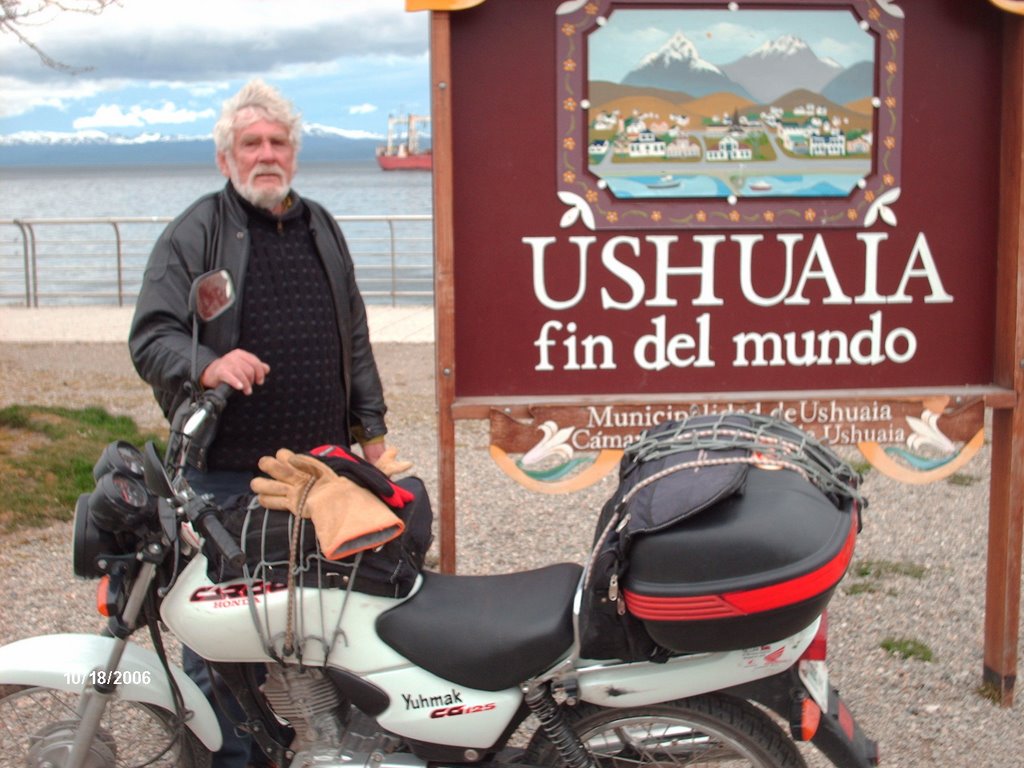
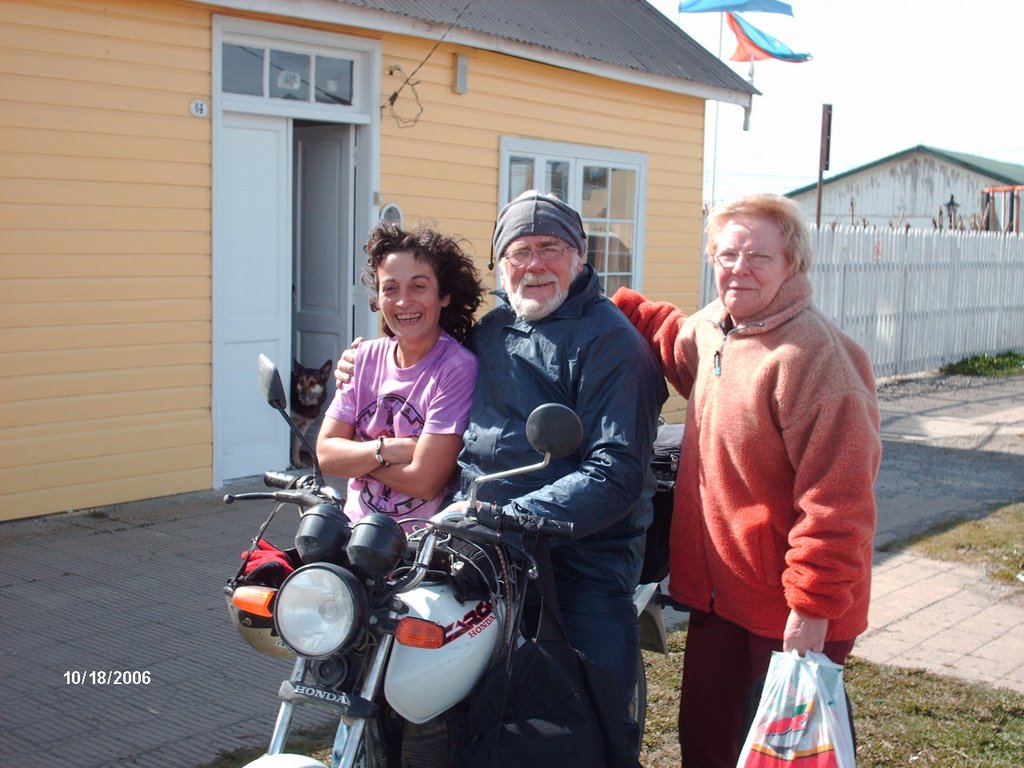
I share the bunkroom (four bunks) with an absent Japanese. I unload the bike and ride out of town to the Honda agency. The owner of the restaurant where I stopped for lunch has called to announce my impending arrival. The manager expects me. The owner of the agency also owns a warehouse and cold store. The bike is to be garaged there. I ride back to town and park on the waterfront. A passing tourist takes my picture.

LUCA'S BIRTDAY

FRIDAY, OCTOBER 19
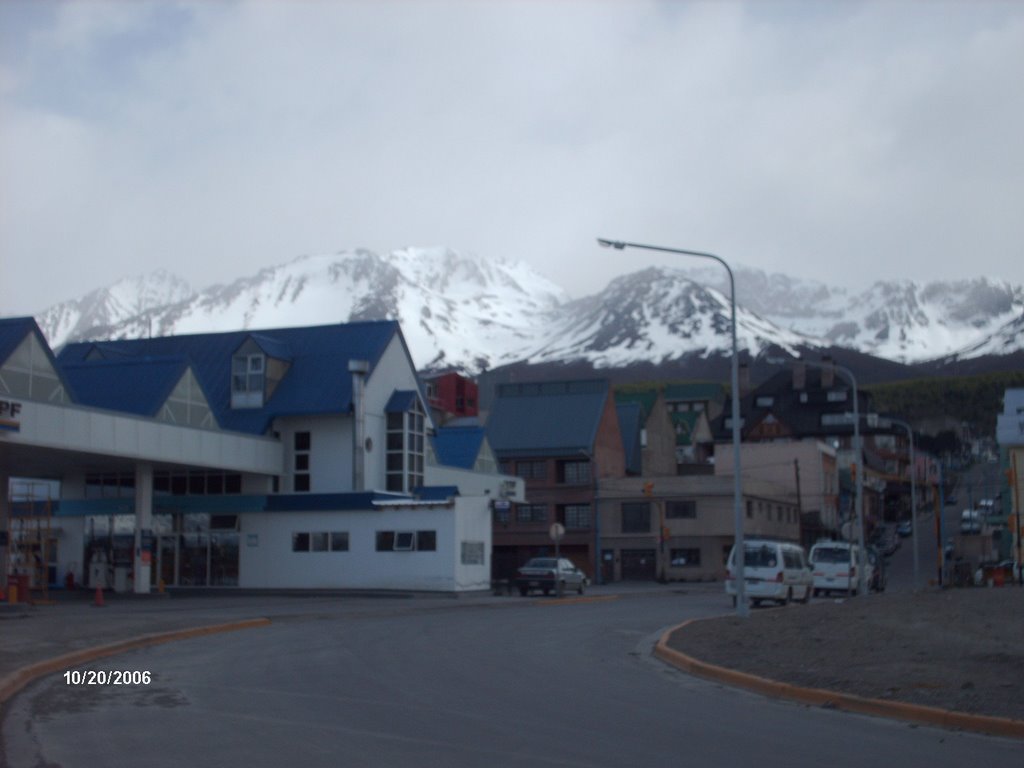
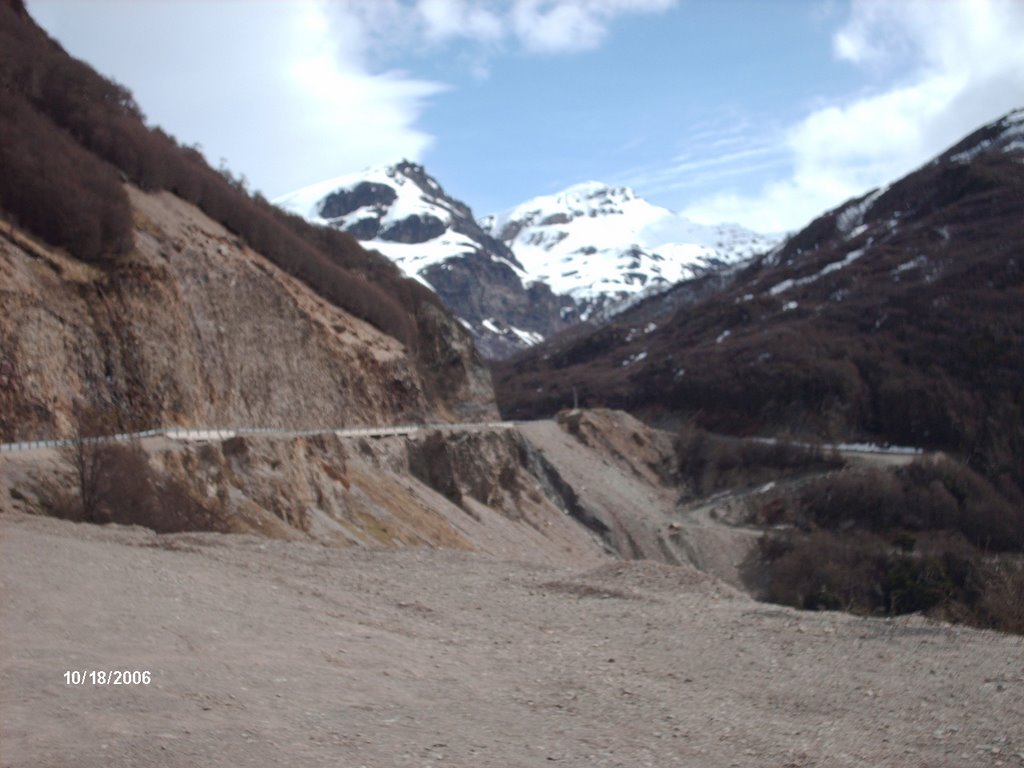
I cross the final mountain pass to Ushuaia. A few specks of snow sting my cheeks. Snow turns to rain as I dip into town. Ahead lies the Beagle channel. I book into the Hostal Cruz del Sur. The owner, Luca, is Italian. He is a friend of Graciela’s. This is his birthday. He is thirty-three. Luca shows me to a bunkroom. Bunkrooms are unsuitable accomodation for an old man. How will I manage the climb to an upper bunk in the middle of the night? I cross the street to a hotel with rooms that have private baths. I look back over my shoulder and see Luca watching me. Argentine friends are preparing the barbecue on the sidewalk. Luca has invited me. I feel a traitor. I circle to a grocery and buy three bottles of red wine.

VICIOUS BEAVERS


final climb


FRIDAY, OCTOBER 19
Honda and I are on the final climb of our journey. Snow closes in. Sun-lit peaks shimmer. I stop for lunch at a restaurant on the right of the road. The owner quizzes me. Where do I go next? Where will I leave my bike? At the Honda agency. I, in turn, ask what happened to the treees. Beavers did the killing. The beavers were imports from Canada.

WAR ZONE


FRIDAY, OCTOBER 19
I have gained a day. I had a Friday yesterday. Now I discover that today is Friday. One day in six months is no big deal. I ride out of Rio Grande with regret. The Hotel Argentina has been good for me. Losing the bike documents dumped me into a deep depression. Graciela dug me out. Wind is standard in Patagonia. So is the cold. I ride across sheep country, cross rivers, pass by ponds, see the occasional farmhouse tucked into a clump of trees, wave to a Hereford bull (he ignores me).
The tailend of the Andes squeezes in from the west. Snowcaps march across the horizon. A forest of strange conifers trail moss. A huge lake opens to the right. I enter a World War One battlefield. It is a scene of grim devastation in which shattered trees are tumbled one on another. The few trunks that remain standing are stripped of branches; their peaks are shared and ragged and resemble the rotting teeth of some huge prehistoric animal. What happened?

Friday, October 27, 2006

GRACIELA


graciela, self and a
german fellow guest


FRIDAY, OCTOBER 19
I eat an excellent grill and stroll back passed the Liverpool Pub. The cops remain in occupation. The kitchen at the Hotel Argentina is welcoming. The coven and the students slope off to watch a couple of rented horror films on TV. Graciela and I sit and chat of this and that. Hotel Argentina is the best budget option in Rio Grande and Graciela gets the travellers. Most are good and easy. Some are weird; some have chemically recalibrated their brains; a few suffer from tangled wires in their heads. A young Frenchman stayed two months. He believed that Graciela was the Virgin Mary reincarnated. He was John the Baptist. He tended to stare at Graciela which put her off cooking. Imagine attempting a mayonnaise with someone gazing at you, someone with such expectations. Virginal is a tough demand when you have three grown kids and have suffered a recent divorce.
I sit there in the kitchen utterly content while Graciela tells me of her life. She is both extraordinarily youthful and very adult. She has humor and she reads books.
I have been biking five months and have enjoyed no proper (nor improper) female company apart from those few days in Nascar. I prefer a woman’s company. Men don’t do it for me. I miss Bernadette. I miss all four boys. I want to cuddle my grandson. And I want to visit with my daughter. Yeah, yeah, yeah...Get to bed, you old fool. It is 1.30 a.m. and you ride to Ushuaia in the morning. Thank you, Graciela.

JULIO'S IS THE SEMI SHACK NEXT DOOR

FRIDAY, OCTOBER 19
Rincon de Julio in Rio Grande is across the highway from the gas station. Julio is where the locals eat, those serious about food. Don’t try the smart restaurant attached to the expensive hotel. Julio’s is the semi shack next door. Be there before 9.30 or you won’t get a table. I had intended dropping by the Liverpool Pub for a pre-dinner drink. The pub was closed. An cop was on guard at the door and a couple of officers were out back searching the grass. Disappointing - I wanted to ask the owner whether he had named his pub in honour of the city or the football club, whether he had visited England - and how he felt about LOS MALVINAS SON ARGENTINAS at the next intersection. Dinner was good.

A WITCHES' COVEN


FRIDAY, OCTOBER 19
I fill with gas, take a right at The Liverpool Pub, an immediate left and a second right on the main avenue. Hotel Argentina is the low, single-floor tin building on the right. You can’t miss it. Graciela has worked it over with a bucket of yellow paint. Graciela is the owner. She has grown kids and has kept young. I find her reading Tarot cards at the kitchen table in company with three women friends. I ask if they are a coven or the Rio Grande chapter of the Feminist Union.
“Both,” says Graciela.
Two student-age young men join us at the table. They are expert in that student skill of both being there and not being there while taking up considerable space.
Graciela tells the one to take his cap off in the house so she can see his face and tells the other to get his feet of the chair.
I love her.
I remark on a monument to Argentine ownership of the Malvinas coexisting with The Liverpool Pub. One of the coven tells me that the cost of maintaining the Malvinas will be too great for Britain. In a matter of years the islands will be absorbed by Argentinia. She talks of the islands as if they are uninhabited. On TV the news shows a battle between two political factions. The factions are participating in the reinternment of Peron at San Vicente. Most are armed with staves and baseball bats. One man fires a pistol. Immagine a kelper (Falkland Islander) watching on TV. Would he or she wish to be part of this society?

LOS MALVINAS SON ARGENTINAS


FRIDAY, OCTOBER 20
The gas gauge shows zero as I creep down the highway into Rio Grande. Visibility is down to fifty meters. My eyesight is lousy without spectacles. I can´t see to the far side of a traffic circle. I turn uphill. The engine cuts out as I park on the grass below a two-floor bourgeois house. A plump lady in green jumpers and plastic curls waters a flowerbed below the terrace. I call up to her, asking where the gas station is.
She sees an ancient greybeard astride a Honda – a greybeard in a helmet and wearing enough clothes to outfit a small tribe. The shape must perplex her. And how so much stuff can fit on such a mini-motorbike.
I ask again as to the whereabouts of the gas station.
She wonders what language I am speaking. I am too weird to be talking Spanish.
I try again: “Madam, please, where is the gas station?”
She recognises a mixture of panic and irritation – a real turn off. She shrugs and parks the small watering can on a ledge on the terrace and goes back indoors.
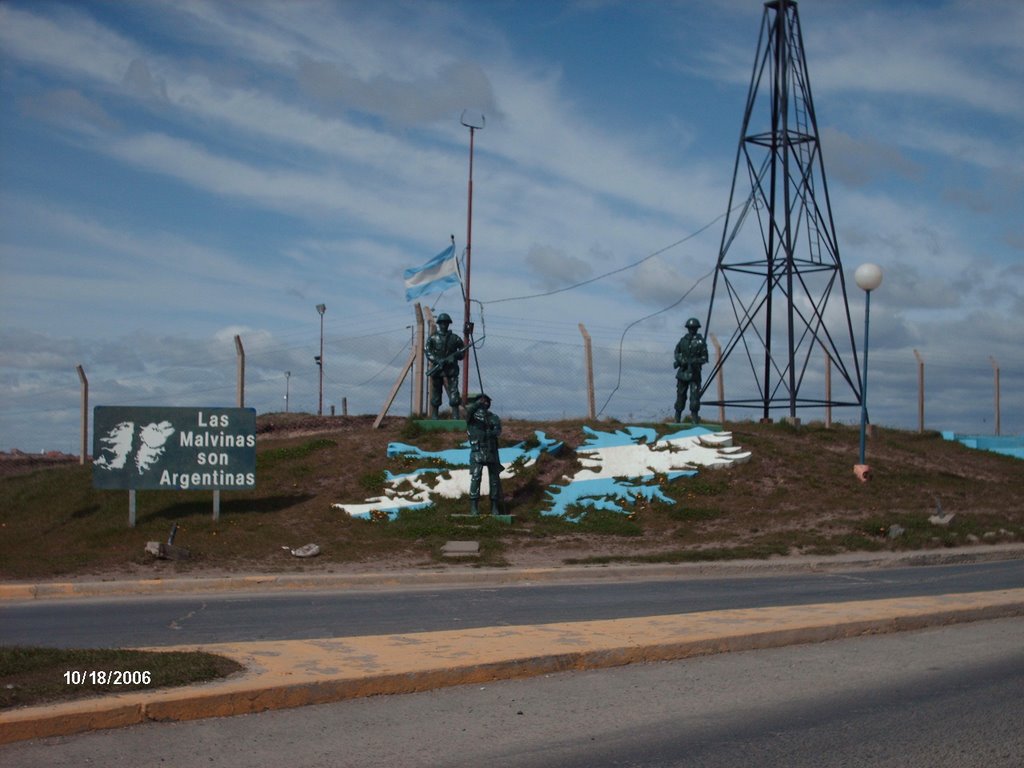
First I curse, then I kick the starter. The engine fires. I make a U turn and am confronted by a large notice: LOS MALVINAS SON ARGENTINAS
Three life size soldiers sculpted in khaki concrete or plastic or, possibly, bronze, threaten me with rifle and bayonet. They stand on a blue pattern that could be a representation of the islands. How would I know? I am not one of the very few English people familiar with the Malvinas. The Malvinas are an Argentine obsession.
The engine cuts out. I am blocking the road. A car stops. The driver asks whether I am lost.
I reply that I need gas.
He tells me to keep going up the highway. The gas station is on the left. If I miss the gas station in the fog, I will face the Liverpool Pub at the next intersection. The Liverpool Pub is too far.

BRAIN DEAD

FRIDAY, OCTOBER 20
There is a lot of water on the approach to Rio Grande. Earley evening and mist smokes off the lakes and ponds and streams. Cold closes in. Visibility drops and my spectacles fog over. The fuel gauge is on reserve (this is a first in 22,000 Ks). There must have been a gas pump at the Automobile Club hostal. Why didn´t I stop? Had I stopped, I wouldn´t have lost the bike´s documents; I wouldn´t be cold and tired and depressed. I wouldn´t be scared of running out of gas and being stranded in the dark in the middle of nowhereland.
What has happened? Is it simply that I am near the end and want to get the journey over with – or has the cold and distance finally reached into my brain and flicked the off switch?

Wednesday, October 25, 2006

MAYBE A SHEEP WILL EAT THEM

FRIDAY, OCTOBER 20
I am half an hour at the Argentine border. I fly home at the end of the month and will return in February to ride north. I intend storing the Honda with the Honda agent in Ushuaia. The customs official tells me not to worry. The bike is on a temporary import permit for six months. I should show the permit to the customs at the quay in Ushuaia. I am very tired and consider stopping the night at the Automobile Club’s hostal at the border. Doing so would leave me a long ride tomorrow into Ushuaia. I ride on.
What stopped me closing and fastening my bag properly? The bag that rests against my back and which holds all the bike’s papers and the duplicates. The bag that I have unfastened and unzipped four times today at four frontiers. Exhaustion?
Or did I relax with the journey almost finished?
I stop for a pee midway to San Julian and discover the document pocket gaping. I have lost the bike’s registration papers, the temporary import permit, the FootPrint guidebook and Argentine Automobile Club member’s guide.
I have been on the road the best part of six months and have been so careful.
Weeping won’t help.
Maybe a sheep will find and eat them.
Shit!
Shit!
Shit...!

DIRT

FRIDAY, OCTOBER 20
Paperwork at the Chilean border takes half an hour. I have 180 Ks to cross before reaching the next frontier. The first 30 Ks are concrete; the rest is gravel. Gravel would have defeated me at the outset in Mexico. Now I am semi-expert and ride the dirt at 60 KPH. The knack is in staying relaxed and not tightening up when the wheels slither. Expert or not, dirt is exhausting. Oncoming trucks drag clouds of dust and cut visibility to zero. When overtaken, I pull off the road and wait. I have reached serious sheep country. Not all are fenced and I beware of lambs chasing across the road. At last the Chilean border, a quick formality, then 18 Ks to Argentina and a paved road.

FOUR BORDERS TO CROSS


tierra del fuego,
no big deal


FRIDAY, OCTOBER 20
I have four borders to cross: out of Argentina, into Chile; out of Chile, into Argentina. A young Argentine cop at the first border discusses the Malvinas war. He was a child, too young to remember much and is uncertain as to the background of the conflict. He is certain that war was unnecessary. England and Argentina are friends. Many English have settled in Argentina. “It was the politicians, the Generals,” he says.
I share my thoughts of the monument in San Julian: that there were no heroes, only sacrifices.
He agrees. “Those poor boys from up north sent down there without proper clothes.”

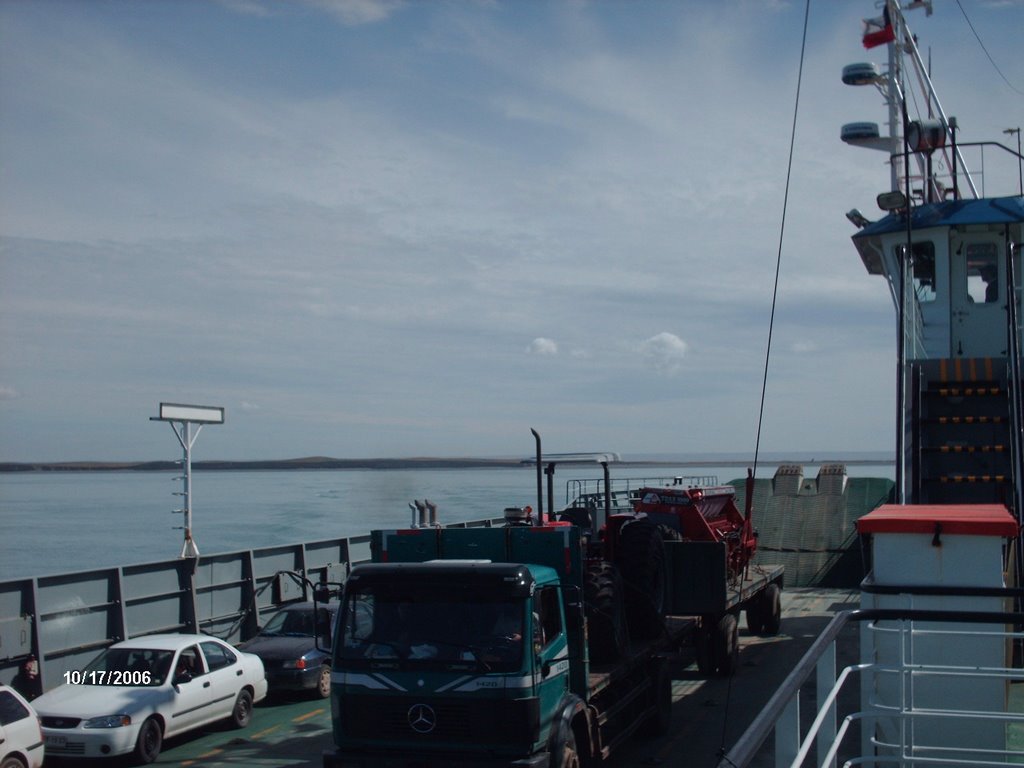
FERRY TO TIERRA DEL FUEGO


FRIDAY, OCTOBER 20
There are no gas stations between Santa Cruz and the border. Fill up in town. Wind as usual. The landscape has more shape; scrub has given way to vast grass paddocks. The grass is thin and tufty. Sheep graze separately. Despite the cold, this is springtime. Lambing has begun. The young butt their mothers’ udders.
A road sign points left to Tierra del Fuego. An ostrich inspects me. He is one of eight. The other seven look the other way. I meet half-a-dozen trucks. The road dips. The channel lies ahead. A sailor is about to close the ferry ramp with a chain. He waves me on board. Drivers ask where I’ve come from. The driver of a new 4X4 pours me coffee from a flask. I go to the office to pay the ferry fare and am given free passage. I stand on the raised walkway and watch as we approach Tierra del Fuego. Rather than exhilaration, I feel relief. My journey is almost done.

STICK WITH BEEF

THURSDAY, OCTOBER 19
Santa Cruz is the Provincial capital. It is packed with visiting officials and people needing to speak with officials. And it has the Province’s main hospital. I try six hotels before finding a bed. The shortage puts the room rate up to $20. I find a restaurant that professes to serve fresh fish. When will I learn? When in Argentina, stick with beef.

CROSSING PATAGONIA

THURSDAY, OCTOBER 19
I face another day of wind and cold and vast distances.
I am accustomed now to the dress code for springtime in Patagonia. On the bottom half I wear underwear and long underwear, two pairs of pyjama bottoms, thick jeans and rain pants. The top gets three undershirts, cord shirt, three jerseys, leather jacket, scarf, windproof rainjacket. I pad the front of the jerseys with newspaper. Next I load the bike. One bag goes on the gas tank. I wedge a second bag into the gap between the seat and the cargo box. Maps, spare gloves and the FootPrint guidebook go in rubber webbing on the box lid. I struggle into the backpack, settle the helmet and security glasses, pull on wool gloves and leather gauntlets. Ready…
Passers-by stop to watch this large blue balloon in a crash helmet prepare to mount. I know their thoughts.
Will the old weirdo get his leg over?
Will the bike fall?
Safely seated in the saddle, I kick the starter, no throttle: Brrrmmmm…
I smile at the disbelievers, raise a disdainful paw, slip the Honda into gear and ride off into the sun. And ride – and ride – and ride…
I have seen a red lake and a green lake and blue lakes and dry lakes. I have shouted at fat married couples (birds) to get off the road. I have talked to Hereford cattle and road repair gangs.
I whirl an arm to denumb my fingers, stretch my legs, wriggle my toes. I bow to lessen wind buffeting by passing trucks, wave to gauchos, slalom the broken white line. I check my watch and the distance travelled against the distance remaining to the next gas stop. 100 Ks is the beginning of a countdown. 100 Ks is only sixty miles. 80 Ks is fifty miles. 20 Ks is nearly there.
My dismounting technique is ungainly – more a semi-fall sideways. I hobble to the lavatory and fumble deep within all the folds of clothing for something to pee with. I sip black coffee in the gas station cafeteria, munch a sandwich, chat with whoever asks where I come from. These are the moments that make the trip worthwhile: so many different people, all content to share with me a little of themselves.
I fill the tank. Backpack, helmet, glasses, gloves: Brrrrmmmm.
Ahead lies a further 150 Ks.
Is it fun?
In truth?
Fun is the wrong word.
Challenge comes closer. In my seventies, can I ride 22,000 Ks on a small bike the length of the Americas? The start of each day is hardest. I wake and lie in bed and contemplate the distance ahead. One more night in a strange bed. Broken sleep. Every part of me aches - back, knees, ankles. I want to give up. I fumble for spectacles and the lamp switch. Check the AAC route guide. Tomorrow I will be on the final page. Get up, you old fool. Take a hot shower.

Tuesday, October 24, 2006

VICTIMS


THURSDAY, OCTOBER 19

Morning and the wind forces me to tack as I view San Julian’s monument to the Argentine airman killed in the war. The plane seems so small, little more than a toy. I stagger under the wind. The South Atlantic rollers are white with foam. I imagine the sailors of the Belgrano, human flotsam. I circle and find the the names of the dead inscribed on black plaques:
Heroes of the Malvinas.
Argentine or Brit, there were no heroes – only victims: victims of political ineptitude and politicians’ vainglory.

WAR CRIME

WEDNESDAY, OCTOBER 18
I am in a fishing port. I want to eat fish. The best restaurant has been taken over by elderly couples form Buenos Aires on a bus tour of Patagonia. A table will be available at 10.30.
I wait in the hotel and talk with the manager. She is a reminder of the schoolteachers who told me of the US invasion of Panama. She has the same soft voice as she tells me of the young soldiers sent to the Malvinas. Poor boys, how they suffered. Most were from the north. They had never experienced cold and they had neither suitable clothes nor adequate food.
I reply that I recall reading of British officers’ anger at discovering the condition of the Argentine soldiers and their contempt for Argentine army officers, many of whom abandoned their men.
I walk back down the cliff road to the restaurant. Wind grabs at my jacket. I imagine the ancient Argentine battleship, Belgrano, torpedoed. For how many minutes could a sailor survive in the freezing sea? The sinking was criminal. Both Brits and Argentinians were culpable. Surely a warning could have been given – through the US? Or was reasoning impossible with Galtieri and his officer clique? Galtieri was a graduate of the notorious School of the Americas - something to dwell on as I exchange the icy South Atlantic wind for the warmth of a restaurant famous for fresh fish.
The two bus drivers and the tour guide for the oldies invite me to their table. We chat of road conditions and distances and the countries we have visited. Later they drop me back at the hotel in the double-decker coach. I lie in bed and think of the vile headlines in England’s popular press. A good Argie was a dead Argie. And what of all those Brits who, over generations, have settled in Argentina?

SAN JULIAN ATHLETIC CLUB

WEDNESDAY, OCTOBER 18
I do my internet work at a bar in San Julian. The bar is the headquarters of the San Julian Athletic Club. The Athletic Club’s football team continuously exceeds expectations for a small town club. Two walls are required to display the trophies. The trophies are massive. I chat at the bar with two young men. I had presumed that much of the town’s wealth would come from the sea. They tell me that the fishing fleet is in the hands of a small clique and is of little benefit to the town. Mining supplies the major income: silver and gold.

PORTO SAN JULIAN

WEDNESDAY, OCTOBER 18
Most towns on the Patagonian plain seem built by the three little piggies. Along comes a wolf and he’ll blow them away. Porto San Julian is different. It possesses solidity and permanence. I don’t know why - perhaps being out on a point and 6 Ks off the highway. The townsfolk care for their town and they make the best of where it is. A community of 18,000, it has three football clubs and a fives court. I make a tour in search of a hotel and find a monument out on the cliff front. The monument is a fighter plane from the Falklands/Malvinas war. The Hotel Municipal faces the monument. It is a good hotel. The room rate is higher than my want. Going elsewhere would be a retreat. I have been in Argentina for three weeks and have avoided the war. I am a Brit. The war is something I need to confront.

GOD AS LANDSCAPER

WEDNEDAY, OCTOBER 18
The land between Caleta Olivia and Porto San Julian began as a plateau. God got bored and chopped the plateau with the side of his hand every fifty miles or so. Rivers run through the valleys. Which direction the rivers drain depends on the angle at which God chopped: east into the South Atlantic or west to Lago Argentina. Geographers and geologists don’t care for God and will give you a different explanation.
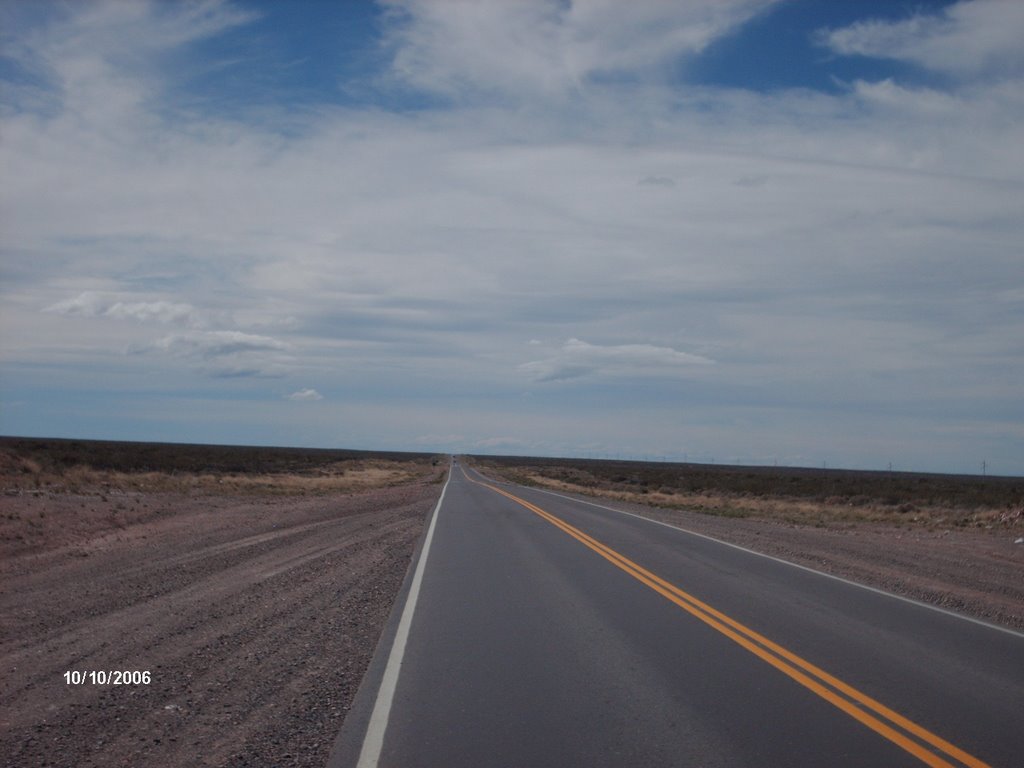
The road runs straight as a ruler across the plateaux. Have the wind in your face and you barely move. The clarity of light leads to confusion. You can see for ever. You presume three bushes are a clump. The clump splits: the first bush is a mile closer then the second and the third is a further mile distant. A service station is the first stop after 150 Ks and there’s a new hostal on the right 100 Ks short of San Julian. That’s it. I may have seen a small tree. If so, it was a small tree. Crossing the terrain on a small bike, you need to keep your mind occupied. God as a landscape artist served me well.

REGRET FOR ANDALUCIA

MONDAY, OCTOBER 16
I sit with the owner of the Hotel Andalucia at the front table beneath the TV. In his mid-sixties, he is a short man, thickset, square hands. He wears a flat cap with a worn peak, blue suit, white shirt, no tie. Enter any café in Andalucia and you will find his twins playing dominoes or cards. He owned land near Granada. He worked the land with mules. A hard life…so he sold up and emigrated. He was back recently, after thirty-five years. His childhood friends now use tractors on the land and employ workers. They’ve built new houses, own two or three cars. A health card gives them free medical treatment in a modern hospital. They draw comfortable State pensions. The local café has central heating. He stayed three months. He wanted to stay for ever. He is a proud man and doing so would have been an admittance of his mistake. He rises from the table and goes outside and unlocks his new Ford 4X4. He sits in the car a while before driving off round the block. I watch part of a football match on TV. The owner returns and sits in his same chair. He doesn’t speak to me. Speaking with me would remind him of where he is. His wife sits at the table in the kitchen. Open their skulls and you would uncover dreams of a village of whitewashed houses and cobbled streets, of olive trees and fresh figs and wind-cured ham – and of friendships and enmities that endure through generations. Caleta Olivia is all too new.

SOVIET ART


MONDAY, OCTOBER 16
The politics of Argentina have been tawdry in the extreme. Politicians are held in centempt and search for heroes with whom to associate themselves. Statues memorialise great men in even the smallest village. Caleta Olivia memorialises the oil field worker. An enormous statue dominates the central plaza. The statue is a direct descendent of Soviet art. Mother’s Day and pizza parlours are doing great business.

CALETA OLIVIA

MONDAY, OCTOBER 16
Caleta Olivia is an oil town. Here, too, the wind is in command. I stop at a small hotel near the plaza. The owners emigrated from Andalucia so let me call it the Hotel Andalucia. The wife appears from the kitchen, books me in and retreats back into the kitchen. I open my laptop on a table in the bar/lobby and work to late evening. The wind drops and the young come out to play. The women wear the standard uniform of the young, jeans or pants supported by their backsides, two inches of bare belly, shoulder tattoos. The guys wear swagger and grease their hair against the wind. Piercings are in, mostly ears and eyebrows, a few noses, no lips that I notice.

COMODORO RIVADAVIA


MONDAY, OCTOBER 16
Wind buffets the Honda and I crouch low on the ride to Comodoro Rivadavia. Ahead lies the South Atlantic. I intended servicing the bike at the Honda agency. Comodoro Rivadavia appears deserted. Wind commands the streets. Dust devils snake across the tar. I stop for fuel. A lone truck pulls into the gas station. I have hit a national holiday: Mother’s Day.
I turn south on the coastal road and halt on a cliff top. The wind has brought clear skies. The sea is dark blue. Curling lines of surf, whiter than white, burst over the rocks. My camera is buried beneath layers of clothing. I pry through the layers. My fingers are numb and the wind whips the camera case over the cliff.

Tuesday, October 17, 2006

HOTEL COLON

SUNDAY, OCTOBER 14
I ask Mrs Hotel Colon if there is a restaurant open nearby. She asks whether a steak and fries would satisfy. A steak and fries would be just dandy.
I drink a second beer and nod intelligently to asides from my barstool neighbour. The asides refer to the general conversation. A mystic would find them obtuse.
Mrs Hotel Colon summons me to a small dinning room. She says, “I put a couple of eggs on your steak.”
I thank her and ask for a third beer.
Three beers and dinner cost $7.
Room rate for a single with bath is $15. Should you ever pass through Sarmiento, you know where to stay. Take a right at the park, ride three blocks and turn left. The Colon is on your right.
Don’t bother with the conversation. It won’t be comprehensible. You are a year or two late…

BIKER HEAVEN

SUNDAY, OCTOBER 14
The Hotel Colon in Sarmiento is the type of dump any respectable biker hankers after. The bar is the right length. Six people and it doesn’t feel empty; twelve and it doesn’t feel overcrowded. Sarmiento is a small town. I doubt there are more than twelve serious bar stool occupiers. The six in possession have been on the same conversation for a while. Maybe it began yesterday or last week. It is one of those conversations that expand over time and develop threads that go nowhere and are put to death. Mostly what is said now is in allusion to what has been said earlier and you would need to have been in on the conversation early to understand its direction – if it has a direction. I sit at the far end of the bar, order a small beer and watch the last few minutes of a football match on TV. The conversationalists seem content with my presence. The pool table to the left of the bar hasn’t been used in months. It is there because this type of bar requires a pool table. The girlie advertisements for beer exist for the same reason. They are expected, as are the three tables, each with four folding chairs, arranged along the wall. The barstool residents would be uncomfortable were they absent. A young couple occupies the table closest to the door. I guess that they are students. She wears spectacles and is perhaps the more confident – or the more pressing of their relationship. The obligatory guitar case protrudes from amongst the bags and backpacks heaped on the floor. I wonder if they are waiting for a bus – or for a parent.
I imagine Josh or Jed calling home. “Dad, can you pick us up.”
I wonder if my sons are aware of the happiness I find in being asked. To be of use is a joy, no matter the time of day or night. I will bitch, of course. Bitching is expected.
I don’t ask how many Us is.
I don’t ask if the girl is a friend or a girlfriend.
Asking would be an infringement.
Of course I want to know – though not to judge, but because this is part of who they are.
However I do wish that they would sit a while in the kitchen once we get home, let me cook them something, talk to me, let me share a little of their lives. They tend to hurry straight upstairs to their room.
I guess it’s my age.
I’m sort of odd, an embarrassment.
You know? Having a dad in his seventies…And, yes, I am odd. I do odd things.

ONWARD

SUNDAY, OCTOBER 14
The nearest pollution must be hundreds of Ks to the north. I am struck by the clarity of light and the extraordinary depth of blue in the sky. The blue is reflected in the lake on the approach to Sarmiento. The lake at Villa del Chocon was the same amazing blue. So was Lake Titicaca. I have seen parrots today. I have seen flamingos graze in ponds alongside sheep and Hereford cattle. Awareness that flamingo breed in the Andes fails to make their presence any less surprising. Those long thin legs should freeze and snap.
Now, in evening, I pass cars parked by a bridge on the outskirts of Sarmiento and Sunday fisherman walking with their fly rods along the riverbank.
I turn off the road at a sign offering B&B. Dogs greet me kindly. A woman shows me a bunkroom. She rents the room with its six beds and use of a kitchen for $20. I don’t have use for six bunks. Nor can I use the kitchen. My logic confronts her prices. My logic fails. I take a room in town at the Hotel Ismir for $15. The room is miserable. So am I. I am tired. I have ridden 600 Ks. I have hay fever or a streaming head cold. I shower and walk a couple of blocks in search of a restaurant. Joy is foreign to Sermiento in a gale. People huddle and watch TV. Bungalows shrink within themselves. The Hotel Colon is a rarity. I spy six men at the bar. I guess that they missed out on church serviced and have been at the bar much of the day. How will they view an intruder? A Brit? I pass half a dozen times before getting my courage up. A set of aluminium doors leads into a porch from which more doors open to the bar. The doors are ill fitting. They grate and squeak and clatter. An army tank would make less noise. Conversation ends. The six men at the bar turn on their stools and inspect me. So does the owner. So does he wife.
I hold my hands above my head in surrender. “I am a Brit,” I say. “Am I allowed?”
“They allow horses,” says a man in a flat gaucho hat.

IT BLOWS IN PATAGONIA

SUNDAY, OCTOBER 14
I ride out of Teka into a full gale. A moment’s inattention and I would be slammed off the road. I consider turning back. A great restaurant – maybe there is a great bed. However Patagonia is famous for its winds. What I consider a gale is probably the standard Patagonian breeze.
Gobernador Costa is a further 60 Ks south on route 40. The streets are empty. Those out for a Sunday stroll have been blown away. I stop for gas and a coffee.
A pretty young woman operates both the gas pump and the coffee machine. She asks where I am going.
“Sarmiento,” I say.
“That’s two hundred and sixty kilometres,” she says.
I agree.
“There’s a gale blowing,” she says.
I’ve noticed.
“You should stay the night here,” she says.
“Patagonia is famous for wind,” I say. “Will there be less wind tomorrow?”
“Of course there will be less,” she says. “This is a storm. We don’t always have storms.”
She fails to convince me. There could be a storm tomorrow. It could bring a more intense wind. Weaken, and I could be stuck for weeks. I don’t have weeks. I have a flight booked to Madrid out of BA on the 30th.
Better the devil…

GNOCCHI

SUNDAY, OCTOBER 14
A true restaurateur is a miracle you luck on in the strangest places. Evidence starts with the greeting. Tecka, the owner has been waiting all his life for my arrival. Will the plat de jour suffice? A simple gnocchi?
Simple?
The gnocchi are al dente. The sauce is a combination of tomato, garlic, herbs, ham and Italian sausage. The quantity is as vast as Argentina. It is served in a dish cradled in a basket. It is divine. So are the fresh-baked bread rolls.
Bikers, forget your schedules. Stop here and eat.

HIPPIE HAVEN


to esquel


SUNDAY, OCTOBER 14
Esquel was a hippie haven in the seventies. Now it is a fashionable resort - bright hippies tracked the change and shop with Platinum-grade credit cards. The road from Bolson crosses a stretch of altiplano. I pass two cops wrapped in balaclavas and frost-retardant. I ask what happened to the central heating. The one cop says, “The Government forgot to pay the gas bill.”
I top up with gas at Esquel and head for Tecka. The road follows a wide flat river valley of huge sheep paddocks. Trees grow along the river. I startle a flight of green parrots. What are parrots doing up here on the altiplano? And why haven’t the farmers planted shelter strips? Teka doesn’t look much on the Auto Club map. So much for maps: Teka holds a treasure. I turn off the highway onto a dirt street. Tin-roof bungalows each side are closed tight against the wind. The road becomes tar and I spot pickups parked outside a gas station. The gas station is out of use. The drivers are here for Sunday lunch.

BOLSON


bolson


SATURDAY, OCTOBER 13
Bolson is cute tourist town. Prices are high. So are the mountains. The tourist office found me a room ($15). Face the square and turn left up main street. Pass the oculist and t real estate office and the Hospedaje is on the left. I have a large comfortable room. The double bed has a good mattress. The radiator is hot, the water in the shower is hot. I have a window onto a garden and a table that I can write at. Honda is safe under cover in the garage. Bringing the Blogs up to date takes a full day.

I AM A BIKER


biker test


FRIDAY, OCTOBER 12
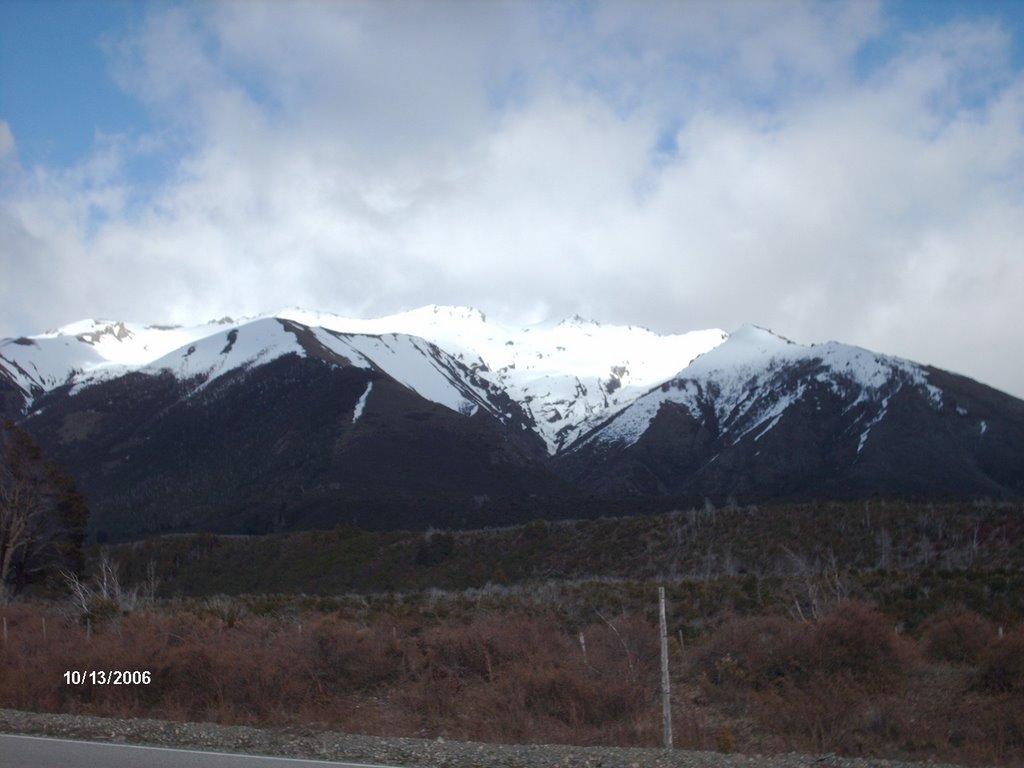
Bariloche. I wonder at the name. Was it born as Barry’s loch? Pines edge the lakeshore. Above shine the ski slopes. Lift cables bisect the pistes. The road swings south towards Bolson. I follow a second lake. Rain closes in. The road climbs. Rain turns to sleet. My feet are soaked, toes and fingers numb. Sun finds a cleft in the clouds. The peaks glisten. I am in semi-dark. My cheeks suffer a bombardment of ice crystals. I raise the speed by 10 KPH to intensify the pain. I must be crazy. I even stop to photographs the peaks. I kneel beside the road and steady the camera. There, on my knees, illumination strikes. Size is of no account. Nor is speed. Years are immaterial. This is the test. The pass mark is having fun. Enjoy yourself under these conditions and you may ware the label proudly: BIKER.

SINUOUS & SENSUOUS


FRIDAY, OOCTOBER 12
Argentina excels in road signs. SINUADO is my favourite. SENSUADO would be extra. Any biker knows the meaning: sweeping curves, smooth dips, curving climbs, perfect camber, views to die for. The road to Bariloche passes through a valley maybe half a mile in width. Black mountains rise each side, sharp crests of bare rock. Black scythe blades of rain cut across the valley. Beyond rose the white peaks of the Andes. What more should I want?

Saturday, October 14, 2006

BEWARE

FRIDAY, OCTOBER 13
Route 237 crosses the river only once. The gas station the far side of the bridge has the appearance of a restaurant but isn’t. Ride a few miles further and there is a restaurant on your left down by the river. You can’t miss it. It is the first building after the bridge. Don’t stop. I was charged $10 for a bowl of lentil soup, salad, and a small bottle of water.

HEREFORD


FRIDAY, OCTOBER 13
Another great day. I ride route 327 from Villa el Chocon to San Carlos del Bariloche, then take route 40 to Bolson. Lakes and mountains and dark, forbidding moors are the menu. I recognise a face on the moors. He is a young chap, not fully grown.
“Where are you from?” he asks.
“Colwall,” I reply.
“In Herefordshire? That’s close to Ledbury.”
“Six miles,” I say.
“I believe that’s where my great great grandfather came form,” he tells me.
“Very probably,” I say and take his photograph.
He is embarrassed at having spent so much time with an old fogie. Off he trots to join his friends.

MURDER IS MORAL

THURSDAY, OCTOBER 12
Villa el Chocon down by the lake is a tourist resort. The cops at the cop station warned me of the prices and suggested a hostal in the roadside village.
Hostal El Alamo is a find. Any biker riding by should stop. The beds are perfect. Bathrooms have power showers. The lady of the house is a great cook: $10 for the room plus $4 for dinner and the tap water is safe.
I share table at dinner with a man of interesting views. He is a building contractor, self-educated. He finds modern society immoral. He places much of the blame on female liberation. Women, once educated, lose respect for their working husbands. They find their husbands uninteresting. They prefer the company of their educated female friends. Soon they are out drinking together and smoking. Prostitution is the next step. He tells me of a dance hall in Buenos Aires. A factory building, it holds three thousand couples. By two in the morning none of the women can dance – all are inebriated, all are for sale.
He was a child when his father was killed in an earthquake. He believes his father came from Syria or Iraq. Iraq is the birthplace of civilisation. Now look what the British are doing in Iraq and Afghanistan. They have killed 650,000 civilians – they and the Americans. The British in Australia were worse than the Spanish in America. Recently 300 Aboriginal bodies were discovered. Their British employer had murdered them rather than pay wages due - a common occurrence.
He believes in a great conspiracy by the rich. Consumerism is part of the conspiracy. Women are the chief targets (yes, we are back to women). 52% of world income is spent on women. Makeup is the largest item. Women are weak and easily influenced. They have no resistance to temptation. Read the Bible. Lot’s wife…
So he continues while I nod my understanding and marvel that his wife hasn’t cut his throat.

GOOD DAY, BAD DAY

THURSDAY, OCTOBER 12
What began as a bad day has been a great day. I stopped for lunch at a shack in the middle of nowhere. A bunch of trucks and pickups were parked outside, a good sign. The drivers sat at two long tables laid with tablecloths. A young pregnant woman was serving platters of steamed trout and bottles of red and white wine.
I sat at a table without a tablecloth and was offered steak and salad or salad and steak. I took the steak and salad. A driver, not of the party, joined me. He was familiar with the place and the pregnant woman’s daughter, a six-year-old, kissed his cheek and fetched him a glass and a bottle of soda. Our food came at the same time and we left together. The driver didn’t know what the party was but was anxious to be on the road ahead of the wine drinkers. I had a rear wheel puncture right by the gas station in the next town. A neighbouring puncture specialist fixed the tube for $1.60. I rode on through Nequeen and took Route 237 towards San Carlos de Bariloche. Late evening and I suffered a couple of sharp rain squalls. The evening sun lit the underside of dark grey cloud over the lake at Villa el Chocon and turned the water into a shimmering sheet of slate-coloured glass. The light on the water was too intense to discern the far shore.

COCHICO


road north


THURSDAY, OCTOBER 12
Cochico is eight shacks and a police barrier. A young cop tells me to pull off the road below a dead pickup. The shack behind the pickup serves coffee. I look for a sign. Only a couple of thin dogs. The door is tacked together from old planks that have been used elsewhere. I tap. A balding head appears and is followed by a hand that scratches the scalp.
The door opens fully and the head extends into a man of my generation. He is fresh from bed and hasn’t completed his ablutions. Coffee? Of course I can have coffee.
He shows me into what passes for a restaurant: five tables, a bar, a TV, and a fireplace big enough to roast a sheep. The unglazed windows are protected by three layers of netting to keep the sand out. The light is dim.
The owner seats me at a table and shuffles off to where ever the kitchen is. He returns after a while with two cups. He hasn’t had time or the inclination or memory to wash his face or brush what is left of his hair. He asks if I want a biscuit or a sandwich or a slice of cake.
“No,” I say, “No, I don’t think that I want a biscuit or a sandwich or a slice of cake.”
He sets the cups down on the table and sits opposite me. Where have I come from? Where am I going? How long have I been travelling? Do I have a wife? Children?
He has four children. All live and work near by – except for a daughter, 27, who is studying in San Juan. The other daughter is married to the ambulance driver. His wife has a job as cook somewhere else (he expects me to know what or where the somewhere else is). He does the cooking in the restaurant. His kids dump the grandchildren on him. He seems extraordinarily contented.
I imagine how good it would be to have my two elder sons close by and Anya running a local stud. Have the door always open. Have Sarah drop the genius off of a morning. Have everyone at table for Sunday lunch. It is the life I imagined for myself when I was young. I have made a real mess.

DEEP BLACK


road south


THURSDAY, OCTOBER 12
7 a.m. and the road leads dead straight across scrub desert. A cold fierce head wind drags smoky patterns of fine sand across the tar. I bend forward over the fuel tank and edge the speedometer up to 70 KPH. The sand gets in my eyes and in my nostrils and in my ears. The road is endless. The country is featureless. Thousands of kilometres remain. Depressing, depressing, depressing…
I check the speedometer. I have ridden six kilometres.
I check the speedometer. I have ridden eight kilometres.
I mark a post on the horizon. I won’t check the speedometer again until I reach the post.
A pale spot becomes a truck. The truck becomes a monster. The bike shudders. Ten kilometres…
I need coffee.
Cochico, at 90 Ks, is the first place on the road map.
90 Ks at 70 KPH?
But it isn’t 70 KPH. I sit up and the speed drops to 60.
All bikers must suffer this type of depression one time or another, mostly when they are young and haven’t dressed for the weather or are riding the wrong bike for what ever it is they are trying to do.

COWARDLY BRIT

WEDNESDAY, OCTOBER 11
General Alvear is a small modern town with a large tree-shaded plaza. Why this need to memorialise the military? What did General Alvear do?
I find a hotel room, hot water, $7. I check the Internet and learn that England has lost to Croatia. For years the sports journalists and fans have blamed a foreigner, Sven Goran Ericsson, for any failure of the national team. Perhaps the Swede did well given the paucity of talent.
I eat steak and salad and return to the hotel. A small neat man in his sixties sits on the sofa in the reception. He wears blue chinos, a blue jumper, blue socks and blue bedroom slippers. His moustache is parted in the middle and teased out into two points. The manager presents him as her friend (hence the slippers). Senor Hostility would be a better introduction. He settles himself on the sofa in the manner of fighter pilot settling in the cockpit.
“You are English.”
“Yes,” I say.
“You English are arrogant. You don’t wish to be part of Europe. You believe you are superior.”
I am pro Europe – what should I say? I suggest that some Brits are nervous of being associated with nations where political corruption is the norm: that this fear is common to most members of the six nations comprising the original European community.
“Your Blair is more corrupt than anyone. More corrupt than Belusconi. He and Belusconi are friends. Look at Iraq - he is a liar, your Blair. There is proof that more than six hundred and fifty thousand civilians have been killed. What do you say to that?”
Senor Hostility is softening me up. Soon he will shift attack to the Falklands/Malvinas war.
“I agree,” I say, “Absolutely...now, please, if you’ll excuse me, I have to be up and on the road by six-thirty.”
So sneaks away the cowardly Brit…

LITERATURE IS PASSÉ

WEDNESDAY, OCTOBER 11
I am due to meet with the regional President of the journalists’ union in San Rafael. His cell phone is permanently busy. The road south traverses flat fields. The mountains are vertical flats and equally boring. San Rafael has nothing to recommend it. I ride on.
Olive groves and terraces of ancient olive trees are familiars of European literature. Literature is passé. Argentina is agro-corporation. Kilometre upon kilometre of young olive trees march to the horizon either side of the road. I break for coffee at a service station. A young woman serves me. She is one of four daughters, no brothers. I have four sons. We compare ages, occupations. Twenty or more shade-netted plant nurseries occupy the far corner of the intersection: baby olive trees fresh from the genetic lab. The owners are Spanish. The town has become dependent on them. These same Spaniards have planted three thousand hectares of almonds. My informant is unsure as to how many thousand hectares of olives have been planted. The young woman tells me that a labourer earns $270 monthly. She asks what a farm labourer earns in England. I guess at $500 a week. I sip my coffee and wonder what the future holds for the European farmer, the Spaniard husbanding olives and almonds on a few cherished hectares. Is he aware of the intention of his compatriots here in Argentina? Perhaps a TV producer could put them together. Imagine a judge as chairperson. Is investing in the destruction of your campatriots’ living an act of treason? Or merely sensible business practice? God Bless The Global Economy, Screw The Loser…

MENDOZA

MONDAY/TUESDAY, OCTOBER 9-10
Mendoza is a clean safe modern city of shaded streets and watered parks and squares cooled by fountains. Plaza San Martin is the centre. I check half a dozen hotels before taking a $13 room on the 3rd floor at the Imperial for two nights. The room has a full size window and hot shower. The towels rate as adequate, the elevator works, staff are helpful. I write eight hours straight at a table in the ground-floor restaurant (prices are reasonable for acceptable food). Three further hours on the internet and I am up to date with Blogs and correspondence. Late evening I sit at a sidewalk café and people-watch. The temperature is ideal, no flies nor mosquitoes. I think of Mendoza as a European city. I am wrong. In any European city I would see African and Asian faces. Here there remains a thin sprinkling of dark mestizo amongst older citizens. Amongst the young, Europe is triumphant, the indigenous visible only in a slight tanning of skin and in a bright blackness of eye. Dress is casual. The young are confident in their sensuality. These are beautiful people and they are having fun. I meet two bikers in the street, Canadians from Nova Scotia on big BMWs. They have done the trip in two months. I have ridden one half the distance in five. The BMWs have comfortable seats.

FLAT


flat either way


MONDAY, OCTOBER 9
Modern machinery and concrete sew the desert with water channels. From the sand sprout vineyards and citrus orchards and serial crops. This is Argentina: the scale is vast, the fields are flat. Close-by soar the snow-capped Andes. I long for a visual foreplay of wooded foothills.

Tuesday, October 10, 2006

DOWNMARKET LOURDES

OCTOBER 8
My wristwatch fell off some time yesterday. I bought the watch in Panama at a street stall for $9. The one window in my room at the Chepes hostal has Venetian blinds that don’t open. I need a morning call. I have parked in the garage behind the hostal owner’s car. She has to leave early.
What is early?
“By nine – half past at latest.”
Is late rising religious?
Was Evita a late riser?
She did much of her early work in bed.
The road crosses 160 Ks of desert. I count three curves, each less than ten degrees. I stop at the first town. Town? A mini-Lourdes built round a hilltop shrine dedicated to the saint of travellers. Believers arrive by bus. I am served the most disgusting cup of coffee of this entire trip, the most revolting enpanadas and the toilet facilities are filthy. The saint is a fraud. Were she genuine, she would strike these exploiters dead.

CHEPES

OCTOBER 7
I have ridden 730 Ks today from Tafi del Valle to Chepes. I couldn’t see a reason to stop. Present a Texan with a slice of this land and he would refer to it as his ranch. Normal people recognise desert. Vegetation is sparse and grey rather than green. Sand blows across the road and gets in your ears and in your eyes. The road runs straight to the horizon and all the way back to the horizon. A dot on the road finally materialises into a truck. A car driven fast overtakes and remains in view twenty minutes later.
A road sign welcomes me to Florida. A dust track leads off to the right and crosses disused rail track. I pass a second sign the other side of the road – Florida is history.
The road crosses a dry lake. A fence runs across the lake parallel to the road. Two Aberdeen Angus bullocks walk beside the fence. They halt and look at me. I poop my klaxon. Perhaps they break wind.
Why didn’t I take the scenic route? The scenic route is riple – Honda and I don’t ride riple.
Chepes is a road junction. It used to be a rail junction. The railway died. What else can I write of Chepes? Dusty streets, a motorised procession of celebrating football fans. I found a hostal at $7. A big beer and steak dinner set me back $3. The steak was on the run from a steel foundry. I stuck my hand in a ceiling fan and sprayed blood over my bed.

DAFODILS

OCTOBER 7
I leave Tafi del Valle at 7 a.m. One elderly man in a thick fawn coat and wool hat sweeps refuse back into a bin dogs have riffled. No one else stirs. The city folk of Salta were equally late in rising. 8 a.m. had the feel of 6 a.m. in an English city. Argentineans siesta and shops stay open until 10 or 11 p.m. British shop assistants would strike. Even first generation Asian kids would rebel.
The road dips passed a lake, rises then follows a stream down through a thickly forested gorge. The trees are peculiar. The leaves are sparse and small and curled. I have ridden a couple of Ks before realisation strikes. Strikes is an understatement for being smitten visually by a mass of yellow daffodils. The trees are deciduous; this is early Spring; I am in a temperate micro climate. Sunrise tints the leaves with pink. One more gift of beauty from South America…
20 Ks further and I reach a tropic floor of cane fields, citrus and wheat. The road crosses west into the next valley. Desert…

TAFI DEL VALLE

OCTOBER 6
This is my first fun night since eating out with Ming in Cartagena, Colombia. Cartegena was full of holidaying Colombians. In Tafi, this restaurant is full of holidaying Argentineans. We three are the only foreigners in the restaurant. We are guests. We want to stay, fine. We want to leave, that’s also fine. We are unimportant. We are peripheral to the economy.
Any other stop on the Gringo route and all the guests would be foreigners, essential income, prey to be targeted, territory to be occupied.
There is no fun in being prey, territory, or a target.
I prefer to be people.
In Tarif I am returned to the human race.

TAFI DEL VALLE

OCTOBER 6
Tafi is a tiny tourist resort. Middle class Argentinians escape there from the heat of the plains. I meet with travelling companions. He is Scots New Zealand, Sara is Italian. We dine together at a restaurant where a gay magician acts as compere. The magician is brilliant. He leans over our table and makes coins and scarves appear and disappear. He works with his sleeves rolled up. Sara and I enjoy and admire. Our companion calculates how the tricks are done. The magician must ware a false palm.
Meanwhile two men from the next table sing to us. The elder, a grey-hair sixties, sings soft Argentine traditional packed with sob and soul. For a pro, he would be good. Amateur, he is amazing. The younger, a late forties Dudley More, is equally talented. He plays and sings pop Latino rock. Call a title, he knows the song. I watch his wife. She has seen him perform a thousand times. She has admired (probably why she fell for him). They are out to dinner, a party of six friends. They are up from San Juan. She hoped for a quiet weekend, a slow cuddle. Now she is faced with the same old need for confidence boosting every artist needs and craves. How did I do? Did I get the notes right? Did people like me? Really like me? I didn’t stay on too long? They didn’t get bored? Yeah, yeah, yeah…
And I see Bernadette reading my latest email.
How did you like the female circumcision Blog?
Sorry…

DYNAMITE CAMELS

OCTOBER 6
I intend sleeping the night in Santa Maria. Santa Maria is a small market town in the centre of nowhere. The road I take is surfaced with ripli. Ripli is Argentinian for corrugated dirt. Honda and I share an antipathy for dirt.
Should I have known that Santa Maria is holding a world conference of Camels? Morales, President of Boliva, was due to attend. Now he is attending funerals of Bolivian miners dead in a fratricidal battle between miners from a co-operative and miners in the State sector. Miners from the co-op are militant. They detest the subsidies and State contracts that advantage miners in the public sector. Their weapons are sticks of dynamite.
Morales or no Morales, every hotel in Santa Maria is full with freeloaders of the conference circuit. A pleasant elderly gentleman with few teeth mans the tourist office in the central square. He is a keen biker and owns an Alpina. He bought the Alpina as a rebuild job. It lies in bits in his garage. It has been in bits for the past fifteen years. It requires spare parts. Parts require money. He doesn’t have any. And he is getting older. Sixties? Hopefully my visit will rekindle his dreams. He advises Tarif as an alternative destination. 90 Ks, and I have two hours of daylight. Does he hate me? Is my liberty salt in the wounds of his disappointments? Why else would he fail to mention that the 90 Ks includes altiplano and a mountain pass? The sky up there is overcast. The temperature falls faster than lead. My tears snap and tinkle on the rutted tar.

GORGEOUS GORGE


OCTOBER 6
The gorge of El Rio de los Conchas is a must for a biker. Temperature is ideal. The road is set up right. The curves and climbs and descents are perfect. Take time out to admire the scenery. What scenery! The walls of the gorge are red rock ground and stretched and wrenched. The thorn trees and scrub along the river seem sprayed with emerald dust and lit with strobe lights. I share the gorge with a pedal-bike race. Cops clear the route. Three riders have a kilometre lead over the pack. A couple at the back catch a drag from attendants in a van. An ambulance brings up the rear.
Weird taste to ride through such beauty with your head down and blinded with sweat.
The riders might think me weird to be riding a pizza delivery bike the length of Latin America.

DONA LADA


typical street

OCTOBER 6
The altiplano is beautiful to the traveller. He passes by. He doesn’t stop. There is nowhere to stop. In Argentina, village after village tempts. I head south from Salta. Colonel Moldes comes first – surely an odd name for a town. Argentina is full of such names: Colonel This and General That.
Colonel Moldes is too charming to be military. Trees shade the main street. Pillared arcades shade the sidewalk. I stop for coffee at the Hospedaje Dona Lada. Birds enjoy the palm trees in the small park where a bust of the Colonel holds sway. The coffee is excellent. The young woman who serves is delightful. Each passer-by greets me. This is bliss. I could stay a week. Townspeople would talk to me in the evenings. I would learn something of Argentina. Big cities don’t work. People are too busy. I am invisible. I learn nothing.
What is the cost? $8 for a single with bath.
I paid double in Salta and had my pocket picked.

TOUGH

OCTOBER 5
I lie in bed - 7.30 a.m. The hotel room is small and dark and dank. Plumbing gurgles. A man converses in German and in Spanish. The Spanish is with a member of the hotel staff. The German complains that his bedside light doesn’t work, that the lavatory won’t flush, that the ceiling fan screeches. He wants a discount on the room rate – or his wife/girlfriend demands that he demand a discount.
My bladder is demanding.
And my laptop is demanding. It waits on the table. I hate my laptop. It is a Panasonic ToughBook and indestructible. It weighs a ton. It travels in the box on the bike’s luggage rack. The box is black. Midday the box becomes an oven. Heat murdered the batteries. I have to work indoors. I tried working last night. The chair sandwiched between the bed and the table has a cracked seat. The crack pinched my arse.
I feel inside my pyjama pants for evidence of the pinch.
I find three spots.
Before riding, I need to put cream on the spots.
I don’t want to ride.
I have been riding for months.
Tierra del Fuego is a further 5000 Ks.
Bernadette thinks that I should ride back in the New Year to New York.
My heart will give out.
I feel for my pulse.
Where the shit is my pulse?
8 a.m. - I must get up.
My years will stick knives in my spine and in my ankles.
I will slip on the soap on the wet floor of the bathroom and crack my head open.
Where did I leave my teeth?
I need my spectacles.
Being old isn’t fun.
I want to be home. I want to sprawl on the couch and watch TV and hug the kids (if they allow) and rest my head in Bernadette’s lap and know that soon she and I will go upstairs to bed.
Salta is half the world away.

PUNISHED

OCTOBER 5
Midnight and I fetch a glass of water from the water cooler in the hotel lobby. Light is dim. The cooler has two taps. One tap appears a darker blue than the other. I put my four heart pills on my tongue, raise the glass, prepare to swallow. The water is boiling. I spit. The darker tap is water for tea or mate. My lower lip is scalded. Great!

I AM A RACIST

OCTOBER 4
I confess. I am a racist. I am in Salta. I am in a recognisably European city of sidewalk cafes and clean parks and smart shops. I have escaped unscathed from the terrorist and bandit territory of indigenous America. I relax. I am robbed. Hah!
I report the loss of my wallet at the police station on the cathedral plaza. I am recompensed with two kisses. The police officer is young and pretty and kind. She says that I am in great shape for an Oldie – that Bernadette must be a wonderful wife to have looked after me so well.
A second police officer groans under the weight of her pregnancy. I recall Bernadette visiting a dear friend on his deathbed. John was gynaecologist. He was also a rugby player and dismissive of women’s aches and pains. Dying of cancer, he complained to Bernadette that every part of him hurt.
“At last you know what it feels like to be pregnant,” said Bernadette.
I report this tale to Salta’s female police officers. Bernadette is their hero.