Monday, June 19, 2006

MAYA RUINS


MONDAY, JUNE 18
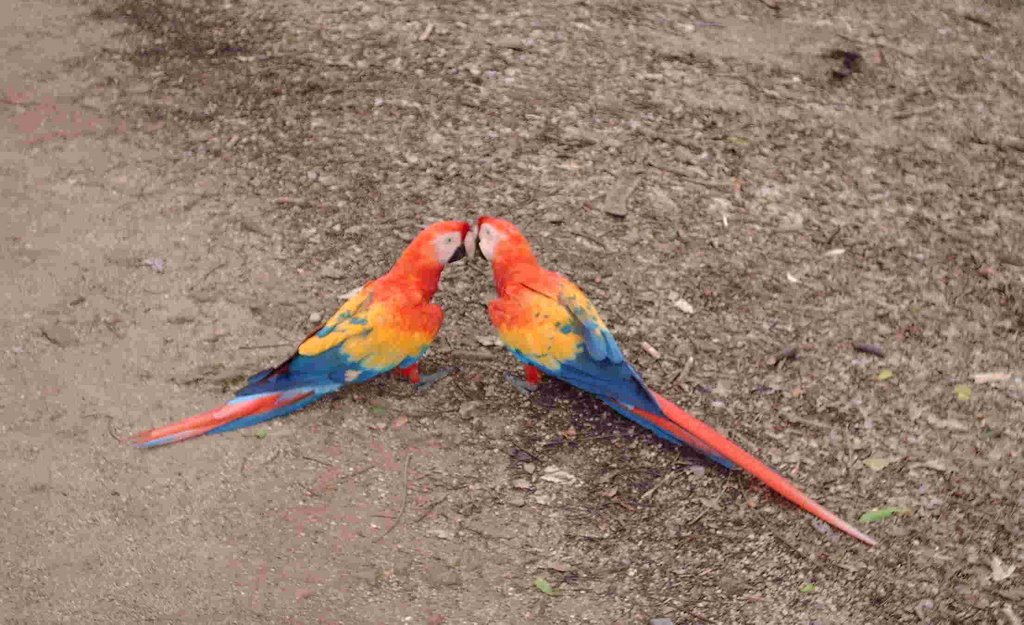
I ride my bike the mile to the Maya ruins. Guatemala, cops remain expressionless as they stare at you. Here a cop armed with a rifle waves at me from the roadside. The entrance fee to the ruins and the museum is aproximately US$15. I prefer sightseeing at my own pace and buy a guide book rather than join a guided troop. Big parrots greet me. I take their photograph. They seem pleased, nodding and squarking.
The ruins are great as ruins go. The setting is magnificent this time of year, the surrounding mountains green as are the huge trees and cropped grass between the pyramids and ball courts and acropolys.
I sit in the shade on the lower steps of a pyramid. I face the sloping side wall of a pyramid some thirty meters high. A pale young blond woman slips on the decent behind me and twists her ankle. She is a missionary, wouldn't you know? From Minesota. She and an older male of the species are in company with a Guatemalan doctor, female, and two others who translate for the missionaries the word of God. The doctor requests a bandage to wrap the ankle. God is off-duty. I remove the bandage I wear when biking (it stops the leather gaiter rubbing the burn).
The incident has destroyed my ability to concentrate on or be impressed by the Maya Gods. I think instead of the work in cutting those stones that form the pyramids, the thosands of cut or crushed fingers. I read in my book that Maya kings destroyed much of what their predecesers had built and rebuilt on the same sight - taller, of course, more impressive.
They, the kings, built: it says so in the book. The book lies. The people built. I know the system well from our years in Cuba: The following will volunteer...The army is the same.
I walk a little, sit a little, admire the gray of the stone so well presented against the brilliant green of the rainy season. I talk with an English woman and her father: she is teaching at an English private school in El Salvador. Later I notice what I think are leaf insects beside a path. I look closer and discover a column of ants carrying freshly cut leafs on their backs. Leafs are lighter than stones and easier to carve.
I fall in with a Puertoricano and his girlfriend. She is small and the steps up the pyramids are not only steep but also high. We decide the height of the steps was designed to so exhaust the sacrifical victims that they would find relief in having their hearts gouged out with an obsidian knife.
I listen to a guide joke of the sacrifices as he explains the ball game to a noisy troop of American students.
Odd, my guide book doesn't mention human sacrifice.
A group of Guatemalans gather at the entrance to a tunnel. One asks where I am from. While the others enter the tunnel, he and I talk of Tikal, which he hasn't visited. He and his companions are members of a small manufacuring co-operative in Zacapa. They are being put out of business by Chinese imports. They need to retool but nobody is willing to invest. It is fear of what will happen, of the violence...
We have been joined by the tunnel explorers. Yes, the violence, they agree. The violence in the capital is very bad.
One says that the violence is deliberately fostered by the government to destabalise democracy. The rich want another general.
They move on and I sit a while, flipping back thru my guide book. Why were each of these Maya sights abandoned? I think of the ants - and of bees swarming and moving on. And I think of the work entailed and that perhaps the Kings' demands were too great and they self-glorified their kingdoms out of existence.
Later I visited the sculpture museum. There I joyfully recognised an expression, a smile, a grimace, twisted fingers. As the sons of my Mexican and Central American friends share with my sons a love for the same music, so these few, the great Maya sculpters, shared with all those other great sculpters, modern or ancient, of what ever continent, a human understanding and sympathy with humanity that escaped the rule of priest and king.

COPAN TOWN


MONDAY, JUNE 19
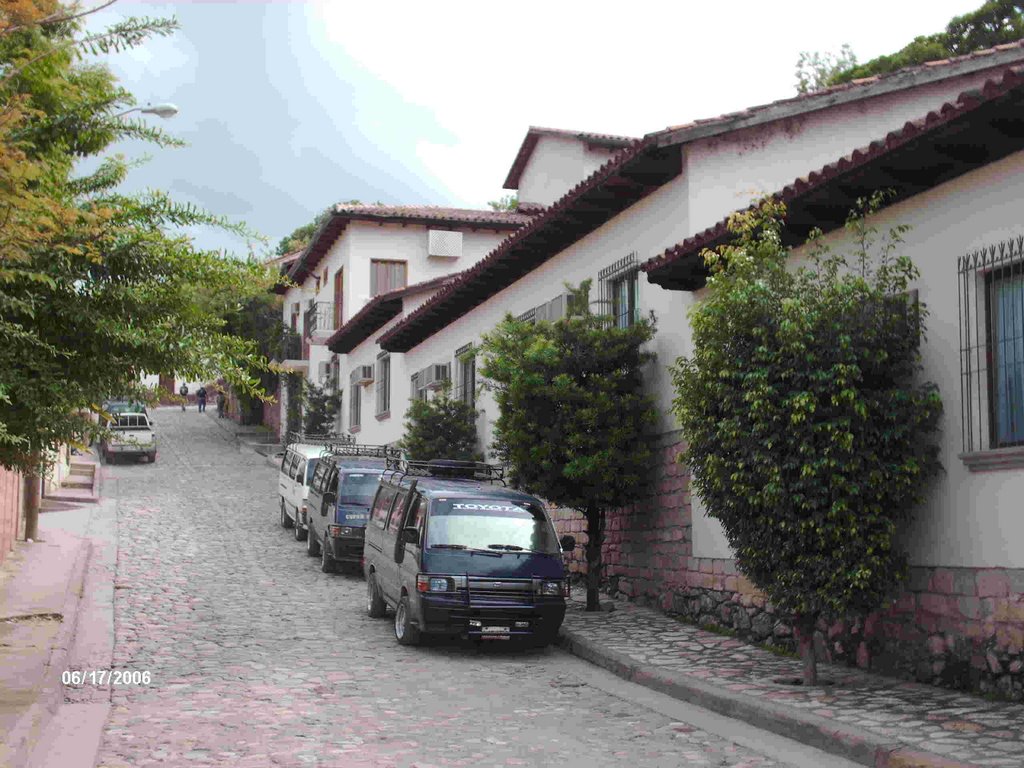
The Maya ruins have made Copan Ruinas affluent. It is a small, pretty town of perhaps fifty blocks divided by cobbled streets and with low, typically Spanish colonial domestic architecture in good repair and freshly painted. I intend catching up on my blog and am up early, walking down two streets to the restaurant where I ate last night. 7.15 and I order orange juice and coffee with eggs. This is central America: the eggs come with refried beans, fried bananas, avocado. The coffee is good. Have I finally reached coffee heaven? Or is this glory particular to Copan Ruinas? I eat under a hard awning on a terrace that gives onto a jungly garden. Bernadette wouldn't aprove the yellow blossoms. The bill is US$2.60.
Repleat, I wait, sitting on the curb, for the internet cafe to open (8 a.m.). This is a town of hope, wonderful after Guatemala. Householders and shopkeepers are out sweeping the sidewalk and watering the cobbles to lay the dust. Passers-by greet me. A white Hyundai pick-up delivering the big five gallon water bottles is new as is the white Isuzo refuse truck. Even the three-wheeler scooter suicide cabs are polished.
The women of Copan celebrate their wealth. Plump/voluptious is the fashion. They wear their clothes tight - T-shirts stretched at bosom and belly. I greet a woman, mid-twenties, wearing a gold belt wide enough to serve as a cummerbund. A roll of silky brown tum breaks free of a short tight black top and spills over the edge of the belt. She strolls with swagger, proud of her girth. No place here for Cate Moss. The generous townsfolk would think her starving and chase her down the street with tortillas stuffed with cheese and cream and refried beans.

HOLD UP AT HONDURAN CUSTOMS


SUNDAY, JUNE 18
I have chosen (lucked into)the right months for travel. The road thru Zacapa to the Honduran frontier runs thru country that Paul Theroux writes of as dusty desert. Now the emerald hillside quivers as the breeze flutters the fresh growth on the trees. The river flows full between irrigated patches of field. The rain storms have torn boulders from the slopes and I ride with extra care on a road that twists thru narrow valleys.
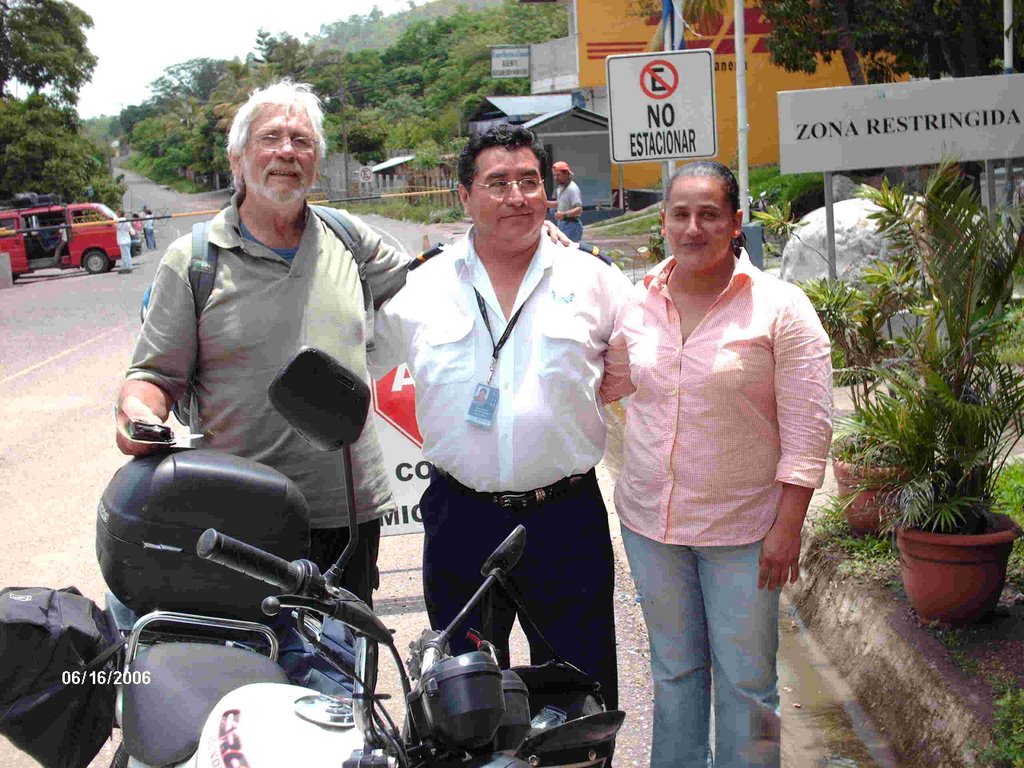
I reach the border. Guatemalan and Honduran Immigration officials share a low, single-story building. They also share a sense of humour of which I, the Honda and my destination are briefly the butt. I negotiate the exchange rate up a few points with a money man in a white Stetson. He then photographs me with the woman Honduran and male Guatemalan Immigration officials.
Honduran Custom officials are more difficult. True, the paper work takes less than ten minutes. However the Customs chief has the world cup on TV in his office: France v Korea. A cold beer, coffee and the match hold me up the best part of an hour.
I ride into Copan Los Ruinas at 4 p.m. A truck pulls up alongside the bike. The driver hands me a card. He owns a hotel: room and bath with hot water for US$10 which is a little less than 200 Limperas (Honduran money). The room is fine. I find a good internet cafe in the care of an Isabelle who plies me with coffee while I work. Dinner is beer and a steak with the normal trimmings: tomatos, fried bananas, black beans, avocado, chili salad - less than four dollars.

TO HONDURAS


SUNDAY, JUNE 18
Breakfast was a real Sunday breakfast: fresh orange juice and fresh fruit for health: bacon, chorizo and French toast with real maple syrup from Canada for cholestrol: great coffee. I load the bike and Ash photographs Marcio and me beside the bike. Marcio has told me of a short cut to the tar road. I ride on good dirt for twenty Ks. I ride slowly and people register what I am. Smiles and Good mornings are almost universal - so different from the Alto Plano of my first two days in Guatemala. The first 50 Ks or so are mostly coffee farms or dairy. Occasionally there is a splash of colour where bourganvilla spills over a fence.
The tar road drops in smooth 70K curves to El Rancho, a distance of 150Ks. I find the road's rythm and am reminded, as I lean into the bends, of skiing Spring snow. This is glorious biking. I sweep thru pine forest and inhale the scent of pine tar. I am dropping from mountain cool into the coastal heat. At El Rancho I gass up beside two massive BMWs and their riders. The BMWs are fitted with all the kit, so are the riders (shades of Dallas, those these two are Guatemaltecos). The fitted luggage costs more than my Honda. We laugh together and shake hands and ride off in different directions - they back to their offices in the capital, me to turn south at Rio Honda...

Sunday, June 18, 2006

LAST NIGHT IN COBAN

SUNDAY, JUNE 18
I doubt that I will revisit Guatemala. Last night a sadness overwhelmed me as I lay in bed. I thought of those I will lose. Eugenio is a brother to me: a younger brother when we first met; now, as I enter my second childhood, an elder brother. Perhaps he will bring Monica and Andresito to visit. And of course there is Santiago, fierce hunter of pigs, and my present hosts, Marcio and Ash - and there is Eric up in Antigua and Lucia.
Waking thru the night, I read Paul Theroux' PATAGONIAN EXPRESS. I have reached page 150, Theroux is in Costa Rica and hasn't yet met anyone he likes. Not has he met anyone to whom he can't condescend. This is a mallady of travel writers. I read a dozen travel books on Latin America before departing on this journey. However charming and amusing and well written the books, in none of them did the writer encounter anyone of greater education or social or financial standing. Apparently it is possible to travel thru Patagonia without being aware of a city of a million inhabitants, of factories and schools and a uiniversity, of office building and apartment blocks equipped with elevators. No wonder those students I talked with back in England pictured Mexicans as sweaty fat men wearing sombreros and speaking with funny accents.

FATHERS' DAY

SATURDAY, JUNE 17
Over these past few days I have been cherished by my hosts, Ashley and Marcio: hot baths, breakfast, being driven into town where I spend the day at an internet cafe run by a couple of beautiful sisters. The sisters permitted me to set up my computer at a vacant desk where it has stayed throughout my visit to Coban. They remained patient when I missed the down step into their lavatory, slammed the handbasin off the wall and ended with my head in the lavatory bowl.
More important than the cherishing, has been the conversation. Way back, Marcio's family were Spanish. They have been Guatemalan far far longer than the vast majority of US families have been established in the US. By training, Marcio is plant pathologist and he has a fine collection of orchids out at the farm. However, as with many men brought up in what people call The Third World, he is a man of many accomplishment.
Forced to leave Guatemala during the clandestine war, he earned a good living as a carpenter while attending night classes in business administration. Now he grows macademia trees, several thousand, and he and Ash run a hotel in Coban, Casa d'Acuna.
The hotel is a resurected colonial town house. The resurection has been done with as much attention to detail as has their own home. I made notes on my first visit: china door knobs, spotless bathrooms with real hot water, fresh flowers on the tables, orchids in the patio and syrup feeders for the hummingbirds. The hotel is set up as a partnership with staff and the staff's pride in what they do is obvious.
The rooms are cheap at Q55 a person and travellers find it a good base. I talked with a young German couple journeying thru Central America. Strange that it possible in so short a time to discover a foundation for friendship. What comes next is the hard part: keeping in contact, writing more than a How Are You? I'm fine.
The Germans told Marcio they intended keeping in touch.
Tonight Ash was privileged in inviting to dinner two of the finest beards in Guatemala. Marcio and I sat either side of her, two dads who have done their best - though best never feels near enough.
The food was excellent, however the dinner was a little solemn, a little sad. Travelling is a series of goodbyes and I leave tomorrow...

PESKY PRIESTS

FRIDAY, JUNE 16
Guatemala is innundated with missionaries, mostly from the US. My favorite is THE CHURCH OF GOD. Other churches are the church of whom? The Devil? Or, perhaps, the Federal Reserve? We have Baptists and Annabaptists, Evangelicals, Seventh Day Adventists...and then, of course, those pale faced Mormon lads in their tasteless ties.
Today the feast of San Juan was celebrated in the village above which my hosts have their farm. Neither Marcio nor Ashley was sure of which San Juan. Not that it mattered. There was a big parade, men and women dressed in their best - men mostly in white shirts and dark pants, women on their long woven skirts and white blouses. There was a ferris wheel and all sorts of food. We ate at a garden stall in aid of damaged local kids. The food was the traditional feast food of the area, rich turkey broth with a turkey leg or thigh sticking up and a chunk of smoked beef.
The Mormons snuck by.
Mormons are always white and they are always pale. Are they scared of the sun? Or scared of being mistaken for the people they have come to save? And why always two of them? One is more than enough. Are they scared? Or do they need to watch each other so neither sneaks off with the collection box?
I watched as they aproached the elderly lady collecting the dinner money. They sidle. Maybe that comes with unlimited rejections. The lady sent them packing. They snuck back, sneak thiefs on the prowl for a victim. Table to table. None of these people, indiginous or near indiginous, were wealthy. They were bringing their spare cash for their own sick. They didn't need these pink rats nibbling...
However, Guatemalans are polite.
Back home Native Americans, those whose great-grandparents survived slaughter by these Mormons' great-grandaddies, might shoot an arrow up their butts.
And the inner city slums of the US are too dangerous for sweet white kids in ties...

Saturday, June 17, 2006

THE MAGINOT LINE

supported by EU

TUESDAY, JUNE 12
We park up at the farm house, cross the road and slither down a steep grass slope that leads to a path to the jungle. The path is gravel once we are in the jungle. We pass thru gates. Santiago names the medicinal plants growing on the verges. The path is neat. The planting is exciting to a concervationist. We are in the hands of proffessionals. We reach a bridge and a wooden bower with seats and a notice asking visitors to remove their footwear. We follow a wooden walkway to thatched buildings of good wood. There is a restaurant, a bar at which a slim French youth serves. A local woman is in the kitchen, her hair bound.
Two Frenchman appear. Don Daniel must be in his mid-sixties, tall, heavily built and over-weight. He is also heavy in personality, short on charm. Jaques is lighter, younger, slim, curly hair graying.
Santiago recounts his visit to the first caves. The woman guide had been ill-informed, the path thru the caves too slippery and dangerous for a man my age unless well prepared. As for the road!
Don Daniel grunts his anger. The Community entrance to the caves is an American plot. Americans made an offer to buy the hotel. Daniel refused. A few months passed and US AID began their financing of the rival entrance. The Community had shown no previous interest. It was all the Americans. Now the Anericans were making trouble for Daniel with the Guatemalan Government.
Santiago recounts our conversation with the man of the Community. Don Daniel explodes. He wants to hear nothing of his title rights. He has had enough.
We are left with Jaques.
Jaques takes us down to a river that springs from a cave only to disapear again. In perfect conditions, the river can be followed by boat thru caverns for thirty kilometers! There's an adventure!
Jaques shows us the rooms and two bungalows. They are charming. The taste is impeccable. The quality of carpentry is excellent. The gardens are magnificent. The wall of jungle that surrounds us is full of mystery. And yet...
First, it is totally unsuitable for the elderly. None of the rooms have private bathrooms. To go for a pee, you have to walk down a path. The path is decoratively curved and the flags are seperated one from the other by a quater-pace. At night? Tiptoeing in a Don Daniele designated curve? Losing your slippers, stubbing your toes...Imagining snakes, scorpions, guerilleros. No, definitely not. However this is only the begining.
There is a dark and heavy feel to the place. The jungle forbids the sun.
The timber is dark and heavy. The plank floors are dark. The thatch is dark. The furniture is dark.
The atmosphere is French Colonial, IndoChina circa 1930. A turgid drama of over-complicated loves and deceits shot in dark sepia.
Only later do I learn from a different source that my reservations were well grounded.

CROSSING THE FRONT LINE IN THE FRANCO-US WAR

US AID

TUESDAY, JUNE 13
I climb alone back up the mountain path. Twice I halt for breath. Finally I regain the Honda. I sit astride and traverse the mud slide with the timidity of a cowardly novice skier on ice. Turning the bike back in the reverse direction is tricky. I manage. I ride with great care and regain the main road. I park under the concrete sign. The car symbol irritates as does the AID symbol. Screw the American people and their generosity. I long for dynamite.
Santiago will be an hour. I ride down the road a further half kilometer and discover a further pair of large concrete signs. These are emblazoned in one corner with the circle of stars on a blue background that is the symbol of the European Union - no boast of my generosity as a European tax payer. The symbols are identical to those on the US AID sign. The toy car is on the extreme right. However there is no evidence of a track, let alone a road. An elderly man is harnessing a horse in a grassed dip below the road. I ask for news of a Frenchman. Yes, he tells me, Don Daniel is at the hotel. The hotel is thru the trees. He points to a wall of jungle. A mere twenty yards. I should follow the grass path.
I can see further than twenty yareds. I see no proof of a hotel.
Park up at the farm, the old man tells me and points to gates to a drive that leads to a house on a small hill. I ride up the drive and am met by a woman.
"Yes, indeed," she tells me, "Don Daniel is that hotel. You may leave your motorbicycle here in safety. Parking is five Quetzales."
I ride back to the AID sign. A minibus unloads a man in his thirties, clean jeans and boots, a clean shirt. He is of the Community and asks if I have visited the caves. I reply that the road defeated me, that the car symbol on the sign is deceitful and dangerous.
"It is for parking," he says.
I point out that there is no where to park and add that I nearly killed myself.
"And it belongs to the community?" I ask.
"Yes," he says.
"Then why does it have US AID symbols rather than the flag of Guatemala?"
"They paid for it," he says.
"It is a gift to the Community?"
"Yes, it is a gift."
"Should givers of gifts boast that they are the givers?"
He turns to look up at the sign.
"Or is not a gift but an advertisement for the United States?" I ask.
He is uncomfortable. He thinks. Then he smiles, his head tilted at a slight angle. The smile announces that he has come to a decision. It is a good smile and he says, "It is publicity for the Americans."
"All the posters in the visitors' center advertise US AID. That is a great deal of publicity," I say. "At least they should have finished the road."
We are interupted by Santiago roaring up the track on his daughter's Suzuki.
Santiago introduces himself. He and the man of the Community discuss the caves. There are two entrances. Don Daniel has a hotel at the second entrance. Don Daniel says that he discovered the caves but he is a liar: the Community always knew of the caves. The caves are on the Community's land. Don Daniel has stolen their land.
Santiago attempts to play the peace maker. French, he sees the logic of self- interest as the road to peace. This quarrel between the Community and Don Daniel must damage tourism. Were they to work together, both would gain.
"True," the man says. He says that the Community has tried talking with Don Daniel, that talking with him is not possible. Don Daniel has no rights to the land he occupies. The Americans have lawyers. They have advised the Community.
Santiago says to me, "We are in a war zone."
We mount and ride down the road to visit the opposing army.

OPENING SHOTS IN THE FRANCO-US WAR

road financed by US AID

TUESDAY, JUNE 13
Entrance to the Candelaria cavern system is on the left of the road when heading back towards the Peten. Santiago had met with a Frenchman, Daniel Dreux, that morning on the road side. Daniel was a member of the group that first explored the cave system some thirty years ago. The caves were known to the local Maya - thus explored rather than discovered.
Santiago tells me that Daniel has built a hotel at the caverns. A large concrete sign anounces the caves as being a community project financed by US AID as a gift from the people of the United States of America. Small symbols run along the bottom of the sign: car, knife and fork, bed.
Santiago leads down a narrow gravel road. The road twists and turns for a kilometer. I am nervous. I think of my leg and of falling again. The gravel ends and we slither on rutted mud. Finally we are faced by a near vertical ascent to a narrow pass. Santiago roars to the top. I fail halfway. Santiago scrambles down what is a mud slide rather than a road and helps me turn the bike across the slope and hitch it onto its stand.
I am irritated - and a little frightened.
We climb the slide and find ourselves on a path that leads down the mountain. The path is narrow. It repeatedly turns back on itself. Much of it is stone steps. My ledg hurts. I curse whatever lying son of a bitch marked the road sign with a toy car. A mule would have been in difficulties.
Santiago cheers me with the mirage of a cold beer. The French enjoy their creature comforts. A French hotel must have cold beer.
We find ourselves on a lawn that hasn't been cut in a month. A few huts promise discomfort. A Maya woman conducts to a visitor's center.
THERE ARE NO FRENCH.
THE WOMAN HAS NEVER HEARD OF THE FRENCH.
THERE IS NO COLD BEER.
Instead, we are faced by a series of posters describing the caverns as the site of Maya rituals. The site is a community project of the local Maya community. It is financed by the people of the United States and every poster carries the insignia of US AID and a reminder of US generosity.
Santiago wishes to visit the caverns. I wish to make my way slowly back up the mountain and ride very slowly and carefully back to the main road before nightfall and before rain turns the track into a quagmire. I remind Santiago that I am an elderly gentleman and know the limits of my capabilities. I have already burnt my leg thru imagining myself the Ibiza stud of my youth. Crawling round caves in the dark while being devoured by mosquitos is for a younger man.

Friday, June 16, 2006

GOODBYE PETEN

ferry
this is comedor
TUESDAY, JUNE 13
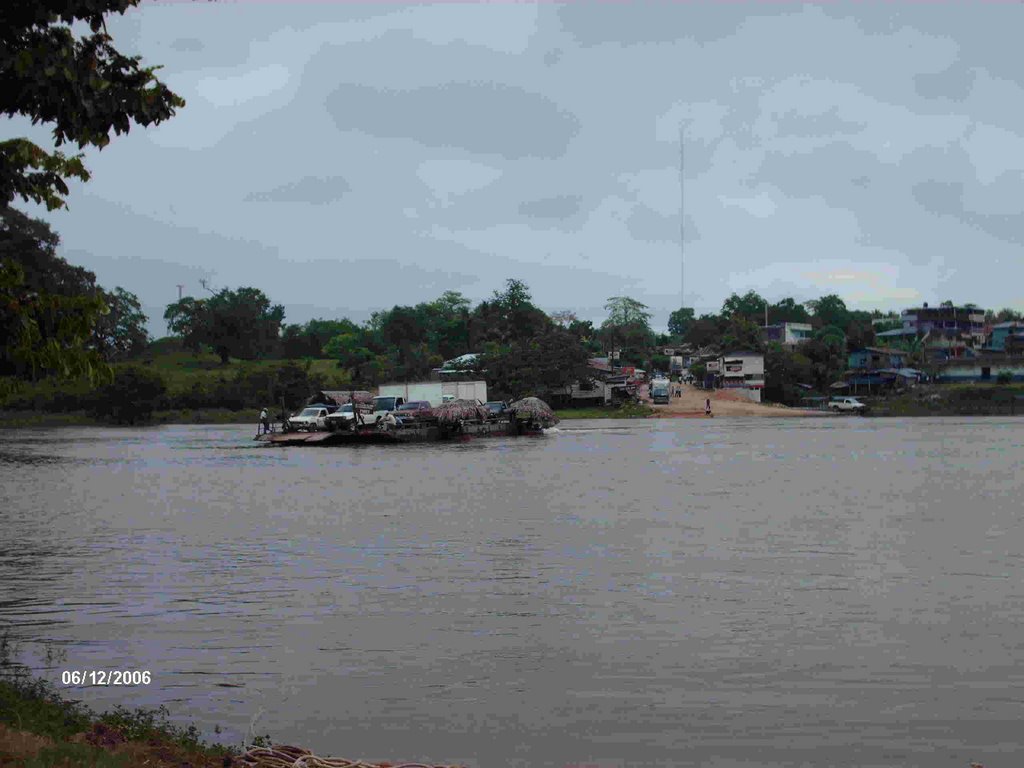
The rains have been fierce over the past weeks. We hit diversions where the tarmac road has been swept away or eroded. At Sayaxche the river is in flood. The ferry is the far side. The crew are eating breakfast or lunch or a mid-morning snack. An impatient truck driver pointlessly beats an impatient tatoo on his claxon. Santiago and I park outside a thatched roofed comedor. Paul Theroux writes that he hates the use of foreign words in travel writing. I know of no English word for comedor. A comedor is not grand enough to be a restaurant, nor is it a cafe as it serves meals. It is a place where you eat. This comedor is typical. Plank walls are waist high leaving a gap below the low eaves for light to enter. It has an unpainted and uneven concrete floor, plastic chairs, tables with plastic tops, an upright cold cupboard and a kitchen in the back that would give a health inspector a heart attack.
We drink good coffee. I eat eggs and beans with cheese and chili sauce. Santiago orders a steak and beans. Both are excellent. The bill comes to Q37 - five dollars US.
The ferry is flazst-topped barge powsered by an outboard powered launch lashed alongside. Three trucks, a car and six bikes make a full load. The water is thick with earth washed down from hillsides denuded of their forest cover. We watch a little anxiously as the current sweeps the ferry broadside.
Beyond the river we cross rich ranch land. One large chunk belongs to a narco traficker. The fences are perfect, so are the farm roads and the cattle are prime.
We pull into a hotel at Chisec. Here we are off the tourist track and take two clean air-conditioned rooms with bath at Q73. The rooms open to a first-floor verandah above the carpark which surrounds a swimming pool with tunnel slides of hollowed concrete tree trunks and shaded by giant concrete mushrooms and real palm trees and acacias and an imense ceber. I eat chicken noodle soup out of a packet while Santiago grinds his way slowly thru the better end of a bad steak. The bill is three dollars. We remount and head back twenty Ks to the cavern system of Candelaria.

DAUGHTERS AND JAGUARS


TUESDAY, JUNE 13
For the past days I have been pursued by a middle-aged hen. Yesterday she got into my room while Norah collected laundry. I found her on my bed. Note the date. I am back-tracking to my departure from the Peten. Santiago has insisted on accompanying me. Rather than insult his own monster Honda trail bike, he will ride his 16-year-old daughter's 125 Suzuki.
At 7.15 a.m. I summon Santiago from the virginal purity of his brand new kingsize bed and inner-sprung matress(purchased yesterday). Santiago appears at 7.30. Facially he resembles Jack Nicholson. This morning he resembles Jack Nicholson on a bad day playing Jack Nicholson on a very bad day. To look this ravaged is an achievement given that Santiago hasn't had a drink in two years.
We leave at 8.30.
Santiago looks better under a full face helmet.
We head for Santa Anna and San Francisco where Santiago circles the square before halting at a charming thatched cottage set in a large garden (what North Americans call a yard). The owner is a nurse. She is the mother of six daughters, each more beautiful than the last(so attests Santiago who yearns after them). Two have married Canadian missionaries, so the mother recounts over coffee and cookies. The fourth or fifth appears from town. She is beautiful - though less beautiful than the mother at the same age. This is my judgement on being shown a framed photograph of the mother. The mother purrs and exchanges bible quotations with her daughter who sits on the arm of her mather's arm chair and threads her mother's curls between slender fingers. Yearn on, Santiago. Your loves (even if you could concentrate on a single daughter or remember how many daughters there are or which daughter is which) will remain unrequited.
Courtship in this family is done with the Bible.
However we do see a jaguar cross the road. Not the full-size verrsion, an ONZA: Feliz Guayarundy.
I have seen a ZORRO, mountain fox, in Santiago´s company, squirrels, listened to howler monkeys and spotted any quantity of birds. Now we speed towards the river that marks the Peten´s southern boundary.

TOAD IN HONEY


THURSDAY, JUNE 14
I am evilly treated with divine comfort. I am staying with friends on their finca some kilometers outside Coban. I awoke to a sunrise of blushed gold filtered through white curtains. I hobbled to my bathroom. The bath was rescued from an old house. It is vast and softly curved. It sits in a bow window. The taps are brass. The water gushes hot from the hot tap and cold from the cold tap. A brick path passes beyond the window. Above the path rises a vertical bank of red soil fringed at the crest with grass. Dew on the grass reflects the early rays of the sun. The grass appears to be licked in flames that dance rose and gold on the cliff edge.

My spectacles lie on the edge of the bath. I reach for my book: Tap. Tap tap tap.

I peek over my book and am confronted by a small bird with a yellow breast. The bird pecks at the window. Its wings whirr as it climbs the glass. Its strength saps and it slithers down to the window ledge. Please, I whisper, please don't harm yourself. But the damage is done. Guilt invades me. I am responsible for the bird´s desire for self-destruction.

The bird perches on the thick shoot of a bromilliad and peers in at me (or at its reflection). Depart, I plead. The glass is too thick or my powers of thought transference are disfunctional this early in the morning. Or the bird is really dumb. Or sadistic...It is deliberately fracturing the basking bliss of this, my first hot bath in two months of travel. I hate it.
And I hate my hosts for steeping me in such wonderful comfort.
They know I must move on and that I am moving on into (to me) the unknown and that quitting such safety and such beauty and such friendship will be tearful.
Then I think of yesterday and swooping on the Honda thru a dawn of mists clinging to magnificent trees that sprout from steep mountainsides - of being totally at one with the Honda, of marvelling at the precise positioning of the seat to suit a man of my exact proportions, the glorious joy of rediscovering the joys of my youth, of the wind and of curling into the curves and of the instant response of the motor. And of pulling into a tiny comedor to wait out a rain storm and being served a bowl of coriander-flavoured chicken soup by a seven-year-old beauty, the only member of her family to be comfortable in Spanish. And of asking why she wasn´t at school (because boys attend her school in the mornings, girls in the afternoon); of pompously warning her of the importance of education - without education she will find herself in service to a man. And playing lion games with her younger siblings. Big roar and they flee giggling, only to creep back for a repeat performance.
I have played the same game with my own children.
My younger sons enjoy the same music and wear the same clothes as the sons of my Mexican friends. Our sons have similar concerns and anxieties and preoccupations. We, their pàrents, have similar concerns and anxieties and preoccupations.
Though I am traveling, I am on familiar territory.

We are, all of us, always on familiar territory. Yet we divide ourselves from this reality by erecting fake barriers and boundaries of nationality and race and religion...

Tuesday, June 13, 2006

COMFORT ZONE

TUESDAY, JUNE 13
When recomending a hotel, I have need to remember that I am writing for people of my own age. Flores would be the best bet in the Peten. Coaches leave for the Maya archeological site at Tikal early in the morning. In the evening you can stroll the cobble streets in safety, take your pick of where to drink a sundowner and where to eat (the lake fish or superb). I have stayed at Hotel Mon Ami out the far end of the lake at El Remate because Santiago is a friend. This would be my choice were I younger and either French or Spanish-speaking and interested by the region's nature in which Santiago is the expert. Swimming in the lake is a delight denied me by the leg. However to sit at the end of Santiago's jetty and admire the sunsets is sufficient pleasure, drink a cold beer or pina colada, eat one of those admirable fish for dinner. And Santiago and I friends in common and we share interests that might well be boring to the ordinary traveller. Today´s politics fascinate me as much as the history of Guatemala - not the history of history books but scraps I can sew together.
I suspect that these are the interests of most of us mature travellers. We are more curious than the young. We don´t want to sprawl on a beach. We are too old to surf. We walk a while but not too far. Then we want to sit in the shade and listen to the peoples of the countries thru which we pass relate their lives to us.

MATHMATICS

TUESDAY, JUNE 13
On Friday last it rained all day and all night HARD! The lake rose 15 cm. The lake is aproximately fifty Ks by four Ks. At breakfast, I asked Santiago, a graduate of one of France´s prestigious Grandes Ecoles, how many tons the rise represented. I await an answer.
We drove round the lake in Santiago´s 4x4 pickup. The road cuts off a narrow leg at the far end. The leg is damned by the road through which runs a single conduit. With less room to expand, the leg had risen a metre and a half above the body of the lake. A giant version of the type of whirlpool that devlops after you pull the plug in a full bath attached to good plumbing swirled above the entry to the conduit and foam gushed thirty metres from the exit of the conduit. All that unharnessed energy - what was the pressure?
Such questions interest an old man.
The young have different interests.
For the past few days, Santiago and I have been neigbours to three young French travellers. The French travellers are concerned by the price and availability of marijuana.
They talk amongst themselves, never listen nor question Santiago - odd given Santiago´s extensive and almost unique knowledge of the Peten.
Santiago told them of my family´s four generation commitment to the manufacture of plastic boots. The male Frenchman asked me the mark of boot. I explained that we were merely manufacturers and imprinted the boots (an advantage of plastic) with the mark of the importers. Later he heard me speak of a past visit to Guatemala and asked whether I had been working. I naturally told him of my family´s contract to supply boots to the Guatemalan army.
Sunday the young were fascinated by the pig. From where had we got it?
From the road, Santiago answered: in Guatemala, any animal in the road was public property.
I contributed the important detail that Sunday is a good day for catching pigs in the road as the owners are in church.
Further details developed: that Santiago had chased and caught the pig and that I had hit it over the head with a rock.
The blond French girl asked what sort of rock. I was stumped as to why this should be important.
A round rock, Santiago explained: a pointed rock would have made the pig bleed and mess up the back of his truck.
Later we listened to the threesom discuss our hunt over their smoke. They seemed impressed at our expertise rather than doubtful of our morality. One of them asked the cook, Anita, for further details. Anita had been briefed by Santiago and accused me of boasting: that, yes, I had hit the pig on the head with a rock, but had only stunned it. Santiago, schooled in the ways of the jungle, had done the actual killing with his machete.
The French are headed north to Mexico. I should have mentioned the chemically recalibrated surf addict and the proof he possessed of seven foot green aliens buried beneath Central America´s pyramids. I might have added that the aliens were discovered wearing plastic boots. It would be satisfactory to guide the young French into a spiritual alliance with a North American.
Or have them hug unhuggable trees (see picture)...

FLORES, CAPITAL OF THE PETEN

MONDAY, JUNE 12
Some twenty years have passed since my last visit to Flores. I stayed at the one hotel. I was directed to the one restaurant where I ate a fish of the lake grilled over coals. The fish was sprinkled with finely chopped garlic and served on a bed of rice. It was delicious.
The lake was at its highest in some years, some six feet higher than it is now. The two roads that connected the Peten with the rest of Guatemala would have been rough going for a Centurion tank and I saw no other foreigners in the two nights I stayed and explored the narrow streets after a day amongst the Maya pyramids and temples of Tikal.
Now the roads are smooth tarmac. Foreigners and foresteros, those from abroad and from outside the Peten, have transformed the semi-abandoned town of my memories. This new Flores reminds me of the newly discovered Ibiza of the mid-sixties with restaurants and cafes and small hotels open on every block. The single-story buildings are freshly painted in a pleasing medly of colours, the cobbled streets are newly patched and alive with visitors and NGOs. Listen to live music, watch a movie projected on a wall screen ( Santiago and I enjoy The Constant Gardener).

BATTLEGROUND

MONDAY, JUNE 12
I attempt to scrub from my wounds the violet evidence of brucharia.
I recall a somewhat similar situtation in the Ogaden in my youth. My leg swelled. It became a liquid-stuffed balloon. The nearest doctor was a North American Seventh Day adventist manning a medical mission five hundred miles south on the banks of Webi Shebelli. I annouced my predicament and my destination over the radio to my department. I drove across a desert of red dust and arrived encrusted in dirt. The doctor was out on patrol. He would return the following afternoon. A blond and beautiful young nurse excamined my leg. She prayed for my soul at the dinner table and proffered cold root beer from an immense refrigerator.
My men had pitched camp across the river from the mission. I awoke to find the leg back to normal. Already ribald remarks over the radio connected my leg to the nurse. Doubts had been cast as to the seriousness of my infirmity - how could I drive five hundred miles with a critical leg? Suspicion had been voiced that I had driven five hundred miles merely to an assignation. Now the nurse risked damnation in the eys of her fellow missionaries.
The nurs and I spent the forenoon beating the leg with wet knotted towels. We achieved a slight swelling round the knee. These are my memories as I fail to eradicate the violet evidence of my betrayal of modern medicine.
Santiago drops me at the doctor´s clinic.
Violet is unpopular.
The doctor growls.
A tough square sadistic nurse, she of the needle, scrubs with sulphuric acid ( by the pain) the scabs and moulting skin from my burns. Bandages are applied, not to cure but ward off further interference. I am told that I can travel - fast, is the implication, fast out of reach of the bruchas from the selva.
The leg is clean.
It is healing.
Your gues is as good as mine as to which treatment has been most eficacious.

PIG FEAST


SUNDAY, JUNE 11
The pig was delicious. Judgement is in the eating. All four of our guests ate three servings. I sat at the table, content, and enjoyed the conversation. What have I learnt over the past few days in which my leg has been a battle ground for the forces of modern medicine and the selva?
I have talked with men and women at small restaurants and at internet cafes and at water-stops on the road to Flores and in Flores. Violence is their one concern. No wonder. Today´s newspaper gives police statistics for Guatemala City: 2200 armed assaults on city busses between January and the 1st of June - 20 drivers killed.
People talk of the need for a strong man to combat endemic violence. General Molina is mentioned ( I read in today´s paper that he has resigned his present position the better to campaign for the Presidency). Others warn that Generals have little respect for human rights, that their attitude to human eradication is also general. I consider that shudderingly explicit expression used in the United States: wasting, not as in wasting human resources, but in laying waste.
I have learnt, in these days, that mountain and forest make difficult the tracking by radar of small aircraft and that airstrips on haciendas in the Peten are the refuelling stops for drug flights to the US. Permission is neccessary for raids on private property. Applying for permission for a raid is faster than e:mail in warning the Narco-traffickers.
I have been told that small farmers are reluctant to improve their farms for fear that a narco-trafficker will make an offer that would be suicidal to refuse...And that, in earlier times, in the years of the clandestine war, army officers made the unrefusable offers.
I am told that narco-traffickers will offer the commander of a military airstrip half a million dollars for its use - the alternative is the killing of the commander´s family. The wife of my informant argues that there is a third, and more common, alternative: that the commander negotiates a higher price. In Guatemala, everything is open to negotiation...

Monday, June 12, 2006

PIG SAFARI

SUNDAY, JUNE 11
This is a bloody tale. Vegetarians should read no further. The idea was mine. Norah cooks breakfast. Santiago has cooked lake fish (delicious). Anita has cooked steak, stew, smoked pork, fried chicken, chicken soup. Today is full moon. The sky is clear. My violet leg demands an outing. This is no time for skulking in a hammnock. Let us invade fresh culinary territory. Avante!
I am in the company, not only of Guatemala's preeminent coservationist, but of a famous explorer, discoverer of the most important Maya site in the Peten jungle since the uncovering of Tikal.
Our prey is a young pig. I am an expert on the Hispanic American variety. I once spent an entire Christmas Eve in Cuba hunting down an ilegal pig. Nervous of authority, the ilegal pig was on the move. We finally ran it to earth at six in the evening. We were in a Moscovitch. Carlito was the driver. Rum was the fuel of our investigation.
Santiago doesn't drink.
Our goal was a small pig, preferably a lechon. We intended cooking it over the coals. Santiago, confident, telephoned a dinner invitation to the director of the Peten´s protected areas and his family.
Santiago drove first to El Remate where the first pig we were offered was small because it was the runt of a litter and had been reared on a refuse heap that was 90% plastic bottle. Two further pigs were too big. We drove back down the lake road. Here we struck lucky with a kindly gentleman dressed in a spotless white straw Stetson, polished boots, clean jeans and a flowered shirt. His wife had two pigs. Santiago and he discussed neighbors and what effect the full moon would have on the weather. We then followed the gentleman up a jungle path. His wife appeared driving two pigs. One was russet, the other more a rose-pink. They posessed fine straight backs and rounded rear ends. I am the expert. The choice is mine. I selected the russet. Q200 is the price.
Should I negotiate?
Santiago murmurs, "The man shot two neigbours over a boundary disgreement."
So I pay and we pay a further Q20 to the wife for killing and debristling the pig ready to roast on the coals.
We have soya sauce, honey, unlimited garlic, chili, concentrate of tomato, both limes and lemons. We search the village tiendas for fresh ginger.

BRUCHAS

SUNDAY, JUNE 11
Both Norah and Anita, Santiago's resident herbalists, have Sudays free. This morning a new woman entered my life, Maria, five foot one inch when stretched and 65 A fine bone structure suggests a youthful beauty confirmed by a niece who drops by to assist in preparing breakfast. Maria is no slouch in the war against modern medicine. One glance at my leg and she is off to the jungle. First comes the poultice of aloe slime followed by a politice of a long leaf from a bush that I haven´t yet discovered in nature (does it grow only in shadow and on the tombs of bruchas deceased?). Worse is to come. Gentian violet! I am in deep doodoo. I must visit the doctor on Monday morning. Hopw to hide this indelible evidence of the competition?
Santiago is the brucha's accomplice.
Hopefully Santiago will be caught and burnt at the stake.
Meanwhile he and I (and my violet leg) take the truck and go hunting a pig.