WEDNESDAY, JULY 19
This is my last blog on JUST CAUSE. I spent a while in conversation with a respected Panamanian journalist at the offices of the leading Panamanian newspaper. Have no doubts: Noriega is a vile man. A group of Defense Force officers arrested him on 3 October, 1989. The officers telephoned the US Embassy. The Embassy refused support. The officers were at a loss as to how to act. A majority of the group fled to the Canal Zone. Noriega persuaded the remainder to release him. Noriega had nine of this group shot the following day. The US invaded Panama on December 20, 1989. The JUST CAUSE was to arrest Noriega. A minimum of 1000 Panamanian civilians were killed in the invasion. The city was ransacked.
The journalist said of the US soldiers that they were country boys, young, ill educated and inexperienced, that they often fired from panic. The blame for the killing of civilians and for the ransacking of the airport by US soldiers lay with incompetent officers.
For Panamanians, the invasion remains an essential ingredient in Panamanian/US relations. I suspect it is considered of very little importance in the US and that few North Americans recall or ever knew the details.
Let me give the last word to the Panamanian journalist: The gringos have never thought of us as equals or important.
Thursday, July 20, 2006


Tuesday, July 18, 2006
ON THAT BOAT?
TUESDAY, JULY 18
I ride to the Fiscal wharf this morning. The wharf is roofed to protect cargo. It is a slum and it stinks. Oswaldo is a big black immigration official with a big kind heart. He has elected himself my transport counsel. We walk down the wharf. The boat that can take me to Jaque lies along side. It is forty feet long. The hull is of rough planks. The deck planks are rougher. Dockers are manhandling sections of mahogany tree trunk from a small hold forward. A wheelhouse/cabin sits on the after deck. A paint can passed by the boat a few years back and forgot to stop. Even a casual inspection gives pause for consideration: as in, What keeps it afloat?.
I enquire of Oswaldo if there is another boat.
"Next month, maybe," Oswaldo says.
I say, "Oh..."
I repeat the Oh.
Then, "This maybe-boat, how is it?"
"The same," says Oswaldo in whom I sense compassion.
"Oh," I say.
The captain of the hulk inspects the Honda and quotes the fare. Oswaldo expects me to negotiate. Negotiating is tough when the alternative is a maybe. I agree the fare. I have betrayed Oswaldo.
Oswaldo, a football fan, watched the penalty shootout between Portugal and England. He believes English fotballers are short on courage. Not negotiating places me in the same catagory.
I am not doing well.
I ride to the Fiscal wharf this morning. The wharf is roofed to protect cargo. It is a slum and it stinks. Oswaldo is a big black immigration official with a big kind heart. He has elected himself my transport counsel. We walk down the wharf. The boat that can take me to Jaque lies along side. It is forty feet long. The hull is of rough planks. The deck planks are rougher. Dockers are manhandling sections of mahogany tree trunk from a small hold forward. A wheelhouse/cabin sits on the after deck. A paint can passed by the boat a few years back and forgot to stop. Even a casual inspection gives pause for consideration: as in, What keeps it afloat?.
I enquire of Oswaldo if there is another boat.
"Next month, maybe," Oswaldo says.
I say, "Oh..."
I repeat the Oh.
Then, "This maybe-boat, how is it?"
"The same," says Oswaldo in whom I sense compassion.
"Oh," I say.
The captain of the hulk inspects the Honda and quotes the fare. Oswaldo expects me to negotiate. Negotiating is tough when the alternative is a maybe. I agree the fare. I have betrayed Oswaldo.
Oswaldo, a football fan, watched the penalty shootout between Portugal and England. He believes English fotballers are short on courage. Not negotiating places me in the same catagory.
I am not doing well.
PANAMA CITY - BAGDAD
MONDAY, JULY 17
I met with a retired police captain this afternoon. He was born in Casco Viejo and lives there now in a house that belonged to his father. He was a lieutenant of police at the time of the invasion. The US Army arrested him and held him in jail without charge for five months. The US Army arrested all the officers of the police force and of the Defense Force. The city was undefended and was ransacked. Is this a familiar scenario?
I met with a retired police captain this afternoon. He was born in Casco Viejo and lives there now in a house that belonged to his father. He was a lieutenant of police at the time of the invasion. The US Army arrested him and held him in jail without charge for five months. The US Army arrested all the officers of the police force and of the Defense Force. The city was undefended and was ransacked. Is this a familiar scenario?
SEA IN SIGHT
MONDAY, JULY 17
Panama City is splendid at providing contrasts. The old quarter of Casco Viejo marks the west end of tthe shore, the ruins of Pananma Viejo mark the east. I entered the city thru a hinterland of slum tenements as grim as any outside Havana. My hotel is in a mid market visitor district for both foreign tourists and Panamanians in from the Provinces. Internet cafes abound, restaurants are reasonable, street walkers appear at night. Turn left up a block and you find a trafic-congested streets of sidewalk stalls and super saver stores. I bought three light-weight short sleeve shirts at $3.95 a piece and a pair of chinos for $9.95. Turn right and you head into a land of pristine highrise cathedrals. Money is God in this BMW banker territory of dark suits, polished shoes and respectable ties. Cops are the street walkers. They linger at every entrance and on most intersections. Sidewalks are swept, shrubs are barbered, grass dividers shaved and watered. Even the poor are neatly dressed - money, however dirty, demands clean servants. Panama is a laundry for dirty money.
Panama City is splendid at providing contrasts. The old quarter of Casco Viejo marks the west end of tthe shore, the ruins of Pananma Viejo mark the east. I entered the city thru a hinterland of slum tenements as grim as any outside Havana. My hotel is in a mid market visitor district for both foreign tourists and Panamanians in from the Provinces. Internet cafes abound, restaurants are reasonable, street walkers appear at night. Turn left up a block and you find a trafic-congested streets of sidewalk stalls and super saver stores. I bought three light-weight short sleeve shirts at $3.95 a piece and a pair of chinos for $9.95. Turn right and you head into a land of pristine highrise cathedrals. Money is God in this BMW banker territory of dark suits, polished shoes and respectable ties. Cops are the street walkers. They linger at every entrance and on most intersections. Sidewalks are swept, shrubs are barbered, grass dividers shaved and watered. Even the poor are neatly dressed - money, however dirty, demands clean servants. Panama is a laundry for dirty money.
Sunday, July 16, 2006
JUST BECAUSE
Just Because was the Pentagon joke name for Operation Just Cause. George H W Bush was the US President. US Army estimated Panamanian deaths at 516 while an Army internal memo put the figure at over a thousand. An independent Commission of Inquiry put the figure at between 1000 and 4000. Some 15,000 civillians were displaced - most were working class. Wide spread looting bankrupted many businesses - insurance companies refused to pay, naming the invasion an act of war. A great museum was ransacked. This was to arrest one man. Shades of Iraq.
Hugh Thomas (though a Protestant, a good historian) writes of Cortes's conquest of Mexico: To a good general, history is as important as geography.
US Generals and the Bush family either disagree or are too lazy to do their homework.
Hugh Thomas (though a Protestant, a good historian) writes of Cortes's conquest of Mexico: To a good general, history is as important as geography.
US Generals and the Bush family either disagree or are too lazy to do their homework.
Saturday, July 15, 2006
PANAMA CANAL
SATURDAY, JULY 15
The Panama Canal is what the US did best. It demanded the absolute support of a Government ruthless in pursuit of a benefit to the US. It demanded great vision and determination, brilliant planning and design, a massive workforce and vast finance. Miaflores dock is a short run from Panama city. Entrance is $8 for an adult, half price for pensioners. The museum is fascinating, clear explanations, geat models, insects, aquarium tanks. Indoors is air conditioned. My spectacles fogged each time I went outdoors and I slept thru most of the promotional film in the theatre.
And something bugged me.
A couple of hours passed before I came up with what. The canal is the only garbage-free zone in Central America. The grass is mown between the roadways and rails. The windows shine. None of the workers shout.
The restaurant is good. Prices range from reasonabale to luxury: $8 or #9 for hamburger or chicken with rice, $14 for Thai sea bass steamed in banana leaves, $35 for San Blas crab.
I stuck to bottled water and a pack of peanuts at the ground floor cafeteria.
Eat and watch the ships go by.
Most people watch from the fourth floor deck. Don't. Perspective takes size from the ships. Stay on the ground floor. The highest price transit ever passed thru today. The ship, MSC FABRIENNE, was built to the maximum size permitted thru the canal. She carries 4500 containers for a transit fee of $246,666. Looking up from gound level, the hard hats at the forward bulwarks looked to be a scattering of M&Ms. A lone pelican sat on the lock gates. Frigate birds floated overhead. Low cloud closed in from the Atlantic coast and rain hid the conical hills.
http//www.pancanal.com and watch the 24 hour live cam of ships passing thru the locks.
The Panama Canal is what the US did best. It demanded the absolute support of a Government ruthless in pursuit of a benefit to the US. It demanded great vision and determination, brilliant planning and design, a massive workforce and vast finance. Miaflores dock is a short run from Panama city. Entrance is $8 for an adult, half price for pensioners. The museum is fascinating, clear explanations, geat models, insects, aquarium tanks. Indoors is air conditioned. My spectacles fogged each time I went outdoors and I slept thru most of the promotional film in the theatre.
And something bugged me.
A couple of hours passed before I came up with what. The canal is the only garbage-free zone in Central America. The grass is mown between the roadways and rails. The windows shine. None of the workers shout.
The restaurant is good. Prices range from reasonabale to luxury: $8 or #9 for hamburger or chicken with rice, $14 for Thai sea bass steamed in banana leaves, $35 for San Blas crab.
I stuck to bottled water and a pack of peanuts at the ground floor cafeteria.
Eat and watch the ships go by.
Most people watch from the fourth floor deck. Don't. Perspective takes size from the ships. Stay on the ground floor. The highest price transit ever passed thru today. The ship, MSC FABRIENNE, was built to the maximum size permitted thru the canal. She carries 4500 containers for a transit fee of $246,666. Looking up from gound level, the hard hats at the forward bulwarks looked to be a scattering of M&Ms. A lone pelican sat on the lock gates. Frigate birds floated overhead. Low cloud closed in from the Atlantic coast and rain hid the conical hills.
http//www.pancanal.com and watch the 24 hour live cam of ships passing thru the locks.
JUST CAUSE
FRIDAY, JULY 14
We sat facing the Cathedral. The two white towers gleamed in the sun. The plump, motherly school teacher was reluctant to talk of people. She talked of the apartment buildings in the district that were destroyed in the invasion, that the buildings weren't luxurious but that they were an improvement and that there was a community feeling to the district.
She repeated the Bocas driver's accusation: that Noriega was easy to arrest. There were so many opportunities. He travelled out in the country, walked in the streets.
"So many people died."
She spoke of an entire family who were her neighbors. All were killed. The grandmother was seventy-three(my age). The youngest child was only six, a girl. The teacher said that none of the houses of the rich were damaged, none of the rich were killed, none of the captains.
Her friend nodded agreement. "They knew," she said. Her husband was second-in-command in Colon (cop?). At eight in the evening he sent one of his men with food and instructions that she wasn't to leave the house.
"It was against the poor," the motherly teacher insisted. Poor people weren't important. Artisans died and poor people who sold fried fish on the street corner and on the beach at weekend. "Very flavoursom," she assured me, "Fried with chili and with garlic."
Memory of the fish was a trigger. She wept, yet her tone of voice remained calm, almost wonderous, as she talked of her sister who had lived on the top floor of a building. "They shouted that everyone must come out into the street or they would be killed. There was so much blood in the elevator and bits of bodies, hands, legs, a head.
Her sister died two days after the invasion. "It was the shock..."
Her friend, the thin teacher, passed her a handkercief and she wiped her eyes.
"They lied," she said. "They killed more than five thousand people. They buried them with tractors. They are hidden there deep down in the area that is called Arenal. It was Henry Ford and Arias Calderon. They wanted to do it."
In the evening I talked with a successful businessman in his fifties, a computer expert. "Yes," he said, "There were thousands killed."
And, Yes, it would have been easy to capture Noriega. The invasion was uneccessary. He gave the booming Panamanian economy as the reason for the invasion. The canal would be handed over to Panama in ten years. The US was loosing control. The invasion was designed as a reminder for Panamanians as to their true status.
The US army named the invasion, Operation Just Cause.
I have not met a Panamanian who agrees.
We sat facing the Cathedral. The two white towers gleamed in the sun. The plump, motherly school teacher was reluctant to talk of people. She talked of the apartment buildings in the district that were destroyed in the invasion, that the buildings weren't luxurious but that they were an improvement and that there was a community feeling to the district.
She repeated the Bocas driver's accusation: that Noriega was easy to arrest. There were so many opportunities. He travelled out in the country, walked in the streets.
"So many people died."
She spoke of an entire family who were her neighbors. All were killed. The grandmother was seventy-three(my age). The youngest child was only six, a girl. The teacher said that none of the houses of the rich were damaged, none of the rich were killed, none of the captains.
Her friend nodded agreement. "They knew," she said. Her husband was second-in-command in Colon (cop?). At eight in the evening he sent one of his men with food and instructions that she wasn't to leave the house.
"It was against the poor," the motherly teacher insisted. Poor people weren't important. Artisans died and poor people who sold fried fish on the street corner and on the beach at weekend. "Very flavoursom," she assured me, "Fried with chili and with garlic."
Memory of the fish was a trigger. She wept, yet her tone of voice remained calm, almost wonderous, as she talked of her sister who had lived on the top floor of a building. "They shouted that everyone must come out into the street or they would be killed. There was so much blood in the elevator and bits of bodies, hands, legs, a head.
Her sister died two days after the invasion. "It was the shock..."
Her friend, the thin teacher, passed her a handkercief and she wiped her eyes.
"They lied," she said. "They killed more than five thousand people. They buried them with tractors. They are hidden there deep down in the area that is called Arenal. It was Henry Ford and Arias Calderon. They wanted to do it."
In the evening I talked with a successful businessman in his fifties, a computer expert. "Yes," he said, "There were thousands killed."
And, Yes, it would have been easy to capture Noriega. The invasion was uneccessary. He gave the booming Panamanian economy as the reason for the invasion. The canal would be handed over to Panama in ten years. The US was loosing control. The invasion was designed as a reminder for Panamanians as to their true status.
The US army named the invasion, Operation Just Cause.
I have not met a Panamanian who agrees.
TWO TEACHERS
FRIDAY, JULY 14
I returned to Casco Viejo district late this morning. Yesterday I discovered a comida that sells fresh, unsweetened pear juice. Today I drank two glasses ($0.50). Later I sat with two women on a bench in the Cathedral Square. The women were school teachers. They asked if I enjoyed their country and what I enjoyed. I spoke truthfully of the openess I encountered in the people and of the beauty of the country. Pleased, they asked if I had visited the church with the Golden Altar (the altar is a survivor of Henry Morgan's fire. I had and I had walked widely and said that the Casco Viejo would be very beautiful again once it was all restored.
"It will be for tourists," the younger of my companions said. "That is what the Government plans. It will be too costly for ordinary people, for the poor."
This teacher was in her fifties, a thin somewhat severe woman, black, her hair dragged back in a tight tuft.
Mention of the poor started the elder teacher talking of the US invasion of Panama in 1989. She is a plump motherly woman, 64 years old, her hair dyed a golden brown and set in quite youthful curls. She held a transparent plastic file case on her lap. Her fingers were chubby and she wore a gold wedding band together with an engagement ring set with a fragment of green stone.
I returned to Casco Viejo district late this morning. Yesterday I discovered a comida that sells fresh, unsweetened pear juice. Today I drank two glasses ($0.50). Later I sat with two women on a bench in the Cathedral Square. The women were school teachers. They asked if I enjoyed their country and what I enjoyed. I spoke truthfully of the openess I encountered in the people and of the beauty of the country. Pleased, they asked if I had visited the church with the Golden Altar (the altar is a survivor of Henry Morgan's fire. I had and I had walked widely and said that the Casco Viejo would be very beautiful again once it was all restored.
"It will be for tourists," the younger of my companions said. "That is what the Government plans. It will be too costly for ordinary people, for the poor."
This teacher was in her fifties, a thin somewhat severe woman, black, her hair dragged back in a tight tuft.
Mention of the poor started the elder teacher talking of the US invasion of Panama in 1989. She is a plump motherly woman, 64 years old, her hair dyed a golden brown and set in quite youthful curls. She held a transparent plastic file case on her lap. Her fingers were chubby and she wore a gold wedding band together with an engagement ring set with a fragment of green stone.
CASCO VIEJO
THURSDAY, JULY 13
Casco Viejo is a slum undergoing gentrification under Government guidance. Streets have been paved. Official buildings gleam. Buildings awaiting resurection have been given a coat of pastel paint. Other buildings have rows of bells beside new doors. The doors are lined with steel. Police patrol - some on pushbikes and wearing shorts and biker helmets. The first upmarket restaurants have opened behind closed doors (to protect the electrically cooled air). The poor sit on doorsteps. I enter a store in search of ballpoint. The goods on sale are in one half of the room: a few Panama hats, black waistcoats embroidered with golden animals. A grey-haired lady has collapsed on a sofa beside a cutting table in the remaining part of the store. Her husband sits at a work table trimming silk lining for a pair of evening slippers. The lady is overweight and has difficulty in rising. I appologise for disturbing her.
"It is the heat," she says, and wipes her forehead on her forarm...The heat and she has a headache.
I have been walking an hour. My feet ache and I agree as to the heat.
She pours me a glass of water from a plastic jug.
I would be rude in not drinking - possibly unwise in drinking. Travel is full of such quanderies. I sit in a wicker chair beside the work table and write up these notes.
Casco Viejo is a slum undergoing gentrification under Government guidance. Streets have been paved. Official buildings gleam. Buildings awaiting resurection have been given a coat of pastel paint. Other buildings have rows of bells beside new doors. The doors are lined with steel. Police patrol - some on pushbikes and wearing shorts and biker helmets. The first upmarket restaurants have opened behind closed doors (to protect the electrically cooled air). The poor sit on doorsteps. I enter a store in search of ballpoint. The goods on sale are in one half of the room: a few Panama hats, black waistcoats embroidered with golden animals. A grey-haired lady has collapsed on a sofa beside a cutting table in the remaining part of the store. Her husband sits at a work table trimming silk lining for a pair of evening slippers. The lady is overweight and has difficulty in rising. I appologise for disturbing her.
"It is the heat," she says, and wipes her forehead on her forarm...The heat and she has a headache.
I have been walking an hour. My feet ache and I agree as to the heat.
She pours me a glass of water from a plastic jug.
I would be rude in not drinking - possibly unwise in drinking. Travel is full of such quanderies. I sit in a wicker chair beside the work table and write up these notes.
POINTS OF VIEW
THURSDAY, JULY 13
The old part of Panama City dates back to the 1670s. Tourists would expect it to be called Old Panama. It is called the Old Compound, Casco Viejo. Panama Viejo is a collection of overgrown ruins. The buildings were beautiful before they were put to the torch by that great English privateer, Henry Morgan. They were beautiful before they were put to the torch by that vicious murderous English pirate, Henry Morgan.
By family, I am both British and Hispanic. My great grandfather, Ramon Cabrera, was a Spanish terrorist. He built his terrorist band into an army, won battles and became the Marques del Ter, Conde de Morella. I must make a speach in Morella on the 6th of December in celebration of his 200th anniversary. Doing so, I will glorify a terrorist and become a criminal according to the inane laws proposed by the present British Government and passed by Parliament. The Government is sadly short of historians. Most are lawyers. Historians would have known better than commit British troops to Iraq and Afghanistan.
The old part of Panama City dates back to the 1670s. Tourists would expect it to be called Old Panama. It is called the Old Compound, Casco Viejo. Panama Viejo is a collection of overgrown ruins. The buildings were beautiful before they were put to the torch by that great English privateer, Henry Morgan. They were beautiful before they were put to the torch by that vicious murderous English pirate, Henry Morgan.
By family, I am both British and Hispanic. My great grandfather, Ramon Cabrera, was a Spanish terrorist. He built his terrorist band into an army, won battles and became the Marques del Ter, Conde de Morella. I must make a speach in Morella on the 6th of December in celebration of his 200th anniversary. Doing so, I will glorify a terrorist and become a criminal according to the inane laws proposed by the present British Government and passed by Parliament. The Government is sadly short of historians. Most are lawyers. Historians would have known better than commit British troops to Iraq and Afghanistan.
Friday, July 14, 2006
TO PANAMA CITY
WEDNESDAY, JULY 12
I slept last night in David at the Hotel Iris on the Cathedral square, a good clean room with a/c and hot water in the evening, not in the morning ($14). Today I rode to Panama City on the PanAmerican Highway, 450 Ks. I encountered heavy rain part of the way. Guide books report Panama City as dangerous - even by daylight. My destination is the Hotel Caribe on Central Avenue, a big American style highrise easy to find and with a garage for the Honda. I bargain the room rate down $2 to 25. The bed is great. The TV controller doesn't work. Nor does the light in the bathroom. I am too tired to complain and I am mad in the morning at finding the Honda moved and punctured.
Hey, the old fool is going to have to pay to have it fixed - licking of lips.
No.
I push the bike up the ramp and round two blocks to a puncture repair shop. We remove wheel and tyre in time for an electricity cut. Result, I waste the morning - if wasting is being directed to a street stall that serves a great breakfast with two cups of coffee for $.80 and finding a perfect hotel with a hot water power shower, a/c, cable and a good restaurant for $16.
First impressions of Panama City? Cabs stop so you can cross the road. And I haven't been mugged.
I slept last night in David at the Hotel Iris on the Cathedral square, a good clean room with a/c and hot water in the evening, not in the morning ($14). Today I rode to Panama City on the PanAmerican Highway, 450 Ks. I encountered heavy rain part of the way. Guide books report Panama City as dangerous - even by daylight. My destination is the Hotel Caribe on Central Avenue, a big American style highrise easy to find and with a garage for the Honda. I bargain the room rate down $2 to 25. The bed is great. The TV controller doesn't work. Nor does the light in the bathroom. I am too tired to complain and I am mad in the morning at finding the Honda moved and punctured.
Hey, the old fool is going to have to pay to have it fixed - licking of lips.
No.
I push the bike up the ramp and round two blocks to a puncture repair shop. We remove wheel and tyre in time for an electricity cut. Result, I waste the morning - if wasting is being directed to a street stall that serves a great breakfast with two cups of coffee for $.80 and finding a perfect hotel with a hot water power shower, a/c, cable and a good restaurant for $16.
First impressions of Panama City? Cabs stop so you can cross the road. And I haven't been mugged.
STRAWBERRIES AND CREAM

TUESDAY, JULY 11
The Atlantic coast is hot and damp and jungly. Cross the divide and you are in a drier country, a country worked by people. Dairy farms with Swiss names cling to the mountains high on the divide. Lower you are in a rolling grassland of wealthy ranchers. Race horses graze neatly fenced paddocks. Turn up hill and you reach the vegetable and fruit farms of Bloquet and Volcan. Bloquet is sick with an infestation of weekend housing developments. Why must the houses be so utterly charmless? However my goal is reached on the left at the entrance to the town: FRESAS MARIE. Here, close to the equator, I sit in the sun and eat fresh picked strawberries with whipped cream - surely a luxury equal to eating a fresh peach in the Antartic.
Late afternoon and I ride to David, a modern city, and find a comfortable hotel on the central square. Exploring the city, I discover a Domino Pizza Parlor. The delivery bikes are Honda 125 Cargos. I order a pizza and have a delivery rider photograph my own Cargo amongst its pizza twins.
WOW, WHAT A DAY
TUESDAY, JULY 11
The road from Almirante to David first follows the mountainous coast. At each corner there is a fresh and seemingly more beautiful view down across jungle to a sea strewn with wooded islands.
I take photographs and question whether one is a better view than another.
I recall why I have traveled without a camera for years.
The camera is a barrier. I am thinking camera, looking for views and judging views rather than simply absorbing and enjoying an incredible ride.
Yesterday, from the ferry, I counted four lines of mountains rise one above the other. The fourth is the divide. I reach the summit. Nothing separates me from Africa other than the curvature of the earth. Look ahead and only the curvature of the earth separates me from New Zealand, Australia, the Far East. I have been warned of the wind that rips across the ridge. No one mentioned the fear, the sense of being less than a pinhead.
The road from Almirante to David first follows the mountainous coast. At each corner there is a fresh and seemingly more beautiful view down across jungle to a sea strewn with wooded islands.
I take photographs and question whether one is a better view than another.
I recall why I have traveled without a camera for years.
The camera is a barrier. I am thinking camera, looking for views and judging views rather than simply absorbing and enjoying an incredible ride.
Yesterday, from the ferry, I counted four lines of mountains rise one above the other. The fourth is the divide. I reach the summit. Nothing separates me from Africa other than the curvature of the earth. Look ahead and only the curvature of the earth separates me from New Zealand, Australia, the Far East. I have been warned of the wind that rips across the ridge. No one mentioned the fear, the sense of being less than a pinhead.
BREAKFAST IN ALMIRANTE
TUESDAY, JULY 11
Joni runs the best breakfast place in town. She is part Irish going back three generations and the rest West Indian. Her grandad came to Almirante from Jamaica to work for United Fruit. Joni recalls Almirante under United Fruit. The town was clean and ordered. Everything worked. The trains ran on time. The same is said by the Old Folk of Mussolini's Italy and Nazi Germany and the Indian subcontinent under British rule.
An old man enters with packets of dough.
"Just the one today, Pappi," says Joni.
"As you wish, my love," comes the answer.
Then we are back to comparing United Fruit with Chiquita Banana. "Chiquita is all measurements," says Joni. "All they care is measurements. They measure everything."
Later I talk for half an hour with a successful local businessman. He is Jewish. What is happening in the Middle East appauls him. Here, in Panama, Jewish, Syrian and Lebanese do business together; most are IN business together.
"United Fruit was good and bad," he says. Staff were housed according to rank. Houses were maintained by the Company. United Fruit moved employees from Company town to Company town, saw to their health, their pensions, educated their children, decided what stock was available in the Company store. In return, employees were loyal to the Company rather than to themselves and their roots were in the company rather than in Almirante. Now they feel lost and abandoned.
"The Company was king, paternalistic. Chiquita is accountants."
The businessman has a fear of a powerful investor moving in, a financial entity witth no care for the environment. He asks me to tell my readers to support Green Peace.
READERS, SUPPORT GREEN PEACE...
Joni runs the best breakfast place in town. She is part Irish going back three generations and the rest West Indian. Her grandad came to Almirante from Jamaica to work for United Fruit. Joni recalls Almirante under United Fruit. The town was clean and ordered. Everything worked. The trains ran on time. The same is said by the Old Folk of Mussolini's Italy and Nazi Germany and the Indian subcontinent under British rule.
An old man enters with packets of dough.
"Just the one today, Pappi," says Joni.
"As you wish, my love," comes the answer.
Then we are back to comparing United Fruit with Chiquita Banana. "Chiquita is all measurements," says Joni. "All they care is measurements. They measure everything."
Later I talk for half an hour with a successful local businessman. He is Jewish. What is happening in the Middle East appauls him. Here, in Panama, Jewish, Syrian and Lebanese do business together; most are IN business together.
"United Fruit was good and bad," he says. Staff were housed according to rank. Houses were maintained by the Company. United Fruit moved employees from Company town to Company town, saw to their health, their pensions, educated their children, decided what stock was available in the Company store. In return, employees were loyal to the Company rather than to themselves and their roots were in the company rather than in Almirante. Now they feel lost and abandoned.
"The Company was king, paternalistic. Chiquita is accountants."
The businessman has a fear of a powerful investor moving in, a financial entity witth no care for the environment. He asks me to tell my readers to support Green Peace.
READERS, SUPPORT GREEN PEACE...
HUNGER
MONDAY, JULY 11
The ferry is slow. We load trucks and cars in Bocas and head back to Almirante. A young mulatta woman asks if I have a novia. I answer that my wife is my novia. She tells me that many Gringos on Bocas have novias. I believe her. She has failed in seeking a Gringo - partly, perhaps, because she gnaws her nails. She is also awkward in her movements, consumptively thin and devorced of charm. She has no money and hasn't eaten. Fish and fluffy pancakes cost $1.50. She doesn't thank me. One of the drivers and I chat with the cook who earns $250 a month. She is a competent cook of simple food. Most billionaires have more sophisticated tastes.
The ferry is slow. We load trucks and cars in Bocas and head back to Almirante. A young mulatta woman asks if I have a novia. I answer that my wife is my novia. She tells me that many Gringos on Bocas have novias. I believe her. She has failed in seeking a Gringo - partly, perhaps, because she gnaws her nails. She is also awkward in her movements, consumptively thin and devorced of charm. She has no money and hasn't eaten. Fish and fluffy pancakes cost $1.50. She doesn't thank me. One of the drivers and I chat with the cook who earns $250 a month. She is a competent cook of simple food. Most billionaires have more sophisticated tastes.
MILLION DOLLAR HOMES


MONDAY, JULY 10
The ferry from Almirante is on its second run. It unloads a couple of 4X4s and a freezer truck at Bocas. The Mack trucks are on board. I park the Honda and sit with the drivers outside the ferry's cafe. A driver points to the first of the million dollar homes in the Bocas archipelago. The house sits on a point. A second house is a further kilometer down the same island and we spot a third before the ferry turns in to the private dock on Frefor island. Frefor is an island without a village. It is an island without Panamanians. The developer and his staff are American. They speak English. Most of the workers are of West Indian background. They are big men dressed in American work clothes. They are delivered in shifts by launch. They appear well fed and carry themselves with a certain arrogance. It is an arrogance often evident in those employed by the very rich.
The sun breaks thru the clouds and the sea gleams between patches of mangrove. Frefor is a long jungle cloaked ridge. The million dollar homes are on the far side facing the open sea. The ferry turns in to the private dock. I watch the Mack trucks dump their gravel a hundred yards uphill. Hopefully a sufficiency of billionaires will enable the drivers to buy their own trucks.
WATER TAXIS

village and plush hotel
MONDAY, JULY 10
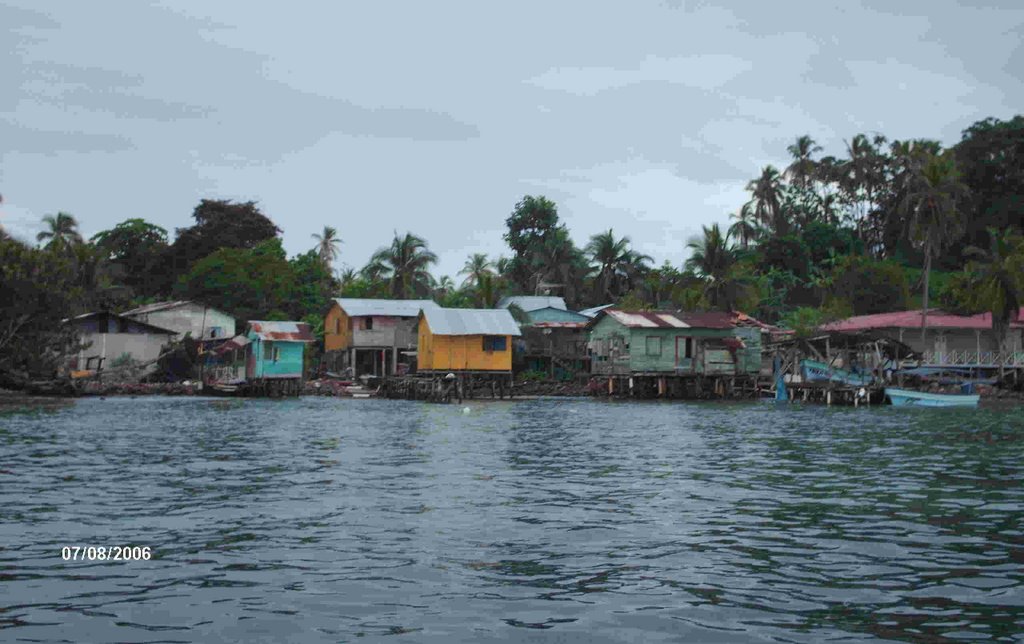
Bocas cabs are outboard-powered boats. A tourist party arrives by launch from Almirante. They pile up-market luggage on the dock. They require a boat to take them fifty meters to a plush new hotel on the water front - a confectionery of white paint that has cost (I am told and believe) a million dollars. An indigenous local poles his boat over to the dock. The hotel's white greeter spots half an inch of water in the bilges. He instructs the tourists to wait while he fetches a better boat. He ignores the boatman. The boatman sponges the offending water out of the bilges. He is a patient man, perhaps a little closed. I ride with him over to a village on the next island. A rash of wooden docks stick out from the shore. The boatman patrols a while, collecting passengers one by one. He drops a health worker off at a bar on the return trip to Bocas. A young Israeli woman (resident here for three years)works at the plush hotel. The boatman drops her at the hotel's dock. The boatman and I laugh together. The trip has been fun.
EDUCATION IS A PRIVLEDGE
MONDAY, JULY 10
Light rain falls as I ride the length of Bocas. The road rises thru low hills. The crest is capped with a patch of bamboo forest. Weighted by rain, the bamboos arch over the road. Much of the land is cattle ranch. Lots are advertised for sale. A development of cheap tasteless wooden holiday homes would benefit from a can of gasoline and a match. The bay the far end of the island faces the open sea. Turn left and a sand track leads to the Institue for Tropical Ecology and Conservation. The teachers are North American. So are the students. Some are from Canada, most from the US. I read the literature (ITEC is a not-for-pofit organisation based in Gainesville, Florida).
http//www.itec-edu.org
The school is on a sand beach protected by a reef. A further reef projects from the next island. Students eat at a next door restaurant. The restaurant has a small orchard: breadfruit, guanavara, a calabas tree. I order coffee and watch, between the palm trees, waves break on the reefs. A lone pelican sits on a marker post 50 meters out. Two parots nibble my ankles beneath the table.
The parents of a student I talk with have paid $2,500 for his five week course. He is from New England, a great kid, quarter Indian (as in Asia). He intends entering business once he has his Masters. Business is exciting. He believes that the Iraq war is the right war. He is having a great day. So am I. I resist relating the opinions voiced by the driver of the Mack truck.
I stop off at the Smithsonian Institute on the way back into town. Staff are out on the reef. The adminsitrative secretary gives me a beautifully produced catalogue of the Institute's work in Panama. I will send the catalogue to my son, Mark, a marine biologist.
Light rain falls as I ride the length of Bocas. The road rises thru low hills. The crest is capped with a patch of bamboo forest. Weighted by rain, the bamboos arch over the road. Much of the land is cattle ranch. Lots are advertised for sale. A development of cheap tasteless wooden holiday homes would benefit from a can of gasoline and a match. The bay the far end of the island faces the open sea. Turn left and a sand track leads to the Institue for Tropical Ecology and Conservation. The teachers are North American. So are the students. Some are from Canada, most from the US. I read the literature (ITEC is a not-for-pofit organisation based in Gainesville, Florida).
http//www.itec-edu.org
The school is on a sand beach protected by a reef. A further reef projects from the next island. Students eat at a next door restaurant. The restaurant has a small orchard: breadfruit, guanavara, a calabas tree. I order coffee and watch, between the palm trees, waves break on the reefs. A lone pelican sits on a marker post 50 meters out. Two parots nibble my ankles beneath the table.
The parents of a student I talk with have paid $2,500 for his five week course. He is from New England, a great kid, quarter Indian (as in Asia). He intends entering business once he has his Masters. Business is exciting. He believes that the Iraq war is the right war. He is having a great day. So am I. I resist relating the opinions voiced by the driver of the Mack truck.
I stop off at the Smithsonian Institute on the way back into town. Staff are out on the reef. The adminsitrative secretary gives me a beautifully produced catalogue of the Institute's work in Panama. I will send the catalogue to my son, Mark, a marine biologist.
BOCAS HOSPITAL
MONDAY, JULY 10
Bocas hospital has an emergency unit with aircon. An indigious child with an infected foot is the only other patient. A nurse sits me on a chair and sets to work with tweezers and blade. The removal is painless. The nurse dreams of being a writer. She doesn't read. Read two pages and she has a headache. The headaches began sooon after she left University. She has medical training: sugesting an eye test seems presumptious. She despatches me round the block to pay. I see, thru an open window, a skeletal old man curled up on a bed. He groans as he attempts to roll over. I hunt down the cashier's window and pay $5.
Bocas hospital has an emergency unit with aircon. An indigious child with an infected foot is the only other patient. A nurse sits me on a chair and sets to work with tweezers and blade. The removal is painless. The nurse dreams of being a writer. She doesn't read. Read two pages and she has a headache. The headaches began sooon after she left University. She has medical training: sugesting an eye test seems presumptious. She despatches me round the block to pay. I see, thru an open window, a skeletal old man curled up on a bed. He groans as he attempts to roll over. I hunt down the cashier's window and pay $5.
BOCAS
MONDAY, JULY 10
Bocas is beautiful. A small island, it is on the World map. It has arrived. It is a non-tourist tourist destination. The architecture is wood-shuttering Cape Cod-Carribean. Every building on Main Street sells something: food, booze, tours, real eastate.
Two weeks on the island and tourists enjoy the delusion of belonging. They become prey for male mid-age ex-trendies with tans and pony tails. Hustlers and marks sit in conference in bars and restaurants. On sale is the dream of owning some easy business, life without stress, a yearly holiday of 365 days, sun, sand and sex.
The scene is familiar: Ibiza, Block Island, Hydra, Mykinos...
I need a hospital. Eight days have passed since I sliced my hand. The stitches are due out.
Bocas is beautiful. A small island, it is on the World map. It has arrived. It is a non-tourist tourist destination. The architecture is wood-shuttering Cape Cod-Carribean. Every building on Main Street sells something: food, booze, tours, real eastate.
Two weeks on the island and tourists enjoy the delusion of belonging. They become prey for male mid-age ex-trendies with tans and pony tails. Hustlers and marks sit in conference in bars and restaurants. On sale is the dream of owning some easy business, life without stress, a yearly holiday of 365 days, sun, sand and sex.
The scene is familiar: Ibiza, Block Island, Hydra, Mykinos...
I need a hospital. Eight days have passed since I sliced my hand. The stitches are due out.
Subscribe to:
Posts (Atom)