PUERTO ARMUELLES: JANUARY 25
Cameron is a big florid man in his late fifties. He is a Scot born in the Caribbean. His father was United Fruit. Cameron is Chiquita Banana. Cameron has been king in half a dozen countries. King? Take United Fruit's operation centered at Almirante on Panama's Caribbean coast. United Fruit began shipping fruit at the turn of the 19th century. The road connecting Almirante to the rest of Panama was completed in 1995. Drive from Almirante to Panama City, you had to travel via San Jose, Costa Rica – a four-day journey even in modern times. The bridges into Costa Rica were built by and belonged to United Fruit. Same for the road and railway and the port and the schools and hospital and 90% of the houses in town. King?
OK, Regent. The Company was King.
Here, in Puerto Armuelles, the workers came out on strike.
The King abdicated.
Tuesday, January 29, 2008


BEST SPORT FISHING IN THE WORLD
 hookedonpanama boat shed: puerto armuelles
PUERTO ARMUELLES: JANUARY 25
I have never pushed anythng in which I didn't believe. I believe in Hookedonpanama. The new lodge has ten cabins and a club house. The site is superb.
Rex has five boats in the water. Young captains from the US are fanatic fishermen. Marlin fishing is the best in the world. Opening date? March 1st.
Maria will continue to run the Puerto Armuelles guest house for drop-ins.
ONE MORE CRASH
 thru trees at new lodge: hookeonpanama
PUERTO ARMUELLES: JANUARY 25
Rex landed an eight-hundred pound marlin last week. Today he is boat-building in an old United Fruit warehouse. His daughter, Maria runs the hotel and paperwork. His wife landscapes 20 Ks along the shore where they are building a fishing lodge in partnership with two Texan brothers from Maui.
The road is gravel. I hate gravel. A truck pushes me wide. The bike slides into scrub. I struggle out from under and heave the bike back onto the track. My leg is OK. Thank Alpinestars for great boots.
HOOKED ON PANAMA
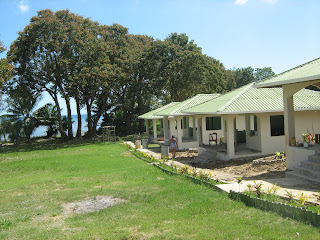 new lodge
PUERTO ARMUELLES: JANUARY 24
Rex is a Texas boat builder. He, his wife and daughter run a Pacific Coast sports fishing operation at Puerto Armuelles. Puerto Armuelles is a creation of United Fruit/Chiquita Banana. The Company pulled out a couple of years back. A worker's Co-op runs the plantations. The Panamanian Government subsidises the Co-op.
HOOKEDONPANAMA run the Fruit Company's old guest house as a hotel. This is a great building, full of history, romantic, spacious rooms with a/c, splendid bathrooms, excellent chef. I sleep in luxury - recompense for fear,
SCARED HALF TO DEATH
TO PUERTO ARMUELLES: DECEMBER 24
I am out of Panama City. Nigel took me for shrimp breakfast, then depatched me north to a sports fishing operation close to the frontier with Costa Rica. The Pan American highway crosses hill country with magnificent panoramas of Panama's mountain spine. I descend to the western plains and cruise at 90 KPH. The rear tyre blows. I am on a section of duel carriageway. The bike skitters side to side. Klaxons blare. Tip at this speed - end of journey. I don't dare break. One hundred metres to halt the bike. Push the bike a further two hundred metres up a gradient to a gas station. A boy helps dismount the wheel. A three-inch nail has shreded the inner tube. I carry a spare. I could do with a spare leg and renewed nerves...
I am out of Panama City. Nigel took me for shrimp breakfast, then depatched me north to a sports fishing operation close to the frontier with Costa Rica. The Pan American highway crosses hill country with magnificent panoramas of Panama's mountain spine. I descend to the western plains and cruise at 90 KPH. The rear tyre blows. I am on a section of duel carriageway. The bike skitters side to side. Klaxons blare. Tip at this speed - end of journey. I don't dare break. One hundred metres to halt the bike. Push the bike a further two hundred metres up a gradient to a gas station. A boy helps dismount the wheel. A three-inch nail has shreded the inner tube. I carry a spare. I could do with a spare leg and renewed nerves...
NIGELED
PANAMA CITY: JANUARY 21/23
I have been Nigeled. Is this a complaint or a boast at having survived. Nigel is a burly Brit more or less resident in Panama. He is a producer for Fox Sport and a fixer. He is happiest when speaking on two cell phones simultaneously – preferably whilst sneeking his car through an invisble rush-hour gap (he carries a reserve of Argentine Malbec on the back seat and steers with his knees).
Nigel is friends with a large portion of Panama's finance, real estate and hotel community. People enjoy his enthusiasm and his generosity. Visit Panama, he is the man to call. I called and was wined and dined and lunched and breakfasted for three days. I met people I hope to meet again, learnt statistics of Panama's property boom, placed a documentary movie project and did a live Spanish language radio broadcast.
I have been Nigeled. Is this a complaint or a boast at having survived. Nigel is a burly Brit more or less resident in Panama. He is a producer for Fox Sport and a fixer. He is happiest when speaking on two cell phones simultaneously – preferably whilst sneeking his car through an invisble rush-hour gap (he carries a reserve of Argentine Malbec on the back seat and steers with his knees).
Nigel is friends with a large portion of Panama's finance, real estate and hotel community. People enjoy his enthusiasm and his generosity. Visit Panama, he is the man to call. I called and was wined and dined and lunched and breakfasted for three days. I met people I hope to meet again, learnt statistics of Panama's property boom, placed a documentary movie project and did a live Spanish language radio broadcast.
BANKING IN PANAMA
PANAMA CITY: JANUARY 21/23
President Noriega comandeered Panama's banks. The US invaded Panama and arrested Noriega for drug trafficing and money laundering (and concurrently slaughtered a thousand or so innocent Panamanians – too bad).
Noriega was evil. He was a graduate of the School of the Americas (GOOGLE). He was a one-man band.
Now Panama is an international financial centre. The waterfront is spectacular so are the restaurants. Property prices have quadrupled in five years. So have the number of banks. Many are US subsidaries.
What do the banks do?
Launder drug money?
Surely not...
President Noriega comandeered Panama's banks. The US invaded Panama and arrested Noriega for drug trafficing and money laundering (and concurrently slaughtered a thousand or so innocent Panamanians – too bad).
Noriega was evil. He was a graduate of the School of the Americas (GOOGLE). He was a one-man band.
Now Panama is an international financial centre. The waterfront is spectacular so are the restaurants. Property prices have quadrupled in five years. So have the number of banks. Many are US subsidaries.
What do the banks do?
Launder drug money?
Surely not...
Wednesday, January 23, 2008
COPPER ROBBERY

PORTO BELO: JANUARY 19
I am at Marco's house on the hill above Porto Belo (Marcos on whose yacht I sailed from Cartagena).
Marcos returned yesterday from visiting his family in Canada over the holidays. He sails with passengers for Cartagena on Wednesday. He has much to do. A thief has stolen all the copper wiring from his boat. This is the village Marcos professes to love. Good luck to him – and good luck to his monkey and Rotweiler; they must remain a further three weeks at the animal posada.
Two of Marcos' passengers are French, young women on vacation from a year at University in Cali, Columbia – part of a five year degree course at Lille. A third is Sicilian, perhaps in his late thirties, a tailor of men's and women's suits. He was a master diver with the Italian marines and has a disability pension – small reward for an embolism in the brain.
I am at Marco's house on the hill above Porto Belo (Marcos on whose yacht I sailed from Cartagena).
Marcos returned yesterday from visiting his family in Canada over the holidays. He sails with passengers for Cartagena on Wednesday. He has much to do. A thief has stolen all the copper wiring from his boat. This is the village Marcos professes to love. Good luck to him – and good luck to his monkey and Rotweiler; they must remain a further three weeks at the animal posada.
Two of Marcos' passengers are French, young women on vacation from a year at University in Cali, Columbia – part of a five year degree course at Lille. A third is Sicilian, perhaps in his late thirties, a tailor of men's and women's suits. He was a master diver with the Italian marines and has a disability pension – small reward for an embolism in the brain.
JUNIOR IS MY HERO

Miss Junior discussing toy catalogue
COLON: JANUARY 19
One night to recuperate, then on to Colon by bus. My bike gleams in Junior's yard. Junior's bother-in-law opens the gates. Junior lies under the surgeon's knife in Panama City (hasn't Junior has suffered enough?). I dawdle sorting clothes and loading the bike. Junior's wife calls. The operation is successful. Junior is in recovery. I can talk with him on Monday.
One night to recuperate, then on to Colon by bus. My bike gleams in Junior's yard. Junior's bother-in-law opens the gates. Junior lies under the surgeon's knife in Panama City (hasn't Junior has suffered enough?). I dawdle sorting clothes and loading the bike. Junior's wife calls. The operation is successful. Junior is in recovery. I can talk with him on Monday.
ROAD RAGE - ROAD TERROR
 panama city skyline
ADVICE FOR BUS PASSENGERS: JANUARY 18/19
Panaline coaches depart San Jose at 1 PM and are scheduled to arrive in Panama City at 5 AM. The fare is US $25.
The highway south from San Jose heads for the mountains and keeps climbing. Don't look out unless you have a head for heights. Never watch the road: oncoming traffic will scare the hell out of you.
I read a book. A truck removes our side mirror. Our driver halts on the soft shoulder. My idiot fellow passengers crowd that side of the bus to scope the drop. What they see is clouds. The bus tilts a little. I resist a desire to curl into a feetal ball.
8:30 PM – our driver swerves. Thump...We've killed a bicyclist. No lights on the bike.
An ambulance removes the corpse. Cops remove our driver He will be held six days pending investigation.
We wait for a replacement bus.
In England passengers would be in shock. Central America, dead bicyclists are standard. The small boy in the seat ahead drapes a sheet to make a play house. Even a pair of nuns smile. I keep thinking of the driver. Horror must be churning his belly. The family of the deceased - do they know he's dead? Or are they waiting up for him?
All these lives changed.
I was under a truck in Tierra del Fuego. How come I survived?
Terror almost did for me in Venezuela.
Giving up takes more courage than continuing - the shame factor.
A local bus arrives to take us to the frontier to meet a coach sent from Panama City.
I sit in the front seat and watch the driver. He drives with one hand on the wheel while jabbering into his cell phone. The bus shimmies on the soft shoulder as he overtakes a truck. An instance of murder being justified?
NYCPD AND BOOZE
SAN JOSE: JANUARY 17
A retired New York cop is a property developer. He began with rundown buildings on South Beach, Miami. Now he invests in San Jose. He owns a nine-bedroom town house that was a small hotel and two commercial buildings.
He plans opening a bar in one of the commercial buildings. Every New York cop dreams of owning a bar. The dream is a rebellion: for serving cops, bar ownership or dealing in booze is prohibited.
The ex cop is a Richard. He enjoys San Jose.
“You don't find it dangerous?”
“Nah,” Richard says – No, in English.
We drink a couple of beers while he considers.
Then, “Yeah, maybe a little.” Richard tilts his head to display the scar on the underside of his chin. A local kid knifed him, a real mess. A cosmetic surgeon worked magic.
We drink a few more beers. We briefly discuss US politics.
Were he to vote, Richard would vote Democrat – though all the Presidential candidates are full of shit.
The bar owner buys a final round. Then Richard escorts me to the Posada Amon. His nine-bedroom home is on the next block. At first glance I took him for mid-forties. Closing on sixty is correct. His father is back in Florida. They have enjoyed eighteen cruises together on cruise ships over the past few years.
Richard is a nice man, unusual...
A retired New York cop is a property developer. He began with rundown buildings on South Beach, Miami. Now he invests in San Jose. He owns a nine-bedroom town house that was a small hotel and two commercial buildings.
He plans opening a bar in one of the commercial buildings. Every New York cop dreams of owning a bar. The dream is a rebellion: for serving cops, bar ownership or dealing in booze is prohibited.
The ex cop is a Richard. He enjoys San Jose.
“You don't find it dangerous?”
“Nah,” Richard says – No, in English.
We drink a couple of beers while he considers.
Then, “Yeah, maybe a little.” Richard tilts his head to display the scar on the underside of his chin. A local kid knifed him, a real mess. A cosmetic surgeon worked magic.
We drink a few more beers. We briefly discuss US politics.
Were he to vote, Richard would vote Democrat – though all the Presidential candidates are full of shit.
The bar owner buys a final round. Then Richard escorts me to the Posada Amon. His nine-bedroom home is on the next block. At first glance I took him for mid-forties. Closing on sixty is correct. His father is back in Florida. They have enjoyed eighteen cruises together on cruise ships over the past few years.
Richard is a nice man, unusual...
LIFE
SAN JOSE: JANUARY 17
A Costa Rican complains of gringos owning so many hotels and bars in San Jose – the bars tourists frequent. We are drinking at a bar owned by a US citizen.
“Even the beaches are owned by foreigners,” he says. “They build walls to keep us out, Resentment is natural. Violence is natural.”
I nod commiseration.
He buys me a beer.
I listen to his complaints.
Such is life.
A Costa Rican complains of gringos owning so many hotels and bars in San Jose – the bars tourists frequent. We are drinking at a bar owned by a US citizen.
“Even the beaches are owned by foreigners,” he says. “They build walls to keep us out, Resentment is natural. Violence is natural.”
I nod commiseration.
He buys me a beer.
I listen to his complaints.
Such is life.
RAZOR WIRE CAPITAL
SAN JOSE: JANUARY17
San Jose remains the razor-wire capital of the World. A cab is the safe way into town.
I am greeted with a kiss on both cheeks from the owner of the Posada Amon. My room is ready, the room I occupied on my previous visit. “And the grandchild?”
“No grandchild.”
Her sympathy is for my daughter, “Boys are always late.”
AM I A WHORE?
JFK, NEW YORK: JANUARY 16
AM I A WHORE?
Why do I ask?
Because the ticket lady at Taka Airlines upgraded me to First Class.
Did I do a calculated charm number on her – or merely treat her as a human being?
Monday, January 14, 2008
ONCE MORE INTO THE BREACH, DEAR READERS


views from the house
DUTCHESS COUNTY, NEW YORK: MONDAY, JANUARY 14, 2008
I have been blessed with the joy of staying with my adoptive daughter for the past three weeks. Most days views from the farm have been sun-lit and superb. Snow fell last night and continues to fall. I leave for the City tomorrow and on by air to San Jose, Costa Rica. From there I catch a bus down to Panama to retrieve my bike.
How do I feel?
Sad at leaving.
Sad not to have been home to see Bernadette and my sons and Sarah and my grandson, Charlie Boo, and my brother and his wife...and all my friends...Yes, and Herefordshire with its villages and green hills and ancient woods and cattle. I have been away eight months. Part of me is desperately homesick.
And I am nervous of the road ahead.
I am also excited by thoughts of the road ahead.
I will see friends.
I will cross stupendous country.
Finally I will ride north from the Mexican border to the Great Lakes.
I understand Hispanic America. I know how it functions. I share thoughts and opinions and language with Latin Americans.
Small town USA is very different - unknown and unfamiliar territory.
I have been blessed with the joy of staying with my adoptive daughter for the past three weeks. Most days views from the farm have been sun-lit and superb. Snow fell last night and continues to fall. I leave for the City tomorrow and on by air to San Jose, Costa Rica. From there I catch a bus down to Panama to retrieve my bike.
How do I feel?
Sad at leaving.
Sad not to have been home to see Bernadette and my sons and Sarah and my grandson, Charlie Boo, and my brother and his wife...and all my friends...Yes, and Herefordshire with its villages and green hills and ancient woods and cattle. I have been away eight months. Part of me is desperately homesick.
And I am nervous of the road ahead.
I am also excited by thoughts of the road ahead.
I will see friends.
I will cross stupendous country.
Finally I will ride north from the Mexican border to the Great Lakes.
I understand Hispanic America. I know how it functions. I share thoughts and opinions and language with Latin Americans.
Small town USA is very different - unknown and unfamiliar territory.
JUMBO SIZE SHRIMP COCKTAILS

CARTAGENA: WEDNESDAY, DECEMBER 6
The historic quarter of Cartagena displays Hispanic Colonial architecture at its best. The fortifications are immense. Churches and official buildings are superb. Houses range from humble and charming to magnificent. Magnificent describes the mansion where I stay. The mansion belongs to Anglo/Colombian friends of Anglo/Colombian friends back home. My room opens off a ground-floor patio where opulent breakfast is served by kindly maidservants.
Motor bikes are forbidden within the city walls. I have booked my Honda a night in the patio of a backpacker's hostel beyond the walls.
Evening and I wander the streets and admire the buildings and walk out through the gates to the Parque Centenario. I sit at a kiosk in the Parque and order a cold beer and a jumbo size shrimp cocktail. The shrimp are delicious. This moment has been in my dreams for the past six months. I have completed my circumnavigation of South America.
The historic quarter of Cartagena displays Hispanic Colonial architecture at its best. The fortifications are immense. Churches and official buildings are superb. Houses range from humble and charming to magnificent. Magnificent describes the mansion where I stay. The mansion belongs to Anglo/Colombian friends of Anglo/Colombian friends back home. My room opens off a ground-floor patio where opulent breakfast is served by kindly maidservants.
Motor bikes are forbidden within the city walls. I have booked my Honda a night in the patio of a backpacker's hostel beyond the walls.
Evening and I wander the streets and admire the buildings and walk out through the gates to the Parque Centenario. I sit at a kiosk in the Parque and order a cold beer and a jumbo size shrimp cocktail. The shrimp are delicious. This moment has been in my dreams for the past six months. I have completed my circumnavigation of South America.
Tomorrow I will find a yacht for the passage to Panama.
Two elderly Colombians draw me into conversation.
"How are things?" I ask.
"Better, a little better."
ECOLOGICAL DISASTER
TO CARTAGENA: WEDNESDAY, DECEMBER 6
The highway divides, left to Bogota, ahead to Cartagena. I followed the Bogota road last year and stopped at Giron and Villa de Leyva and Tunja, a wonderful journey - though, on a bike, viciously cold over the passes at 4000 metres in altitude. Now I follow the coast.
The highway crosses a vast lagoon. The lagoon was tidal prior to the building of the road. Now the water inland of the road is stagnant. Scum glistens on the surface. The stink is sickening. Fishermen's shacks on stilts huddle in the putrid water. Those who commissioned the road are responsible for an ecological disaster.
The highway divides, left to Bogota, ahead to Cartagena. I followed the Bogota road last year and stopped at Giron and Villa de Leyva and Tunja, a wonderful journey - though, on a bike, viciously cold over the passes at 4000 metres in altitude. Now I follow the coast.
The highway crosses a vast lagoon. The lagoon was tidal prior to the building of the road. Now the water inland of the road is stagnant. Scum glistens on the surface. The stink is sickening. Fishermen's shacks on stilts huddle in the putrid water. Those who commissioned the road are responsible for an ecological disaster.
LOVE FOR COLOMBIA AND COLOMBIANS
TO CARTAGENA: WEDNESDAY, DECEMBER 6
Having only one case makes loading the bike easy. The small case went on the gas tank. Turn the bike when parked and the klaxon button always hit the case. I stop at a bike mechanic on the way out of town and have the chain tightened. A bunch of bikers congregate, enquire how the trip has been - no charge for tightening and greasing the chain, nor for a cup of good coffee. I love Colombia. I love Colombians.
I wish that I were younger and able to clamber up the few thousand steps leading through the Secret City.
Riding the coastal highway must suffice.
In places the sierra soars almost vertically from the coast. Other parts, there is a narrow coastal strip. The strip that surrounds the sierra harbors the most beautiful ranches anywhere on any continent. Shade trees are immense, rivers are clean, grass is lush, views to the sierra are magnificent, cattle and horses are plump. Even workers appear well fed.
Even five years ago this road was dangerous.
Now army and police are in command.
Today's newspapers carry front page photographs of a newly surrendered band of FARC guerrillas.
Having only one case makes loading the bike easy. The small case went on the gas tank. Turn the bike when parked and the klaxon button always hit the case. I stop at a bike mechanic on the way out of town and have the chain tightened. A bunch of bikers congregate, enquire how the trip has been - no charge for tightening and greasing the chain, nor for a cup of good coffee. I love Colombia. I love Colombians.
I wish that I were younger and able to clamber up the few thousand steps leading through the Secret City.
Riding the coastal highway must suffice.
In places the sierra soars almost vertically from the coast. Other parts, there is a narrow coastal strip. The strip that surrounds the sierra harbors the most beautiful ranches anywhere on any continent. Shade trees are immense, rivers are clean, grass is lush, views to the sierra are magnificent, cattle and horses are plump. Even workers appear well fed.
Even five years ago this road was dangerous.
Now army and police are in command.
Today's newspapers carry front page photographs of a newly surrendered band of FARC guerrillas.
FAREWELL TO A SUITCASE
SANTA MARTA: TUESDAY, DECEMBER 5
Santa Marta is a big city, a major port, and a popular tourist destination for Colombians. I enter Santa Marta at dusk and search for a hotel close to the seafront. School holidays and the first two hotels I try are full. My ankle gives way on the steps of a third. They have a vacant room on the third floor. The room is dank, dark and noisome. The receptionist kindly telephones a fourth hotel right across the street. I hobble in the wake of a kid carrying the small case that contains my books and diary. The room is fine. It is on the fourth floor. The elevator functions. I fetch the bike. Two men lift it into the lobby. I unstrap the bag from the rack and the concierge carries it to the elevator. I unpack, shower, change. I will write up my diary while eating dinner. Where is my dairy? Shit! The small case is missing.
I ask at the desk.
I ask across the road.
The case is gone.
Maybe the boy who showed me across the road from hotel to hotel?
Frankly, I don't give a damn.
I am too happy to be in Colombia - happy to be somewhere where eye contact earns a smile. I feel safe as I hobble on my crutches beneath Christmas lights on the seaside esplanade. I find an open-air cafe, drink cold beer and watch the crowd. I have one less case to carry, one less case over which to worry. Great...
Santa Marta is a big city, a major port, and a popular tourist destination for Colombians. I enter Santa Marta at dusk and search for a hotel close to the seafront. School holidays and the first two hotels I try are full. My ankle gives way on the steps of a third. They have a vacant room on the third floor. The room is dank, dark and noisome. The receptionist kindly telephones a fourth hotel right across the street. I hobble in the wake of a kid carrying the small case that contains my books and diary. The room is fine. It is on the fourth floor. The elevator functions. I fetch the bike. Two men lift it into the lobby. I unstrap the bag from the rack and the concierge carries it to the elevator. I unpack, shower, change. I will write up my diary while eating dinner. Where is my dairy? Shit! The small case is missing.
I ask at the desk.
I ask across the road.
The case is gone.
Maybe the boy who showed me across the road from hotel to hotel?
Frankly, I don't give a damn.
I am too happy to be in Colombia - happy to be somewhere where eye contact earns a smile. I feel safe as I hobble on my crutches beneath Christmas lights on the seaside esplanade. I find an open-air cafe, drink cold beer and watch the crowd. I have one less case to carry, one less case over which to worry. Great...
GUILT FOR GLUTTONY
RIOHACHA, COLOMBIA: TUESDAY, DECEMBER 5
Guilt for gluttony drives me back to Escuela Britanica. An indigenous gatekeeper, eight years old, directs me to park in the shade of a mango tree. He shows me to the Principal's office. The principal is the owner, a Mrs Cohen. She is Colombian from Cartagena. Her mother is Catholic and she was raised a Catholic.
English is an essential of executive employment. English is a low priority of State schools. Private lessons are way beyond the financial reach of indigenous students. The Escuela Britanica is Mrs Cohen's attempt to fill the gap. It is a one-woman charity. It is admirable. Mrs Cohen is a warm intelligent woman. Her funds are limited. She needs a volunteer teacher. She can house and feed a teacher. A volunteer can obtain paying work at the two Universities where Mrs Cohen has good relationships.
The job offers an opportunity to interact with the indigenous population.
Riohacha is a safe town.
Beaches are good.
It is a great base from which to explore the Secret City to the west and the Guajira peninsular.
Readers, please pass the word...
Guilt for gluttony drives me back to Escuela Britanica. An indigenous gatekeeper, eight years old, directs me to park in the shade of a mango tree. He shows me to the Principal's office. The principal is the owner, a Mrs Cohen. She is Colombian from Cartagena. Her mother is Catholic and she was raised a Catholic.
English is an essential of executive employment. English is a low priority of State schools. Private lessons are way beyond the financial reach of indigenous students. The Escuela Britanica is Mrs Cohen's attempt to fill the gap. It is a one-woman charity. It is admirable. Mrs Cohen is a warm intelligent woman. Her funds are limited. She needs a volunteer teacher. She can house and feed a teacher. A volunteer can obtain paying work at the two Universities where Mrs Cohen has good relationships.
The job offers an opportunity to interact with the indigenous population.
Riohacha is a safe town.
Beaches are good.
It is a great base from which to explore the Secret City to the west and the Guajira peninsular.
Readers, please pass the word...
THE GOD OF MATHEMATICS IS ON MY SIDE
RIOHACHA: TUESDAY, DECEMBER 5
A restaurant serving sophisticated Italian food strikes me as unlikely in Riohacha. I enter the Gourmet Italiano with few expectations. Fresh flowers, thick white cotton tablecloths and napkins hint at a discovery. Stout matrons in tight dresses and fat men in suits occupy six of the ten tables - serious eaters. A waiter dismisses apologies for my appearance, seats me at a table against the wall and places my crash helmet and document bag on a vacant seat. I order lobster ravioli followed by a creme brule. The pasta is perfect and perfectly cooked, the lobster filling tastes of lobster as does the sauce. The creme is feather light beneath brittle caramel. I drink one glass of a crisp white wine perfectly chilled.
The offices of the Insurance company are open: the system is down. Maybe tomorrow...
Tomorrow I will reach Cartagena where I won't ride the Honda.
No need for insurance.
The saving more than pays for lunch at Gourmet Italiano.
The God of mathematics is on my side.
A restaurant serving sophisticated Italian food strikes me as unlikely in Riohacha. I enter the Gourmet Italiano with few expectations. Fresh flowers, thick white cotton tablecloths and napkins hint at a discovery. Stout matrons in tight dresses and fat men in suits occupy six of the ten tables - serious eaters. A waiter dismisses apologies for my appearance, seats me at a table against the wall and places my crash helmet and document bag on a vacant seat. I order lobster ravioli followed by a creme brule. The pasta is perfect and perfectly cooked, the lobster filling tastes of lobster as does the sauce. The creme is feather light beneath brittle caramel. I drink one glass of a crisp white wine perfectly chilled.
The offices of the Insurance company are open: the system is down. Maybe tomorrow...
Tomorrow I will reach Cartagena where I won't ride the Honda.
No need for insurance.
The saving more than pays for lunch at Gourmet Italiano.
The God of mathematics is on my side.
WHEN THE GOING GETS TOUGH, MEN GO TO LUNCH
RIOHACHA: TUESDAY, DECEMBER 5
A State University and a private University are side by side on the left hand side of the highway a few kilometres prior to the coastal town of Riohacha. The Universities compete for students from Colombia's indigenous population. The ESCUELA BRITANICA is across from the Universities on the right hand side of the road. Bougainvillea and hibiscus spill over a once-white wall. The wall encloses a tree-shaded garden, untidy buildings.
The school nags as I ride on into Riohacha. A proper writer of fact would have investigated.
The offices of the Insurance company are closed for a two hour lunch. I sit a while on the steps beside a fruit cart, drink juice, eat a melon and chat with the cart's owner. He is a young man, married with two children. He scraped a living in Cartagena for a couple of years as a freelance tourist guide before returning to Riohacha. The drop in violence brought him back. Guerrillas and paramilitaries are in retreat. Most of the country is safe. The economy has picked up. He can support his family.
And he gives me information: Colombia, the clocks an hour behind Venezuela.
I must wait a further hour for offices to open.
I recall a friend's motto: When the going gets tough, men go for lunch.
A State University and a private University are side by side on the left hand side of the highway a few kilometres prior to the coastal town of Riohacha. The Universities compete for students from Colombia's indigenous population. The ESCUELA BRITANICA is across from the Universities on the right hand side of the road. Bougainvillea and hibiscus spill over a once-white wall. The wall encloses a tree-shaded garden, untidy buildings.
The school nags as I ride on into Riohacha. A proper writer of fact would have investigated.
The offices of the Insurance company are closed for a two hour lunch. I sit a while on the steps beside a fruit cart, drink juice, eat a melon and chat with the cart's owner. He is a young man, married with two children. He scraped a living in Cartagena for a couple of years as a freelance tourist guide before returning to Riohacha. The drop in violence brought him back. Guerrillas and paramilitaries are in retreat. Most of the country is safe. The economy has picked up. He can support his family.
And he gives me information: Colombia, the clocks an hour behind Venezuela.
I must wait a further hour for offices to open.
I recall a friend's motto: When the going gets tough, men go for lunch.
Sunday, January 13, 2008
GUAJIRA PENINSULAR
 WEST FROM GUARERO: TUESDAY, DECEMBER 5
The highway cuts across the Guajira peninsular. This is indigenous territory, a dry land of sand dunes and scrub. Sun shines. A creeper spills pale blue flowers over thorn bush. The Honda runs perfectly. We are freed from Venezuela. I am immensely happy.
PATIENCE AND COURTESY
GUARERO/MAICAO: TUESDAY, DECEMBER 5
Midday and the Captain appears with the Customs clerk. The clerk spots me, speaks with the Captain. The Captain beckons me in to the office, signs and stamps my papers.
Frontiers demand patience and courtesy.
I am first in the queue at Customs. A clerk issues a temporary import certificate for the bike. I require a signature from the Military and insurance. The Military commander hasn't arrived. I am directed to the Army post the far end of Maicao town. I stop beside a biker at traffic lights. He points me to an insurance office on the next block. They issue certificates for a minimum of three months. A different company in the next town, Riohacha, issues monthly certificates. Fine.
I find the army post. The Captain has left for the frontier. I ride back to the frontier. Ten drivers now queue outside Customs. 11.30 AM and Customs closes for lunch at mid day.Midday and the Captain appears with the Customs clerk. The clerk spots me, speaks with the Captain. The Captain beckons me in to the office, signs and stamps my papers.
Saturday, January 12, 2008
JUDGEMENT
GUARERO, VENEZUELA: TUESDAY, DECEMBER 5
I traveled through Venezuela at a critical time in the country's history - the referendum. As a result, my Venezuelan BLOGS contain a surfeit of politics and insufficient action. This is a final observation. As always in Latin America I am enraged by the monstrous disparity between rich and poor. This is particularly so in a major oil producer awash with petroleum dollars. Oil companies and their allies in the oligarchy were criminally irresponsible. Revolution is their deserved reward.
Only the type of Revolution is in question.
Chavez?
I don't believe so.
Chavez is a megalomaniac drunk on power.
I traveled through Venezuela at a critical time in the country's history - the referendum. As a result, my Venezuelan BLOGS contain a surfeit of politics and insufficient action. This is a final observation. As always in Latin America I am enraged by the monstrous disparity between rich and poor. This is particularly so in a major oil producer awash with petroleum dollars. Oil companies and their allies in the oligarchy were criminally irresponsible. Revolution is their deserved reward.
Only the type of Revolution is in question.
Chavez?
I don't believe so.
Chavez is a megalomaniac drunk on power.
ADIEU VENEZUELA
THE FRONTIER: TUESDAY, DECEMBER 5
Stretches of tar have crumbled on the narrow two-lane highway. Potholes are deep and dangerous. Scrub trees close in. This is guerrilla country and bandit country and a smuggler's route. Traffic is sparse and mostly indigenous inhabitants driving old, rust-encrusted pick-ups with bent chassis and fenders lashed with wire. I am overtaken by two motorcycle cops. The cops don't wear helmets. I try to keep them in site. They turn back at the frontier. I dismount and produce my documents. The Venezuelan officials are polite and speedy.
Stretches of tar have crumbled on the narrow two-lane highway. Potholes are deep and dangerous. Scrub trees close in. This is guerrilla country and bandit country and a smuggler's route. Traffic is sparse and mostly indigenous inhabitants driving old, rust-encrusted pick-ups with bent chassis and fenders lashed with wire. I am overtaken by two motorcycle cops. The cops don't wear helmets. I try to keep them in site. They turn back at the frontier. I dismount and produce my documents. The Venezuelan officials are polite and speedy.
FAKE HOUSES AND REAL BIRDS
TO THE FRONTIER: TUESDAY, DECEMBER 5
Sixty Ks to the frontier: this is indigenous territory. Chavez posters border the coastal highway. Many posters boast of new houses built under the partnership of Chavez and the State Governor. I pass a clutch of pale blue huts crammed on a patch of freshly spread gravel, no shade. The huts are the size of a suburban garden shed. Each hut has a door and one window. The huts are new and unoccupied. They are statistic houses - glories of the Revolution.
The highway cuts across a tidal lagoon and damns the flow of water. The lagoon inland of the highway is stagnant and odoriferous. The seaward side is a shallow haven of water birds. A herdsman dressed in shorts and a baseball cap drives a few thin cows across the lagoon to graze sparse grass on a dune. I park and count bird species: two kinds of heron, waders, ibis, duck, oyster catchers, what appear to be moorhens, a small bird with long legs and a long, thin, curved beak...
Why, oh why, don't I carry a bird book?
Because I don't have space.
Sixty Ks to the frontier: this is indigenous territory. Chavez posters border the coastal highway. Many posters boast of new houses built under the partnership of Chavez and the State Governor. I pass a clutch of pale blue huts crammed on a patch of freshly spread gravel, no shade. The huts are the size of a suburban garden shed. Each hut has a door and one window. The huts are new and unoccupied. They are statistic houses - glories of the Revolution.
The highway cuts across a tidal lagoon and damns the flow of water. The lagoon inland of the highway is stagnant and odoriferous. The seaward side is a shallow haven of water birds. A herdsman dressed in shorts and a baseball cap drives a few thin cows across the lagoon to graze sparse grass on a dune. I park and count bird species: two kinds of heron, waders, ibis, duck, oyster catchers, what appear to be moorhens, a small bird with long legs and a long, thin, curved beak...
Why, oh why, don't I carry a bird book?
Because I don't have space.
WILL VENEZUELA COME TO A HALT?
FRONTIER ROAD: TUESDAY, DECEMBER 5
My last day in Venezuela and I am out of bed and on the road by 6.30 AM. Market day in the last town before the frontier and traffic is heavy. A yellow digger backs across the road to load a dumpster truck in the town center. The first car brakes. A driver tries to squeeze through on the outside. A driver tries to squeeze through on the inside. The same happens the far side of the dumpster truck. These are Venezuelan drivers. Giving way is unthinkable. In minutes the road is blocked solid three vehicles wide. Klaxons and curses accompany me as I ease off the road, ride fifty metres in a dirt ditch, reach the market and inch between market stalls. I circle through a couple of dirt lanes and back to the highway. Two complacent cops watch the blockage build. One of them gives me a grin and a nod. I follow the ditch out of town. By evening the blockage should be 100 Ks deep. Maybe it will spread to Caracas. Venezuela will come to a halt.
My last day in Venezuela and I am out of bed and on the road by 6.30 AM. Market day in the last town before the frontier and traffic is heavy. A yellow digger backs across the road to load a dumpster truck in the town center. The first car brakes. A driver tries to squeeze through on the outside. A driver tries to squeeze through on the inside. The same happens the far side of the dumpster truck. These are Venezuelan drivers. Giving way is unthinkable. In minutes the road is blocked solid three vehicles wide. Klaxons and curses accompany me as I ease off the road, ride fifty metres in a dirt ditch, reach the market and inch between market stalls. I circle through a couple of dirt lanes and back to the highway. Two complacent cops watch the blockage build. One of them gives me a grin and a nod. I follow the ditch out of town. By evening the blockage should be 100 Ks deep. Maybe it will spread to Caracas. Venezuela will come to a halt.
Friday, January 11, 2008
FRONTIER PORNO
TO COLOMBIA: TUESDAY, DECEMBER 5
The zone either side of the Venezuela/Colombia border has an evil reputation. Drug cartel killers and moralist left-wing killers (FARC) fight over territory. Venezuelan police practice a low profile and the military mostly keep to their barracks.
Two small towns separate me from the frontier. Cops at the first are checking vehicles. Late afternoon and a cop advises me to book into the only hotel and stay in my room. Outdoors after sundown is dangerous.
The hotel is a short-stop facility, porno on TV. Each room has its own garage. Two guards pack big-game handguns that would put a rhinoceros to flight.
I dump my bags and ride in search of an Internet cafe.
It is not yet dusk.
The owner of the Internet cafe is about to lock up.
He says I should return to my hotel.
I take his advice.
I spot two mosquitoes in the bathroom. The shower head is missing, so is the seat off the lavatory bowl. The tiny cotton towel wouldn't dry a damp vole.
I surround the bed with mosquito coils.
I flick channels on TV. The choice is between two men sharing one woman, two women in a homosexual tryst, or a moderately banal male/female one-on-one.
Football would be more interesting and I don't much care for football.
Take-out is steak and fries or fries and steak.
This is a fun place...
The zone either side of the Venezuela/Colombia border has an evil reputation. Drug cartel killers and moralist left-wing killers (FARC) fight over territory. Venezuelan police practice a low profile and the military mostly keep to their barracks.
Two small towns separate me from the frontier. Cops at the first are checking vehicles. Late afternoon and a cop advises me to book into the only hotel and stay in my room. Outdoors after sundown is dangerous.
The hotel is a short-stop facility, porno on TV. Each room has its own garage. Two guards pack big-game handguns that would put a rhinoceros to flight.
I dump my bags and ride in search of an Internet cafe.
It is not yet dusk.
The owner of the Internet cafe is about to lock up.
He says I should return to my hotel.
I take his advice.
I spot two mosquitoes in the bathroom. The shower head is missing, so is the seat off the lavatory bowl. The tiny cotton towel wouldn't dry a damp vole.
I surround the bed with mosquito coils.
I flick channels on TV. The choice is between two men sharing one woman, two women in a homosexual tryst, or a moderately banal male/female one-on-one.
Football would be more interesting and I don't much care for football.
Take-out is steak and fries or fries and steak.
This is a fun place...
NO TO DICTATORSHIP
SANTA ANA DE CORO: SUNDAY/MONDAY, DECEMBER 3/4
Late evening and Coro is closed tight. I can't even buy a sandwich. Fireworks celebrate the undeclared result of the referendum. I doze off with the TV on - wake and discover the result. The people of Venezuela have voted NO. Chavez has lost by a couple of percentage points. Chavez boasted that he intended to be President in 2050.
Analysis shows abstentions amongst his supporters.
Venezuelans want change.
They don't want a dictator.
Chavez should be congratulated on the honesty of the referendum.
Or criticised by his followers for over-confidence.
He could have fixed the votem - Castro's Cubans have ample experience.
As to the people of Coro, they seem in shock.
Late evening and Coro is closed tight. I can't even buy a sandwich. Fireworks celebrate the undeclared result of the referendum. I doze off with the TV on - wake and discover the result. The people of Venezuela have voted NO. Chavez has lost by a couple of percentage points. Chavez boasted that he intended to be President in 2050.
Analysis shows abstentions amongst his supporters.
Venezuelans want change.
They don't want a dictator.
Chavez should be congratulated on the honesty of the referendum.
Or criticised by his followers for over-confidence.
He could have fixed the votem - Castro's Cubans have ample experience.
As to the people of Coro, they seem in shock.
Thursday, January 10, 2008
THE PAINTING PASSION OF ELIZABETH ORTIZ

LA VELA: SUNDAY, DECEMBER 3
The painter, Elizabeth Ortiz lives in La Vela. She has left a message for me at the hotel. I visit her in the evening. Her newly-built house on a mud road is part of village gentrification. She is a broad, dark, mature woman, comfortably overweight. She wears long skirts, lots of colours. She has travelled through a Catholic upbringing to Buddhism and brown-rice meditation. Now she is born again as a Baptist Christian. She is quiet but determined in her faith: it shines through her paintings.
Painting is her passion.
The painter, Elizabeth Ortiz lives in La Vela. She has left a message for me at the hotel. I visit her in the evening. Her newly-built house on a mud road is part of village gentrification. She is a broad, dark, mature woman, comfortably overweight. She wears long skirts, lots of colours. She has travelled through a Catholic upbringing to Buddhism and brown-rice meditation. Now she is born again as a Baptist Christian. She is quiet but determined in her faith: it shines through her paintings.
Painting is her passion.
She is a school teacher and part-time cab driver in her own car. She has two grown children, never bothered with a husband. She is dismissive of men, men are nothing but trouble.
Of the Chavez Revolution, she says: "The cure is worse than the illness. Men vote without thinking. Now they've voted, they are home getting drunk."
She says: "Christians must become part of the nation's political life: we must declare ourselves."
I wonder whether she is endangered in expressing her opinions.
"I am unafraid," she replies. "Write what I say."
Of the Chavez Revolution, she says: "The cure is worse than the illness. Men vote without thinking. Now they've voted, they are home getting drunk."
She says: "Christians must become part of the nation's political life: we must declare ourselves."
I wonder whether she is endangered in expressing her opinions.
"I am unafraid," she replies. "Write what I say."
THIS DAY OF DECISION
LA VELA: SUNDAY, DECEMBER 3
Elizabeth Ortiz is a painter. Her work is exhibited in the municipal art center across from the Cathedral. She paints women. Her style is simple. Her paintings are warm and full of heart and belief.
I call her home number. She is away. She will return in late afternoon.
Referendum day: few cars are on the road - no trucks. I ride 20 Ks out of town to La Vela, a fishing village famous for its restaurants and fresh fish for Sunday lunch.
The village is mid way between collapse and gentrification. Rain fell in the night and I inch through slippery mud and deep puddles. All restaurants are closed. Villagers wait in line at polling booths. Women walk carefully in pairs, holding hands. A good number of men are already drunk. They slouch in groups at street corners, caps reversed, sleeveless singlets, patched chinos, cheap trainers. Bottles are much in evidence. I am an intruder on this day of decision, a foreigner, an outsider shunned by stone faces - a welcome so un-Latin American.
Elizabeth Ortiz is a painter. Her work is exhibited in the municipal art center across from the Cathedral. She paints women. Her style is simple. Her paintings are warm and full of heart and belief.
I call her home number. She is away. She will return in late afternoon.
Referendum day: few cars are on the road - no trucks. I ride 20 Ks out of town to La Vela, a fishing village famous for its restaurants and fresh fish for Sunday lunch.
The village is mid way between collapse and gentrification. Rain fell in the night and I inch through slippery mud and deep puddles. All restaurants are closed. Villagers wait in line at polling booths. Women walk carefully in pairs, holding hands. A good number of men are already drunk. They slouch in groups at street corners, caps reversed, sleeveless singlets, patched chinos, cheap trainers. Bottles are much in evidence. I am an intruder on this day of decision, a foreigner, an outsider shunned by stone faces - a welcome so un-Latin American.
WILL CHRISTMAS BE ILLEGAL?
SANTA ANA DE CORO: SUNDAY, DECEMBER 3
Sunday morning and I walk the historic quarter in search of breakfast. Referendum day, there is a heaviness to the air and that almost threatening stillness that precedes a thunderstorm; streets are deserted, shops and restaurants are closed. Finally I find a baker serving coffee. Two elderly men argue on the sidewalk. Are they arguing politics, football or ancient rivalry over a school-years sweetheart?
I attend mass at the cathedral. The interior has a perfect simplicity: pitched roof lined with timber, floor paved with unglazed tiles, white pillars, white walls.
Does the congregation know that Chavez' hero, Fidel Castro, closed churches, banned religion, that wearing even a small crucifix in Cuba was a criminal offense as was celebrating Christmas?
The streets of Coro are decorated with Christmas lights...
Sunday morning and I walk the historic quarter in search of breakfast. Referendum day, there is a heaviness to the air and that almost threatening stillness that precedes a thunderstorm; streets are deserted, shops and restaurants are closed. Finally I find a baker serving coffee. Two elderly men argue on the sidewalk. Are they arguing politics, football or ancient rivalry over a school-years sweetheart?
I attend mass at the cathedral. The interior has a perfect simplicity: pitched roof lined with timber, floor paved with unglazed tiles, white pillars, white walls.
Does the congregation know that Chavez' hero, Fidel Castro, closed churches, banned religion, that wearing even a small crucifix in Cuba was a criminal offense as was celebrating Christmas?
The streets of Coro are decorated with Christmas lights...
Wednesday, January 09, 2008
PIRATES OR HEROES? WERE THEY GAY?

first cross raised in south america
SANTA ANA DE CORO: SUNDAY, DECEMBER 3
Tradition claims that the cross raised in Coro was the first cross raised in South America. The cross is of wood and stands in a domed shrine in the plaza between a convent, the cathedral and a church. Secret cellars lie below the churches. The cellars were sanctuaries against pirate attacks. Francis Drake and his associates were the pirates.
I was taught at school in England that they were heroes.
The historians of Hollywood agree.
Brits only become villains with the American War of Independence.
Such is history.
Such is art.
All art is political declared Fidel Castro shortly after the Triumph. Homosexuals and politically incorrect writers and performers were excluded from the Artists' Union and banned from publishing or performing. Homosexual painters were forbidden exhibitions.
In Europe, Castro remains a hero of the Left.
Fewer and fewer English schools teach history.
Ah, well...
SHRIMP, LIES AND PARADISE
SANTA ANA DE CORO: SATURDAY, DECEMBER 2
Two guards sit on the steps to the Museum of Art. I am late. The museum is closed. The guards shift their backsides so I can mount the steps. The doors are open. One of the guards says, "Take your time..."
I don't ride at night. I take a cab to a Chinese restaurant. The cab driver is from Caracas. Violence made him flee the capital. He claims that Coro is a Paradise.
Maybe...However, shrimp at the Chinese restaurant are a disappointment.
I watch Chavez on TV in my mini suite at the Intercaribe. Chavez has been on all five channels for the past hour. He is attacking Western (US) media of monopoly dictatorship and broadcasting nothing but lies and propaganda. He names CNN as a major culprit.
Two guards sit on the steps to the Museum of Art. I am late. The museum is closed. The guards shift their backsides so I can mount the steps. The doors are open. One of the guards says, "Take your time..."
I don't ride at night. I take a cab to a Chinese restaurant. The cab driver is from Caracas. Violence made him flee the capital. He claims that Coro is a Paradise.
Maybe...However, shrimp at the Chinese restaurant are a disappointment.
I watch Chavez on TV in my mini suite at the Intercaribe. Chavez has been on all five channels for the past hour. He is attacking Western (US) media of monopoly dictatorship and broadcasting nothing but lies and propaganda. He names CNN as a major culprit.
POOL-SIDE CORO
SANTA ANA DE CORO: SATURDAY, DECEMBER 2
Chavez has announced on TV that he expects to be President in 2050. His ex-Minister of Defence has described the referendum as an attempted coup d'etat. I sit at a pool-side table and sip cold beer.
Why must the music be so loud?
Anti-thought this eve of the referendum?
Anti-thought every day?
Why think?
What is there to think about?
Venezuelans are similar to Argentinians in their attitude to life: The crash is inevitable. Dance and laugh till it hits?
A pretty young woman wears a pink T shirt on which she has written: I WILL LOVE YOU FOR ALL MY LIFE.
I ask if this is true. She says it will be true - though she hasn't found the man yet.
A voluptuous black late-teens wears black net over an almost non-existent black bikini.
A young man swings a rosary as if it were worry beads. The beads are pearl glass. His T shirt bears two dice and the slogan: YOU CANT PLAY THE PLAYER.
No one tells the kids to collect crisp packets and sweet wrappers and soda bottles they strew at the pool side or in the pool.
I finish my beer, dress and seek shelter in the 16th century...
Chavez has announced on TV that he expects to be President in 2050. His ex-Minister of Defence has described the referendum as an attempted coup d'etat. I sit at a pool-side table and sip cold beer.
Why must the music be so loud?
Anti-thought this eve of the referendum?
Anti-thought every day?
Why think?
What is there to think about?
Venezuelans are similar to Argentinians in their attitude to life: The crash is inevitable. Dance and laugh till it hits?
A pretty young woman wears a pink T shirt on which she has written: I WILL LOVE YOU FOR ALL MY LIFE.
I ask if this is true. She says it will be true - though she hasn't found the man yet.
A voluptuous black late-teens wears black net over an almost non-existent black bikini.
A young man swings a rosary as if it were worry beads. The beads are pearl glass. His T shirt bears two dice and the slogan: YOU CANT PLAY THE PLAYER.
No one tells the kids to collect crisp packets and sweet wrappers and soda bottles they strew at the pool side or in the pool.
I finish my beer, dress and seek shelter in the 16th century...
WAITING OUT THE REFERENDUM

SANTA ANA DE CORO: SATURDAY, DECEMBER 2
Chavez supporters will be empowered by a Yes vote in the referendum. Big city riots are forecast. I want to witness the referendum. I want to witness the referendum from somewhere safe. Coro fits the bill. The Hotel Intercaribe is at the entrance to the historic district. It has a pool. Back a few years it was the smartest hostelry in Coro. The hotel is near empty. I ask for a room and am shown a damp poky cupboard. A second room has two narrow single beds. The third room has a double bed; it also has an air conditioner that could provide the sound track for a war movie. Finally I am shown a mini suite. The suite is great (though the carpet needs changing). I negotiate the room rate for three nights down to the price of a single. I park and unload and head for the pool.
Tuesday, January 08, 2008
SANTA ANA DE CORO

SANTA ANA DE CORO: SATURDAY, DECEMBER 2
Though a State Capital, Santa Ana de Coro is small and manageable. Spaniards founded the town in 1527. It is a safe clean joyful place - no warnings against robbers, muggers, drug addicts, homosexuals or degenerates. You can relax and walk the historic quarter in the evening. Search here in vain for the splendours of Oaxa or Cusco. Coro is on a humbler, more intimate scale. Even the cathedral is little bigger than a parish church. Yet if perfection is simplicity and immaculate proportions, then Coro is a jewel. Sad that Coro is on UNESCO list of World Heritage Sites in danger...
Though a State Capital, Santa Ana de Coro is small and manageable. Spaniards founded the town in 1527. It is a safe clean joyful place - no warnings against robbers, muggers, drug addicts, homosexuals or degenerates. You can relax and walk the historic quarter in the evening. Search here in vain for the splendours of Oaxa or Cusco. Coro is on a humbler, more intimate scale. Even the cathedral is little bigger than a parish church. Yet if perfection is simplicity and immaculate proportions, then Coro is a jewel. Sad that Coro is on UNESCO list of World Heritage Sites in danger...
BRITAIN - A US SATELLITE
ROAD TO CORO: SATURDAY, DECEMBER 2
I stop to take on gas and coffee thirty Ks short of Coro. A big Yes for Chavez poster is affixed to the wall of the service station cafeteria. The man behind the bar doesn't like foreigners. He isn't rude - merely stone-face resistant. I encounter this instant rejection two or three times a day. I have ridden the length of Hispanic America and Brazil. It is a reaction unique to Venezuela. It isn't common. But it happens. Foreigners are the enemy (unless Cuban). Chavez says so - particularly citizens of the US...And Chavez condemns Britain as a US satellite. George W Bush is the devil; Blair was his acolyte...
I stop to take on gas and coffee thirty Ks short of Coro. A big Yes for Chavez poster is affixed to the wall of the service station cafeteria. The man behind the bar doesn't like foreigners. He isn't rude - merely stone-face resistant. I encounter this instant rejection two or three times a day. I have ridden the length of Hispanic America and Brazil. It is a reaction unique to Venezuela. It isn't common. But it happens. Foreigners are the enemy (unless Cuban). Chavez says so - particularly citizens of the US...And Chavez condemns Britain as a US satellite. George W Bush is the devil; Blair was his acolyte...
COMPARATIVE SAFETY
ROAD TO CORO: SATURDAY, DECEMBER 2
Rain clouds cool a pleasant cattle country of rolling hills. I have escaped the oil fields. Fewer trucks menace. Drivers of pickups and cars are more humane. Midday and I seek shelter from a shower in a small restaurant beside a gas station. Colour lithographs of soulful saints and the Virgin Mary decorate the walls. A rosary hangs behind the bar. The owner is first generation Venezuelan. His parents emigrated from Portugal.
Why Venezuela rather than Brazil?
He grins and says, "A mistake. They weren't good at geography."
Orange juice and big bowl of mutton soup cost a dollar.
Rain clouds cool a pleasant cattle country of rolling hills. I have escaped the oil fields. Fewer trucks menace. Drivers of pickups and cars are more humane. Midday and I seek shelter from a shower in a small restaurant beside a gas station. Colour lithographs of soulful saints and the Virgin Mary decorate the walls. A rosary hangs behind the bar. The owner is first generation Venezuelan. His parents emigrated from Portugal.
Why Venezuela rather than Brazil?
He grins and says, "A mistake. They weren't good at geography."
Orange juice and big bowl of mutton soup cost a dollar.
Monday, January 07, 2008
GOD SAVE ME FROM VENEZUELA
TO CORO: SATURDAY, DECEMBER 2
I ride through my last city in Venezuela. I am on a six-lane thruway. A small Chevrolet whips across from the outside lane to the hard shoulder and overtakes a truck on the inside before swerving back out to the fast lane. A truck pulling a trailer loaded with steel girders sits on my arse. I slow a second and he hits his klaxon. I am scared. I am so scared I want to weep. I don't know which exit I should take. The overhead signs mean nothing. I look up for more than a moment and a maniac will kill me. I want to give up, pull in to a gas station, hire a truck to transport me out of this hell. A pickup shoots from the fast lane to an exit. The driver misses me by inches. Please God save me. What am I doing here?
I ride through my last city in Venezuela. I am on a six-lane thruway. A small Chevrolet whips across from the outside lane to the hard shoulder and overtakes a truck on the inside before swerving back out to the fast lane. A truck pulling a trailer loaded with steel girders sits on my arse. I slow a second and he hits his klaxon. I am scared. I am so scared I want to weep. I don't know which exit I should take. The overhead signs mean nothing. I look up for more than a moment and a maniac will kill me. I want to give up, pull in to a gas station, hire a truck to transport me out of this hell. A pickup shoots from the fast lane to an exit. The driver misses me by inches. Please God save me. What am I doing here?
THE MORE THAT CHANGES, THE LESS CHANGES
WEST FROM CARACAS: FRIDAY, DECEMBER 1
I find a small beach hotel with a pool and drink beer and eat fresh fish on the terrace with a young Venezuelan. The Venezuelan runs two open launches for scuba diving and tours of the Marine National Park. He is booked tomorrow by a Venezuelan family. He has had no foreign tourists this season. Either the referendum or the sub prime crisis has kept them away.
He relates his experiences visiting cousins in Australia. Strangers accosted him in bars: he presumed that they were either drug dealers or took him for a drug dealer (Latino). He took a while to realise that Australians were simply friendly. And he needed time to relax and accept that it was unnecessary to ask whether it was safe to walk outside.
"Here nowhere is safe. We Venezuelans need eyes in the back of our heads..."
His dad helped him buy the launches and he is a No voter. He understands the Yes vote.
The poor lived without hope.
Chavez offered change. Many supporters dislike Chavez. However, the alternative is a continuation of the insupportable.
"We are all to blame. Venezuelans think only of themselves. See the way we drive. No one believes in the law or in justice or in politicians..."
Supporters of Chavez are no different. A big wheel in the party has built himself a mansion on the peninsular of the Marine National Park, on National Park land. The politico was penniless before Chavez came to power.
"It is how we are, we Venezuelans. Each for himself..."
I assure him that Cubans are no different. Castro's long term companion, the sainted Celia Sanchez, commandeered Havana mansions for all her family in the first weeks of the Triumph. How do I know? When first living in Cuba, we rented a mansion from Celia Sanchez' niece.
I find a small beach hotel with a pool and drink beer and eat fresh fish on the terrace with a young Venezuelan. The Venezuelan runs two open launches for scuba diving and tours of the Marine National Park. He is booked tomorrow by a Venezuelan family. He has had no foreign tourists this season. Either the referendum or the sub prime crisis has kept them away.
He relates his experiences visiting cousins in Australia. Strangers accosted him in bars: he presumed that they were either drug dealers or took him for a drug dealer (Latino). He took a while to realise that Australians were simply friendly. And he needed time to relax and accept that it was unnecessary to ask whether it was safe to walk outside.
"Here nowhere is safe. We Venezuelans need eyes in the back of our heads..."
His dad helped him buy the launches and he is a No voter. He understands the Yes vote.
The poor lived without hope.
Chavez offered change. Many supporters dislike Chavez. However, the alternative is a continuation of the insupportable.
"We are all to blame. Venezuelans think only of themselves. See the way we drive. No one believes in the law or in justice or in politicians..."
Supporters of Chavez are no different. A big wheel in the party has built himself a mansion on the peninsular of the Marine National Park, on National Park land. The politico was penniless before Chavez came to power.
"It is how we are, we Venezuelans. Each for himself..."
I assure him that Cubans are no different. Castro's long term companion, the sainted Celia Sanchez, commandeered Havana mansions for all her family in the first weeks of the Triumph. How do I know? When first living in Cuba, we rented a mansion from Celia Sanchez' niece.
BRAVE AS A LION (WIZZARD OF OZ)
WIZZING THRU CARACAS: FRIDAY, DECEMBER 1
A motorway cuts straight through Caracas and out the far side. I stop once to check with a cop that I am on the right road. Approaching Caracas, I was too preoccupied by terror to notice that the road climbed. Now the highway plunges, twisting and turning towards the sea. Down-hill drivers play fairground dodgem cars, swerving this way and that. Long convoys of Chavez buses climb towards the capital. An imaginative opposition would seek the bus park and puncture the tyres. Chavez supporters would be unable to return home to vote.
A motorway cuts straight through Caracas and out the far side. I stop once to check with a cop that I am on the right road. Approaching Caracas, I was too preoccupied by terror to notice that the road climbed. Now the highway plunges, twisting and turning towards the sea. Down-hill drivers play fairground dodgem cars, swerving this way and that. Long convoys of Chavez buses climb towards the capital. An imaginative opposition would seek the bus park and puncture the tyres. Chavez supporters would be unable to return home to vote.
ROBBERS, MUGGERS AND REVOLUTIONARIES
ROAD TO CARACAS: FRIDAY, DECEMBER 1
I resist riding a 200 kilometre detour. Bikers ride through Caracas every day. Not all of them get hijacked or robbed. Nor can the robbers and muggers be more dangerous than Venezuela's drivers.
The anti Chavez vote mounted a huge demonstration in Caracas last night. Today is the Yes vote mobilises. Every bus in the country is crammed with red shirts headed for the capital. Banners wave, fresh painted slogans gleam, klaxons screech a premature victory tattoo. Buses, old and new, collect at service stations. Red shirts swirl in the forecourt and in cafeterias or clump forlornly beside a steaming radiator or a flat tyre with the tread worn smooth as an egg. Hills slow the ancient to a crawl. Putative mechanics peer under a relic's hood. Bricks support an antique marooned by a broken spring. A shattered half-shaft strands another.
Six chrome-and-polish monsters steamroll me off the hard shoulder. I hit soft dirt, skid as I break and nearly fall. The engine stalls. I sit astride the bike, legs trembling, heart pit-a-pat and a fear-pain in the belly. Thanks buddies, thanks for the brotherhood of man. Long live the Revolution.
I resist riding a 200 kilometre detour. Bikers ride through Caracas every day. Not all of them get hijacked or robbed. Nor can the robbers and muggers be more dangerous than Venezuela's drivers.
The anti Chavez vote mounted a huge demonstration in Caracas last night. Today is the Yes vote mobilises. Every bus in the country is crammed with red shirts headed for the capital. Banners wave, fresh painted slogans gleam, klaxons screech a premature victory tattoo. Buses, old and new, collect at service stations. Red shirts swirl in the forecourt and in cafeterias or clump forlornly beside a steaming radiator or a flat tyre with the tread worn smooth as an egg. Hills slow the ancient to a crawl. Putative mechanics peer under a relic's hood. Bricks support an antique marooned by a broken spring. A shattered half-shaft strands another.
Six chrome-and-polish monsters steamroll me off the hard shoulder. I hit soft dirt, skid as I break and nearly fall. The engine stalls. I sit astride the bike, legs trembling, heart pit-a-pat and a fear-pain in the belly. Thanks buddies, thanks for the brotherhood of man. Long live the Revolution.
BOUNDLESS BIGOTRY
AFTER DINNER: THURSDAY, NOVEMBER 30
I find an Internet cafe. The Internet doesn't work. I chat with a Venezuelan civil engineer, mid-forties, short hair, heavyweight chinos, work boots. He is anti Chavez and anti the Cubans that he claims are flooding the country - together with other foreigners. He says:
"Here it is similar to Chile at the time of Allende or to Nicaragua with the Sadinistas. Chavez surrounds himself with foreigners. They are everywhere. If we must have a Revolution, let it be our Revolution.
"Why must Chavez have all these outsiders? They want to use our oil. They are no different to those Chavez has expelled.
"Chavez is a creation of the rich. Their corruption of the system has created him."
The engineer talks for half an hour on the telephone, giving detailed technical explanations and instructions. Later I fetch coffee and we talk of the US. He accuses US oil companies of arrogance and of possessing a colonial attitude - people in the US believe themselves superior and believe that only they are competent to run an oil field.
He laughs when I tell him that I have been advised to detour round Caracas.
True the city is dangerous but tens of thousands drive through Caracas daily.
I have travelled 30 000 kilometres. Colon, Panama, is the only city where I have felt in danger.
The engineer has worked in Panama. He says, "In Colon they are the same people. Blacks. Blacks are lazy and dangerous. Look at cities in the United States. All the Blacks have guns."
I consider mentioning Afro American military commanders and an Afro American Secretary of State and an Afro American candidate for President. There is no point...As there was no point in asking the cop in Barcelona why he listed homosexuals as dangerous.
I find an Internet cafe. The Internet doesn't work. I chat with a Venezuelan civil engineer, mid-forties, short hair, heavyweight chinos, work boots. He is anti Chavez and anti the Cubans that he claims are flooding the country - together with other foreigners. He says:
"Here it is similar to Chile at the time of Allende or to Nicaragua with the Sadinistas. Chavez surrounds himself with foreigners. They are everywhere. If we must have a Revolution, let it be our Revolution.
"Why must Chavez have all these outsiders? They want to use our oil. They are no different to those Chavez has expelled.
"Chavez is a creation of the rich. Their corruption of the system has created him."
The engineer talks for half an hour on the telephone, giving detailed technical explanations and instructions. Later I fetch coffee and we talk of the US. He accuses US oil companies of arrogance and of possessing a colonial attitude - people in the US believe themselves superior and believe that only they are competent to run an oil field.
He laughs when I tell him that I have been advised to detour round Caracas.
True the city is dangerous but tens of thousands drive through Caracas daily.
I have travelled 30 000 kilometres. Colon, Panama, is the only city where I have felt in danger.
The engineer has worked in Panama. He says, "In Colon they are the same people. Blacks. Blacks are lazy and dangerous. Look at cities in the United States. All the Blacks have guns."
I consider mentioning Afro American military commanders and an Afro American Secretary of State and an Afro American candidate for President. There is no point...As there was no point in asking the cop in Barcelona why he listed homosexuals as dangerous.
GREED, CORRUPTION, IRRESPONSIBILITY
TOWARDS CARACAS: THURSDAY, NOVEMBER 30
Dusk approaches. I pull off the highway into a small town that is mostly high rises for oil workers. I find a modern mid-market hotel a block back from the beach. The hotel suffers from lack of maintenance and a poolside bar that doesn't serve alcohol. I swim in the pool and ask for a cold soda. The refrigerator is broken. The manager tells me that walking the block to the beach is safe if I am careful. A restaurant on the beach serves excellent fresh fish. A couple of beers and I feel less depressed. A young handsome couple with a two-year-old daughter sit at the next table. The daughter won't eat. Her mother tells me that the child never eats. I suggest that she is watching her waist line. We get into conversation. Politics is foremost.
The husband will vote No in the referendum. He rates himself as middle class. His family have sufficient money to put him through a good high school and University. He works in the family business. He says that the super rich, with their greed and corruption and irresponsibility, have created Chavez.
"What will happen if Chavez wins the referendum?"
"We will resist. We are not like Cubans. Cubans are soft."
Both he and his wife warn me not to ride through Caracas.
Caracas is dangerous.
They suggest a detour that would add a couple of hundred Ks to my journey.
I want out of Venezuela by the fastest route.
Dusk approaches. I pull off the highway into a small town that is mostly high rises for oil workers. I find a modern mid-market hotel a block back from the beach. The hotel suffers from lack of maintenance and a poolside bar that doesn't serve alcohol. I swim in the pool and ask for a cold soda. The refrigerator is broken. The manager tells me that walking the block to the beach is safe if I am careful. A restaurant on the beach serves excellent fresh fish. A couple of beers and I feel less depressed. A young handsome couple with a two-year-old daughter sit at the next table. The daughter won't eat. Her mother tells me that the child never eats. I suggest that she is watching her waist line. We get into conversation. Politics is foremost.
The husband will vote No in the referendum. He rates himself as middle class. His family have sufficient money to put him through a good high school and University. He works in the family business. He says that the super rich, with their greed and corruption and irresponsibility, have created Chavez.
"What will happen if Chavez wins the referendum?"
"We will resist. We are not like Cubans. Cubans are soft."
Both he and his wife warn me not to ride through Caracas.
Caracas is dangerous.
They suggest a detour that would add a couple of hundred Ks to my journey.
I want out of Venezuela by the fastest route.
FEAR AND FATIGUE
BARCELONA: THURSDAY, NOVEMBER 30
I have been away from home since mid-June. I travel on a Honda 125 designed for city transport (my record is 800 Ks in a single day - that was Brazil). I am old and tired. Being run down in Tierra del Fuego has made me nervous. Venezuelan drivers scare me. I am scared for most of each day. Add that everyone I meet warns that Venezuelan cities are dangerous and I have a strong desire to be somewhere else. I tour the historic quarter of Barcelona: no glorious churches, no glorious buildings, neither a cloister nor a beautiful square - and no sidewalk cafes. Disappointment is an understatement. I am out of here...
I have been away from home since mid-June. I travel on a Honda 125 designed for city transport (my record is 800 Ks in a single day - that was Brazil). I am old and tired. Being run down in Tierra del Fuego has made me nervous. Venezuelan drivers scare me. I am scared for most of each day. Add that everyone I meet warns that Venezuelan cities are dangerous and I have a strong desire to be somewhere else. I tour the historic quarter of Barcelona: no glorious churches, no glorious buildings, neither a cloister nor a beautiful square - and no sidewalk cafes. Disappointment is an understatement. I am out of here...
Sunday, January 06, 2008
THIEVES, DEGENERATES, DRUG ADDICTS, HOMOSEXUALS AND PROSTITUTES
BARCELONA: THURSDAY, NOVEMBER 30
Rain forest cloaks the south face of the coastal mountains. The north face is arid. The sea is spread with rocky islands. The coast is pierced with coves and inlets and gulfs. Drivers should ignore the magnificent views. Don't be tempted to pull off the road. Venezuelans consider the hard shoulder part of a race track.
Two frigate birds float peacefully overhead.
I envy the birds.
Riding a small bike in Venezuela is truly terrifying.
Barcelona is draped in red posters and banners.
A cop directs me to the historic district. "After dark, it is dangerous," he warns. "Very dangerous. It is full of thieves, degenerates, drug addicts, homosexuals and prostitutes."
Why are homosexuals numbered amongst the dangerous?
And why stop somewhere where you can't sit out in the evening at a sidewalk cafe?
Nor is the historic district remotely comparable with the glories of Colombia or Peru or Ecuador.
Rain forest cloaks the south face of the coastal mountains. The north face is arid. The sea is spread with rocky islands. The coast is pierced with coves and inlets and gulfs. Drivers should ignore the magnificent views. Don't be tempted to pull off the road. Venezuelans consider the hard shoulder part of a race track.
Two frigate birds float peacefully overhead.
I envy the birds.
Riding a small bike in Venezuela is truly terrifying.
Barcelona is draped in red posters and banners.
A cop directs me to the historic district. "After dark, it is dangerous," he warns. "Very dangerous. It is full of thieves, degenerates, drug addicts, homosexuals and prostitutes."
Why are homosexuals numbered amongst the dangerous?
And why stop somewhere where you can't sit out in the evening at a sidewalk cafe?
Nor is the historic district remotely comparable with the glories of Colombia or Peru or Ecuador.
SUICIDE IS VENEZUELA'S NATIONAL SPORT
BARCELONA: THURSDAY, NOVEMBER 30
I chatted with a couple of German travelers last night and with two Germans resident in Venezuela. They warn that Caracas is dangerous, Merida is dangerous, even Barcelona is dangerous. Barcelona is my next stop. It has an historic centre. Hopefully the centre will be less of a disappointment than Carupano.
Mount up and head out...
The coast road is curves and heavy traffic. I cling to the hard shoulder and pull off where ever possible to let trucks and cars pass. Don't let them pass and they overtake on the next blind curve. Why? Because this is Venezuela.
Suicide behind the wheel is Venezuela's national sport.
Players are homicidal maniacs with a minus IQ.
They scare the shit out of me.
I chatted with a couple of German travelers last night and with two Germans resident in Venezuela. They warn that Caracas is dangerous, Merida is dangerous, even Barcelona is dangerous. Barcelona is my next stop. It has an historic centre. Hopefully the centre will be less of a disappointment than Carupano.
Mount up and head out...
The coast road is curves and heavy traffic. I cling to the hard shoulder and pull off where ever possible to let trucks and cars pass. Don't let them pass and they overtake on the next blind curve. Why? Because this is Venezuela.
Suicide behind the wheel is Venezuela's national sport.
Players are homicidal maniacs with a minus IQ.
They scare the shit out of me.
TEACHING INDIGENOUS GRANNIES TO SUCK EGGS
POSSADA NENA: WEDNESDAY, NOVEMBER 29
I chat with an intelligent woman. She reads books in a hammock while her husband scuba dives. Her husband is an expert on Central America. In Honduras he taught poor Central Americans to build cheap houses for themselves. Now he oversees junior German aid workers teach poor Central Americans to build cheap houses. He is a small man determined to be muscular. He showers and changes from one short-shorts sports outfit to another short-shorts sports outfit. His wife is an adult. He is a teenager. Both are in their mid-forties.
I ask if he teaches adobe-making.
The question irritates. He doesn't answer.
I chat with an intelligent woman. She reads books in a hammock while her husband scuba dives. Her husband is an expert on Central America. In Honduras he taught poor Central Americans to build cheap houses for themselves. Now he oversees junior German aid workers teach poor Central Americans to build cheap houses. He is a small man determined to be muscular. He showers and changes from one short-shorts sports outfit to another short-shorts sports outfit. His wife is an adult. He is a teenager. Both are in their mid-forties.
I ask if he teaches adobe-making.
The question irritates. He doesn't answer.
FUN DIRT
POSSADA NENA: WEDNESDAY, NOVEMBER 29
A German in his 40s is on a GREAT ADVENTURE. He has shipped a big Suzuki trail bike from Germany. He has tattoos, muscles and a pony tail.
I ride a small Honda and have a grey beard and a belly.
The German's geographic knowledge is a little vague and he doesn't carry maps. He is heading for Chile to visit an uncle. He sort of knows where Chile is - Down there.
He is excited at meeting a fellow biker. He serves me a beer. He suggests we ride up some dirt-road mountain tomorrow. The road is rough. We will have fun bouncing from rock to rock and the view from the peak is great.
I say, "Old men on pizza delivery bikes don't do fun dirt."
A German in his 40s is on a GREAT ADVENTURE. He has shipped a big Suzuki trail bike from Germany. He has tattoos, muscles and a pony tail.
I ride a small Honda and have a grey beard and a belly.
The German's geographic knowledge is a little vague and he doesn't carry maps. He is heading for Chile to visit an uncle. He sort of knows where Chile is - Down there.
He is excited at meeting a fellow biker. He serves me a beer. He suggests we ride up some dirt-road mountain tomorrow. The road is rough. We will have fun bouncing from rock to rock and the view from the peak is great.
I say, "Old men on pizza delivery bikes don't do fun dirt."
WORLD HERITAGE FRAUD
CARUPANO: WEDNESDAY, NOVEMBER 29
Carupano is on the coast. Guide books describe it as a splendid colonial town, a World Heritage Site. What earns a city the accolade of World Heritage Site? Who decides? Do politics or money play their part?
The church in Carupano has been ruined by restoration - imagine a Bad B movie tart-up. A few houses are good. The rest is a mess. And there are no cafes where I can sit outside and drink a beer. A sign advertises a possada with pool and Internet. The pool is empty. Internet doesn't connect. Owner and guests are German. I am too tired to move.
Carupano is on the coast. Guide books describe it as a splendid colonial town, a World Heritage Site. What earns a city the accolade of World Heritage Site? Who decides? Do politics or money play their part?
The church in Carupano has been ruined by restoration - imagine a Bad B movie tart-up. A few houses are good. The rest is a mess. And there are no cafes where I can sit outside and drink a beer. A sign advertises a possada with pool and Internet. The pool is empty. Internet doesn't connect. Owner and guests are German. I am too tired to move.
PINK BATHING BEAUTY, CHAVEZ AND GARBAGE
NORTH TO CARUPANO: WEDNESDAY, NOVEMBER 29
Four days to the referendum that will invest Chavez with a dictator's power and the right to stand for President indefinitely. Red pro-Chavez banners and posters decorate every lamp post and road sign in each town and village. Pickets in red shirts stop traffic to distribute pro-Chavez windscreen stickers. I pull off the road and watch a picket from the shade of a mango tree: refuse the sticker and your name goes on a list.
Opposition is invisible in these small communities yet big city protests by university students feature on CNN. Is this US propaganda? If so, for whom? The wealthy are unlikely to support Chavez and only the wealthy have access to satellite TV.
The road climbs through rain forest where tin shacks drip. Roadside and village are strewn with garbage. Women scrub clothes. Men shelter and drink beer beside piles of discarded bottles and plastic containers. I pass a small netted vivarium, plants for sale witness to one man's or one family's hope for a better future. What quality differentiates the owner from his or her neighbours? The neighbours sit idle. Why don't they collect the garbage?
VENEZUELA HACIENDA: WEDNESDAY, NOVEMBER 29
I load the bike and have one last swim in the pool. Floating on my back, I peer myopically over my pink belly at the pool-side oven and grill. Will a local Chavez politico have the house next year? Sunday barbecues for loyalist beer bellies? Such is the way of Latin America.
I thank the estate manager for his hospitality. He is a fine man. The hacienda is an admirable achievement.
Four days to the referendum that will invest Chavez with a dictator's power and the right to stand for President indefinitely. Red pro-Chavez banners and posters decorate every lamp post and road sign in each town and village. Pickets in red shirts stop traffic to distribute pro-Chavez windscreen stickers. I pull off the road and watch a picket from the shade of a mango tree: refuse the sticker and your name goes on a list.
Opposition is invisible in these small communities yet big city protests by university students feature on CNN. Is this US propaganda? If so, for whom? The wealthy are unlikely to support Chavez and only the wealthy have access to satellite TV.
The road climbs through rain forest where tin shacks drip. Roadside and village are strewn with garbage. Women scrub clothes. Men shelter and drink beer beside piles of discarded bottles and plastic containers. I pass a small netted vivarium, plants for sale witness to one man's or one family's hope for a better future. What quality differentiates the owner from his or her neighbours? The neighbours sit idle. Why don't they collect the garbage?
VENEZUELA HACIENDA: WEDNESDAY, NOVEMBER 29
I load the bike and have one last swim in the pool. Floating on my back, I peer myopically over my pink belly at the pool-side oven and grill. Will a local Chavez politico have the house next year? Sunday barbecues for loyalist beer bellies? Such is the way of Latin America.
I thank the estate manager for his hospitality. He is a fine man. The hacienda is an admirable achievement.
Saturday, January 05, 2008
BLACK BATHING BEAUTIES
 bathing beauties
VENEZUELA HACIENDA: TUESDAY, NOVEMBER 29
My cousin, John, is an admirer of black bathing beauties. His is President of the World Admiration Society. He keeps large harems in various countries. His beauties prefer liquid mud to spring water and each paddock has a swimming hole. The ladies wallow through the heat of the day and presumably philosophise. Only their eyes and nose and sometimes their tails show above the milk-chocolate surface.
I envy them. The heat is fierce today. Philosophising in a mud bath must be preferable to riding a small Honda amongst homicidal maniacs.
My cousin, John, is an admirer of black bathing beauties. His is President of the World Admiration Society. He keeps large harems in various countries. His beauties prefer liquid mud to spring water and each paddock has a swimming hole. The ladies wallow through the heat of the day and presumably philosophise. Only their eyes and nose and sometimes their tails show above the milk-chocolate surface.
I envy them. The heat is fierce today. Philosophising in a mud bath must be preferable to riding a small Honda amongst homicidal maniacs.
Friday, January 04, 2008
AM I A CLOSET CONSERVATIVE?

big slogan
VENEZUELA: TUESDAY, NOVEMBER 28
I have been considering the last Post: MORALITY OR EXPEDIENCY.
I think of myself as an old Lefty. Am I a closet Conservative?
I have never been against people being rich. I am against people being poor.
I am against abuse of power, whether by the wealthy, or by Corporation or Government.
Poverty in Latin America is monstrous. Politicians and their supporters in the oligarchies are criminals. So are outside Governments. The US bears much responsibility, as did the Soviets and Cuba in fostering civil war. Yes, and we Brits were in there prior to World War 2 (the US took our investments in payment for armaments).
Even the best of elected politicians tend to think short term.
Dictators more often govern by caprice. Fidel Castro is a good example. He had an idea in the night. The idea became Government policy in the morning.
Chavez is similar.
Both have had good ideas.
Some ideas have born fruit.
Most fail through lack of planning or analysis.
And slogans don't solve poverty.
Solving poverty requires long term planning, long term effort, an end to coruption. It also requires National unity of purpose.
Latin America suffers too many divisions.
Chavez and Morales foster those divisions: they foster hatred.
MORALITY OR POLITICAL EXPEDIENCE
VENEZUELA HACIENDA: TUESDAY, NOVEMBER 28
I have ridden across only a small section of Venezuela. The hacienda is an island of discipline and productivity. One hundred and fifty thousand acres is a big island. Vision was the first step, followed by major investment in alliance with agricultural expertise.
There is a question of morality in the ownership of so much land.
Land reform has a moral ring.
Break the hacienda into the minimum economic parcels. Each family averages three children. The children have three children. Ownership ties the children to the land - institutionalised poverty.
A worker's cooperative is a splendidly socialist alternative. Governments world-wide have a bad record at providing sufficient working capital for cooperatives or seeing cooperatives through bad years.
Finally there is nationalisation: think the UK's Groundnut scheme in Tanzania, the old USSR or Cuba - agricultural disasters.
Chavez has a different logic. He preaches that the rich are villains. The rich are responsible for poverty. Taking their land gains Chavez popularity amongst the urban poor.
There is an unfortunate biproduct. Threaten nationalisation or expropriation and banks withdraw credit. Farmers minimise investment. Production slumps. Prices rise. Shops nationwide are already out of milk and out of flour.
I have ridden across only a small section of Venezuela. The hacienda is an island of discipline and productivity. One hundred and fifty thousand acres is a big island. Vision was the first step, followed by major investment in alliance with agricultural expertise.
Does the estate benefit the community?
Does the estate benefit the nation?
These are legitimate questions. Count those directly and indirectly employed with those employed on similar acreages, match the productivity. Unprejudiced economists would answer in the affirmative.There is a question of morality in the ownership of so much land.
Land reform has a moral ring.
Break the hacienda into the minimum economic parcels. Each family averages three children. The children have three children. Ownership ties the children to the land - institutionalised poverty.
A worker's cooperative is a splendidly socialist alternative. Governments world-wide have a bad record at providing sufficient working capital for cooperatives or seeing cooperatives through bad years.
Finally there is nationalisation: think the UK's Groundnut scheme in Tanzania, the old USSR or Cuba - agricultural disasters.
Chavez has a different logic. He preaches that the rich are villains. The rich are responsible for poverty. Taking their land gains Chavez popularity amongst the urban poor.
There is an unfortunate biproduct. Threaten nationalisation or expropriation and banks withdraw credit. Farmers minimise investment. Production slumps. Prices rise. Shops nationwide are already out of milk and out of flour.
MILITARY LOVERS
VENEZUELA HACIENDA: NOVEMBER 28
I spend the afternoon and evening with the estate manager. He has been here from the beginning. He arrived as a young man in his early twenties. He is now in early middle age. His commitment is absolute. He will work a fourteen hour day until the sword falls.
He differs in character from his cattle manager. He has no need of arrogance. His achievements are manifest.
He reminds me of a lover dedicated to a long term relationship - and of a military commander. He has a lover's feel for the soil. The eye for detail is military. So is the planning and the precision and the delegation of responsibility down through the chain of command.
The estate is divided into huge quadrants, each with its own herdsmen. Quadrants are sub divided into paddocks in which grazing is controlled by electric fencing. Dirt roads divide the paddocks. A grader works the dirt roads. The roads are straight and well drained. Everything is neat and clean. Yes, very military.
My relatives are Generals. The vision was theirs. The over-all planning is theirs, as is the allocation of resources. They visit, stay a few nights, inspect, where necessary make suggestions. They are also lovers.
I stalk the house they have built for themselves and discover small details that tell of their love...and of their pride in their creation. The estate is their baby. Now it is threatened with expropriation.
They are fortunate in having other, older children.
I spend the afternoon and evening with the estate manager. He has been here from the beginning. He arrived as a young man in his early twenties. He is now in early middle age. His commitment is absolute. He will work a fourteen hour day until the sword falls.
He differs in character from his cattle manager. He has no need of arrogance. His achievements are manifest.
He reminds me of a lover dedicated to a long term relationship - and of a military commander. He has a lover's feel for the soil. The eye for detail is military. So is the planning and the precision and the delegation of responsibility down through the chain of command.
The estate is divided into huge quadrants, each with its own herdsmen. Quadrants are sub divided into paddocks in which grazing is controlled by electric fencing. Dirt roads divide the paddocks. A grader works the dirt roads. The roads are straight and well drained. Everything is neat and clean. Yes, very military.
My relatives are Generals. The vision was theirs. The over-all planning is theirs, as is the allocation of resources. They visit, stay a few nights, inspect, where necessary make suggestions. They are also lovers.
I stalk the house they have built for themselves and discover small details that tell of their love...and of their pride in their creation. The estate is their baby. Now it is threatened with expropriation.
They are fortunate in having other, older children.
Thursday, January 03, 2008
BIG NUMBERS - TOUCH OF COLONIALISM
VENEZUELA HACIENDA: WEDNESDAY, NOVEMBER 28
Sixty four thousand hectares is one hundred and fifty thousand acres (give or take a few hundred). Farm is definitely inappropriate. We Brits would call it an estate. The same acreage in Texas or Tierrra del Fuego might sound impressive. Reality would be a few thin beasts grubbing for sustenance. This land is different. It is rich in topsoil and well watered.
My relatives have been its proprietors for sixteen years. They invested massively. At time of purchase the land held two small buildings and a beef herd of 450 animals. Now there are ten thousand beef cattle and one thousand water buffalo, good housing for workers and managers, machine shop, a/c offices with nine computers (I mention the computers because I went from desk to desk in hope of reading my mail: the Internet connection is a disaster).
I noted a few statistics in no particular order:
450 kilometres of electric fencing
200 kilos of fertiliser for each animal per year
200 kilos of dry feed per animal
A dairy manufactures three tons of cheese each month from buffalo milk.
I spend the morning with the cattle manager. The figures are his. He is a tall, handsome man, going grey, perhaps a little impatient, a little intolerant, very certain of his superiority.
I know something of agriculture. I left school early to learn farm management in what is now Zimbabwe. That was nearly sixty years ago. Now, seated in the pick-up, I am reminded of those white Rhodesian farmers. The professionalism is similar, the hard work...and the odd comment.
There is also a connection to modern Zimbabwe: this hacienda is under threat of expropriation.
Sixty four thousand hectares is one hundred and fifty thousand acres (give or take a few hundred). Farm is definitely inappropriate. We Brits would call it an estate. The same acreage in Texas or Tierrra del Fuego might sound impressive. Reality would be a few thin beasts grubbing for sustenance. This land is different. It is rich in topsoil and well watered.
My relatives have been its proprietors for sixteen years. They invested massively. At time of purchase the land held two small buildings and a beef herd of 450 animals. Now there are ten thousand beef cattle and one thousand water buffalo, good housing for workers and managers, machine shop, a/c offices with nine computers (I mention the computers because I went from desk to desk in hope of reading my mail: the Internet connection is a disaster).
I noted a few statistics in no particular order:
450 kilometres of electric fencing
200 kilos of fertiliser for each animal per year
200 kilos of dry feed per animal
A dairy manufactures three tons of cheese each month from buffalo milk.
I spend the morning with the cattle manager. The figures are his. He is a tall, handsome man, going grey, perhaps a little impatient, a little intolerant, very certain of his superiority.
I know something of agriculture. I left school early to learn farm management in what is now Zimbabwe. That was nearly sixty years ago. Now, seated in the pick-up, I am reminded of those white Rhodesian farmers. The professionalism is similar, the hard work...and the odd comment.
There is also a connection to modern Zimbabwe: this hacienda is under threat of expropriation.
Wednesday, January 02, 2008
VENEZUELA HACIENDA
VENEZUELA HACIENDA: WEDNESDAY, NOVEMBER 29
I rode twelve hours yesterday. I arrived exhausted. I was in no state to appreciate where I was. This morning I explore the house and its grounds. Though spacious, the house is simple in materials and decoration. Floors and benches are polished cement. Woodwork is carpentry as opposed to cabinet-making. This is Latin America: the wood oven and grill beside the pool could cook an ox. I slip naked into the water and swim a couple of lengths. The sun is low on the horizon. Sunlight, filtered by trees, dapples the water. I dry myself and stretch, waggle the bad ankle and do my squats. I am surrounded by emerald pasture spotted with white cattle. Bifocals in place, I admire the view. The farm manager collects me in a four wheel drive pick-up. Farm? Hardly an appropriate word for 64 000 hectares...
I rode twelve hours yesterday. I arrived exhausted. I was in no state to appreciate where I was. This morning I explore the house and its grounds. Though spacious, the house is simple in materials and decoration. Floors and benches are polished cement. Woodwork is carpentry as opposed to cabinet-making. This is Latin America: the wood oven and grill beside the pool could cook an ox. I slip naked into the water and swim a couple of lengths. The sun is low on the horizon. Sunlight, filtered by trees, dapples the water. I dry myself and stretch, waggle the bad ankle and do my squats. I am surrounded by emerald pasture spotted with white cattle. Bifocals in place, I admire the view. The farm manager collects me in a four wheel drive pick-up. Farm? Hardly an appropriate word for 64 000 hectares...
KILL HIM IF YOU CAN
FEAR: TUESDAY, NOVEMBER 28
I was scared last night. I never ride in the dark yet there I was, car and truck drivers attempting to commit me to oblivion.
I have ridden the length of the Americas. I am on my way back north. Drivers in other countries merely terrified me. An Argentine truck driver smashed my leg.
I have the experience to judge.
Believe me, Venezuelan drivers are the worst.
A police advertisement on television announces 35 000 road deaths in the previous twelve months. The cops show film of squashed cars and mashed trucks, decimated trees and steel-draped concrete pillars, lots of blood.
Was I sacred last night riding in the dark?
Too damn right!
Did I sleep soundly?
No.
I wake and ease tired joints outdoors to be blessed by morning sunshine.
I was scared last night. I never ride in the dark yet there I was, car and truck drivers attempting to commit me to oblivion.
I have ridden the length of the Americas. I am on my way back north. Drivers in other countries merely terrified me. An Argentine truck driver smashed my leg.
I have the experience to judge.
Believe me, Venezuelan drivers are the worst.
A police advertisement on television announces 35 000 road deaths in the previous twelve months. The cops show film of squashed cars and mashed trucks, decimated trees and steel-draped concrete pillars, lots of blood.
Was I sacred last night riding in the dark?
Too damn right!
Did I sleep soundly?
No.
I wake and ease tired joints outdoors to be blessed by morning sunshine.
TOO LONG IN THE SADDLE
NORTH FROM THE ORINOCO: MONDAY, NOVEMBER 27
I left the hotel this morning a few minutes before 7 AM. I am expected at a cattle farm this evening. The owners are distant relatives. I believe the farm to be thirty five Ks towards the next big town north of the Orinoco. Right road, wrong distance. The farm is thirty-five Ks short of the next big town. Late afternoon and I have a further hundred and fifty Ks to ride.
I lose the race against the setting sun. I quake and peer into murk thick with dust and bugs. Manic drivers hurtle down the road. I am five Ks beyond where the farm should be. I make a U turn. Two sets of headlights blind me. A car overtakes a truck and forces me off the tar. I miss the sign a second time, make a second U. Lights flash from a truck down a dirt road. The road leads to a bunch of farm buildings set amongst tall trees. Men are hosing a trailer. I am directed to the office. The farm manager greets me. I munch on a vast steak in the manager's home before being driven to the owner's house. The house stands on a low knoll in a grove of trees. The doors lead to a vast open-plan living room. Rough-cut beams support the roof. Two sides are open behind mosquito netting and wooden shutters. Big sofas form a square on a central dais - kitchen and pantry to the right, bedrooms on the left. I am too tired to explore - shower and bed.
I left the hotel this morning a few minutes before 7 AM. I am expected at a cattle farm this evening. The owners are distant relatives. I believe the farm to be thirty five Ks towards the next big town north of the Orinoco. Right road, wrong distance. The farm is thirty-five Ks short of the next big town. Late afternoon and I have a further hundred and fifty Ks to ride.
I lose the race against the setting sun. I quake and peer into murk thick with dust and bugs. Manic drivers hurtle down the road. I am five Ks beyond where the farm should be. I make a U turn. Two sets of headlights blind me. A car overtakes a truck and forces me off the tar. I miss the sign a second time, make a second U. Lights flash from a truck down a dirt road. The road leads to a bunch of farm buildings set amongst tall trees. Men are hosing a trailer. I am directed to the office. The farm manager greets me. I munch on a vast steak in the manager's home before being driven to the owner's house. The house stands on a low knoll in a grove of trees. The doors lead to a vast open-plan living room. Rough-cut beams support the roof. Two sides are open behind mosquito netting and wooden shutters. Big sofas form a square on a central dais - kitchen and pantry to the right, bedrooms on the left. I am too tired to explore - shower and bed.
GREAT BRIDGE - GREAT POVERTY
ORINOCO: MONDAY, NOVEMBER 27
Venezuela is an immensely rich nation.
I measure the bridge over the Orinoco: five kilometers. The end sections are supported on pylons. A suspension bridge spans the center. The bridge is a great feat of engineering.
Is feeding the poor of Venezuela so much more difficult? Or developing an economy in which today's extremes of poverty are confined to history?
Venezuela is an immensely rich nation.
I measure the bridge over the Orinoco: five kilometers. The end sections are supported on pylons. A suspension bridge spans the center. The bridge is a great feat of engineering.
Is feeding the poor of Venezuela so much more difficult? Or developing an economy in which today's extremes of poverty are confined to history?
RIVER ROMANCE
ACROSS THE ORINOCO: MONDAY, NOVEMBER 27
I have sailed the Beagle Chanel, crossed the Straits of Magellan and the Amazon. Today I cross the Orinoco. Ahead lie the Panama Canal, Mississippi, Delaware and Hudson, names recalled from childhood fantasies. Other rivers and channels exist in the Americas. None so romantic.
I have sailed the Beagle Chanel, crossed the Straits of Magellan and the Amazon. Today I cross the Orinoco. Ahead lie the Panama Canal, Mississippi, Delaware and Hudson, names recalled from childhood fantasies. Other rivers and channels exist in the Americas. None so romantic.
Tuesday, January 01, 2008
BAD NIGHT
NORTH THROUGH VENEZUELA: MONDAY, DECEMBER 27
I wake at 4 AM. A car alarm screeches directly below my window for twenty seconds; it does so every twenty minutes. My bathroom door locks itself from the inside. The room key doesn't fit. I have to go downstairs to use the lavatory behind the bar. I give up on sleep and load the bike. An organiser for Chavez is paying his bill. He has traveled widely through Europe, mostly in what was the USSR. He lives in Caracas. Guidebooks and other travelers warn that Caracas is dangerous. The politico says the people are good. They are poor. Poverty is inescapable. Stealing is their only possibility.
Must they rob with violence?
I wake at 4 AM. A car alarm screeches directly below my window for twenty seconds; it does so every twenty minutes. My bathroom door locks itself from the inside. The room key doesn't fit. I have to go downstairs to use the lavatory behind the bar. I give up on sleep and load the bike. An organiser for Chavez is paying his bill. He has traveled widely through Europe, mostly in what was the USSR. He lives in Caracas. Guidebooks and other travelers warn that Caracas is dangerous. The politico says the people are good. They are poor. Poverty is inescapable. Stealing is their only possibility.
Must they rob with violence?
YES WITH CHAVEZ
ONWARD NORTH: SUNDAY, NOVEMBER 26
The road escapes from the mountains and rain forest into open farmland. One week remains before the referendum which will give Chavez powers of a dictator. Villages are bedecked with red banners bearing Chavez' portrait and a simple message: With Chavez, Yes.
Cars bear red banners across their rear windows. Buses are similarly bedecked.
I see no visible sign of opposition.
Then an open air cattle market and hundreds of pick-ups and mud-spattered SUVs, an opposition politician on a platform...
Dusk approaches. I turn off the highway into a small town and find a hotel across from the church on the central square. Applause for socialism boom from boom boxes on a banner-draped truck. Cheer leaders urge support from the flat bed of the truck. The truck circles a few blocks. Two pick-ups, three scooters and around thirty pedestrians complete the procession. All participants wear red shirts, WITH CHAVEZ, YES printed across their shoulders. Organisation is obvious, enthusiasm less so.
I watch and eat an excellent pizza at an outdoor table the church side of the square.
Sunday evening and the church is locked.
Is the parish priest frightened by socialism's bully boys?
Or perhaps he visits a mistress on Sunday evenings?
The road escapes from the mountains and rain forest into open farmland. One week remains before the referendum which will give Chavez powers of a dictator. Villages are bedecked with red banners bearing Chavez' portrait and a simple message: With Chavez, Yes.
Cars bear red banners across their rear windows. Buses are similarly bedecked.
I see no visible sign of opposition.
Then an open air cattle market and hundreds of pick-ups and mud-spattered SUVs, an opposition politician on a platform...
Dusk approaches. I turn off the highway into a small town and find a hotel across from the church on the central square. Applause for socialism boom from boom boxes on a banner-draped truck. Cheer leaders urge support from the flat bed of the truck. The truck circles a few blocks. Two pick-ups, three scooters and around thirty pedestrians complete the procession. All participants wear red shirts, WITH CHAVEZ, YES printed across their shoulders. Organisation is obvious, enthusiasm less so.
I watch and eat an excellent pizza at an outdoor table the church side of the square.
Sunday evening and the church is locked.
Is the parish priest frightened by socialism's bully boys?
Or perhaps he visits a mistress on Sunday evenings?
SUNDAY LUNCHEON
SOMEWHERE ON THE ROAD: SUNDAY, NOVEMBER 26
Spotted by light rain, I stop for lunch at a jumble of shacks huddled at the foot of a gorge. The shacks are trying to be a town without success. Three restaurants line the road, charcoal fires outdoors. Three locals wait for takeaway at the first. Surely a good sign?
The cook is a buxom black woman, 50s, white apron over a flowered dress, spotless white cap.
I ask for soup.
Soup is served in a big bowl. Chunks of beef and root vegetables bathe in dark broth. The broth is rich and spicy.
"A perfection," I tell the cook.
She replies, "Have a good journey, my heart."
So much happiness and companionship gained in two short lines of conversation!
Spotted by light rain, I stop for lunch at a jumble of shacks huddled at the foot of a gorge. The shacks are trying to be a town without success. Three restaurants line the road, charcoal fires outdoors. Three locals wait for takeaway at the first. Surely a good sign?
The cook is a buxom black woman, 50s, white apron over a flowered dress, spotless white cap.
I ask for soup.
Soup is served in a big bowl. Chunks of beef and root vegetables bathe in dark broth. The broth is rich and spicy.
"A perfection," I tell the cook.
She replies, "Have a good journey, my heart."
So much happiness and companionship gained in two short lines of conversation!
COPS AND MILITARY
NORTH FROM SANTA ELENA: SUNDAY, NOVEMBER 26
The Federal police are the elite of Venezuela's guardians. I am told that that the Government considers them untrustworthy. They are confined to barracks. Cars and trucks queued for gas at service stations outside Santa Elena. Soldiers demanded documents and destination. Some drivers were turned away.
Now I am stopped at an army post on the road down from the Grand Sabana. Other than at frontiers, this is the first time that I have been asked for my documents during my travels through the Americas. These are serious soldiers, no small talk - or I have the wrong humor for Venezuela. My passport is examined. Where have I come from? Where am I going? What is the purpose of my visit? Finally a stamp and signature are added to the back of the temporary import permit for the Honda.
I am stopped three further times during the day by equally unfriendly military.
The Federal police are the elite of Venezuela's guardians. I am told that that the Government considers them untrustworthy. They are confined to barracks. Cars and trucks queued for gas at service stations outside Santa Elena. Soldiers demanded documents and destination. Some drivers were turned away.
Now I am stopped at an army post on the road down from the Grand Sabana. Other than at frontiers, this is the first time that I have been asked for my documents during my travels through the Americas. These are serious soldiers, no small talk - or I have the wrong humor for Venezuela. My passport is examined. Where have I come from? Where am I going? What is the purpose of my visit? Finally a stamp and signature are added to the back of the temporary import permit for the Honda.
I am stopped three further times during the day by equally unfriendly military.
NORTH FROM SANTA ELENA
GRAND SABANA: SUNDAY, NOVEMBER 26
Today I enjoy one of the great bike rides. The road crosses the Grand Sabana National Park, a wonderful country of grassland and folded hills. Patches of woodland fill the hollows and palm trees edge the streams. Villages are a sprinkling of thatched adobe huts amongst wispy grass. The road climbs to a cold, windswept moor blanketed by charcoal cloud. A stinging drizzle drives me to seek shelter in the cafe of an indigenous tourist centre. No coffee, no soup. Nothing. The clouds lift to show a magic land of flat-topped mountains. What lies within the clinging mists and jungles of these small isolated plateaus? Imagine clambering the precipices, rocks slippery with spray from waterfalls, knotted tree roots - bight eyes of a dinosaur, ruined walls of a forgotten civilisation.
The road discovers a crack between mountains and plunges down and down from the cold moors into steamy rain forest. Mountain sides are vertical. Glancing up, I catch glimpses of cloud spilling over jungle table-tops.
Today I enjoy one of the great bike rides. The road crosses the Grand Sabana National Park, a wonderful country of grassland and folded hills. Patches of woodland fill the hollows and palm trees edge the streams. Villages are a sprinkling of thatched adobe huts amongst wispy grass. The road climbs to a cold, windswept moor blanketed by charcoal cloud. A stinging drizzle drives me to seek shelter in the cafe of an indigenous tourist centre. No coffee, no soup. Nothing. The clouds lift to show a magic land of flat-topped mountains. What lies within the clinging mists and jungles of these small isolated plateaus? Imagine clambering the precipices, rocks slippery with spray from waterfalls, knotted tree roots - bight eyes of a dinosaur, ruined walls of a forgotten civilisation.
The road discovers a crack between mountains and plunges down and down from the cold moors into steamy rain forest. Mountain sides are vertical. Glancing up, I catch glimpses of cloud spilling over jungle table-tops.
Subscribe to:
Posts (Atom)